Disclaimers
Most zoochat members who post reviews are experienced travelers and have been on many road trips to countless zoos, and can therefore make informative and helpful comparisons to other facilities. I have had very little travel opportunity in my life due to family matters, so the vast majority of my comparisons will be limited to local Chicago facilities. This lack of experience will at some point likely manifest in a generosity towards things that have been done better elsewhere.
I wrote the bulk of this and then sat on the review for some months and considered not posting or completing it due to that lack of experience, but as I feel Denver is a relatively less discussed facility on this site, I made the decision it might be worth revising and sharing my thoughts for the sake of increasing coverage of the facility and spurring discussion for it, as well as to kickstart before I begin writing reviews of other facilities... this is actually my first official review on zoochat!
As a structural note: if you’re already very familiar with the facility and aren’t interested in the trip report and personal experiences, you can skip the Background and Walkthrough sections as I cover the core review elements afterward.
Background
In August 2022, me and three friends arranged to meet up and stay together in Denver, Colorado for a few days to attend an unrelated special event. This was my first trip outside the midwestern United States in fifteen years, and my first trip away from home without a family member since my scouting days. I recalled that Denver had a zoo as @snowleopard had offered some praise for it and vaguely that I had seen it on some rarity lists, and considered if fitting it in might be an option, though I was unsure if the friends I would be meeting there would have any interest. By chance, we ended up staying within fifteen minutes of the zoo.
This visit took place on Saturday August 13, 2022.
I have to thank my sister for her words of encouragement, as it was thanks to her I made plans in advance and felt motivated to let my traveling companions know this was an important stop for me.
Walkthrough
As the exhibits are listed in order as visited; a few are duplicated as a result.
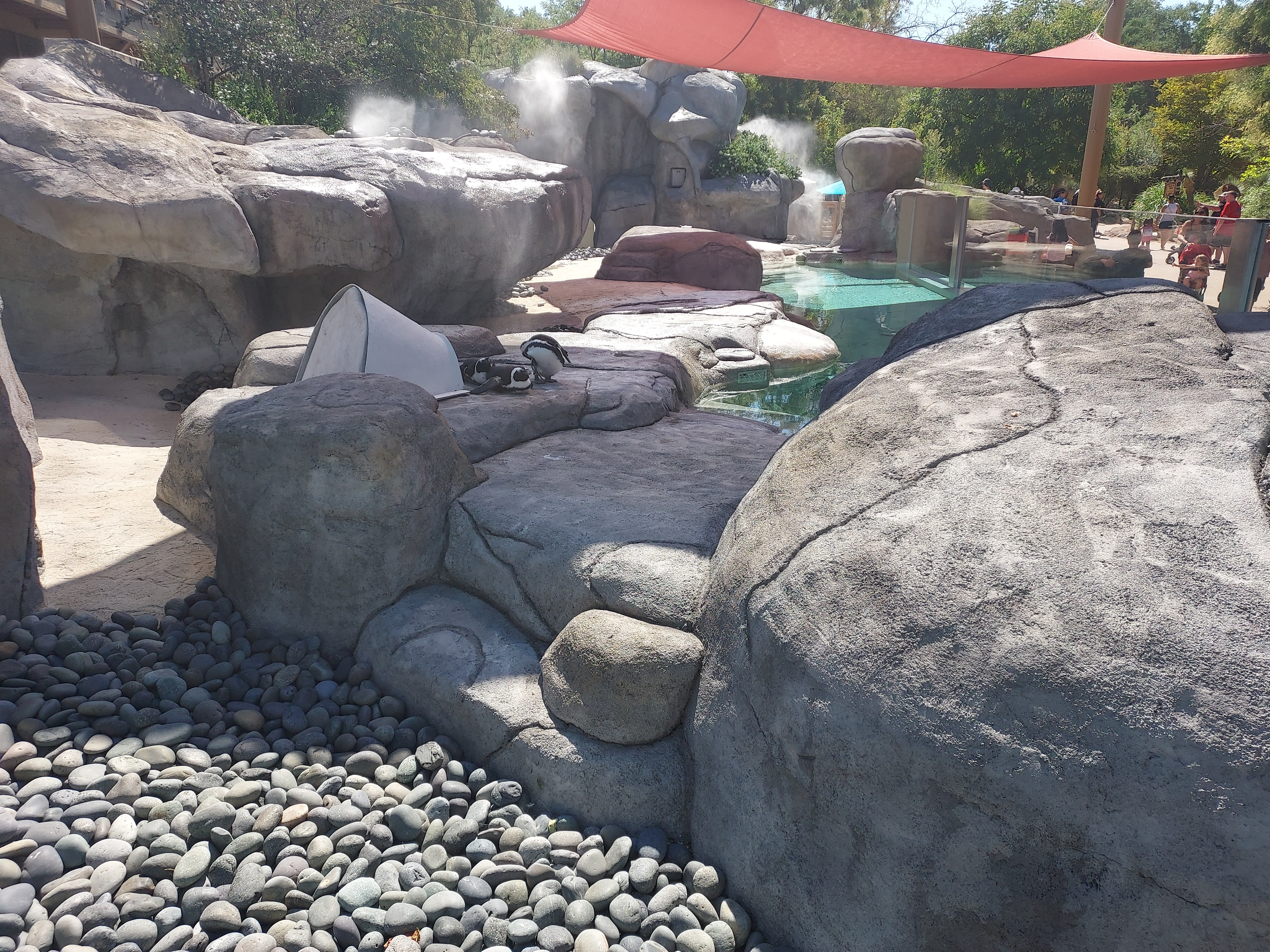
The Zoo Entrance was more elaborate than either of Chicago's zoos, with the Gift Shop well-integrated in the plaza and a fast ticketing process. Due to Covid-19, tickets were not sold on site but ordering in advance was simple enough despite warnings to buy in advance. Almost immediately after entry, to the left was an African Penguin Habitat with glass windows, low underwater viewing, with rock work and gravel for the penguins. It was an extremely hot day and the tropical penguins seemed content to relax on land. These tropical penguins make a great species to introduce visitors to the zoo at least. I appreciated that the penguin viewing was just below eye-level, while in an effort to better showcase underwater viewing some penguins are housed at eye-level or above. I was surprised by the amount of gravel in the habitat though, which felt artificial until I compared it more mentally with the rocky shores tropical species habitat. I have since found it formerly housed mongoose! It overall made a positive first impression though for certain.
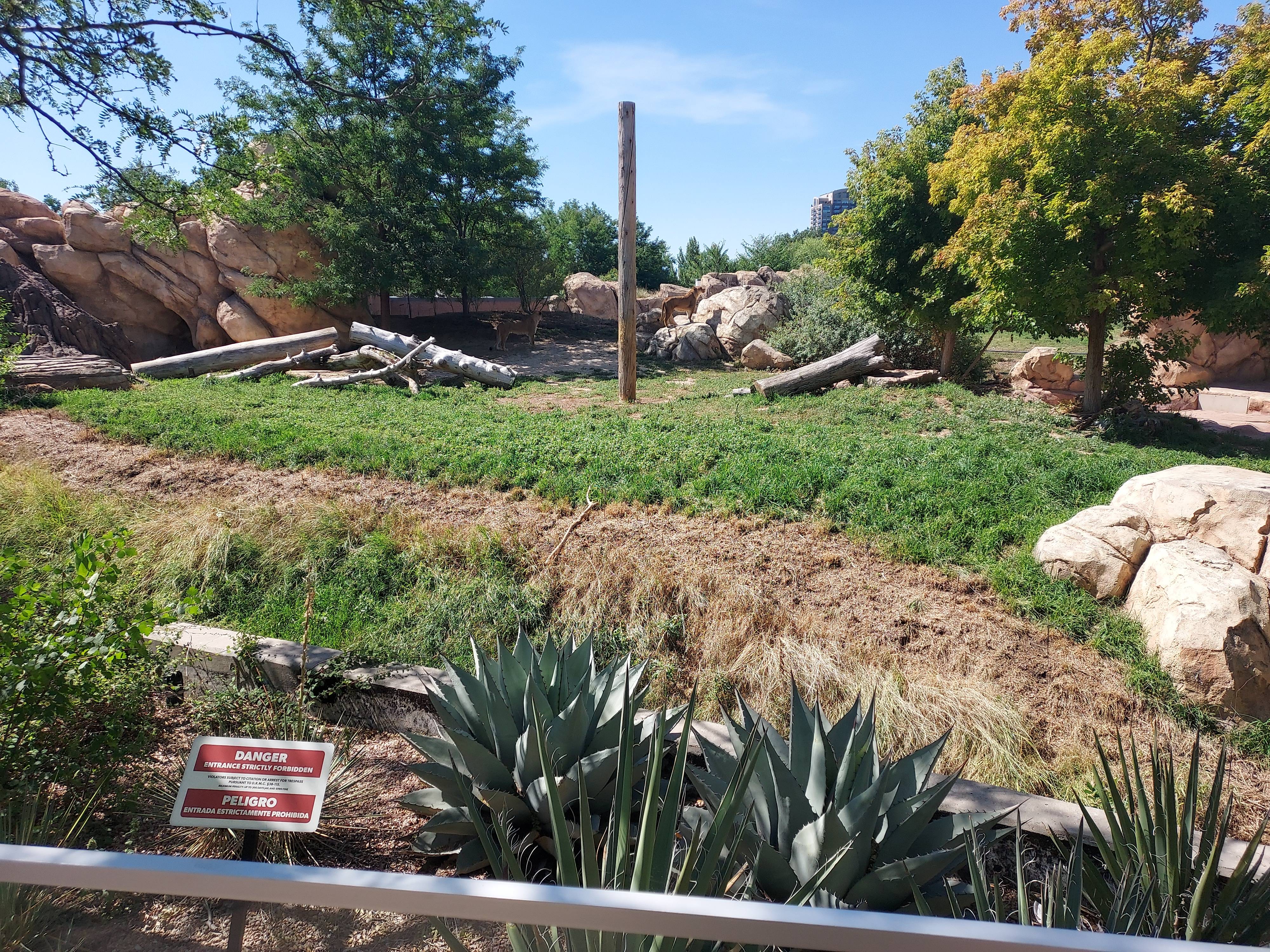
The first major exhibit complex lay directly ahead of us - Benson Predator Ridge, which has rotating yards for three major African predators. The first viewing was for a spacious, grassy exhibit with two active adult lions visible in the distance, posing on the rocks nearby, dwarfed by the exhibit's size. Local facilities had up until this time kept lions in grottos with rockwork, usually housed in pairs, so it was a different experience to see two adults following each other through a grassy habitat in the distance. To the left, a LEGO brick-built Lion was visible; although I am a big LEGO fan, this was surprising to see as part of an, as far as I can tell, permanent exhibition. This lead over to a viewing area with two large windows into separate, additional lion enclosures. A lioness rested with her head almost against the glass behind one window, while behind the other a large adult male lion rested with his huge paws almost next to the glass giving me a true sense of scale for these majestic animals. His exhibit had some more rockwork than the lioness' larger, grassier exhibit, although in a large complex and as one of many options this feels perfectly acceptable. The multi-enclosure access allows them to hold a larger pride, which is also a nice change of pace from two individuals sharing a rocky grotto. (Chicago would follow suit with Pepper Family Wildlife Center, which I did not see for a few months more.)
Continuing down the path, we began to see Hoofstock Yards as well - a few Grevy's Zebra shared an exhibit with Somalian Wild Ass, with a sign explaining that the zoo was experimenting with keeping the species together to facilitate breeding separation for the latter animal. The hoofstock paddock seemed spacious if generic - however, the Somalian ass were an unexpected new species for me and rather impressive, I found. The contrast of their leg and body coloration was very attention-grabbing, though admittedly the two individuals seemed bored and more interested in their food than anything else. Nearby was a smaller giraffe exhibit with at least three giraffe present, and a barn that offered interior viewing. I chose not to enter the barn. The outdoor exhibit looked a bit barren for my taste, resembling a desert to me more than a savanna.
The zoo's infamous, historic feline building would have been around here, but was permanently closed sometime before the visit. I'm sure this will be good news for any zoochatters not already aware, as the building was known here for being horrendous for residents.
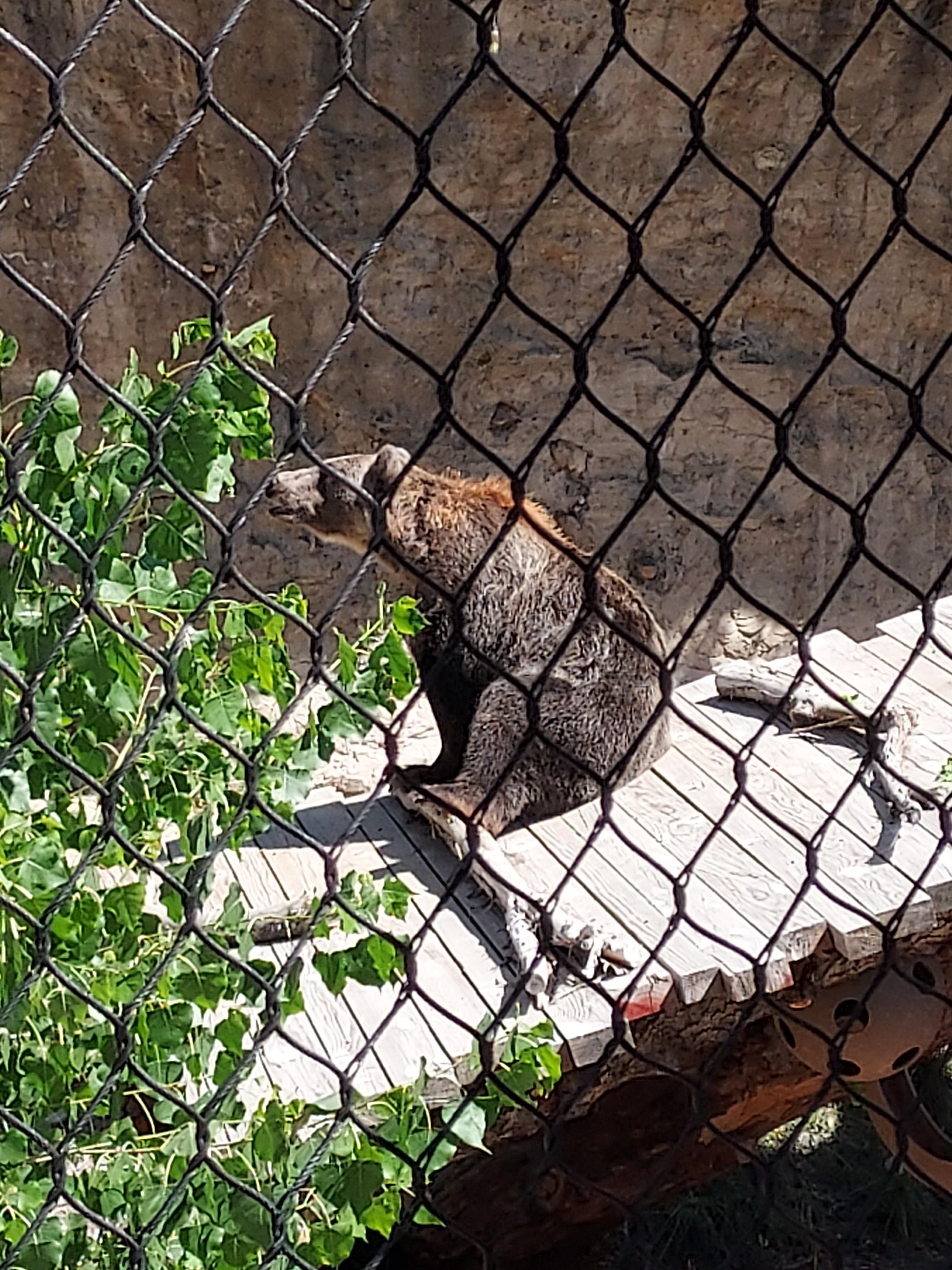
We next took a detour to the newer Harmony Hill complex, home to Tundra the grizzly bear - in terms of visitor experience, I thought it was a very cute exhibit, appealing to visitors the relationship between nature and their own lives, and discussing national parks, which I felt was a very successful contrast and concept. That said, the grizzly exhibit was not inspiring -- it was a grassy exhibit but much lower than eye level for visitors, with Tundra perched on what looked like a rock teeter-totter (it was not actually, I don't think) and visible through netting. The exhibit felt like a modern version of a historical bear pit, with enough substrate and soft ground to feel modernized, but it felt rather ineffective and unsatisfying for viewing the animals.
Further down the complex is a smaller 'backyard' habitat with a nice pool -- a white creature was exiting the water and a keeper introduced visitors to Cashew and Pecan, two adorable white raccoons. They were quite active, had a large pool and lots of toys and were a treat to watch. I’ve never seen a raccoon swim before! A keeper or docent explained they were two members of an orphaned litter, but the ones with normal patterns were released to the wild, which is the correct thing to do, though I think the contrast of a normal pattern individual might have been nice. The racoons vastly overshadowed the nearby grizzly and we stood for a while watching them play in the water.
The small complex as a whole is hard to judge. I really like what the zoo is going for -- focusing on where humans and nature meet is a great theme for an exhibit and it was pretty educational in theory, but something doesn't click, and the signage while thematic doesn't feel like it sufficiently relates to the exhibits themselves. While this is no doubt an improvement in welfare on the zoo's previous bear holdings, which lacked substrate or soft areas, I think more could have been done to highlight the bears as animals. I think based on some press material the bears were intended to rotate both spaces before the raccoons took on the second, which would explain some of the problem. I was surprised to find the exhibit was only a few years old, and disappointed to see it replaced an otter exhibit in addition to the famous polar bears. I would not suggest the zoo should have kept polar bears when there just aren't enough to go around, but that this feels like an underwhelming replacement for such a fan favorite.
The otters, polar bears, seals, sea lions were once all part of a larger complex called Northern Shores, and while this branding has remained the surviving exhibits are strictly for California sea lion. Their main exhibit has a very prominent rockwork wall alongside a good amount of eye-level beach for the sea lions to use if needed and of course plenty of water for them, with the sea lions clearly visible as they swam through. There was an underwater viewing with some kelp but the sea lions were not there when we returned later. The underwater window was outdoors, unlike at the Chicago exhibits, and the sea lions were easily seen. The beach was narrow but I appreciated that it was not a round island. While it can’t compare to some of the more recent rocky shores and underwater tunnels, I was fairly impressed here - though I have seen sea lions before at multiple facilities it still felt like a new experience.
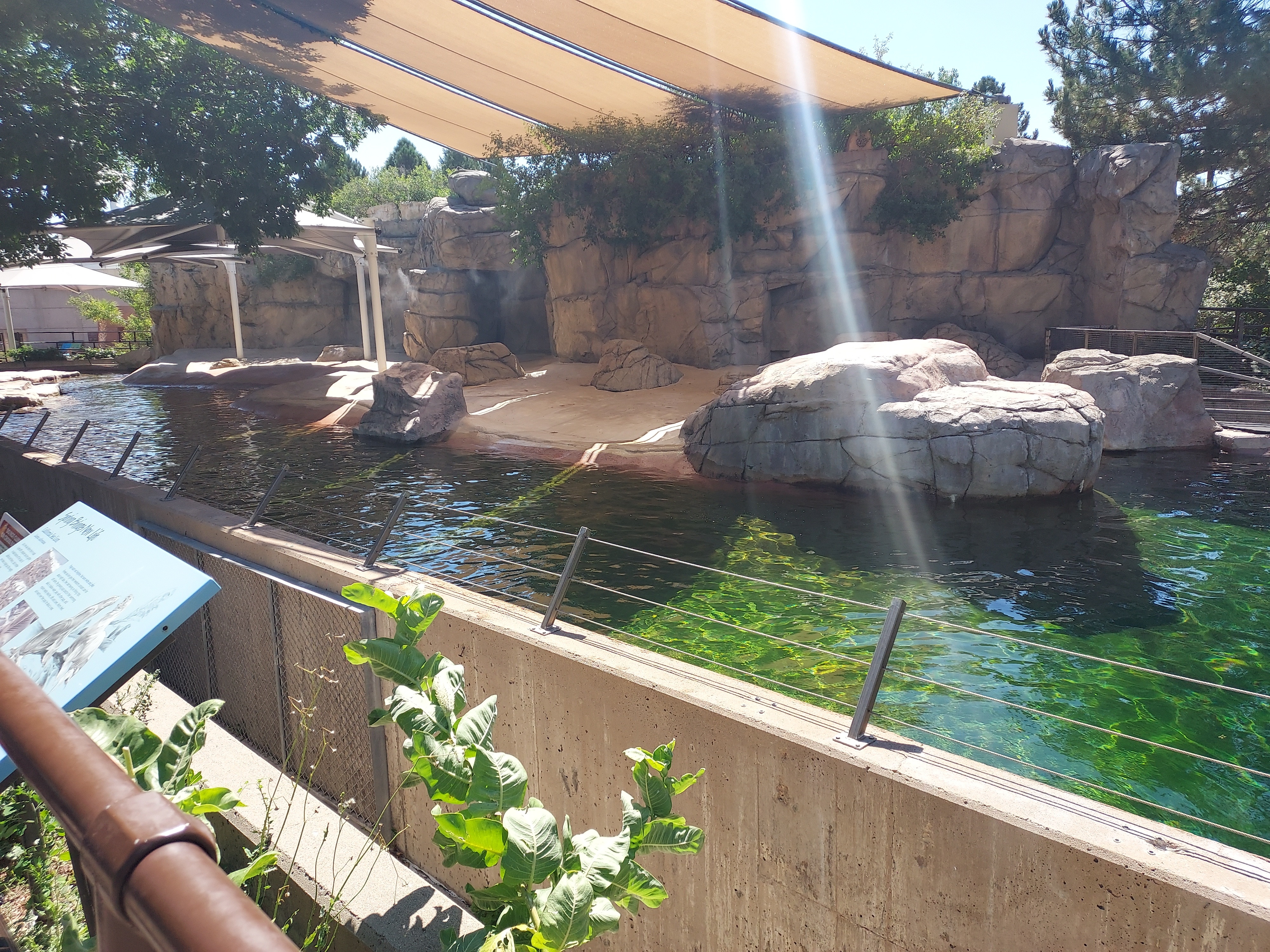
Nearby is the entrance to Tropical Discovery, which we will cover shortly, and some amenities, but also just north was another pinniped exhibit, similar to the previous California sea lion exhibit but smaller. A pinniped with ears poked its head out of the water and I quickly and confidently identified it as a sea lion; but my friend noticed the signage for a Harbor seal and thought he had caught me in a lie, and the animal did not surface promptly. (Thankfully zoochatters have since validated my identification; why the signage never changed is a big question.) It seemed like a smaller and less exciting cousin to the same exhibit.
Although I enjoy what remains of Northern Shores, the branding feels rather orphaned at this stage, with only one species remaining in two exhibits, and though the zoo has apparently and ambitiously promised the eventual return of polar bears, it’s hard for me to imagine them returning to this space. A new exhibit for flamingo is being built in this area as well, which does not feel like it ties into the theming. A previous master plan suggested adapting this area to Coasts, but with Harmony Hill cutting into it, I can’t help but feel that this area lacks identity, more significantly so because Harmony Hill and Northern Shores were designed as thematic exhibits. It's possible seals may return at least though.
We entered Tropical Discovery around this time, a building that houses reptiles, amphibians and fish in an indoor rainforest setting, but also includes many reptiles from arid environments, marine aquaria, and a handful of small mammals. The building feels massive and almost overwhelming, boasting a wide variety of species on display at every turn with some solid theming throughout. Poison dart frogs and milk frogs were engaging amphibians, a tank of piranha caught me by surprise, and a whole sub-exhibit focused on venomous snakes including multiple cobras, fer-de-lance and gaboon viper invited me to compare and contrast the variety of these animals and appreciate them a little more than I did finding one or two of them tucked into corners at other zoos, and I imagine offers some comfort to visitors who may want to avoid these venomous animals. A capybara at eye-level was another experience where a familiar species felt new; the capybara was enjoying hay but feeling like it was missing something (the recent passing of its howler monkey friend!) while nearby a cave held two bat exhibits, one with inactive vampire bats and one where dozens of bats continued to fly around, a far more intriguing sight than a quiet, sleepy colony! While I have seen multiple species of bat before including in the wild, it felt like my first time truly seeing bats! We then reached some surprisingly open-top aquariums including upside down jellyfish, though I missed the mudskipper. There was also a mangrove aquaria with bamboo sharks, and I almost made the mistake of walking past the tall tree that held the zoo's two-toed sloths, who felt more like a part of the guest area.
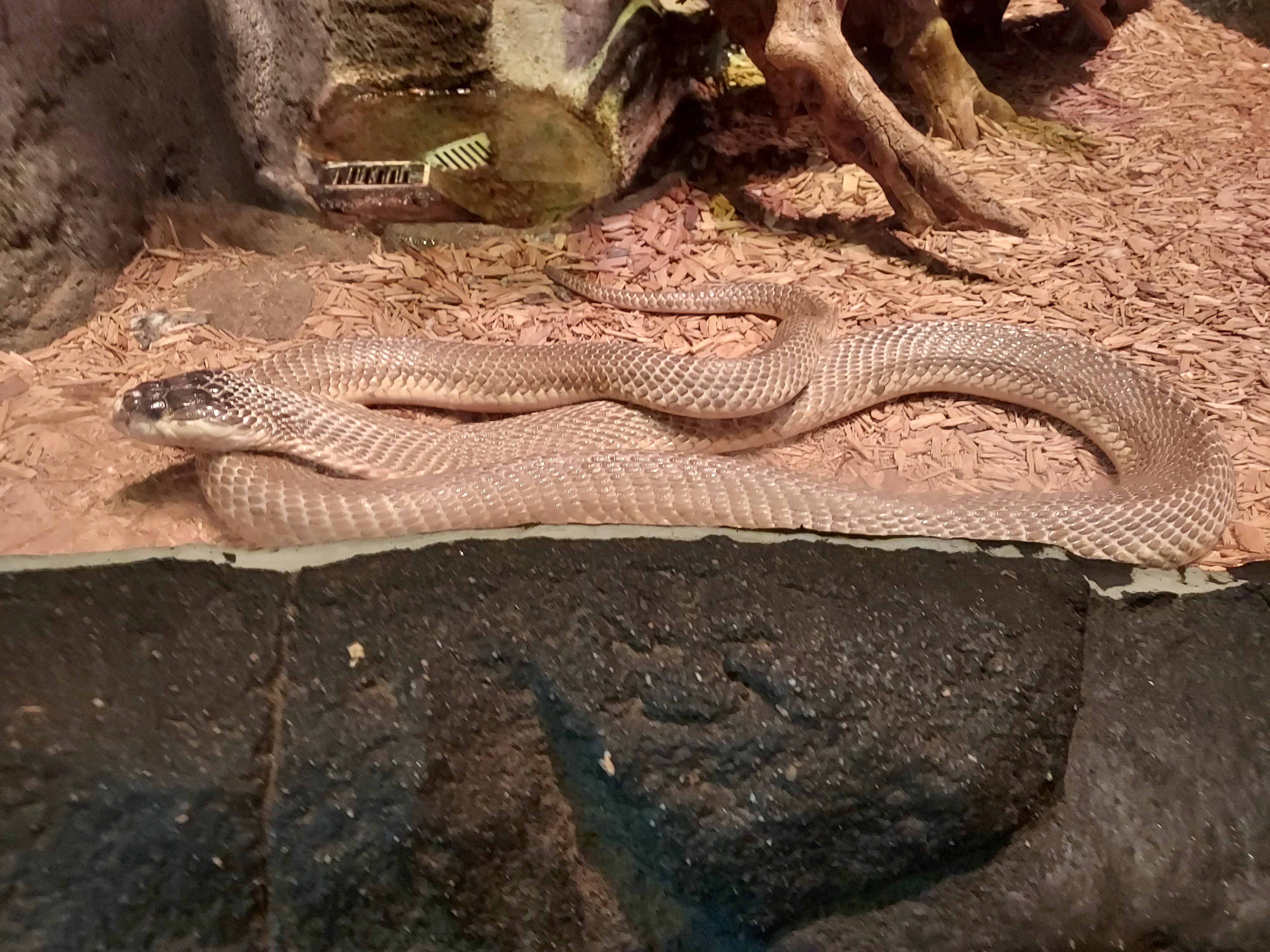
Next was a hall dedicated to marine life, including a large saltwater coral reef tank, sea aneomone, and a number of other small species down the hall such as garden eel. I was impressed by the quality of the larger aquaria exhibits in this building and the wide variety of fish on display, though I had trouble keeping track of them. A section on cypress swamps followed, including an impressive Florida kingsnake, some turtles and terrapins, bamboo sharks, and of course a massive Alligator Snapping Turtle in another large tank, a favorite of a good friend and often a highlight.
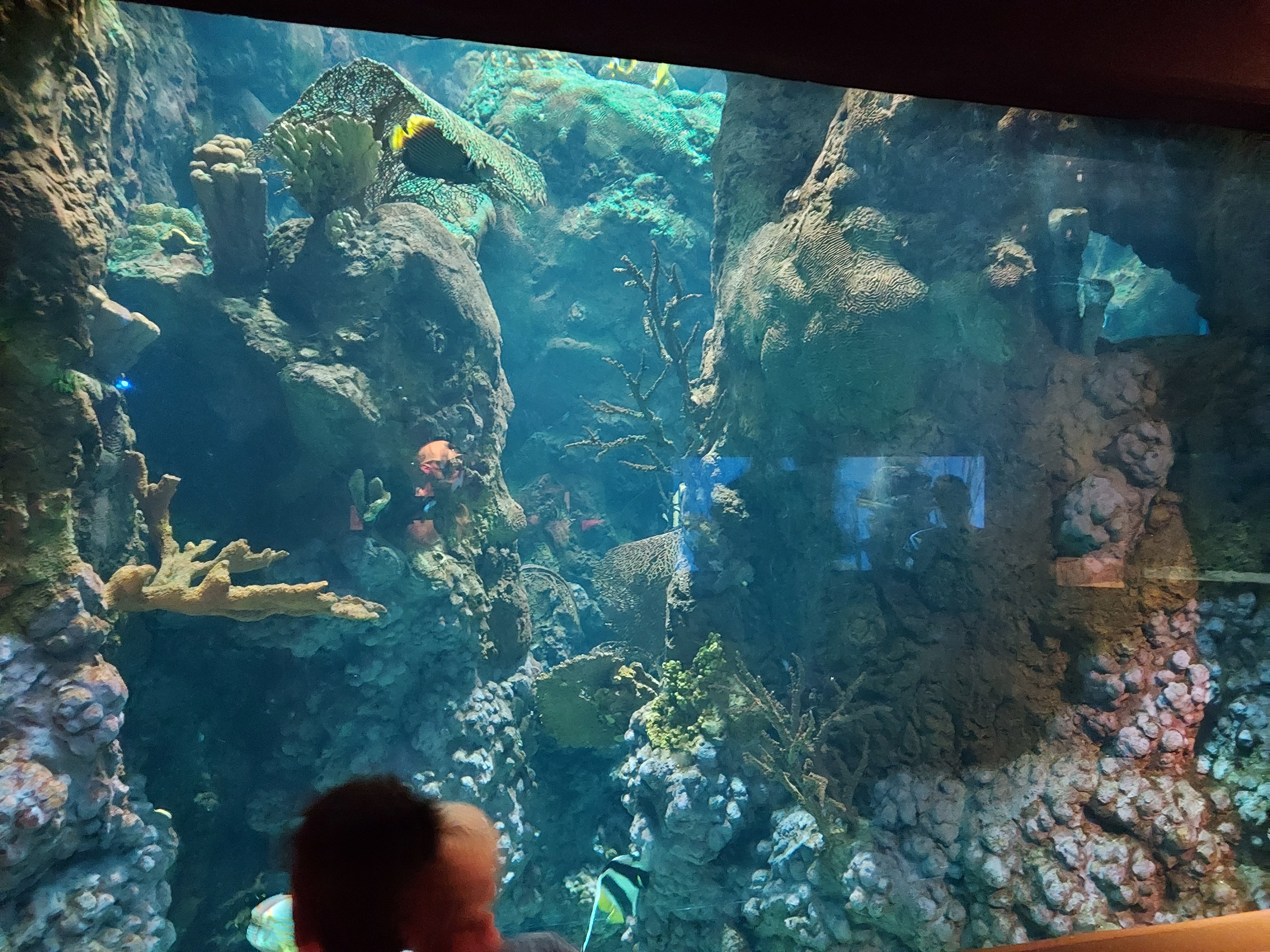
We then moved to the hall of lizards, which included some well-lit, larger exhibits with water, plants, sand and branches. There was the first Nile Monitor I've ever seen, an impressively bulky fellow, and a Komodo Dragon who seemed disinterested in guests today, almost non-moving but in a spacious habitat, head facing away. A Philippine sailfin lizard perched on a branch seemed excited by guests though, turning its head around a lot, its exhibit shared with a black tree monitor. A rhinoceros iguana, like the komodo, sat with its tail towards the glass. All of these larger lizards were very impressive and like the venomous snakes, I felt like I appreciated them better in contrast with each other. The dedicated lizard hall was a great highlight.
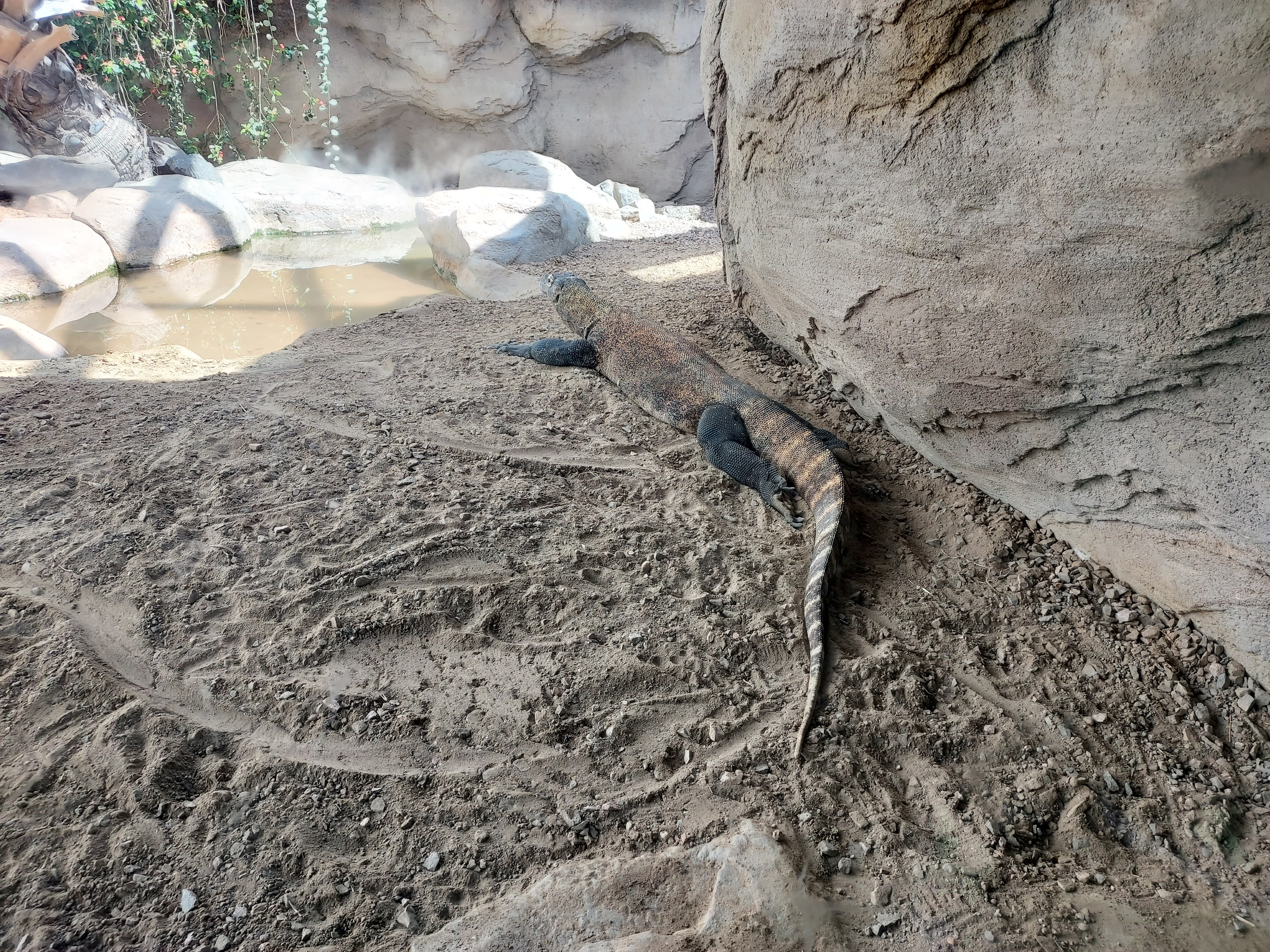
Leaving behind the hall of lizards was a fairly spacious exhibit for Daphne, the zoo's Siamese crocodile, another new species for me and one of the larger crocodilians I've seen. Nearby was also a matamata turtle, a fascinating species with a strange appearance that I am mostly familiar with through pop culture, but I found quite engaging; also nearby an Australian filled lizard, a species I always enjoy as well, perched on a branch in a lush habitat. Near the exit was a tank for Lake Titicaca Water Frog, a species Denver has an important history with, and dozens of frogs all visible at once!
Me and my companion briefly considered skipping Tropical Discovery - the title seemed very non-indicative to me, and housing reptiles, amphibians and fish gave me concern it would only hold small, very standard exhibits for a handful of each. I decided to see it anyway, and I'm so pleased I did. While I am not going to argue that Tropical Discovery is objectively some kind of essential, must-see for any zoo fan, I think it is the finest species-rich zoo building I have ever set foot inside. It was the first truly impressive experience at the zoo, reminding me of Lincoln Park's Small Mammal-Reptile House on a much, much larger scale. It was a very effective rainforest recreation for guests but also showcased so many reptiles, amphibians, fish and a few small mammals in a way that felt exciting and fresh, with new animals at almost every turn and larger terraria than other reptile exhibits I have seen. I appreciated that different rooms had their own subthemes, allowing the animals to still feel grouped by habitat and taxonomy at once.
Moving northward, we next saw a massive catwalk between two tall cages, bringing us to The Edge, which was a very attention-grabbing name. The catwalk feels almost like an archway into the primary viewing area, where guests can view the Amur tigers from a loop in between both larger cages. The effort to place the guests as close to tigers as possible is admirable, and the exhibits seemed quite lush, more reminiscent of a rainforest clearing than a taiga. According to the website there is a lot of enrichment available but nothing stood out like the catwalk. The viewing loop within the exhibit has sections meant to simulate peering through the woods at the tigers, obstructing view. On this particular day, one of the tigers was napping on the catwalk, relaxed and content, and another was laying low but so close to the fence it was almost impossible to notice from the main viewing area, and I only noticed it from the last viewing space for the exhibit.
I love everything The Edge is trying to be, and it is no doubt an improvement compared to the moated grottos in the midwest for the animals or the former feline building, but it leaves much to be desired and is compromised by practicality. While the exhibit was more lush and pleasing than a grotto, the fencing is much more obtrusive than expected, and the simulated viewing through trees an unnecessary eyesore. The fencing needs great strength to hold the strong tigers back from any escape and to support a catwalk that can itself support these animals, but these necessities compromise the visibility of the exhibit. It is no doubt an impressive space for the animals to live in, but the exhibit feels shockingly underwhelming for visitors. Very much like Harmony Hill, the welfare seems like an improvement but the viewing seems poor, and unlike Harmony Hill, the additional signage doesn't feel as helpful or educational here. The catwalk makes the exhibit and while it would no doubt be thrilling to see an animal using it, watching an animal sleep on the catwalk above my head doesn't hold the same excitement for me.
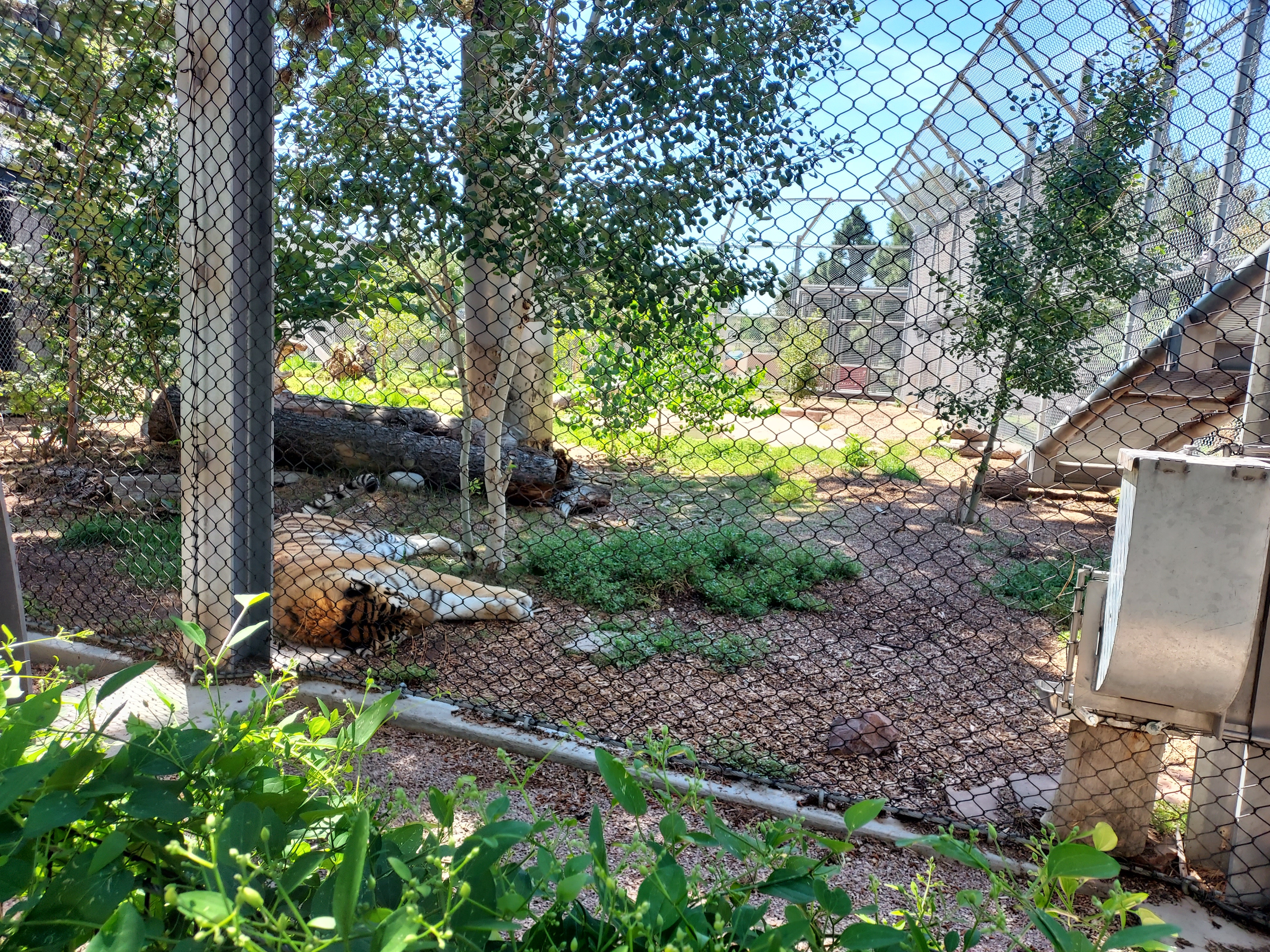
Almost directly next down the path from The Edge are two Gobi Desert hoofstock yards that are paired together, with a great deal of room and just enough trees in the barren sand, and a shared viewing area. These exhibits are separate from the main hoofstock loop and do a decent job of recreating an authentic desert environment, though background chainlink and some odd pillars do detract. Each exhibit holds Bactrian Camel and Przwalaski's Wild Horses, both ungulates native to the Mongolian deserts and grasslands. I recall signs suggesting these two exhibits form a small Gobi Desert complex, but can find no mention of such online; in addition, at least one sign seemed to try to tie them into The Edge, which officially is limited to the tiger exhibit, implying a common theme that these animals "live on the edge". I have to say it felt innovative to try to display these hoofstock in a themed area, even if the exhibits were still basic hoofstock paddocks.
After our brief visit to the Gobi Desert, we took lunch at the Kamala Cafe nearby, which should have been an excellent and memorable culinary adventure, and I want to applaud Denver for adding food that ties into the local exhibitry... however, we had dinner at an Asian fusion restaurant the night before that I had not been able to enjoy, so at the moment I craved familiarity and skipped past the varied menu of Asian food and instead selected a hot dog and a soda, limiting my experimentation to dole whip. (I will try authentic food when I return to Denver!) I had never had dole whip before and found it a fun surprise, especially on such a hot day. I also bought a souvenir cup so I could get free refills throughout the day because it was insanely hot and I still had sunburn from a hike at Red Rocks two days before. The view of the McGrath Family Amphitheater was superb and though we were seated quite far back, we had a clear view of one of the zoo's elephants - the promise of adventure yet to come and a great view improved the meal, feeling like part of the experience instead of an interruption as I have sometimes felt when eating at Brookfield Zoo's Safari Grill/BZ Red Hots, which is a walk from any animal attractions.
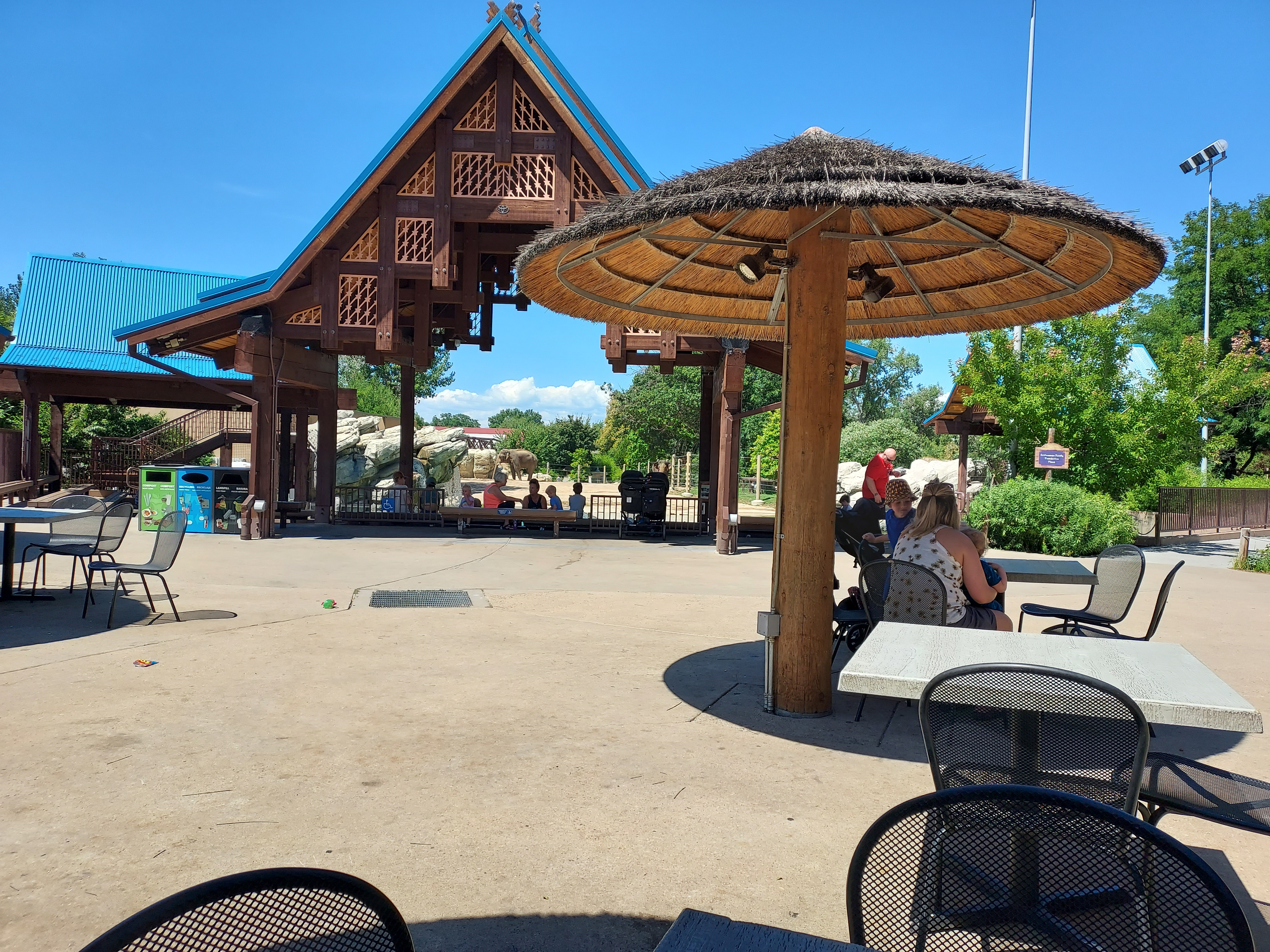
After eating, I ventured to the nearest exhibits in the 'hoofstock loop' and looked into a spacious, grassy yard that held an Okapi to my surprise, along with a Saddle-billed stork that I nearly overlooked at first. (There truly is something to be said about how birds in hoofstock exhibits can feel like ornaments.) The okapi was mostly focused on eating hay out of a container on the fence while the stork emerged quietly. The animals' placement in such a grassy yard felt a little off for an animal known for living in the tropical rainforest though. It also feels off in context of the surrounding exhibits - two desert animals before and a third one next, the proper Somalian wild ass exhibit, with one of the animals also feeding. There was a surprisingly narrow exhibit next that normally holds a Vietnamese pot-bellied pig, but the animal was off-display with a sign remarking it was often used for demonstrations as an ambassador animal. I believe between the giraffe and okapi I missed out on a yellow-backed duiker exhibit, but as they are held at my home zoo this was an acceptable loss.
As we moved past those exhibits, my anticipation was sharply focused on Toyota Elephant Passage. I have never seen a modern elephant complex before and my local facilities typically focus on African varieties of these animals so the larger animals in this exhibit are all rare species to me. I have loved all of the animals once considered pachyderms since I was a small child, with elephants my favorite animal in childhood and painfully long missing from Chicago, so I cannot describe my childish excitement for this part of the visit. The exhibit back by the amphitheater was a taste of what was to come -- some limited rockwork at the side, lots of open space and massive pools of water, leaving enough room for multiple elephants to be submerged or to roam the shores. Moats are well-hidden and not obtrusive to the eye.
Elephant Passage is a closed loop off the main path, including separate amenities and two exhibit buildings as well as a series of longer, interconnected exhibits that can rotate freely between elephants, rhinoceros, and allegedly tapirs as well. This was a totally different approach than I expected, but a rewarding one, the animals feeling surprisingly close and intimate and still allowing a strong guest viewing opportunity rather than a small viewing area into a massive habitat as I had feared. I also hadn’t realized how many additional species were part of the complex.
The first exhibit (second, counting the one closest to the amphitheater) had two elephants holding trunks behind cable fences, while on the other side of the path was a lush Clouded leopard exhibit that was covered in mesh, grassy and full of climbing opportunities, but there was no sign of the animals. The next large yard was devoid of grass and had another elephant walking through at a leisurely pace. Next was the chance to enter the elephant barn, which had an indoor exhibit behind cable fences, a visible higher level presumably for staff to interact safely with the animals. No elephants were in the guest viewing area but one was visible through a maintenance door or some bars blocking off a maintenance area.
The nearby building with indoor exhibits from the Asian rainforest was fine. A fishing cat neglected its stream or climbing opportunity to hide inside a log, facing me as I looked into the log for it. Asian small-clawed otters had recently bred and were not on display, their exhibit drained, but they had a live camera to their den. A Great Indian Hornbill slept in an exhibit - a cramped exhibit for such a majestic species, but an animal I’m very happy to see all the same. A window was offered into one of the large yards, though nothing was visible from this angle. The building felt a little tacked-on, with the interior exhibits a little on the small side, and darkly lit visitor areas more reminiscent of older zoo buildings, but I really appreciated the effort to include more southern Asian species alongside the elephants, who could have carried the massive complex on their own.
Exiting the building was an exhibit with Sarus cranes, who were quite visually striking, across from a large crowd around a massive pool... upon approach, the top of an elephant and its trunk began to stick out from the pool by an elephant almost submerged! In ninety degree heat, the elephant had found an incredible way to cool off and I know I wasn't the only visitor utterly captivated to enjoy the animal here. After several long moments, the bull became bored and left the pool. This was easily one of the day's highlights. Nearby a long yard, the same one visible from indoors, held two Indian rhinoceros (or Greater One-Horned Rhinoceros, as Denver prefers) had the same idea to cool off on a warm day by submerging themselves in the water. This is one of the species I've waited my whole life to see, and I had no idea they were so comfortable in such deep water. Wow!

Finishing the Elephant Passage loop is a set of two interconnected exhibits: a barn, a wide exhibit with a large pool and two islands, and a third exhibit across the path with a third island located in a pool. All three islands and the barn are connected by 'wire' and contain climbing structures. The visitor feels as if they are passing on a bridge in the middle of a river. A third Indian rhinoceros is visible in the distance in the wide exhibit near the shore of the pool, while a pair of fuzzballs wait in the barn door to come out and play, despite the many signs warning about possible gibbons overhead. The male briefly leaves, swinging a few feet over the water, expels waste and returns to his mate. The crowd is nonetheless enchanted by the 'will he stay or will he go' of it all. The gibbons seem uninterested in all of the toys and amenities visible on their three islands, content to hang at their barn door.
I had a little disappointment upon leaving Elephant Passage, as the Malayan tapir had not been in any of the rotational yards, a striking species I had wanted to see and was now considering if Denver had quietly phased out... but there was a yard right outside the exhibit loop, and lo and behold, there was our tapir, resting under a shade structure instead of the water. While the animals can rotate between all of the loop exhibits, this one is limited only to the tapir and from social media it sounds like it is usually here, while the elephants and rhinos rotate in the previous exhibits.
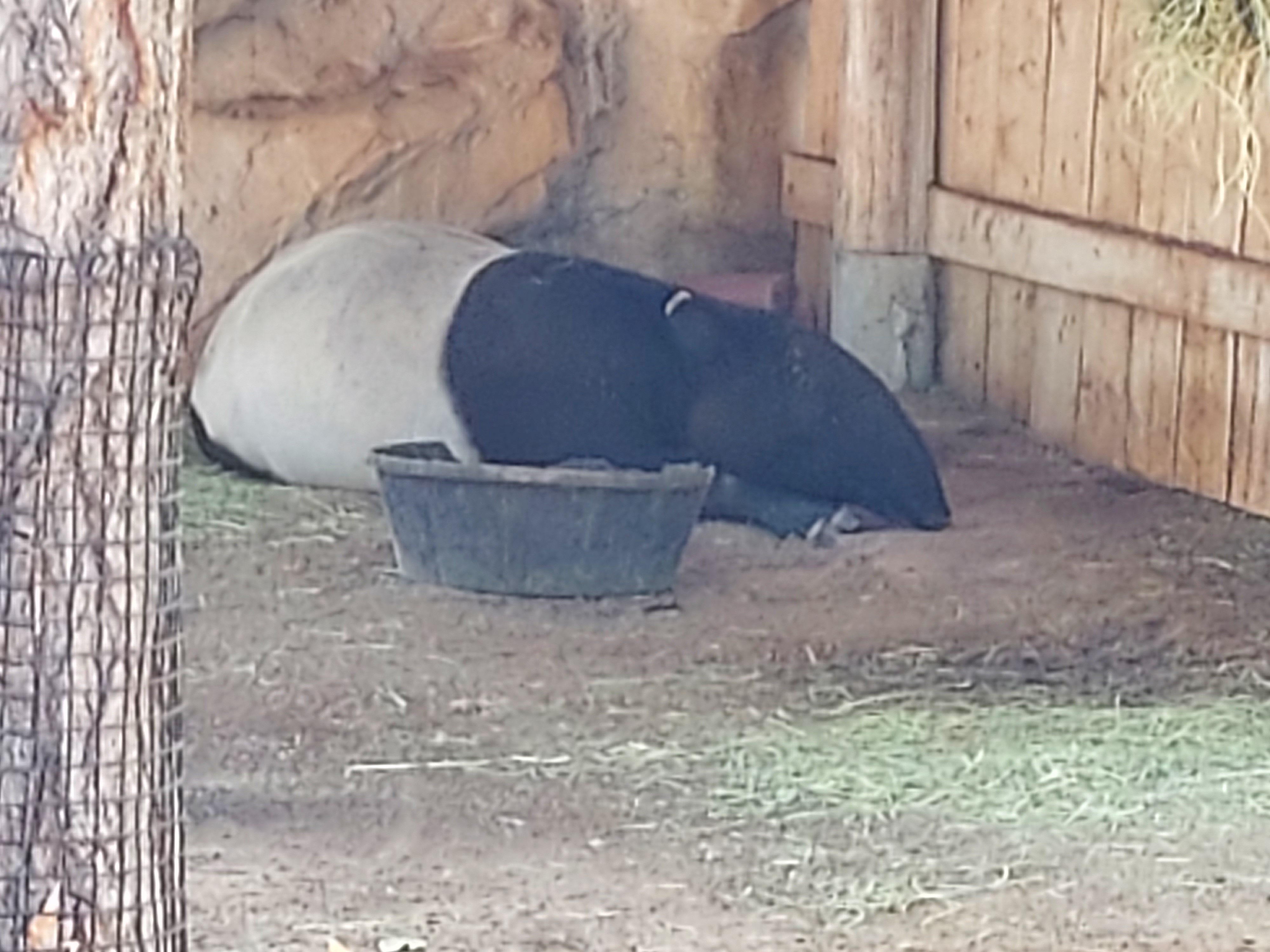
Many things stood out to me about Elephant Passage's exhibit design. The first is how many massive pools of water there were, with more than enough room for elephants, rhinos or tapirs to cool off, play, and even submerge almost completely, far more than mere ponds. I've never seen such large water spaces for these animals before and they were visually stunning even without animals in them. The second aspect was how well hidden the moats were; the exhibits managed to feel surprisingly intimate because you felt closer to the animals than you were. It was also an exciting thought to imagine the three rare Asian pachyderms rotating exhibits and sharing space. I also like the integration of the clouded leopard and crane exhibits, giving the feeling of animals at every turn, and the cranes were an unexpected new species for me.
I am not well-traveled like most zoochatters, so much of this paragraph is subjective and personal, but for me, it was unlike anything I had ever experienced in a zoo - my first modern elephant complex and my first true Asia complex at once. I have no basis of serious comparison for either of these kinds of exhibits. For me it felt groundbreaking to see these magnificent animals in this kind of complex, treated like the superstars they are, with so much space and so many individuals, exhibiting distinct behavior. The exhibit also overcame me with a sense of possibility - it was a reminder of what a great zoo can be capable of. It met and exceeded my expectations and proved to be an unforgettable experience... and this was still only the halfway point of the zoo trip!
Directly across from the exit to Elephant Passage and the tapir exhibit is the hippopotamus yard off the zoo's historic Pachyderm House, with a friendly keeper providing lots of stories and information about the hippo, who remained almost motionless in the water. Though it was my first time seeing a river hippopotamus in years, the lone animal did not seem interested in being seen, laying nearly motionless in the water as a keeper talked about how often the pond was cleaned. It was a good keeper chat, feeling more off the cuff and straightforward rather than a polished and rehearsed script. I had unfortunately not looked into the zoo's old paychyderm building and was completely unaware that it had an interior open to the public, and forgot it further when I turned a corner to see some llama, at which point I lost any sense of the exhibit itself.

I don't feel fair to judge the pachyderm building as it was rather lost in the shuffle of being between the two biggest attractions for me in my mind. I can certainly say the parts of it I did see were largely bland and unimpressive. I hope to spend more time there on a revisit.
Before embarking further, I decided to backtrack to see what I might have missed from the central hoofstock yards area while in Elephant Passage. The remaining exhibits include a very small exhibit for a pot-bellied pig who was not visible, and a tragically empty kudu exhibit and then found two yards holding mountain bongo, the first holding a single individual and the second the rest of the family. The hoofstock exhibits are constructed at an angle, so the exhibit is lower the closer it is to the fence, similar to Milwaukee. Each of the bongo sat in this area, so close to the fence that most visitors would assume they were not out unless they leaned over, and proving hard to photograph. I later found out one of these exhibits used to hold eland - such a pity, they would have been a wonderful addition. There were also Addax, one of my favorite antelope but a species held close to home and worth speeding near. Also nearby were some red kangaroo resting comfortably in the shade, hard to see in a shady area with tall grass.
Returning where we had left off ahead of Elephant Passage is when things became a little less cohesive and easy to follow. This area used to be anchored by Bird World, a large bulding home to seventy species of avians. At the time of my visit, the building was already demolished, now a large construction site for a new exhibit, "The Land Down Under", a new Australia and Ocenia-themed area which will provide a new home for red kangaroo, as well as emu, wallaby, and some former Bird World residents such as kookaburra, cassowary, and kea. The posters, and online press releases contained a nearly identical description, making me wish I knew more and more about the addition. The idea of a modern Australia building was interesting to me but there wasn't a lot of information available besides that it would contain a walkabout and some kind of conservation station. I hope to return to Denver in the future so I should someday experience whatever all that is for myself.
Up to this point, the visit had been following the pathway in a loop around the zoo, which was refreshingly straightforward compared to some of my local facilities. There had never been confusion as to what was next or where to go, as there was a simple path, with animal exhibits almost constantly visible and making for obvious landmarks. The pachyderm area offers shortcuts across the zoo on each side, parallel to the Bird World site, which is useful and straightforward, but only a short walk later, there is further branching out, with another shortcut path across the middle, and a path up north, with no visible exhibits. This area is more wooded, with a garden nearby, a grass maze, a conservation carousel, and a children's train ride. I found this area confusing and frustrating to navigate. I spent a half hour wiggling around this area full of confusion between the main path and the two railroad paths that cross around.
After accidentally passing downward across the path, I came across a completely unexpected Humboldt Penguin Exhibit, clearly smaller and inferior to the earlier habitat. This exhibit seems to be entirely mock rock and water, lacking the gravel and additional land area of the African penguin habitat near the entrance. It was surprising to find the zoo held two different kinds of banded penguin species; indeed, it was only recently I could really absorb the morphological distinctions between African and humboldt penguins. It was hard not to contrast both penguin exhibits and find a clear preference for the newer one. I only found out later the entrance exhibit was a conversion of a former mongoose habitat and that the humboldt exhibit is more historic, though the zoo formerly kept African penguins at Bird World.
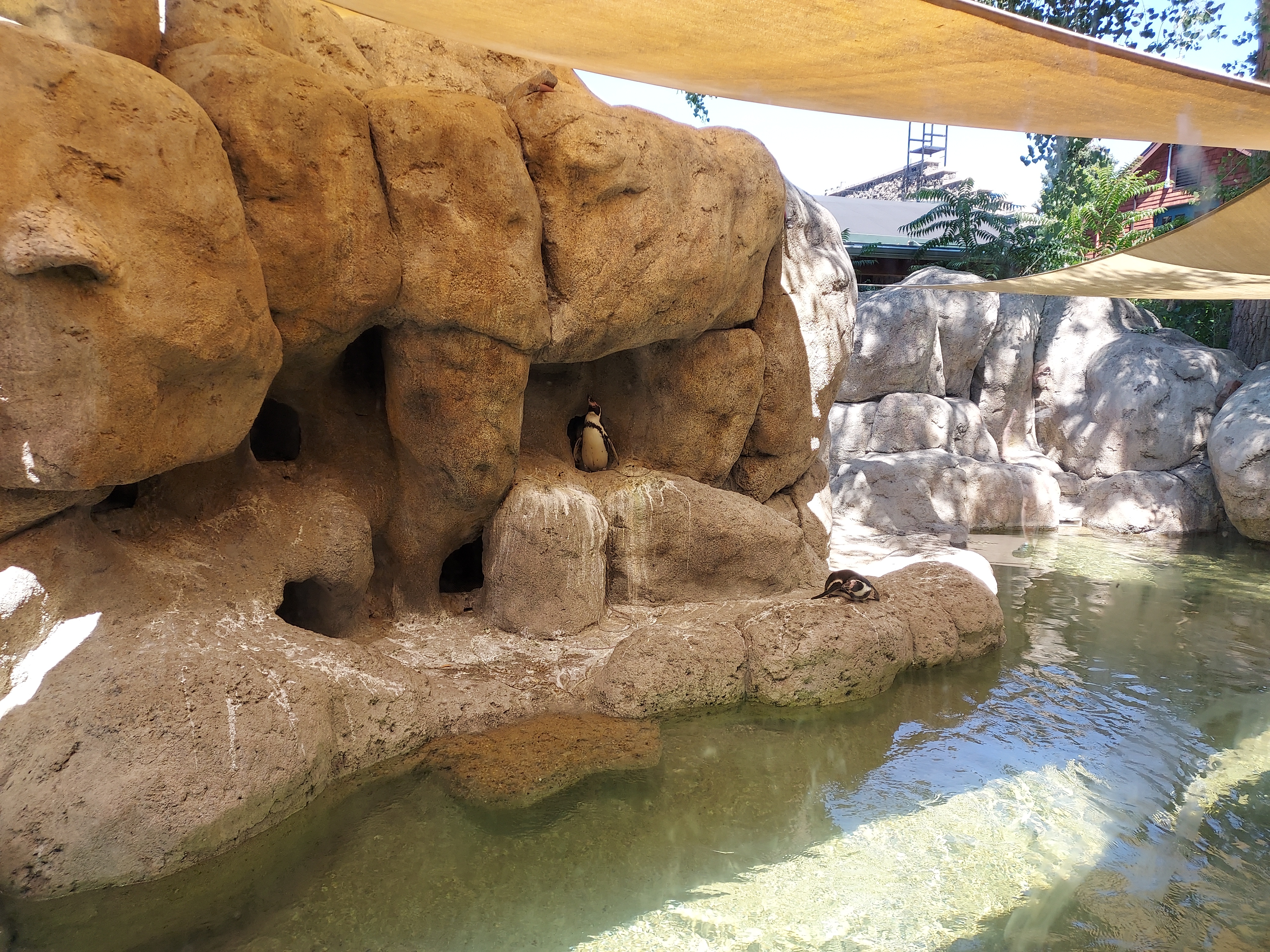
Not far nearby I found what little remains of the historic Bear Mountain, the zoo's original barless cage now home to an unseen porcupine. It’s great this exhibit has been preserved for history but it looks unsuitable for holding any animals today. I soon backtracked to where Bird World had been and continued back along the main path.
Even without the former bird exhibit, the area surrounding its footprint is still populated spottily with bird habitats. There was a small line of Bird of Prey aviaries, and I was overcome immediately by their small size though, worrying if the birds of prey could fully stretch their wings, and this is one of very few parts of this zoo that immediately struck me as inferior to my local facilities. One of the exhibits held an Andean Condor, so size is critical; the other held a Bald Eagle. They at least were in better condition than the pinioned cinerous vultures at the Pachyderm House... these species could use better holding and hopefully their long-term plans including new holding for them.
Nearby was the Nurture Trail, which I thought would be a scenic nature trail - fun, but not of interest to my tired and sweaty friend, who wanted to hurry along and was losing interest. I was not aware until later that there were exhibits along the trail, including an opportunity to see the kea. A very unfortunate decision, but I also wonder if I would have fully appreciated the exhibits during the trip in these circumstances.
The last of these border bird exhibits was located close to the entrance to Primate Panorama - a beautiful Lagoon for waterfowl, with a large flock of Chilean flamingo on display, and nearby a beautiful elephant statue, known as Mother and Child, that used to sit in the Governor's Mansion in Colorado. It was an odd little fun fact but added to the experience of learning about the history of the state while there. (I had actually seen the current Governor at an event earlier in the week as well.) The flamingo were very attractive and the pond felt like a nice place to relax. It was a truly beautiful slice of the zoo and I’m surprised it did not have a name designated on the map. Denver usually holds a mixed flock of American and Chilean flamingos, however, the American flamingo were not outside due to bird flu concerns, and were instead being held nearby indoors through an awkward window. The winter holdings for these animals were extremely difficult to see into, and even in my photo me and my companion are clearly visible in the window reflection, but I was able to see a keeper work with them. The flamingo will be moving to a new home as mentioned earlier.
Across from the pond, I finally located the entrance to the Primate Panorama complex, an exhibit I am surprised to have not heard more about before! This and Elephant Passage were my two highest priorities so I refused to miss this one.
Primate Panorama is a closed loop off the main path on the western side of the zoo, much like Elephant Passage, though the overall area (five to seven acres) is larger for visitors and more immersive. After passing through the initial amenities, we first encountered a lush, netted lemur habitat with lots of trees, ropes, and a wooden climbing structure, with ring-tailed lemurs cuddling back on the climbing structure and not very active. Still a beautiful exhibit and a sign of what was to come. Nearby was another lemur island with a water moat, and I almost missed the red ruffed lemurs, which were so much more striking in real life. They were again, not active, but still in a beautiful habitat. Nearby was an exhibit for DeBrazza's Monkey that left little impression on me, with no monkeys visible.
As we approached the Jewels to the Emerald Forest building, several massive glass windows and shaded structures made for cozy viewing for a fantastic primate habitat -- a large, grassy area with two large trees supporting a netted top (above the viewing area) with ropes. At the time of my visit, eastern black-and-white guereza colobus monkeys were here, but zoochat shows they once held Sulawesi black crested macaques in this exhibit, mixed with lion-tailed macaques at one point. What a pity!
Jewels of the Emerald Forest, nestled in all of these expansive and impressive outdoor areas, would likely to be a letdown for any zoochatter in terms of design, and is more typical of the era it was opened: beautiful rainforest murals, simulated branches, diorama-style display in darkened rooms with signage. I have to confess that I was so overwhelmed by the larger complex that it didn't sink in to me until later how much the building shows its age, in line with the Helen Brach Primate House in Lincoln Park but perhaps even less imaginative. As a small part of Primate Panorama and as a dayroom for lemurs, it’s effective; as an exhibit by itself, I realize it is lacking.
It is also worth noting the name -- this is not a monkey-exclusive building, nor is the overall Panorama complex exclusively primates. The first animal I saw in the building for example, was a tamandua! Though they seem to be widely held, tamandua often serve as ambassador animals -- so it was very different to see this one climbing branch to branch in its element, watching its prehensile tail at work. What a beautiful creature. It had a rather spacious exhibit with many branches. A few smaller, indoor-only exhibits, include a Golden Lion Tamarin, small and cute as I've ever seen, and then a slightly deeper and more interesting space, holding a white-faced saki and a coppery titi, both new species to me. Cinnamon, the titi, remained fairly stationary, a sign explaining her advanced age and bald tail, but the saki crossed the branches to stuff its face from the food bowl, one of the highlights of my visit.
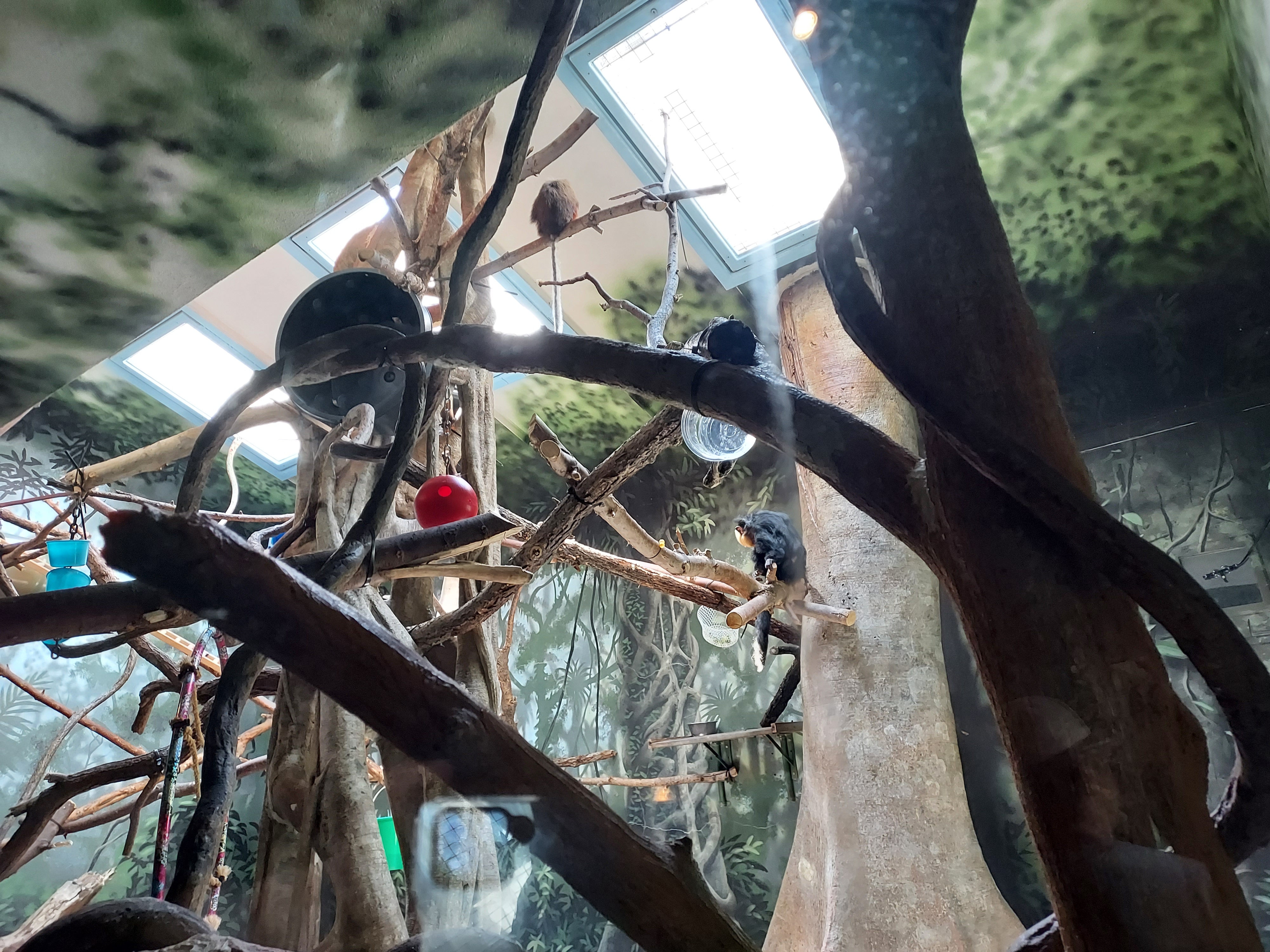
(After I wrote the bulk of this review, Cinnamon was announced to have passed away. I feel luckier to have spent time with such a special animal by chance.)
After this signage directed me to 'Primates by the Night', a nocturnal part of the building with three large windows allowing viewing for Aye-Aye. Me and my companion spent maybe fifteen to twenty minutes here, waiting for eyes to adjust to find the aye-aye while many other guests passed through bored. There was finally a sign of movement and the long bushy tail was clearly visible as the animal hung to a branch, then crawled down. I could not spot the distinctive front claws or face, but it made an impression - it was much larger than I expected. Such an amazing animal to see and well worth the wait. The exhibit may have seemed small at a glance but it was deeper than it first appeared and had lots of climbing structures. The final room for Jewels of the Emerald Forest held smaller animals including tamarins and marmosets, and then empty indoor rooms for the lemurs already seen outside. I did see golden lion tamarin and emperor tamarin both briefly. I missed another small species. I believe they held a prevost squirrel here at one point before my visit.
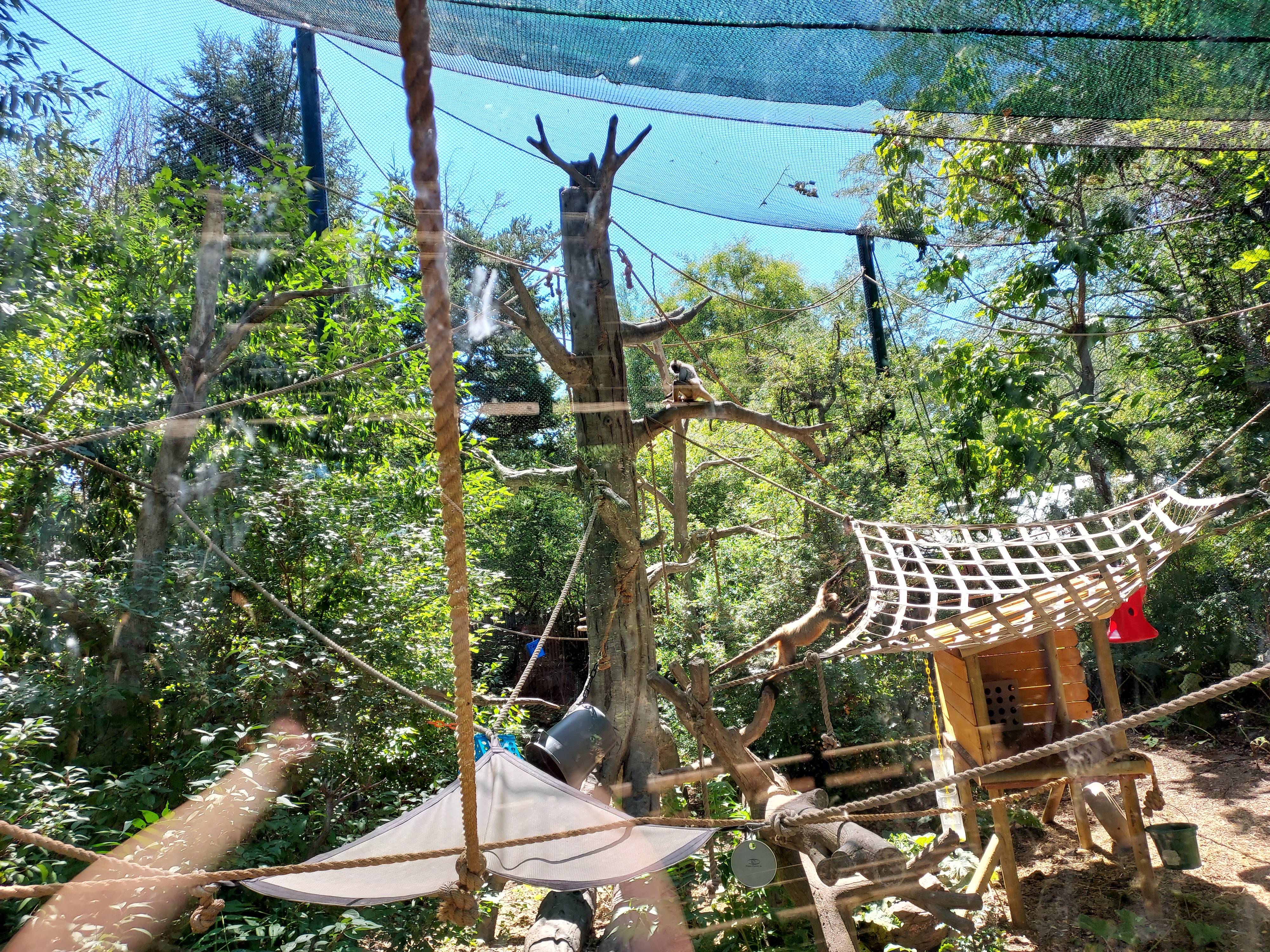
Outside, nearby were two larger enclosures - one was a mesh enclosure for two spider monkeys, one of which came close to the fence and seemed playful and active, swinging happily. A large central tree, ropes and another small wooden house made for plenty of enrichment. The other exhibit had a large viewing window under a nice little roof and was labeled in dedication as a 'Gibbon-Langur Habitat' but no signage for the specific animals, with nothing visible in the incredibly lush exhibit area but a wild rabbit. I asked a docent at a later primate exhibit and she was not sure which species were meant to be here, only that it was a distinct gibbon from the white-cheeked gibbons from the ones at Elephant Passage and that they had not seen the langurs out yet there. I know golden or buff-cheeked gibbon were previously held in Primate Panorama, and the spider monkey moved here from elsewhere in the zoo, possibly replacing red-capped mangabey. I had been reading about langurs on zoochat a few days before so missing them was unfortunate, and even now I cannot seem to find out what species was held there, only that they previously held Hanuman langur by Monkey Island. I also swear I have heard since then that the zoo does still hold red-capped mangabey?
Passing an empty outdoor orangutan exhibit quickly, we soon reached the Great Ape House, which made for an interesting experience - the first outdoor exhibit we saw looked empty and was difficult to see, and when we entered the building it was empty except for a docent, standing near two massive windows into open rooms, filled with toys and enrichment for orangutan and gorilla, as well as a keeper cleaning the orangutan exhibit and a lone silverback gorilla in the back of his side, easy to miss if one were strolling casually. Before we had moved on and as I chatted with the docent, the cleaning concluded and two orangutan entered from the outdoor exhibit, while the silverback suddenly became active. Large crowds formed to watch both animals. As there is no good orangutan viewing nearby (sorry, Brookfield) whereas Lincoln Park has excellent gorilla habitats, I focused on the orangutan, a female which climbed many structures and seemed eager to entertain guests. A male wandered in, without his trademark face flaps yet, only interested in food. It truly felt like my first time seeing an orangutan! After a while, the gorilla exited the building and for the first time, I watched a gorilla outside, despite two of my three nearest zoos having outdoor access. It was nice to see the animal exploiting his choice to move where he wanted. It's always great to see spontaneity in these animals!
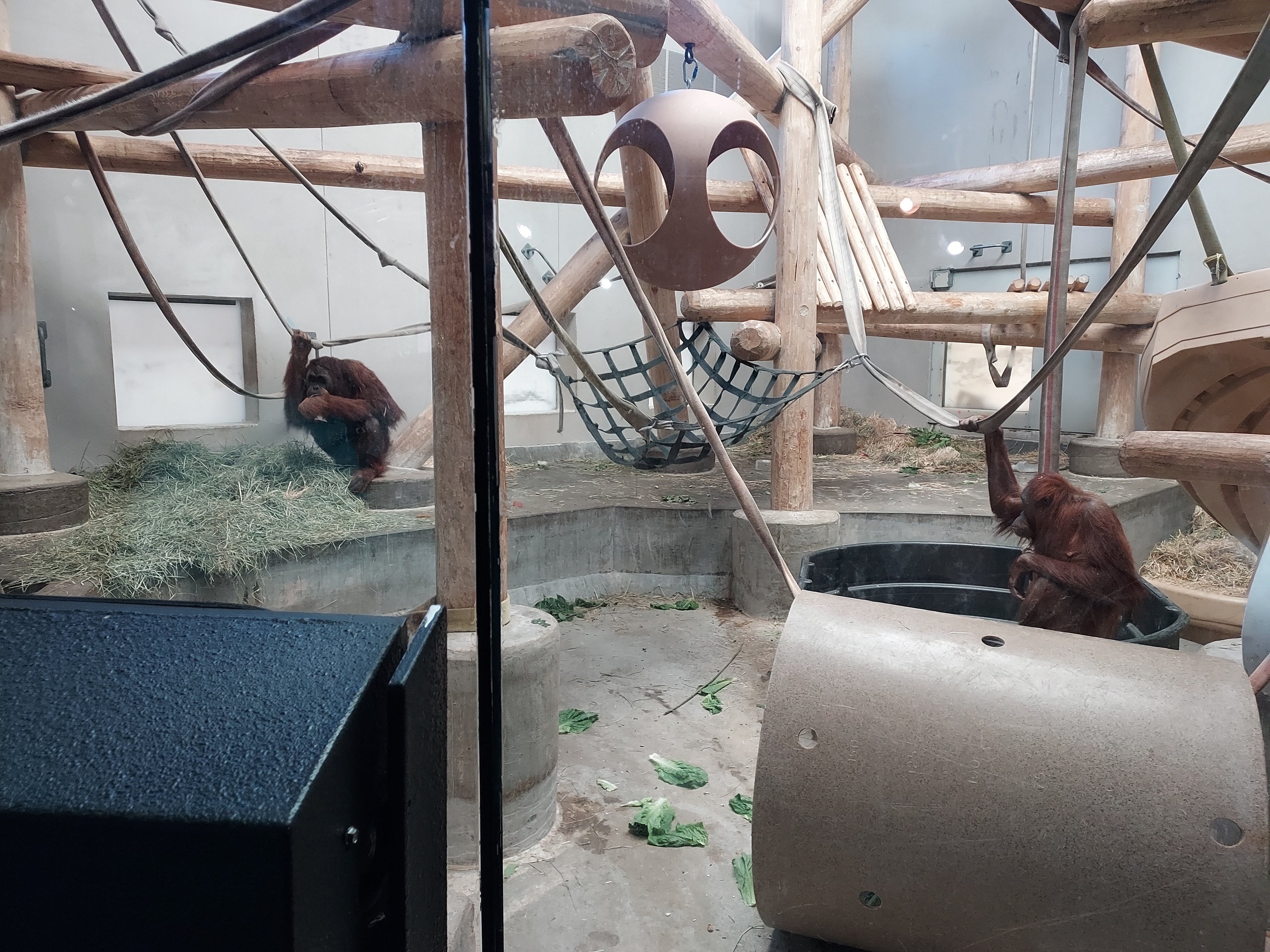
I think the combination of naturalistic outdoor exhibits and the enrichment-filled indoor dayroom was effective here. There is a lot of debate about whether apes need more access to enrichment or naturalism, and these exhibits feel like they check both boxes -- the outdoor gorilla exhibit is naturalistic but seemed to lack climbing space, for example, whereas the indoor exhibit for both animals offered lots of space to climb and explore and enrich the animals, which we saw both gorillas and orangutans use very effectively. Since the outdoor area was natural, I did not feel troubled by the dayroom’s lack of naturalism, and since the indoor area offered enrichment I did not feel disappointed by the lack of it outside.
By now, my companion was starting to remind me we had an engagement we needed to leave soon to attend, so from this point on, we were rushing to speed through the remainder of the zoo. We made our engagement and had an excellent time there but in retrospect, we could have easily killed another half-hour to hour at the zoo without losing time with that.
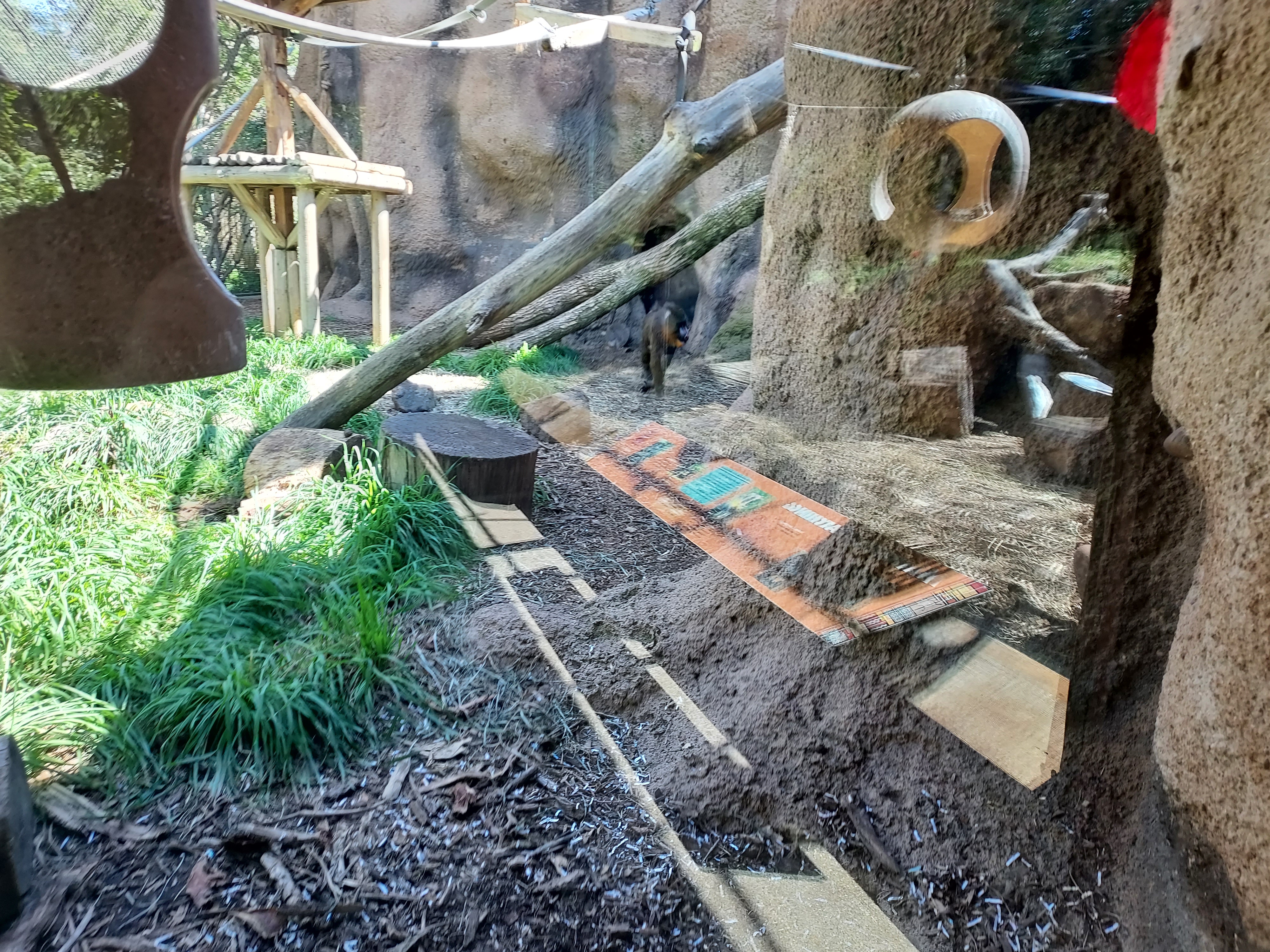
Before we finished Primate Panorama, having now seen around twelve primate species by now (I've seen articles online state there were once over thirty primates in this pavilion at one time; I know I missed three and at least five are gone) I insisted I go back and look for the mandrill exhibit I had missed; in this process, I came across a beautiful walkthrough forest aviary. I have never been inside an outdoor walkthrough aviary in my life before and I was more taken marveling at the exhibit design than the animals contained, which seemed to be primarily waterfowl in one spot. It was a beautiful little walk and all I could imagine is how much more I feel I would appreciate seeing birds in habitats like this rather than dedicated buildings. After leaving the aviary, I managed to find where the mandrill and red river hog exhibits were. The mandrill exhibit seemed empty of animals but filled to the brim with toys, and my companion wanted to rush on, but to my luck, the mandrill briefly came out for only seconds, as if to say hi to me, then leave.
I have visited several other primate holdings in the past at four zoos (Tropic World, Baboon Island, Helen Brach Primate House, Macaque Forest, Regenstein Center for African Apes, Primates of the World/Apes of Africa/etc, Macaque Island, the Think Tank) and this complex blew all of them out of the water, not because Lincoln Park does not have excellent ape and snow monkey habitats, but because Primate Panorama is a full, complete package -- monkeys, apes, and lemurs, the majority with outdoor access and lots of enrichment. The fact it is a taxonomic-based display of primates does not force Denver to resort to holding them in boring cages, no, they still manage to fill acres with complex, high-quality exhibits. I have always enjoyed primates but I had forgotten how engaging they could until this exhibit -- seeing the saki crossing a branch, seeing the orangutan swinging from ropes, the spider monkey coming within feet of me and then crawling to the top of the tree -- and seeing the aye-aye especially reminded me what a massive, diverse group that primates truly are.
It also strikes me as unique to see a modern-style exhibit complex dedicated to a taxonomic mammal group. Unlike reptile and bird houses, nearly every form of mammal house has fallen out of style and remains associated with older, outdated exhibits, with newer, immersion-style exhibits often being based on habitat rather than group - so it’s interesting to see those design choices applied to a large collection of primates and a few associates. While jungle-themed primate exhibits are hardly rare, I don’t think any has been executed on this scale to date, and sadly none will ever rival this scale.
Afterward, our road back passed by Monkey Island, which was again surrounded by a surprising water moat... sadly, the large island was empty. There was no sign of the hooded capuchins, nor any water birds. A couple nearby looked for them but couldn't locate the animals, either. I approached the historic monkey row, which seemed tiny, and I would swear were tinier in person than zoochat photographs of them appear. A sign explained these were winter holdings for the capuchins, with no mention of recently holding unique species, such as a Hanuman langur who died only last year. In the context of a temporary housing, it seemed inoffensive enough, but if they still held anything there year-round it would be an abysmal exhibit. The monkey island, on the other hand, looked like it could be a fun place to watch capuchins play, at least.
This was a good time to take a break and we stopped at the Brown Bear Cafe, which feels so out of place without bears anywhere nearby now. I purchased some ice cream and refilled my souvenir cup with soda. This was my second of two all-day outdoor events in Denver during a scorching hot August summer, and we needed the coolness. My companion had to pour water on himself. We were hyperventilating. In light of that, the cafe was a godsend and the souvenir cup had proved worth every penny.
Finally came the Sheep Mountains, both made of dedicated rockwork. I have developed a small soft spot for mountain-dwelling ungulates in recent years, sadly not coincidentally just as they are phased out of many zoos, living alongside my memories of Ibex Island as a child, making these exhibits a little more exciting for me than rockwork deserves to be. The mountain goat was nowhere to be seen, another big miss, but next door two female bighorn sheep were outside relaxing in the sun. I would have liked to see a ram, but a new species is a new species. These are probably among the most aged exhibits left in the zoo, and should in theory be on the chopping block, but I hope should they renovate this space they retain at least one of these ungulates on a brand new, naturalistic mountain, rather than replace it with an expanded habitat for a more popular species.
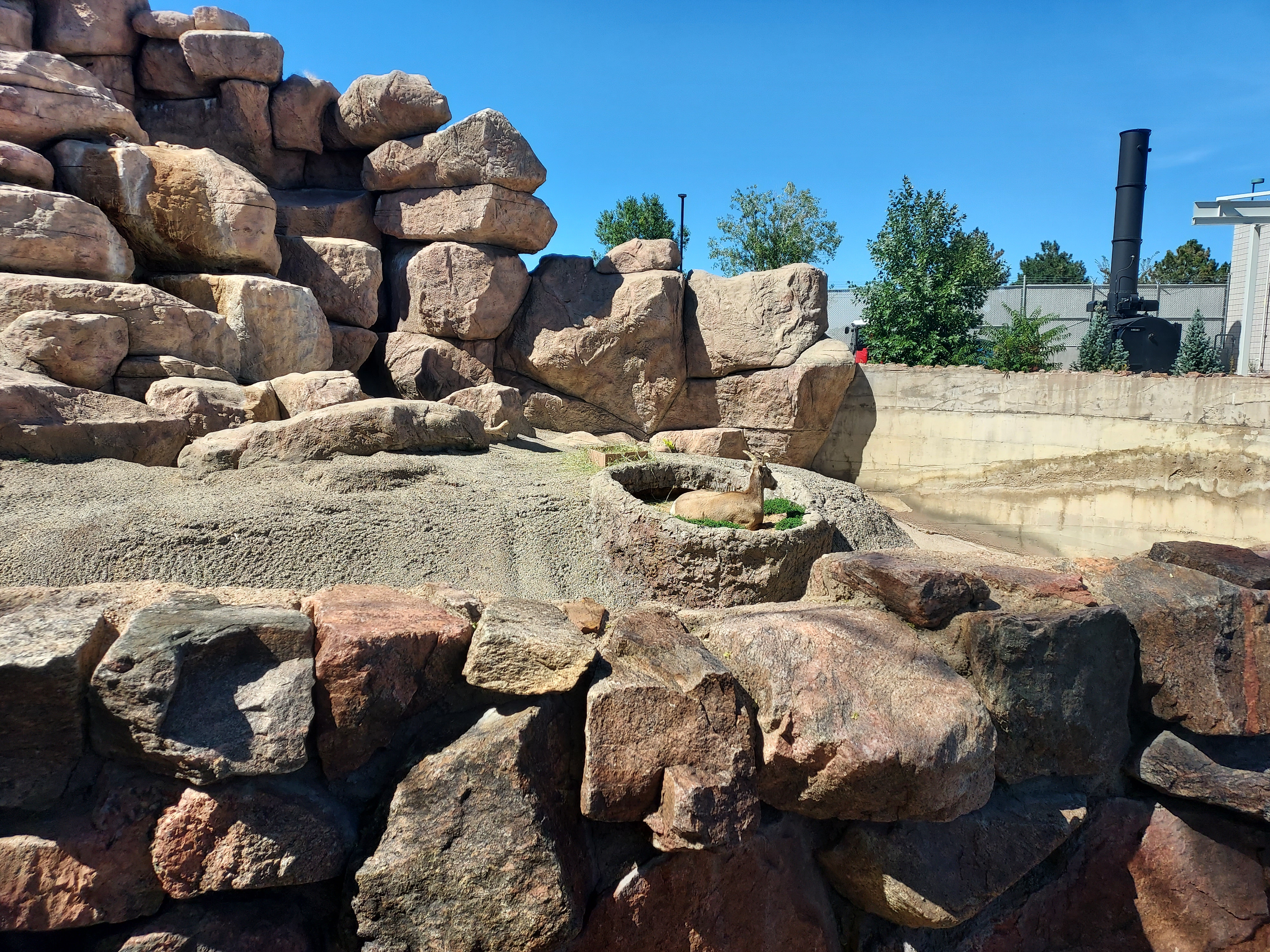
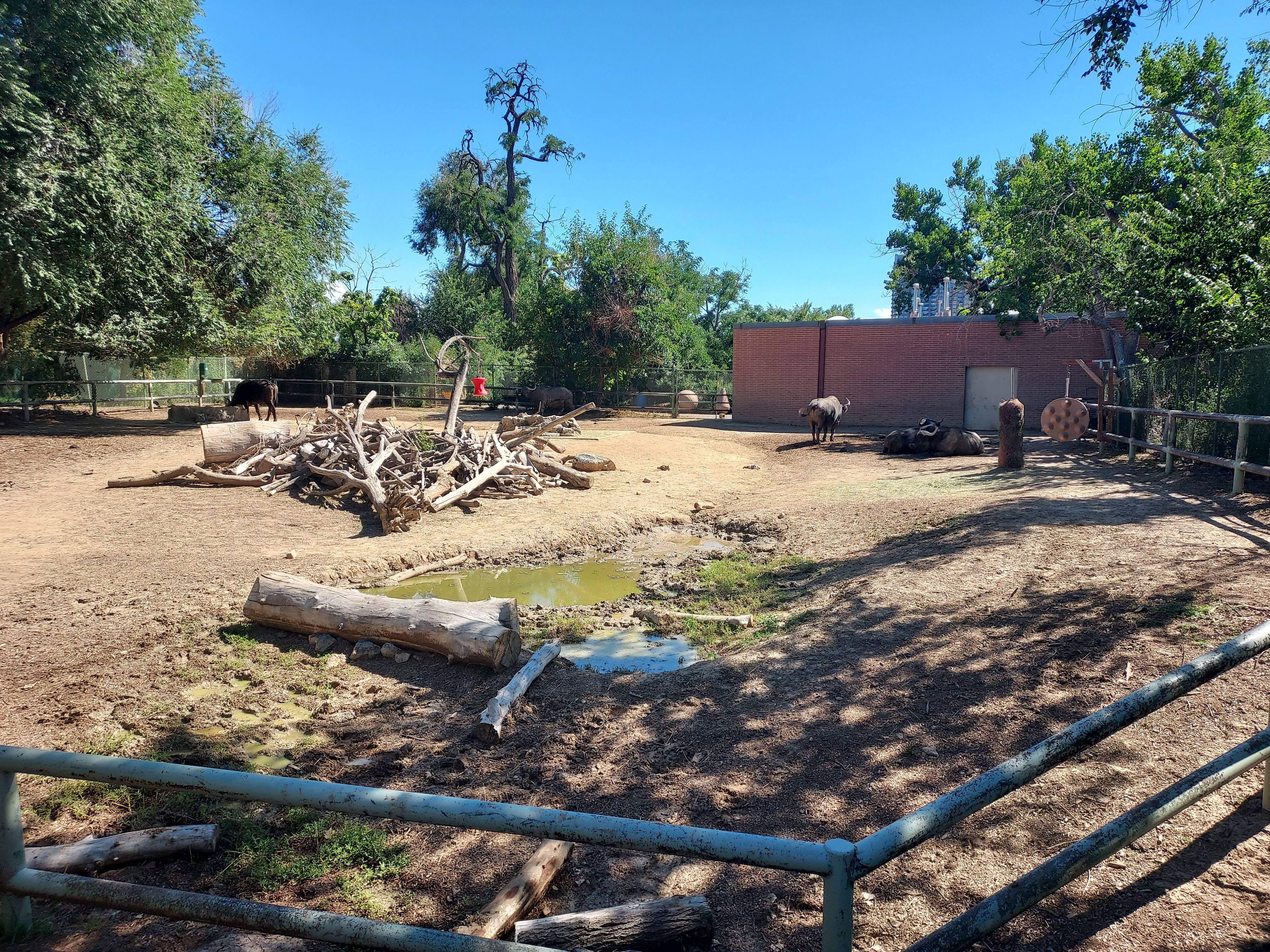
This put us across from the southern end of Pachyderm House but I have no definitive memory of seeing it over there. I do recall seeing the new animal hospital, which has an outdoor area where animals are sometimes on exhibit, but saw nothing. I passed by several hoofstock yards including the former cheetah exhibit, but don't recall seeing anything that caught my eye until I reached probably the biggest animal on my must-see list... a large yard with five African buffalo, four resting in the shade. This is an animal that as a child I never understood why it was so uncommon in captivity (it has since been explained to me here on zoochat several times) and while I only had a moment to appreciate them, they were still wonderful to see, especially seeing five of them and not simply an elderly individual waiting to die, as I had feared I would see. If I visit again I hope to spend more time with these animals, and if I do not see them again, I'm glad I had the opportunity. The yard was large, spacious and a little barren, but seemed very appropriate for the unique animals contained.
As we neared the entrance, I found a small tortoise exhibit at Predator Ridge which definitely felt as if it had been built for something else. (Possibly the former dik-dik exhibit?) The tortoises played in the hay though, and it was great viewing. We then closed our loop by going inside Predator Ridge's indoor viewing area -- just in time for a brief glimpse of a spotted hyena. No sign of the lions or wild dogs from here, though I didn't mourn as we had seen lions earlier in other parts of the exhibit and the wild dogs are easily seen in Chicago. (I have since heard Denver may be out of wild dogs.) Inside of the building, a zoo employee did a presentation on a skink that was informative, if a funny way to end our visit. I finally arranged to spend a few minutes inside the gift shop before we had to leave and catch our bus, looking for gifts for my family members back home and running out of time to find anything for myself... but I had a souvenir cup, an unforgettable experience, and a renewed passion for wildlife and zoos.
Evaluation
Elephant Passage, Primate Panorama, and Tropical Discovery proved the most memorable exhibits at the zoo for me, with Predator Ridge up to the same level of quality but simply not as active on this particular day as the other three exhibits. My least favorite exhibits were Harmony Hill and the Edge, which shared similar flaws. The similar strengths in the former and flaws in the latter contribute to giving this zoo a strong and distinctive sense of character.
The three large complexes all feature an interesting balance of habitat immersion and partial taxonomic grouping that feels like a marriage between the organization of an older zoo with the theming of a modern facility. These habitats are expansive and portray charismatic megafauna alongside interesting secondary species including reptiles and birds. Elephant Passage and Predator Ridge, the two most focused on charismatic megafauna, also allow for extensive rotation of animals between the habitats, which is fun for repeat guests and the animals. Both of these exhibits include a pretty high level of exhibitry. I think some would suggest some of the elephant habitats could be larger, though I felt many of them are large enough that it is okay if some are a little smaller.
While some reptile buildings feel limited, and some mixes (Small Mammal-Reptile House, Reptile and Aquatic Center) can cut into fully representing either group, Tropical Discovery has quantity and quality in abundance without feeling very restricted. Primate Panorama reaches beyond a primate building with outdoor exhibits into a full, immersive complex dedicated to a fascinating group of animals. Both of these complexes feature a robust collection, with outliers that add some interest to the greater complexes, and even with some shrinkage in the primate area still represents many key groups of animals. Jewels of the Emerald Forest could use some improvements, and the Great Ape House could use some substrate and murals on the interior at least, in my opinion, but as many of the animals in both buildings have outdoor access these aren’t ironclad suggestions.
The exhibits are also, like at Brookfield, rather biodiverse, including animals from multiple families and classes -- Elephant Passage features hornbill, cranes and small cats alongside pachyderms, Predator Ridge has small reptiles indoors, the forest aviary is a hidden gem in Primate Panorama, and Tropical Discovery features sloths, bats, and capybara alongside reptiles, fish and amphibians. A few of the hoofstock yards also mix with large birds, though it's open-ended whether these are ornamental or meaningfully integrated here. The forest aviary, while missable for a mammal enthusiast, remains an excellent bird habitat all the same, rather than feeling like an afterthought.
Let’s talk about the weak exhibits now. I acknowledge that Harmony Hill is a welfare improvement for the bears, who once walked on concrete, and it has interesting theming and education for guests, but the lack of viewing options absolutely devastate the core bear exhibit, which just feels like a grassy pit. The raccoons are adorable and overshadow the bears, but these two animals don’t feel like enough to really make for a themed complex, leaving the well-done theming feeling almost wasted on dressing up an uninspiring habitat.
There’s nothing wrong with The Edge, honestly, but like the bear exhibit, it offers a poor viewing experience and feels dramatically themed for largely a single species. There’s a lot to appreciate about the tigers having access to such a lush habitat without dramatic rockwork, but the plantings can actually make it difficult to see the animals in some cases (that’s why most guests missed the second tiger) and the mesh and the fencing infringes much of the view, made worse by a section of the viewing ‘plaza’ that is meant to represent looking through the woods. The catwalk is novel but hardly feels unique next to Philadelphia, and doesn’t do enough to make a sleeping animal exciting, for me. The x-treme name is distracting despite its intent to evoke the ‘edge of extinction’. Like the Hill, it is an improvement for the animals over their previous exhibit but feels barely adequate for guests’ ability to engage them.
I’ll add that I did not care for the older humboldt penguin exhibit. It relied too much on rockwork compared to the newer African penguin habitat (which also has gravel) I’m not sure any zoo needs two banded penguin colonies, and felt too much like an inferior duplicate of an existing habitat as a result. If they want to keep humboldt penguins at the zoo, they need a distinctive habitat.
The hippopotamus exhibit was also pretty disappointing; the keeper chat made it a positive experience overall and I was still happy to see the animal in his pond, but there wasn't a lot of land area and it's a shame to just keep a single hippo alone. I actually think Milwaukee County Zoo's new hippopotamus habitat is much, much superior to Denver here, and many would say Milwaukee's hippo exhibit is behind the times as it is!
Finally, the birds of prey were usually not well represented either. The eagle and condor aviaries were on the small side, and some pinioned cinereous vultures outside at the pachyderm exhibit. All three animals have better accommodations at my local facilities.
The hoofstock yards, pinniped habitats, sheep mountain and African penguin habitats all seemed roughly in the middle -- decent, serviceable exhibits that I found pretty impressive but don’t have dramatic praise for. I liked that the mountains seemed to have some substrate to go along with the rocks, and I was just pleased as punch the zoo had two such species instead of one, in an age when many zoos now lack caprids entirely. I’m taking a pass on Monkey Island since I was rushing by then and did not get to see the animals anyway.
I think it is important to acknowledge that by the time of my visit, the zoo's infamous feline building and bear pits were gone, and the old monkey row has been limited to a winter holding for the Capuchins only. Previous reviews on zoochat of the facility seemed significantly marred by the presence of large predators and fascinating primates in these dated exhibits; the closing of the former and reduction of the latter seemed to receive little noise, but in closing them, the zoo has eliminated their biggest liabilities, leading to a stronger zoo overall despite the loss of more than a dozen significant mammals in these habitats. What dragged down and disappointed past visitors to the zoo has been eliminated, and while some of the replacements are not groundbreaking, they are still relatively modern.
The animal collection felt fairly strong across the board. Mammals and reptiles are well-represented throughout the facility, with most popular groups represented to please the casual zoogoer, and an overall alphabet’s worth of animals. I really think canids and cervids felt the most overlooked out of mammal groups; and there’s definitely room for one more larger cat species somewhere, maybe even another bear. The zoo’s extensive bird collection is also underexposed without a dedicated bird building; hopefully a new one is in the pipeline, as many of Bird World’s residents are still held behind the scenes. The zoo’s collection is focused on Africa and in a refreshing change for a more northern facility, Asia, while North American animals have been reduced over the years, and a new Australia exhibit is upcoming. South American animals are present but not in focus.
I see room for improvement in a few areas - particularly the North American collection, which has been the victim of the zoo's expansion more than any other. The zoo had long associations with bison and musk ox, but those are long gone, and wolves and otters have been victims to recent expansions. There are also no deer or cervids present. Harmony Hill and Northern Shores do continue to feature a vague North America theme; expansion into the former feline building location could keep these areas linked, unless the decision is made to focus instead on a coasts theme.
The zoo currently has the Edge, the Gobi hoofstock, and Elephant Passage as a greater Asia area, without obvious room for expanding in that area... but there were once plans for a further Asia expansion which would include leopard, snow leopard, and even dhole. These predators would be great additions, but I would also suggest small mammals such as previously removed red panda and tree shrew, maybe loris, and more ambitiously, Japanese macaques. The zoo's primate collection has lost macaque (and mangabey) representation, which is a shame, but the Japanese macaques are active and can handle Colorado weather well.
I do not know much about the former Monkey House but that could also be great for expansion, or at least improved winter holding for Capuchin. The former Bear Mountain area is also open for development, but the area lacks theming between the northern Sheep Mountain and the nearby Capuchins. The pachyderm exhibit could probably be a good candidate for renovation, too. Pygmy hippos might be a better investment than their larger cousins.
I'd like to know more about the new Australia exhibit. I know it has been dismissed on zoochat as just another walkabout but the continued holding for cassowary and kea seems significant to me, and I'd like to hope they can surprise us with another Australian species of note somewhere. It might also not be a bad idea to move some of the relevant Australian reptiles out of Tropical Discovery for this, opening space in that building for new animals, or other Australian birds; I believe they hold black palm cockatoo. Adding wombat or echidna would be a treat as well.
I think the zoo has a great layout, but I can see why some would disagree. Brookfield and Milwaukee both have large, open areas with natural woods and grasses - something which felt increasingly like wasted space in my teenage years, but that I’ve come to appreciate better as an adult who recognizes how these green areas help immerse the guest in nature. Denver is more dense than this -- the center of the zoo is essentially a giant hoofstock loop, with star exhibits like Elephant Passage and Primate Panorama loops off this central path, with a crossing area near the Pachyderm House and the more forested area around the primates. This area was hard to navigate, but otherwise, the zoo was straightforward and felt bursting with activity. I loved it. I’m sure for some who have seen many zoos like this, it is not impressive.
Speaking of this, the zoo had many amenities. On the eastern side there are four sets of bathrooms and three places to eat, so you are rarely far from something you might need. To the west of the Pachyderm House, there is only one set of bathrooms and one place to eat. It is worth mentioning specifically that the loops for Elephant Passage and Primate Panorama have no food options inside, and the former no bathrooms, although both have food options close by their respective entrance and exit areas. I think it would be a little helpful if the new Down Under exhibit included an additional set of bathrooms, based on its placement on the map.
I think the number of food options is sufficient - it is not overwhelming and oversold with a popcorn cart outside every habitat, but you have five major dining options, each with a unique menu. (There are more carts listed on the website.) Kamala Cafe was not typical zoo food but tried to theme itself with food relevant to the local Asian animals. I think that was cool and regret being in such an intense need for comfort food - on a future visit I’d like to take better advantage of the varied menu! Given that me and my friend went on an unusually and extremely hot day in warm Colorado weather, we managed to stay pretty hydrated throughout, refilling drinks or buying water at every opportunity on the trail. Under these circumstances, the free refill souvenir cup was a godsend, and stronger than the same equivalent at Lincoln Park.
Most surprisingly, the zoo is enormously restrained when it comes to shopping. There are not themed gift shops at every exhibit complex like at some facilities, but there is a large gift shop by the exit that is well-stocked with lots of items, and a second shopping area marked on the map near the McGrath Family Amphitheatre. This is not a zoo that is looking to turn every exhibit into its own retail opportunity and it made me all the more eager to dig through the Gift Shop by the entrance on the way out, rather than me speeding by after passing through three earlier shops!
In addition, the zoo’s primary non-animal attraction is a 4-D Theatre, which feels in no way obtrusive to the animal viewing experience. Tickets are cheap and affordable, and the films shown are short and educational, so I skipped it but I see it as a win. There is also a conservation carousel and a children’s railroad, which are perfectly acceptable but are located in close proximity to one another, covering a decent land area, and can cause some navigational confusion as a result, as they did for me who kept running into the carousel I was trying to skip. None of these detract from the zoo’s educational goals or mission, but your mileage may vary on how obtrusive they are.
Conclusions
So, to review… I loved the layout, I liked the dining options among good amenities overall, the non-animal attractions weren’t overwhelming. The collection is excellent, with Tropical Discovery, Predator Ridge, Elephant Passage and Primate Panorama all must-see exhibits including a wide variety of species, several immersive outdoor habitats and rotating yards for some species. The worst habitats felt more like problems for visitors than the animals, decent if uninspired and bland, with the exception of the hippopotamus habitat and the birds of prey. I think future developments remain promising.
Two of my favorite memories of the trip are definitely going to be the moment that I realized the large, furry thing I was staring at through the glass in the nocturnal area was not the aye-aye's full body, but the animal’s bushy tail, the realization the aye-aye was larger than I thought, and the childlike excitement I felt. I never saw the creature’s other trademarks as well, but it was still a moment of awe and wonder. The other is going to be seeing a bull Asian elephant completely submerged in the water and cooling off, blowing water over itself to the jealousy of sweaty guests before turning around in the water and slowly exiting something I thought I’d never get to see in a zoo.
I think the Denver Zoo is a fantastic an well-rounded facility overall, and remains extremely overlooked on zoochat. I recommend is most strongly to those who enjoy pachyderms, primates and reptiles, but I encourage even those who may have visited better facilities to give it some consideration.
My trip photos can be seen here and here, with notes hastily written for family and friends. I did try to edit some of them into the post as well. If anything is worth adding to the gallery, let me know.
Most zoochat members who post reviews are experienced travelers and have been on many road trips to countless zoos, and can therefore make informative and helpful comparisons to other facilities. I have had very little travel opportunity in my life due to family matters, so the vast majority of my comparisons will be limited to local Chicago facilities. This lack of experience will at some point likely manifest in a generosity towards things that have been done better elsewhere.
I wrote the bulk of this and then sat on the review for some months and considered not posting or completing it due to that lack of experience, but as I feel Denver is a relatively less discussed facility on this site, I made the decision it might be worth revising and sharing my thoughts for the sake of increasing coverage of the facility and spurring discussion for it, as well as to kickstart before I begin writing reviews of other facilities... this is actually my first official review on zoochat!
As a structural note: if you’re already very familiar with the facility and aren’t interested in the trip report and personal experiences, you can skip the Background and Walkthrough sections as I cover the core review elements afterward.
Background
In August 2022, me and three friends arranged to meet up and stay together in Denver, Colorado for a few days to attend an unrelated special event. This was my first trip outside the midwestern United States in fifteen years, and my first trip away from home without a family member since my scouting days. I recalled that Denver had a zoo as @snowleopard had offered some praise for it and vaguely that I had seen it on some rarity lists, and considered if fitting it in might be an option, though I was unsure if the friends I would be meeting there would have any interest. By chance, we ended up staying within fifteen minutes of the zoo.
This visit took place on Saturday August 13, 2022.
I have to thank my sister for her words of encouragement, as it was thanks to her I made plans in advance and felt motivated to let my traveling companions know this was an important stop for me.
Walkthrough
As the exhibits are listed in order as visited; a few are duplicated as a result.
The Zoo Entrance was more elaborate than either of Chicago's zoos, with the Gift Shop well-integrated in the plaza and a fast ticketing process. Due to Covid-19, tickets were not sold on site but ordering in advance was simple enough despite warnings to buy in advance. Almost immediately after entry, to the left was an African Penguin Habitat with glass windows, low underwater viewing, with rock work and gravel for the penguins. It was an extremely hot day and the tropical penguins seemed content to relax on land. These tropical penguins make a great species to introduce visitors to the zoo at least. I appreciated that the penguin viewing was just below eye-level, while in an effort to better showcase underwater viewing some penguins are housed at eye-level or above. I was surprised by the amount of gravel in the habitat though, which felt artificial until I compared it more mentally with the rocky shores tropical species habitat. I have since found it formerly housed mongoose! It overall made a positive first impression though for certain.
The first major exhibit complex lay directly ahead of us - Benson Predator Ridge, which has rotating yards for three major African predators. The first viewing was for a spacious, grassy exhibit with two active adult lions visible in the distance, posing on the rocks nearby, dwarfed by the exhibit's size. Local facilities had up until this time kept lions in grottos with rockwork, usually housed in pairs, so it was a different experience to see two adults following each other through a grassy habitat in the distance. To the left, a LEGO brick-built Lion was visible; although I am a big LEGO fan, this was surprising to see as part of an, as far as I can tell, permanent exhibition. This lead over to a viewing area with two large windows into separate, additional lion enclosures. A lioness rested with her head almost against the glass behind one window, while behind the other a large adult male lion rested with his huge paws almost next to the glass giving me a true sense of scale for these majestic animals. His exhibit had some more rockwork than the lioness' larger, grassier exhibit, although in a large complex and as one of many options this feels perfectly acceptable. The multi-enclosure access allows them to hold a larger pride, which is also a nice change of pace from two individuals sharing a rocky grotto. (Chicago would follow suit with Pepper Family Wildlife Center, which I did not see for a few months more.)
Continuing down the path, we began to see Hoofstock Yards as well - a few Grevy's Zebra shared an exhibit with Somalian Wild Ass, with a sign explaining that the zoo was experimenting with keeping the species together to facilitate breeding separation for the latter animal. The hoofstock paddock seemed spacious if generic - however, the Somalian ass were an unexpected new species for me and rather impressive, I found. The contrast of their leg and body coloration was very attention-grabbing, though admittedly the two individuals seemed bored and more interested in their food than anything else. Nearby was a smaller giraffe exhibit with at least three giraffe present, and a barn that offered interior viewing. I chose not to enter the barn. The outdoor exhibit looked a bit barren for my taste, resembling a desert to me more than a savanna.
The zoo's infamous, historic feline building would have been around here, but was permanently closed sometime before the visit. I'm sure this will be good news for any zoochatters not already aware, as the building was known here for being horrendous for residents.
We next took a detour to the newer Harmony Hill complex, home to Tundra the grizzly bear - in terms of visitor experience, I thought it was a very cute exhibit, appealing to visitors the relationship between nature and their own lives, and discussing national parks, which I felt was a very successful contrast and concept. That said, the grizzly exhibit was not inspiring -- it was a grassy exhibit but much lower than eye level for visitors, with Tundra perched on what looked like a rock teeter-totter (it was not actually, I don't think) and visible through netting. The exhibit felt like a modern version of a historical bear pit, with enough substrate and soft ground to feel modernized, but it felt rather ineffective and unsatisfying for viewing the animals.
Further down the complex is a smaller 'backyard' habitat with a nice pool -- a white creature was exiting the water and a keeper introduced visitors to Cashew and Pecan, two adorable white raccoons. They were quite active, had a large pool and lots of toys and were a treat to watch. I’ve never seen a raccoon swim before! A keeper or docent explained they were two members of an orphaned litter, but the ones with normal patterns were released to the wild, which is the correct thing to do, though I think the contrast of a normal pattern individual might have been nice. The racoons vastly overshadowed the nearby grizzly and we stood for a while watching them play in the water.
The small complex as a whole is hard to judge. I really like what the zoo is going for -- focusing on where humans and nature meet is a great theme for an exhibit and it was pretty educational in theory, but something doesn't click, and the signage while thematic doesn't feel like it sufficiently relates to the exhibits themselves. While this is no doubt an improvement in welfare on the zoo's previous bear holdings, which lacked substrate or soft areas, I think more could have been done to highlight the bears as animals. I think based on some press material the bears were intended to rotate both spaces before the raccoons took on the second, which would explain some of the problem. I was surprised to find the exhibit was only a few years old, and disappointed to see it replaced an otter exhibit in addition to the famous polar bears. I would not suggest the zoo should have kept polar bears when there just aren't enough to go around, but that this feels like an underwhelming replacement for such a fan favorite.
The otters, polar bears, seals, sea lions were once all part of a larger complex called Northern Shores, and while this branding has remained the surviving exhibits are strictly for California sea lion. Their main exhibit has a very prominent rockwork wall alongside a good amount of eye-level beach for the sea lions to use if needed and of course plenty of water for them, with the sea lions clearly visible as they swam through. There was an underwater viewing with some kelp but the sea lions were not there when we returned later. The underwater window was outdoors, unlike at the Chicago exhibits, and the sea lions were easily seen. The beach was narrow but I appreciated that it was not a round island. While it can’t compare to some of the more recent rocky shores and underwater tunnels, I was fairly impressed here - though I have seen sea lions before at multiple facilities it still felt like a new experience.
Nearby is the entrance to Tropical Discovery, which we will cover shortly, and some amenities, but also just north was another pinniped exhibit, similar to the previous California sea lion exhibit but smaller. A pinniped with ears poked its head out of the water and I quickly and confidently identified it as a sea lion; but my friend noticed the signage for a Harbor seal and thought he had caught me in a lie, and the animal did not surface promptly. (Thankfully zoochatters have since validated my identification; why the signage never changed is a big question.) It seemed like a smaller and less exciting cousin to the same exhibit.
Although I enjoy what remains of Northern Shores, the branding feels rather orphaned at this stage, with only one species remaining in two exhibits, and though the zoo has apparently and ambitiously promised the eventual return of polar bears, it’s hard for me to imagine them returning to this space. A new exhibit for flamingo is being built in this area as well, which does not feel like it ties into the theming. A previous master plan suggested adapting this area to Coasts, but with Harmony Hill cutting into it, I can’t help but feel that this area lacks identity, more significantly so because Harmony Hill and Northern Shores were designed as thematic exhibits. It's possible seals may return at least though.
We entered Tropical Discovery around this time, a building that houses reptiles, amphibians and fish in an indoor rainforest setting, but also includes many reptiles from arid environments, marine aquaria, and a handful of small mammals. The building feels massive and almost overwhelming, boasting a wide variety of species on display at every turn with some solid theming throughout. Poison dart frogs and milk frogs were engaging amphibians, a tank of piranha caught me by surprise, and a whole sub-exhibit focused on venomous snakes including multiple cobras, fer-de-lance and gaboon viper invited me to compare and contrast the variety of these animals and appreciate them a little more than I did finding one or two of them tucked into corners at other zoos, and I imagine offers some comfort to visitors who may want to avoid these venomous animals. A capybara at eye-level was another experience where a familiar species felt new; the capybara was enjoying hay but feeling like it was missing something (the recent passing of its howler monkey friend!) while nearby a cave held two bat exhibits, one with inactive vampire bats and one where dozens of bats continued to fly around, a far more intriguing sight than a quiet, sleepy colony! While I have seen multiple species of bat before including in the wild, it felt like my first time truly seeing bats! We then reached some surprisingly open-top aquariums including upside down jellyfish, though I missed the mudskipper. There was also a mangrove aquaria with bamboo sharks, and I almost made the mistake of walking past the tall tree that held the zoo's two-toed sloths, who felt more like a part of the guest area.
Next was a hall dedicated to marine life, including a large saltwater coral reef tank, sea aneomone, and a number of other small species down the hall such as garden eel. I was impressed by the quality of the larger aquaria exhibits in this building and the wide variety of fish on display, though I had trouble keeping track of them. A section on cypress swamps followed, including an impressive Florida kingsnake, some turtles and terrapins, bamboo sharks, and of course a massive Alligator Snapping Turtle in another large tank, a favorite of a good friend and often a highlight.
We then moved to the hall of lizards, which included some well-lit, larger exhibits with water, plants, sand and branches. There was the first Nile Monitor I've ever seen, an impressively bulky fellow, and a Komodo Dragon who seemed disinterested in guests today, almost non-moving but in a spacious habitat, head facing away. A Philippine sailfin lizard perched on a branch seemed excited by guests though, turning its head around a lot, its exhibit shared with a black tree monitor. A rhinoceros iguana, like the komodo, sat with its tail towards the glass. All of these larger lizards were very impressive and like the venomous snakes, I felt like I appreciated them better in contrast with each other. The dedicated lizard hall was a great highlight.
Leaving behind the hall of lizards was a fairly spacious exhibit for Daphne, the zoo's Siamese crocodile, another new species for me and one of the larger crocodilians I've seen. Nearby was also a matamata turtle, a fascinating species with a strange appearance that I am mostly familiar with through pop culture, but I found quite engaging; also nearby an Australian filled lizard, a species I always enjoy as well, perched on a branch in a lush habitat. Near the exit was a tank for Lake Titicaca Water Frog, a species Denver has an important history with, and dozens of frogs all visible at once!
Me and my companion briefly considered skipping Tropical Discovery - the title seemed very non-indicative to me, and housing reptiles, amphibians and fish gave me concern it would only hold small, very standard exhibits for a handful of each. I decided to see it anyway, and I'm so pleased I did. While I am not going to argue that Tropical Discovery is objectively some kind of essential, must-see for any zoo fan, I think it is the finest species-rich zoo building I have ever set foot inside. It was the first truly impressive experience at the zoo, reminding me of Lincoln Park's Small Mammal-Reptile House on a much, much larger scale. It was a very effective rainforest recreation for guests but also showcased so many reptiles, amphibians, fish and a few small mammals in a way that felt exciting and fresh, with new animals at almost every turn and larger terraria than other reptile exhibits I have seen. I appreciated that different rooms had their own subthemes, allowing the animals to still feel grouped by habitat and taxonomy at once.
Moving northward, we next saw a massive catwalk between two tall cages, bringing us to The Edge, which was a very attention-grabbing name. The catwalk feels almost like an archway into the primary viewing area, where guests can view the Amur tigers from a loop in between both larger cages. The effort to place the guests as close to tigers as possible is admirable, and the exhibits seemed quite lush, more reminiscent of a rainforest clearing than a taiga. According to the website there is a lot of enrichment available but nothing stood out like the catwalk. The viewing loop within the exhibit has sections meant to simulate peering through the woods at the tigers, obstructing view. On this particular day, one of the tigers was napping on the catwalk, relaxed and content, and another was laying low but so close to the fence it was almost impossible to notice from the main viewing area, and I only noticed it from the last viewing space for the exhibit.
I love everything The Edge is trying to be, and it is no doubt an improvement compared to the moated grottos in the midwest for the animals or the former feline building, but it leaves much to be desired and is compromised by practicality. While the exhibit was more lush and pleasing than a grotto, the fencing is much more obtrusive than expected, and the simulated viewing through trees an unnecessary eyesore. The fencing needs great strength to hold the strong tigers back from any escape and to support a catwalk that can itself support these animals, but these necessities compromise the visibility of the exhibit. It is no doubt an impressive space for the animals to live in, but the exhibit feels shockingly underwhelming for visitors. Very much like Harmony Hill, the welfare seems like an improvement but the viewing seems poor, and unlike Harmony Hill, the additional signage doesn't feel as helpful or educational here. The catwalk makes the exhibit and while it would no doubt be thrilling to see an animal using it, watching an animal sleep on the catwalk above my head doesn't hold the same excitement for me.
Almost directly next down the path from The Edge are two Gobi Desert hoofstock yards that are paired together, with a great deal of room and just enough trees in the barren sand, and a shared viewing area. These exhibits are separate from the main hoofstock loop and do a decent job of recreating an authentic desert environment, though background chainlink and some odd pillars do detract. Each exhibit holds Bactrian Camel and Przwalaski's Wild Horses, both ungulates native to the Mongolian deserts and grasslands. I recall signs suggesting these two exhibits form a small Gobi Desert complex, but can find no mention of such online; in addition, at least one sign seemed to try to tie them into The Edge, which officially is limited to the tiger exhibit, implying a common theme that these animals "live on the edge". I have to say it felt innovative to try to display these hoofstock in a themed area, even if the exhibits were still basic hoofstock paddocks.
After our brief visit to the Gobi Desert, we took lunch at the Kamala Cafe nearby, which should have been an excellent and memorable culinary adventure, and I want to applaud Denver for adding food that ties into the local exhibitry... however, we had dinner at an Asian fusion restaurant the night before that I had not been able to enjoy, so at the moment I craved familiarity and skipped past the varied menu of Asian food and instead selected a hot dog and a soda, limiting my experimentation to dole whip. (I will try authentic food when I return to Denver!) I had never had dole whip before and found it a fun surprise, especially on such a hot day. I also bought a souvenir cup so I could get free refills throughout the day because it was insanely hot and I still had sunburn from a hike at Red Rocks two days before. The view of the McGrath Family Amphitheater was superb and though we were seated quite far back, we had a clear view of one of the zoo's elephants - the promise of adventure yet to come and a great view improved the meal, feeling like part of the experience instead of an interruption as I have sometimes felt when eating at Brookfield Zoo's Safari Grill/BZ Red Hots, which is a walk from any animal attractions.
After eating, I ventured to the nearest exhibits in the 'hoofstock loop' and looked into a spacious, grassy yard that held an Okapi to my surprise, along with a Saddle-billed stork that I nearly overlooked at first. (There truly is something to be said about how birds in hoofstock exhibits can feel like ornaments.) The okapi was mostly focused on eating hay out of a container on the fence while the stork emerged quietly. The animals' placement in such a grassy yard felt a little off for an animal known for living in the tropical rainforest though. It also feels off in context of the surrounding exhibits - two desert animals before and a third one next, the proper Somalian wild ass exhibit, with one of the animals also feeding. There was a surprisingly narrow exhibit next that normally holds a Vietnamese pot-bellied pig, but the animal was off-display with a sign remarking it was often used for demonstrations as an ambassador animal. I believe between the giraffe and okapi I missed out on a yellow-backed duiker exhibit, but as they are held at my home zoo this was an acceptable loss.
As we moved past those exhibits, my anticipation was sharply focused on Toyota Elephant Passage. I have never seen a modern elephant complex before and my local facilities typically focus on African varieties of these animals so the larger animals in this exhibit are all rare species to me. I have loved all of the animals once considered pachyderms since I was a small child, with elephants my favorite animal in childhood and painfully long missing from Chicago, so I cannot describe my childish excitement for this part of the visit. The exhibit back by the amphitheater was a taste of what was to come -- some limited rockwork at the side, lots of open space and massive pools of water, leaving enough room for multiple elephants to be submerged or to roam the shores. Moats are well-hidden and not obtrusive to the eye.
Elephant Passage is a closed loop off the main path, including separate amenities and two exhibit buildings as well as a series of longer, interconnected exhibits that can rotate freely between elephants, rhinoceros, and allegedly tapirs as well. This was a totally different approach than I expected, but a rewarding one, the animals feeling surprisingly close and intimate and still allowing a strong guest viewing opportunity rather than a small viewing area into a massive habitat as I had feared. I also hadn’t realized how many additional species were part of the complex.
The first exhibit (second, counting the one closest to the amphitheater) had two elephants holding trunks behind cable fences, while on the other side of the path was a lush Clouded leopard exhibit that was covered in mesh, grassy and full of climbing opportunities, but there was no sign of the animals. The next large yard was devoid of grass and had another elephant walking through at a leisurely pace. Next was the chance to enter the elephant barn, which had an indoor exhibit behind cable fences, a visible higher level presumably for staff to interact safely with the animals. No elephants were in the guest viewing area but one was visible through a maintenance door or some bars blocking off a maintenance area.
The nearby building with indoor exhibits from the Asian rainforest was fine. A fishing cat neglected its stream or climbing opportunity to hide inside a log, facing me as I looked into the log for it. Asian small-clawed otters had recently bred and were not on display, their exhibit drained, but they had a live camera to their den. A Great Indian Hornbill slept in an exhibit - a cramped exhibit for such a majestic species, but an animal I’m very happy to see all the same. A window was offered into one of the large yards, though nothing was visible from this angle. The building felt a little tacked-on, with the interior exhibits a little on the small side, and darkly lit visitor areas more reminiscent of older zoo buildings, but I really appreciated the effort to include more southern Asian species alongside the elephants, who could have carried the massive complex on their own.
Exiting the building was an exhibit with Sarus cranes, who were quite visually striking, across from a large crowd around a massive pool... upon approach, the top of an elephant and its trunk began to stick out from the pool by an elephant almost submerged! In ninety degree heat, the elephant had found an incredible way to cool off and I know I wasn't the only visitor utterly captivated to enjoy the animal here. After several long moments, the bull became bored and left the pool. This was easily one of the day's highlights. Nearby a long yard, the same one visible from indoors, held two Indian rhinoceros (or Greater One-Horned Rhinoceros, as Denver prefers) had the same idea to cool off on a warm day by submerging themselves in the water. This is one of the species I've waited my whole life to see, and I had no idea they were so comfortable in such deep water. Wow!
Finishing the Elephant Passage loop is a set of two interconnected exhibits: a barn, a wide exhibit with a large pool and two islands, and a third exhibit across the path with a third island located in a pool. All three islands and the barn are connected by 'wire' and contain climbing structures. The visitor feels as if they are passing on a bridge in the middle of a river. A third Indian rhinoceros is visible in the distance in the wide exhibit near the shore of the pool, while a pair of fuzzballs wait in the barn door to come out and play, despite the many signs warning about possible gibbons overhead. The male briefly leaves, swinging a few feet over the water, expels waste and returns to his mate. The crowd is nonetheless enchanted by the 'will he stay or will he go' of it all. The gibbons seem uninterested in all of the toys and amenities visible on their three islands, content to hang at their barn door.
I had a little disappointment upon leaving Elephant Passage, as the Malayan tapir had not been in any of the rotational yards, a striking species I had wanted to see and was now considering if Denver had quietly phased out... but there was a yard right outside the exhibit loop, and lo and behold, there was our tapir, resting under a shade structure instead of the water. While the animals can rotate between all of the loop exhibits, this one is limited only to the tapir and from social media it sounds like it is usually here, while the elephants and rhinos rotate in the previous exhibits.
Many things stood out to me about Elephant Passage's exhibit design. The first is how many massive pools of water there were, with more than enough room for elephants, rhinos or tapirs to cool off, play, and even submerge almost completely, far more than mere ponds. I've never seen such large water spaces for these animals before and they were visually stunning even without animals in them. The second aspect was how well hidden the moats were; the exhibits managed to feel surprisingly intimate because you felt closer to the animals than you were. It was also an exciting thought to imagine the three rare Asian pachyderms rotating exhibits and sharing space. I also like the integration of the clouded leopard and crane exhibits, giving the feeling of animals at every turn, and the cranes were an unexpected new species for me.
I am not well-traveled like most zoochatters, so much of this paragraph is subjective and personal, but for me, it was unlike anything I had ever experienced in a zoo - my first modern elephant complex and my first true Asia complex at once. I have no basis of serious comparison for either of these kinds of exhibits. For me it felt groundbreaking to see these magnificent animals in this kind of complex, treated like the superstars they are, with so much space and so many individuals, exhibiting distinct behavior. The exhibit also overcame me with a sense of possibility - it was a reminder of what a great zoo can be capable of. It met and exceeded my expectations and proved to be an unforgettable experience... and this was still only the halfway point of the zoo trip!
Directly across from the exit to Elephant Passage and the tapir exhibit is the hippopotamus yard off the zoo's historic Pachyderm House, with a friendly keeper providing lots of stories and information about the hippo, who remained almost motionless in the water. Though it was my first time seeing a river hippopotamus in years, the lone animal did not seem interested in being seen, laying nearly motionless in the water as a keeper talked about how often the pond was cleaned. It was a good keeper chat, feeling more off the cuff and straightforward rather than a polished and rehearsed script. I had unfortunately not looked into the zoo's old paychyderm building and was completely unaware that it had an interior open to the public, and forgot it further when I turned a corner to see some llama, at which point I lost any sense of the exhibit itself.
I don't feel fair to judge the pachyderm building as it was rather lost in the shuffle of being between the two biggest attractions for me in my mind. I can certainly say the parts of it I did see were largely bland and unimpressive. I hope to spend more time there on a revisit.
Before embarking further, I decided to backtrack to see what I might have missed from the central hoofstock yards area while in Elephant Passage. The remaining exhibits include a very small exhibit for a pot-bellied pig who was not visible, and a tragically empty kudu exhibit and then found two yards holding mountain bongo, the first holding a single individual and the second the rest of the family. The hoofstock exhibits are constructed at an angle, so the exhibit is lower the closer it is to the fence, similar to Milwaukee. Each of the bongo sat in this area, so close to the fence that most visitors would assume they were not out unless they leaned over, and proving hard to photograph. I later found out one of these exhibits used to hold eland - such a pity, they would have been a wonderful addition. There were also Addax, one of my favorite antelope but a species held close to home and worth speeding near. Also nearby were some red kangaroo resting comfortably in the shade, hard to see in a shady area with tall grass.
Returning where we had left off ahead of Elephant Passage is when things became a little less cohesive and easy to follow. This area used to be anchored by Bird World, a large bulding home to seventy species of avians. At the time of my visit, the building was already demolished, now a large construction site for a new exhibit, "The Land Down Under", a new Australia and Ocenia-themed area which will provide a new home for red kangaroo, as well as emu, wallaby, and some former Bird World residents such as kookaburra, cassowary, and kea. The posters, and online press releases contained a nearly identical description, making me wish I knew more and more about the addition. The idea of a modern Australia building was interesting to me but there wasn't a lot of information available besides that it would contain a walkabout and some kind of conservation station. I hope to return to Denver in the future so I should someday experience whatever all that is for myself.
Up to this point, the visit had been following the pathway in a loop around the zoo, which was refreshingly straightforward compared to some of my local facilities. There had never been confusion as to what was next or where to go, as there was a simple path, with animal exhibits almost constantly visible and making for obvious landmarks. The pachyderm area offers shortcuts across the zoo on each side, parallel to the Bird World site, which is useful and straightforward, but only a short walk later, there is further branching out, with another shortcut path across the middle, and a path up north, with no visible exhibits. This area is more wooded, with a garden nearby, a grass maze, a conservation carousel, and a children's train ride. I found this area confusing and frustrating to navigate. I spent a half hour wiggling around this area full of confusion between the main path and the two railroad paths that cross around.
After accidentally passing downward across the path, I came across a completely unexpected Humboldt Penguin Exhibit, clearly smaller and inferior to the earlier habitat. This exhibit seems to be entirely mock rock and water, lacking the gravel and additional land area of the African penguin habitat near the entrance. It was surprising to find the zoo held two different kinds of banded penguin species; indeed, it was only recently I could really absorb the morphological distinctions between African and humboldt penguins. It was hard not to contrast both penguin exhibits and find a clear preference for the newer one. I only found out later the entrance exhibit was a conversion of a former mongoose habitat and that the humboldt exhibit is more historic, though the zoo formerly kept African penguins at Bird World.
Not far nearby I found what little remains of the historic Bear Mountain, the zoo's original barless cage now home to an unseen porcupine. It’s great this exhibit has been preserved for history but it looks unsuitable for holding any animals today. I soon backtracked to where Bird World had been and continued back along the main path.
Even without the former bird exhibit, the area surrounding its footprint is still populated spottily with bird habitats. There was a small line of Bird of Prey aviaries, and I was overcome immediately by their small size though, worrying if the birds of prey could fully stretch their wings, and this is one of very few parts of this zoo that immediately struck me as inferior to my local facilities. One of the exhibits held an Andean Condor, so size is critical; the other held a Bald Eagle. They at least were in better condition than the pinioned cinerous vultures at the Pachyderm House... these species could use better holding and hopefully their long-term plans including new holding for them.
Nearby was the Nurture Trail, which I thought would be a scenic nature trail - fun, but not of interest to my tired and sweaty friend, who wanted to hurry along and was losing interest. I was not aware until later that there were exhibits along the trail, including an opportunity to see the kea. A very unfortunate decision, but I also wonder if I would have fully appreciated the exhibits during the trip in these circumstances.
The last of these border bird exhibits was located close to the entrance to Primate Panorama - a beautiful Lagoon for waterfowl, with a large flock of Chilean flamingo on display, and nearby a beautiful elephant statue, known as Mother and Child, that used to sit in the Governor's Mansion in Colorado. It was an odd little fun fact but added to the experience of learning about the history of the state while there. (I had actually seen the current Governor at an event earlier in the week as well.) The flamingo were very attractive and the pond felt like a nice place to relax. It was a truly beautiful slice of the zoo and I’m surprised it did not have a name designated on the map. Denver usually holds a mixed flock of American and Chilean flamingos, however, the American flamingo were not outside due to bird flu concerns, and were instead being held nearby indoors through an awkward window. The winter holdings for these animals were extremely difficult to see into, and even in my photo me and my companion are clearly visible in the window reflection, but I was able to see a keeper work with them. The flamingo will be moving to a new home as mentioned earlier.
Across from the pond, I finally located the entrance to the Primate Panorama complex, an exhibit I am surprised to have not heard more about before! This and Elephant Passage were my two highest priorities so I refused to miss this one.
Primate Panorama is a closed loop off the main path on the western side of the zoo, much like Elephant Passage, though the overall area (five to seven acres) is larger for visitors and more immersive. After passing through the initial amenities, we first encountered a lush, netted lemur habitat with lots of trees, ropes, and a wooden climbing structure, with ring-tailed lemurs cuddling back on the climbing structure and not very active. Still a beautiful exhibit and a sign of what was to come. Nearby was another lemur island with a water moat, and I almost missed the red ruffed lemurs, which were so much more striking in real life. They were again, not active, but still in a beautiful habitat. Nearby was an exhibit for DeBrazza's Monkey that left little impression on me, with no monkeys visible.
As we approached the Jewels to the Emerald Forest building, several massive glass windows and shaded structures made for cozy viewing for a fantastic primate habitat -- a large, grassy area with two large trees supporting a netted top (above the viewing area) with ropes. At the time of my visit, eastern black-and-white guereza colobus monkeys were here, but zoochat shows they once held Sulawesi black crested macaques in this exhibit, mixed with lion-tailed macaques at one point. What a pity!
Jewels of the Emerald Forest, nestled in all of these expansive and impressive outdoor areas, would likely to be a letdown for any zoochatter in terms of design, and is more typical of the era it was opened: beautiful rainforest murals, simulated branches, diorama-style display in darkened rooms with signage. I have to confess that I was so overwhelmed by the larger complex that it didn't sink in to me until later how much the building shows its age, in line with the Helen Brach Primate House in Lincoln Park but perhaps even less imaginative. As a small part of Primate Panorama and as a dayroom for lemurs, it’s effective; as an exhibit by itself, I realize it is lacking.
It is also worth noting the name -- this is not a monkey-exclusive building, nor is the overall Panorama complex exclusively primates. The first animal I saw in the building for example, was a tamandua! Though they seem to be widely held, tamandua often serve as ambassador animals -- so it was very different to see this one climbing branch to branch in its element, watching its prehensile tail at work. What a beautiful creature. It had a rather spacious exhibit with many branches. A few smaller, indoor-only exhibits, include a Golden Lion Tamarin, small and cute as I've ever seen, and then a slightly deeper and more interesting space, holding a white-faced saki and a coppery titi, both new species to me. Cinnamon, the titi, remained fairly stationary, a sign explaining her advanced age and bald tail, but the saki crossed the branches to stuff its face from the food bowl, one of the highlights of my visit.
(After I wrote the bulk of this review, Cinnamon was announced to have passed away. I feel luckier to have spent time with such a special animal by chance.)
After this signage directed me to 'Primates by the Night', a nocturnal part of the building with three large windows allowing viewing for Aye-Aye. Me and my companion spent maybe fifteen to twenty minutes here, waiting for eyes to adjust to find the aye-aye while many other guests passed through bored. There was finally a sign of movement and the long bushy tail was clearly visible as the animal hung to a branch, then crawled down. I could not spot the distinctive front claws or face, but it made an impression - it was much larger than I expected. Such an amazing animal to see and well worth the wait. The exhibit may have seemed small at a glance but it was deeper than it first appeared and had lots of climbing structures. The final room for Jewels of the Emerald Forest held smaller animals including tamarins and marmosets, and then empty indoor rooms for the lemurs already seen outside. I did see golden lion tamarin and emperor tamarin both briefly. I missed another small species. I believe they held a prevost squirrel here at one point before my visit.
Outside, nearby were two larger enclosures - one was a mesh enclosure for two spider monkeys, one of which came close to the fence and seemed playful and active, swinging happily. A large central tree, ropes and another small wooden house made for plenty of enrichment. The other exhibit had a large viewing window under a nice little roof and was labeled in dedication as a 'Gibbon-Langur Habitat' but no signage for the specific animals, with nothing visible in the incredibly lush exhibit area but a wild rabbit. I asked a docent at a later primate exhibit and she was not sure which species were meant to be here, only that it was a distinct gibbon from the white-cheeked gibbons from the ones at Elephant Passage and that they had not seen the langurs out yet there. I know golden or buff-cheeked gibbon were previously held in Primate Panorama, and the spider monkey moved here from elsewhere in the zoo, possibly replacing red-capped mangabey. I had been reading about langurs on zoochat a few days before so missing them was unfortunate, and even now I cannot seem to find out what species was held there, only that they previously held Hanuman langur by Monkey Island. I also swear I have heard since then that the zoo does still hold red-capped mangabey?
Passing an empty outdoor orangutan exhibit quickly, we soon reached the Great Ape House, which made for an interesting experience - the first outdoor exhibit we saw looked empty and was difficult to see, and when we entered the building it was empty except for a docent, standing near two massive windows into open rooms, filled with toys and enrichment for orangutan and gorilla, as well as a keeper cleaning the orangutan exhibit and a lone silverback gorilla in the back of his side, easy to miss if one were strolling casually. Before we had moved on and as I chatted with the docent, the cleaning concluded and two orangutan entered from the outdoor exhibit, while the silverback suddenly became active. Large crowds formed to watch both animals. As there is no good orangutan viewing nearby (sorry, Brookfield) whereas Lincoln Park has excellent gorilla habitats, I focused on the orangutan, a female which climbed many structures and seemed eager to entertain guests. A male wandered in, without his trademark face flaps yet, only interested in food. It truly felt like my first time seeing an orangutan! After a while, the gorilla exited the building and for the first time, I watched a gorilla outside, despite two of my three nearest zoos having outdoor access. It was nice to see the animal exploiting his choice to move where he wanted. It's always great to see spontaneity in these animals!
I think the combination of naturalistic outdoor exhibits and the enrichment-filled indoor dayroom was effective here. There is a lot of debate about whether apes need more access to enrichment or naturalism, and these exhibits feel like they check both boxes -- the outdoor gorilla exhibit is naturalistic but seemed to lack climbing space, for example, whereas the indoor exhibit for both animals offered lots of space to climb and explore and enrich the animals, which we saw both gorillas and orangutans use very effectively. Since the outdoor area was natural, I did not feel troubled by the dayroom’s lack of naturalism, and since the indoor area offered enrichment I did not feel disappointed by the lack of it outside.
By now, my companion was starting to remind me we had an engagement we needed to leave soon to attend, so from this point on, we were rushing to speed through the remainder of the zoo. We made our engagement and had an excellent time there but in retrospect, we could have easily killed another half-hour to hour at the zoo without losing time with that.
Before we finished Primate Panorama, having now seen around twelve primate species by now (I've seen articles online state there were once over thirty primates in this pavilion at one time; I know I missed three and at least five are gone) I insisted I go back and look for the mandrill exhibit I had missed; in this process, I came across a beautiful walkthrough forest aviary. I have never been inside an outdoor walkthrough aviary in my life before and I was more taken marveling at the exhibit design than the animals contained, which seemed to be primarily waterfowl in one spot. It was a beautiful little walk and all I could imagine is how much more I feel I would appreciate seeing birds in habitats like this rather than dedicated buildings. After leaving the aviary, I managed to find where the mandrill and red river hog exhibits were. The mandrill exhibit seemed empty of animals but filled to the brim with toys, and my companion wanted to rush on, but to my luck, the mandrill briefly came out for only seconds, as if to say hi to me, then leave.
I have visited several other primate holdings in the past at four zoos (Tropic World, Baboon Island, Helen Brach Primate House, Macaque Forest, Regenstein Center for African Apes, Primates of the World/Apes of Africa/etc, Macaque Island, the Think Tank) and this complex blew all of them out of the water, not because Lincoln Park does not have excellent ape and snow monkey habitats, but because Primate Panorama is a full, complete package -- monkeys, apes, and lemurs, the majority with outdoor access and lots of enrichment. The fact it is a taxonomic-based display of primates does not force Denver to resort to holding them in boring cages, no, they still manage to fill acres with complex, high-quality exhibits. I have always enjoyed primates but I had forgotten how engaging they could until this exhibit -- seeing the saki crossing a branch, seeing the orangutan swinging from ropes, the spider monkey coming within feet of me and then crawling to the top of the tree -- and seeing the aye-aye especially reminded me what a massive, diverse group that primates truly are.
It also strikes me as unique to see a modern-style exhibit complex dedicated to a taxonomic mammal group. Unlike reptile and bird houses, nearly every form of mammal house has fallen out of style and remains associated with older, outdated exhibits, with newer, immersion-style exhibits often being based on habitat rather than group - so it’s interesting to see those design choices applied to a large collection of primates and a few associates. While jungle-themed primate exhibits are hardly rare, I don’t think any has been executed on this scale to date, and sadly none will ever rival this scale.
Afterward, our road back passed by Monkey Island, which was again surrounded by a surprising water moat... sadly, the large island was empty. There was no sign of the hooded capuchins, nor any water birds. A couple nearby looked for them but couldn't locate the animals, either. I approached the historic monkey row, which seemed tiny, and I would swear were tinier in person than zoochat photographs of them appear. A sign explained these were winter holdings for the capuchins, with no mention of recently holding unique species, such as a Hanuman langur who died only last year. In the context of a temporary housing, it seemed inoffensive enough, but if they still held anything there year-round it would be an abysmal exhibit. The monkey island, on the other hand, looked like it could be a fun place to watch capuchins play, at least.
This was a good time to take a break and we stopped at the Brown Bear Cafe, which feels so out of place without bears anywhere nearby now. I purchased some ice cream and refilled my souvenir cup with soda. This was my second of two all-day outdoor events in Denver during a scorching hot August summer, and we needed the coolness. My companion had to pour water on himself. We were hyperventilating. In light of that, the cafe was a godsend and the souvenir cup had proved worth every penny.
Finally came the Sheep Mountains, both made of dedicated rockwork. I have developed a small soft spot for mountain-dwelling ungulates in recent years, sadly not coincidentally just as they are phased out of many zoos, living alongside my memories of Ibex Island as a child, making these exhibits a little more exciting for me than rockwork deserves to be. The mountain goat was nowhere to be seen, another big miss, but next door two female bighorn sheep were outside relaxing in the sun. I would have liked to see a ram, but a new species is a new species. These are probably among the most aged exhibits left in the zoo, and should in theory be on the chopping block, but I hope should they renovate this space they retain at least one of these ungulates on a brand new, naturalistic mountain, rather than replace it with an expanded habitat for a more popular species.
This put us across from the southern end of Pachyderm House but I have no definitive memory of seeing it over there. I do recall seeing the new animal hospital, which has an outdoor area where animals are sometimes on exhibit, but saw nothing. I passed by several hoofstock yards including the former cheetah exhibit, but don't recall seeing anything that caught my eye until I reached probably the biggest animal on my must-see list... a large yard with five African buffalo, four resting in the shade. This is an animal that as a child I never understood why it was so uncommon in captivity (it has since been explained to me here on zoochat several times) and while I only had a moment to appreciate them, they were still wonderful to see, especially seeing five of them and not simply an elderly individual waiting to die, as I had feared I would see. If I visit again I hope to spend more time with these animals, and if I do not see them again, I'm glad I had the opportunity. The yard was large, spacious and a little barren, but seemed very appropriate for the unique animals contained.
As we neared the entrance, I found a small tortoise exhibit at Predator Ridge which definitely felt as if it had been built for something else. (Possibly the former dik-dik exhibit?) The tortoises played in the hay though, and it was great viewing. We then closed our loop by going inside Predator Ridge's indoor viewing area -- just in time for a brief glimpse of a spotted hyena. No sign of the lions or wild dogs from here, though I didn't mourn as we had seen lions earlier in other parts of the exhibit and the wild dogs are easily seen in Chicago. (I have since heard Denver may be out of wild dogs.) Inside of the building, a zoo employee did a presentation on a skink that was informative, if a funny way to end our visit. I finally arranged to spend a few minutes inside the gift shop before we had to leave and catch our bus, looking for gifts for my family members back home and running out of time to find anything for myself... but I had a souvenir cup, an unforgettable experience, and a renewed passion for wildlife and zoos.
Evaluation
Elephant Passage, Primate Panorama, and Tropical Discovery proved the most memorable exhibits at the zoo for me, with Predator Ridge up to the same level of quality but simply not as active on this particular day as the other three exhibits. My least favorite exhibits were Harmony Hill and the Edge, which shared similar flaws. The similar strengths in the former and flaws in the latter contribute to giving this zoo a strong and distinctive sense of character.
The three large complexes all feature an interesting balance of habitat immersion and partial taxonomic grouping that feels like a marriage between the organization of an older zoo with the theming of a modern facility. These habitats are expansive and portray charismatic megafauna alongside interesting secondary species including reptiles and birds. Elephant Passage and Predator Ridge, the two most focused on charismatic megafauna, also allow for extensive rotation of animals between the habitats, which is fun for repeat guests and the animals. Both of these exhibits include a pretty high level of exhibitry. I think some would suggest some of the elephant habitats could be larger, though I felt many of them are large enough that it is okay if some are a little smaller.
While some reptile buildings feel limited, and some mixes (Small Mammal-Reptile House, Reptile and Aquatic Center) can cut into fully representing either group, Tropical Discovery has quantity and quality in abundance without feeling very restricted. Primate Panorama reaches beyond a primate building with outdoor exhibits into a full, immersive complex dedicated to a fascinating group of animals. Both of these complexes feature a robust collection, with outliers that add some interest to the greater complexes, and even with some shrinkage in the primate area still represents many key groups of animals. Jewels of the Emerald Forest could use some improvements, and the Great Ape House could use some substrate and murals on the interior at least, in my opinion, but as many of the animals in both buildings have outdoor access these aren’t ironclad suggestions.
The exhibits are also, like at Brookfield, rather biodiverse, including animals from multiple families and classes -- Elephant Passage features hornbill, cranes and small cats alongside pachyderms, Predator Ridge has small reptiles indoors, the forest aviary is a hidden gem in Primate Panorama, and Tropical Discovery features sloths, bats, and capybara alongside reptiles, fish and amphibians. A few of the hoofstock yards also mix with large birds, though it's open-ended whether these are ornamental or meaningfully integrated here. The forest aviary, while missable for a mammal enthusiast, remains an excellent bird habitat all the same, rather than feeling like an afterthought.
Let’s talk about the weak exhibits now. I acknowledge that Harmony Hill is a welfare improvement for the bears, who once walked on concrete, and it has interesting theming and education for guests, but the lack of viewing options absolutely devastate the core bear exhibit, which just feels like a grassy pit. The raccoons are adorable and overshadow the bears, but these two animals don’t feel like enough to really make for a themed complex, leaving the well-done theming feeling almost wasted on dressing up an uninspiring habitat.
There’s nothing wrong with The Edge, honestly, but like the bear exhibit, it offers a poor viewing experience and feels dramatically themed for largely a single species. There’s a lot to appreciate about the tigers having access to such a lush habitat without dramatic rockwork, but the plantings can actually make it difficult to see the animals in some cases (that’s why most guests missed the second tiger) and the mesh and the fencing infringes much of the view, made worse by a section of the viewing ‘plaza’ that is meant to represent looking through the woods. The catwalk is novel but hardly feels unique next to Philadelphia, and doesn’t do enough to make a sleeping animal exciting, for me. The x-treme name is distracting despite its intent to evoke the ‘edge of extinction’. Like the Hill, it is an improvement for the animals over their previous exhibit but feels barely adequate for guests’ ability to engage them.
I’ll add that I did not care for the older humboldt penguin exhibit. It relied too much on rockwork compared to the newer African penguin habitat (which also has gravel) I’m not sure any zoo needs two banded penguin colonies, and felt too much like an inferior duplicate of an existing habitat as a result. If they want to keep humboldt penguins at the zoo, they need a distinctive habitat.
The hippopotamus exhibit was also pretty disappointing; the keeper chat made it a positive experience overall and I was still happy to see the animal in his pond, but there wasn't a lot of land area and it's a shame to just keep a single hippo alone. I actually think Milwaukee County Zoo's new hippopotamus habitat is much, much superior to Denver here, and many would say Milwaukee's hippo exhibit is behind the times as it is!
Finally, the birds of prey were usually not well represented either. The eagle and condor aviaries were on the small side, and some pinioned cinereous vultures outside at the pachyderm exhibit. All three animals have better accommodations at my local facilities.
The hoofstock yards, pinniped habitats, sheep mountain and African penguin habitats all seemed roughly in the middle -- decent, serviceable exhibits that I found pretty impressive but don’t have dramatic praise for. I liked that the mountains seemed to have some substrate to go along with the rocks, and I was just pleased as punch the zoo had two such species instead of one, in an age when many zoos now lack caprids entirely. I’m taking a pass on Monkey Island since I was rushing by then and did not get to see the animals anyway.
I think it is important to acknowledge that by the time of my visit, the zoo's infamous feline building and bear pits were gone, and the old monkey row has been limited to a winter holding for the Capuchins only. Previous reviews on zoochat of the facility seemed significantly marred by the presence of large predators and fascinating primates in these dated exhibits; the closing of the former and reduction of the latter seemed to receive little noise, but in closing them, the zoo has eliminated their biggest liabilities, leading to a stronger zoo overall despite the loss of more than a dozen significant mammals in these habitats. What dragged down and disappointed past visitors to the zoo has been eliminated, and while some of the replacements are not groundbreaking, they are still relatively modern.
The animal collection felt fairly strong across the board. Mammals and reptiles are well-represented throughout the facility, with most popular groups represented to please the casual zoogoer, and an overall alphabet’s worth of animals. I really think canids and cervids felt the most overlooked out of mammal groups; and there’s definitely room for one more larger cat species somewhere, maybe even another bear. The zoo’s extensive bird collection is also underexposed without a dedicated bird building; hopefully a new one is in the pipeline, as many of Bird World’s residents are still held behind the scenes. The zoo’s collection is focused on Africa and in a refreshing change for a more northern facility, Asia, while North American animals have been reduced over the years, and a new Australia exhibit is upcoming. South American animals are present but not in focus.
I see room for improvement in a few areas - particularly the North American collection, which has been the victim of the zoo's expansion more than any other. The zoo had long associations with bison and musk ox, but those are long gone, and wolves and otters have been victims to recent expansions. There are also no deer or cervids present. Harmony Hill and Northern Shores do continue to feature a vague North America theme; expansion into the former feline building location could keep these areas linked, unless the decision is made to focus instead on a coasts theme.
The zoo currently has the Edge, the Gobi hoofstock, and Elephant Passage as a greater Asia area, without obvious room for expanding in that area... but there were once plans for a further Asia expansion which would include leopard, snow leopard, and even dhole. These predators would be great additions, but I would also suggest small mammals such as previously removed red panda and tree shrew, maybe loris, and more ambitiously, Japanese macaques. The zoo's primate collection has lost macaque (and mangabey) representation, which is a shame, but the Japanese macaques are active and can handle Colorado weather well.
I do not know much about the former Monkey House but that could also be great for expansion, or at least improved winter holding for Capuchin. The former Bear Mountain area is also open for development, but the area lacks theming between the northern Sheep Mountain and the nearby Capuchins. The pachyderm exhibit could probably be a good candidate for renovation, too. Pygmy hippos might be a better investment than their larger cousins.
I'd like to know more about the new Australia exhibit. I know it has been dismissed on zoochat as just another walkabout but the continued holding for cassowary and kea seems significant to me, and I'd like to hope they can surprise us with another Australian species of note somewhere. It might also not be a bad idea to move some of the relevant Australian reptiles out of Tropical Discovery for this, opening space in that building for new animals, or other Australian birds; I believe they hold black palm cockatoo. Adding wombat or echidna would be a treat as well.
I think the zoo has a great layout, but I can see why some would disagree. Brookfield and Milwaukee both have large, open areas with natural woods and grasses - something which felt increasingly like wasted space in my teenage years, but that I’ve come to appreciate better as an adult who recognizes how these green areas help immerse the guest in nature. Denver is more dense than this -- the center of the zoo is essentially a giant hoofstock loop, with star exhibits like Elephant Passage and Primate Panorama loops off this central path, with a crossing area near the Pachyderm House and the more forested area around the primates. This area was hard to navigate, but otherwise, the zoo was straightforward and felt bursting with activity. I loved it. I’m sure for some who have seen many zoos like this, it is not impressive.
Speaking of this, the zoo had many amenities. On the eastern side there are four sets of bathrooms and three places to eat, so you are rarely far from something you might need. To the west of the Pachyderm House, there is only one set of bathrooms and one place to eat. It is worth mentioning specifically that the loops for Elephant Passage and Primate Panorama have no food options inside, and the former no bathrooms, although both have food options close by their respective entrance and exit areas. I think it would be a little helpful if the new Down Under exhibit included an additional set of bathrooms, based on its placement on the map.
I think the number of food options is sufficient - it is not overwhelming and oversold with a popcorn cart outside every habitat, but you have five major dining options, each with a unique menu. (There are more carts listed on the website.) Kamala Cafe was not typical zoo food but tried to theme itself with food relevant to the local Asian animals. I think that was cool and regret being in such an intense need for comfort food - on a future visit I’d like to take better advantage of the varied menu! Given that me and my friend went on an unusually and extremely hot day in warm Colorado weather, we managed to stay pretty hydrated throughout, refilling drinks or buying water at every opportunity on the trail. Under these circumstances, the free refill souvenir cup was a godsend, and stronger than the same equivalent at Lincoln Park.
Most surprisingly, the zoo is enormously restrained when it comes to shopping. There are not themed gift shops at every exhibit complex like at some facilities, but there is a large gift shop by the exit that is well-stocked with lots of items, and a second shopping area marked on the map near the McGrath Family Amphitheatre. This is not a zoo that is looking to turn every exhibit into its own retail opportunity and it made me all the more eager to dig through the Gift Shop by the entrance on the way out, rather than me speeding by after passing through three earlier shops!
In addition, the zoo’s primary non-animal attraction is a 4-D Theatre, which feels in no way obtrusive to the animal viewing experience. Tickets are cheap and affordable, and the films shown are short and educational, so I skipped it but I see it as a win. There is also a conservation carousel and a children’s railroad, which are perfectly acceptable but are located in close proximity to one another, covering a decent land area, and can cause some navigational confusion as a result, as they did for me who kept running into the carousel I was trying to skip. None of these detract from the zoo’s educational goals or mission, but your mileage may vary on how obtrusive they are.
Conclusions
So, to review… I loved the layout, I liked the dining options among good amenities overall, the non-animal attractions weren’t overwhelming. The collection is excellent, with Tropical Discovery, Predator Ridge, Elephant Passage and Primate Panorama all must-see exhibits including a wide variety of species, several immersive outdoor habitats and rotating yards for some species. The worst habitats felt more like problems for visitors than the animals, decent if uninspired and bland, with the exception of the hippopotamus habitat and the birds of prey. I think future developments remain promising.
Two of my favorite memories of the trip are definitely going to be the moment that I realized the large, furry thing I was staring at through the glass in the nocturnal area was not the aye-aye's full body, but the animal’s bushy tail, the realization the aye-aye was larger than I thought, and the childlike excitement I felt. I never saw the creature’s other trademarks as well, but it was still a moment of awe and wonder. The other is going to be seeing a bull Asian elephant completely submerged in the water and cooling off, blowing water over itself to the jealousy of sweaty guests before turning around in the water and slowly exiting something I thought I’d never get to see in a zoo.
I think the Denver Zoo is a fantastic an well-rounded facility overall, and remains extremely overlooked on zoochat. I recommend is most strongly to those who enjoy pachyderms, primates and reptiles, but I encourage even those who may have visited better facilities to give it some consideration.
My trip photos can be seen here and here, with notes hastily written for family and friends. I did try to edit some of them into the post as well. If anything is worth adding to the gallery, let me know.
Last edited:
