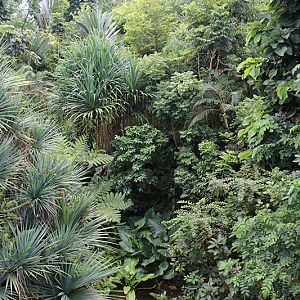
Reducing the tropical forests matchup to a matchup of Masoala vs. Bush doesn't do either zoo justice.
Zurich has the following pertaining to the three categories:
Tropical forests
- 'Masoala'
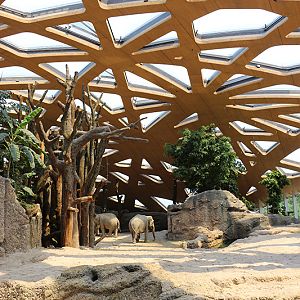
- The 'Kaeng Krachan' elephant house
- The 'Sangay' cloud forest spectacled bear enclosure
- The open flight section of the Exotarium with south american birds
- ca. 2/3 of the terrarium section of the Exotarium
- three very large multistorey and densely vegetated indoor enclosures for the three callitrichidae species in the Exotarium, also housing birds (e.g. helmeted currasow)
- all current 'research stations' in the Exotarium save the one for endangered Madagascan fishes do research on tropical forest species (poison dart frogs & mantella, day geckos, leaf cutter ants, blue/manga giant stick insect / achrioptera manga, )
- The walk in rainbow lorikeet aviary
- The 'Insect Forest' walkthrough insect enclosure in Panthera
- Many active conservation partnerships with tropical forest reserves, notably Masoala, Kaeng Krachan, PanEco in Sumatra, Amphibian Survival in Colombia, and Ndoki Forest in the Congo.
- Many active research projects and partnerships in this area.
Ectotherms
- in Masoala
- panther chameleon (free ranging)
- giant day geckos / phelsuma grandis (free ranging)
- two species of leaf tail geckos / uroplatus (free ranging)
- Aldabra giant tortoise (only non-free ranging species in Masoala)
- further, less prominent reptile species (tortoise, turtles, lizards)
- tomato frogs (free ranging)
- The terrarium section of the Exotarium with a focus on endangered species in excellent terraria including a large and varied collection of day geckos and poison dart frogs
- The aquarium section of the Exotarium with two large and excellently executed coral reef aquaria, a giant open-topped mangrove aquarium with varying tide/water levels and multiple sweet-water aquaria focussing on madagascan fishes
- critically endangered Madagascan fishes including research on and active ex-situ breeding
- in the Masoala ponds (hardly visible)
- exhibited in the Exotarium's aquarium
- exhibited in one of the active research stations in the Exotarium
- The Galapagos house and outdoor enclosure for Zurich's famous breeding group of Galapagos giant tortoises.
- A large and beautiful enclosure for Exuma island iguana and a terrarium for Savu python in the Australia house.
- A large room-sized terrarium for giant plated lizard and pancake tortoise in the kopje section of the Lewa savannah.
- The 'Insect Forest' walkthrough insect enclosure in Panthera
- orange-spotted snakehead (and carp) in the elephant pool/aquarium, vampire crabs, stick insects, and black breasted leaf turtle in terraria in the elephant house
- large native insect exhibits, educational displays, and insect hotels in front of the insect forest in Panthera, the Australia house and the rainbow lorikeet house
- colony of wild local lizards scattered across the zoo
Birds
- 18 species of free raning birds in Masoala
- The open flight section of the Exotarium with south american birds and the birds in the callitrichidae indoors enclosures of the Exotarium
- the scarlet ibis aviary in front of the Exotarium
- breeding groups of king pengiun and Humboldt penguin sharing enclosures in a summer/winter - indoor/outdoor rotation
- The walk in rainbow lorikeet aviary
- four large forest aviaries at the top of the zoo with Egyptian vultures, bald ibis, eurasian spoonbill, and ural owl
- cape ostrich and helmeted guineafowl in the Lewa savannah
- Emu in a walk-through enclosure with no barriers in the Australia section
- grey parrot in a large walk-through aviary in the Lewa savannah
- Bali myna and crested partridge in the aviary and red junglefowl free ranging in the Kaeng Krachan elephant house.
- Greater rhea in the south american camelid enclosures at the top of the zoo.
- red pileated finch in the Galapagos house
- Eurasian geese and ducks in the 'Selenga' wetland enclosure together with the Chile flamingo that are temporarily housed there during the construction of the 'Pantanal' aviary.
- domestic birds in the zoolino children's zoo
- a large breeding colony of wild storks (over 25 nests) scattered over the zoo from 'Selenga' wetlands through to the 'Kaeng Krachan' elephant enclosure that played an important role in the successful reestablishing of wild storks in Switzerland.
- Indian peafowl free ranging throughout the zoo
The Masoala tropical forest hall, the Kaeng Krachan elephant park, the Lewa savannah, and the Sangay cloud forest for spectacled bears and coati are considered by many to be
the best enclosures or enclosure complexes of their kind anywhere. The terraria and aquaria but also the small primate indoors housing in the Exotarium are also often mentioned as ranking among the highest quality enclosures of their kind. Zurich is also unique in the number of direct encounters with animals it enables with no-barriers enclosures such as Masoala, numerous walk-through and walk-in enclosures (emu and rainbow lorikeet in Australia, insect forest, south american flight hall, elephant house etc.), as well as free ranging and wild animals across the zoo (stork, peafowl, local lizards). In addition to the famous 'big-hitter' exhibits, there are many small to mid-sized exhibits of generally very high quality and where the zoo is piloting out highly innovative concepts such as the research stations, the emu walkthrough or the insect forest.
Never having visited Burger's, it would be interesting to learn, what the zoo has to offer pertaining to the three categories of this match. As I understand it, the Bush applies as does the ocean and at least partially the mangrove since it is also a butterfly house. However, I am unsure whether this is sufficient to beat the diverse, innovative and consistently (very) high-quality of Zurich in this match.

 which I personally do think is inferior to Bush, but I know a lot of people differ on this point.
 [URL="https://www.zoochat.com/community/media/masoala-hall.269460/"]