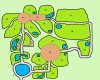
Right, here is my attempt at a Chinese/Japanese area for this cat challenge. I hope it all complies to the rules, if there is anything wrong just make a quick mention and I'll try to tweak it to fit

.
Oriental Gardens
The visitor enters the Oriental Gardens via a gravel pathway that leads under a series of bamboo arches, with many oriental grasses and plants growing on either side. Soon, the visitor appears at a small clearing (still surrounded by the amazing amount of foliage). In this main section of the actual garden there are several potted-plants, a water feature, several chinese dragon statues and a statue of Buddah meditating beneath a large, elegant archway. There are also three-four benches surrounding a large pond filled with
Koi Carp (Cyprinus carpio).
As the visitor moves further into the gardens, they will see a medium sized enclosure to their left for 2.4
Asian Small-clawed Otter (Aonyx cinerea). As they move alongside the glass-viewing for the otters (including a small portion of underwater viewing), the visitor crosses a small stream via a small, wooden bridge. This stream connects the main otter enclosure to a smaller enclosure on the right-hand side of the footpath. The secondary enclosure is usually opened out (thus making one large enclosure), however there are gates in place to seperate the enclosures, allowing for isolation, quarentine and breeding (keeping mum and pups seperate). Indoor accomodation for the otters are small, off-show huts that are lined with straw/hay for bedding. There are several large boudlers and branches to allow the otters different levels of elevation, there is a large, natural pool and streams for swimming (the otters are sometimes fed with lure bouys (disguised to look like rocks or plants). This makes the otters work to get the fish/shellfish out of the netting whilst underwater. Shellfish are also scattered on the bed of the pool and occasionally ‘buried’ under mudpiles so the otters must locate them. There are also many loose pebbles to for the otters to play with, use to open shellfish. The exhibir is altogther well planted with reeds and grasses, and there are several hollow logs where the otters can hide away.
Further along the path, the visitor arrives at the Chinese Wetland Aviary (which they will see to their left just below and opposite the next aviary). This large aviary features a large pond in the centre, and is heavily planted with reeds and grasses. Species in the aviary are 1.1
Chinese Pond Heron (Ardeola bacchus), 2.2
Chinese Egret (Egretta eulophotes), 3.3
Whooper Swan (Cygnus cygnus) and 3.3
Mandarin Duck (Aix galerriculata). Located in the centre of the pond are two small islands that can be used by the birds to ‘hunt’ fish that are scattered into the water. Within the aviary are several sites where the birds can build nests and there are small floating rafts in the pond. For visitors there is also a hide to observe the birds at closer range.
On the opposite side of the path (and slightly higher situated) is a slightly smaller aviary (Chinese Gamebird Aviary). This has many plants and trees, as well as a rocky wall running up the back of it. This wall has several holes at different levels that lead into the indoor shed behind. This shed is split into two halves by a wooden board; one half has a viewing window whilst the other is off-show. The aviary itself also has several rocks and shrubs that can be used for hiding etc. This aviary holds 1.1
Chinese Bamboo Partridge (Bambusicola thoracicus), 1.2
Cabot’s Tragopan (Tragopan caboti), 1.1
Chinese Monal (Lophophorus lhuysii) and 2.2
Golden Pheasant (Chrysolophus pictus).
Moving further on along the gravel path, the visitor arrives at the entrance to the Oriental Cat Breeding Facility. There are six enclosures within this facility, with two species having three enclosures each. The first enclosures are two large ones on either side of the path leading to the entrance, with the left-hand enclosure stretching into a small area of woodland. There are also raised platforms for rest etc, as well as areas of long grass for privacy. The only viewing available here is the glass window that runs along one side of the enclosure, with the rest of it hidden behind the gardens. Although each species of cat rotate between their two main enclosures, this is usually home to 0.2
South China Tiger (Panthera tigris amoyensis). On the other side of the path is a similar sized exhibit for 1.1 of the tigers (this is the main ‘breeding enclosure’). This exhibit is planted with tall oriental grasses and has many boulders, trees and elevated platforms for the tigers, as well as a variety of enrichment devices. It also includes a small pool. Otherwise, both exhibits are similar. Both enclosures have on-show indoor areas as well as off-show dens. There is also an off-show exhibit for the tigers that can be used for quarentine, seperation and a mother with cubs. Inside the facility is indoor viewing for the tigers, as well as several interactive displays and information boards.
Going through into the next room, the visitor comes across the indoor enclosures for 2.2
Asian Golden Cat (Pardofelis temminckii). These are kept in two 1.1 pairs, and there is also an off-show exhibit for the same purposes as the S.C Tiger off-show exhibit. The exhibits here are quite lush with plants and trees, otherwise they are similar to the tiger exhibits (though a little smaller).
After leaving the facility via the exit, the visitor is put on a fresh path that leads past two paddocks (one on each side of the path). The northern paddock is a large Chinese Woodland, and houses 2.3
Golden Snub-nosed Monkey (Rhinopithecus roxellana), 4.4
Reeve’s Muntjac (Muntiacus muntjak), and 3.3
Pere David’s Deer (Elaphurus davidianus). There are plenty of trees within the enclosure (as well as several ‘open’ areas). Trees have ropes connecting them for the monkeys to climb around on, as well as ‘tree-houses’ and other climbing structures. This enclosure is netted to prevent monkeys escaping. They also have scatter feeds and feeder balls for enrichment. There are off-show stables for the deer and an off-show indoor enclosure for the monekys.
The southern paddock is a Japanese Paddock, and is designed in a similar way. However, there is also a large rock pile for the animals to climb around on and a heated pool for 2.3
Japanese Macaque (Macaca fuscata). The other species in this paddock are 2.2
Japanese Serow (Capricornis crispus), and 3.4
Sika Deer (Cervus nippon).
Continuing along the path is an aviary for 1.1
Red-crowned Crane (Grus japonensis) and 1.1
White-naped Crane (Grus vipio). This is heavily planted in a similar manner to the other enclosures.
The next breeding facility in the Oriental Gardens is for 2.1
Giant Panda (Ailuropoda melanoleuca). Each panda has its own enclosure, which is very heavily planted with bamboo and large rocks and poles for climbing. There are also elevated platforms and cubbing dens. A fourth enclosure is off-show for the usual reasons. The reason for the second male is to promote natural competition behaviour that [in theory] may encourage the males to breed with the female.
Along the path leading back to the first part of the garden (koi pond) are enclosures for 1.1
Raccoon Dog (Nyctereutes procyonoides), 1.3
Wild Boar (Sus scrofa) and 4.8
Japanese Quail (Coturnix japonica) (two enclosures). These enclosures are all of a good size and all allow for natural behaviour via enrichment devices.
----------------------------------------------------------------------
So, I think I have everything.
2 cats: South China Tigers, Asian Golden Cats
1 bear: Giant Panda
Mixed Exhibit 1 (3 or more): Golden Snub-nosed Monkey, Reeve's Muntjac, Pere David's Deer
Mixed Exhibit 2 (3 or more): Japanese Macaque, Japanese Serow, Sika Deer
Mixed Exhibit 3: Chinese Pond Heron, Chinese Egret, Whooper Swan, Mandarin Duck
Mixed Exhibit 4: Chinese Bamboo Partridge, Cabot's Tragopan, Chinese Monal, Golden Pheasant
Mixed Exhibit 5: Red-crowned Crane, White-naped Crane
Seperate Exhibits: Asian Small-clawed Otter, Koi Carp, Wild Boar, Japanese Quail, Raccoon Dog.
Attatched Map Key:
1. Oriental Garden
2. Koi Pond
3. Asian Small-clawed Otters
4. Asian Small-clawed Otters
5. Chinese Wetlands Aviary
6. Chinese Wetlands Hide
7. Chinese Game Aviary
8. Chinese Game Aviary (indoors)
9. South China Tigers
10. South China Tigers
11. Oriental Cat Breeding Facility (South China Tigers)
12. South China Tigers (off-show)
13. Oriental Cat Breeding Facility (Asian Golden Cat)
14. Asian Golden Cat
15. Asian Golden Cat
16. Asian Golden Cat (off-show)
17. Chinese Paddock
18. Japanese Paddock
19. Crane Aviary
20. Giant Panda
21. Giant Panda
22. Giant Panda Breeding Facility
23. Giant Panda (off-show)
24. Japanese Quail
25. Wild Boar
26. Raccoon Dog
27. Japanese Quail