Mammal enclosures with natural barriers

Do you think natural barriers are worth it?

  • Yes, I think natural barriers are worth it

  • No, I do not think natural barriers are worth it


Results are only viewable after voting.

animalszoos

Well-Known Member
5+ year member
Do you know of any mammal enclosures in zoos with completely natural looking barriers?
By natural looking barriers, I mean:
- Moats (dry and wet)
- Walk-through (such as lemur and squirrel monkey walk-through's)
- Natural fences (such as large rocks, vertical logs or bamboo etc.)
(for example)
What animals do you think could have these natural barriers?
I think walk-through aviaries for squirrels, marmosets, meerkats, lemurs and other small primates would work.
Moats might work with ungulates, monkeys, apes and small carnivores such as binturongs and civets.
Natural looking fences would probably have to act as a natural safety barrier if there was a moat.

I do not mean:
- The ones listed above with a safety barrier (unless natural such as large logs, rocks etc.)
- Chain or other unnatural looking fencing/barrier such as glass or farmyard fencing
- Bridges (unless they are natural (like Antwerp's' lions), without unnatural fencing)
etc.

For example, imagine Cincinnati zoo gorilla enclosure without the fence and instead large natural looking rock boulders or no additional barrier at all.
Or Singapore Zoo's tiger enclosure without the fence.

In my opinion, Singapore tigers and Cincinnati gorilla enclosures without fences would be an idiotic idea, but I think Antwerp lions and Valencia's gorilla enclosures are great.
bioparc-valencia-17%25255B3%25255D.jpg

This enclosure (Bioparc Valencia: The Immersive Zoo | Amusing Planet) in Bioparc Valencia is completely natural looking as there is no chain fence, glass etc. (or at least in this part of the enclosure)
Or the Antwerp zoo natural rock sculptured bridge in the lion enclosure is a natural barrier.
Singapore zoo also has a zebra enclosure with plants and I think a dry moat in between.
Do you know of any others that are similar to these?
These natural looking barriers are nice, but not suitable for some of the public who might climb over them.

And the poll:
Do you think natural barriers are worth it?
Worth it
covers:
- Worth the safety risks?
- Worth the animals' welfare?
- Worth being able to see the animal not behind actual bars?
- Worth the cost?
(for example)
 
Last edited:
I think they are worth, particularly because they will pay off due to greater attendance in visitors numbers. They worth also the animals welfare and worth being able to see the animal not behind actual bars.
Also I think that Valencia bioparc, is one of the most attractive concepts for zoos world wide, and I don't know for simmilar designed zoo in Europe (except isolated enclosures, but not whole zoo). And I am happy that I am gonna visit Valencia bioparc this month. :)
 
Last edited:
Provided that they provide safe protection for both animals and the visiting public then I can't see any downside to natural looking barriers. Some might even be cheaper than conventional bars and cage based enclosures.

The ability to view animals without bars is a big thing, especially in this day and age where nearly everyone has a camera on them. Being able to see visually and take photos of animals without bars/wires in the way is a huge boon.

It means that people get a more friendly feeling connection to the zoo and the zoo can start to lose that "everything in cages" feeling to it - even if the enclosures are of a similar size. Don't forget that animal expressions are often very simply understood by most people (if at all). As a result an animal can appear sad very easily, esp if they are leaning up against the cage. Suddenly people can interpret that as cruelty. Take that away and the same expressions can be interpreted in different ways.

As someone who visits zoos with a camera I vastly prefer the chance to take photos without the wire/bars in the way.


Note I would class walk-through enclosures (eg lemur/red squirrel) kinds where there is no barrier between animal and person as a different category.
 
There is another option, of course: glass or plexiglass barriers. While they are the most expensive (and can raise additional issues of reflections on the glass) they bring the visitor closest to the animal both in terms of visibility and actual distance. Of course sometimes (as in LZS gorilla exhibit) that is not a good thing
 
They are worth it but not always the best, remember for vertical climbers mesh and even bars are better because they increase substrate for movement.
 
Seal very true, but flip that around; there's more to climb but more to make it look like they are trying to escape from the cold cruelty of captivity.

Plexiglass is a good option, but you've got to send someone around to clean it regularly. Both inside and out as it can quickly get very dirty on both sides.
 
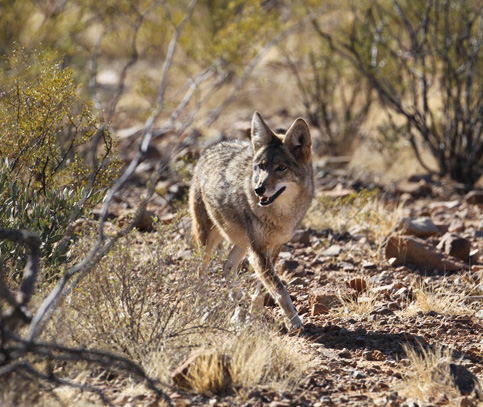
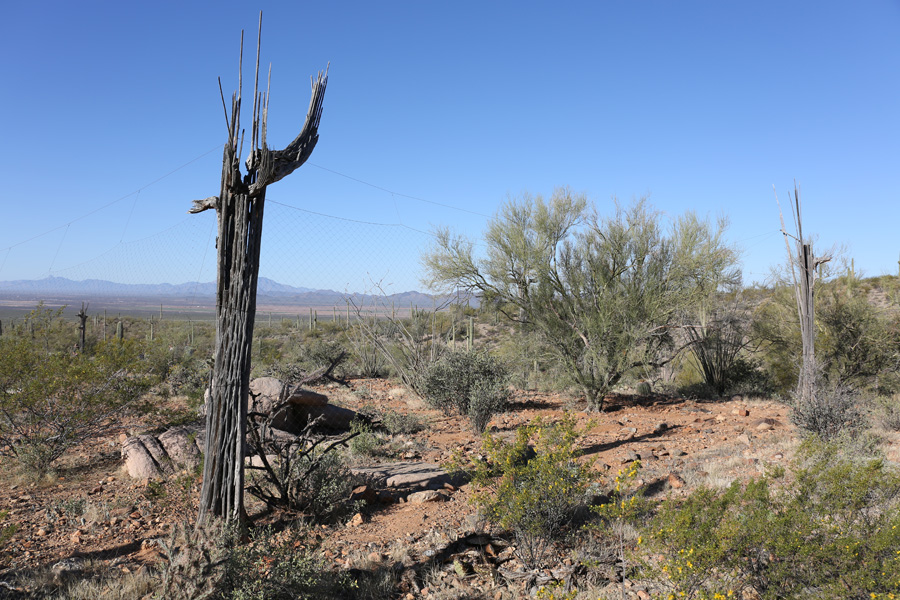
As a photographer I love open, natural looking barriers. My local Arizona Sonora Desert Museum has long been an innovator in this regard. Their coyote exhibit uses Invisinet which they designed. It is a fine mesh fence that is so thin it is practically invisible. It is connected to poles shaped like dead cactus so the effect is impressive. I am surprised they have not sold this to other zoos. However I guess it won't work for some animals. Originally they had it in the javelina exhibit as well, but after several years they had to replace it with a thicker mesh fence (which sadly is quite visible).

 
As a photographer I love open, natural looking barriers. My local Arizona Sonora Desert Museum has long been an innovator in this regard. Their coyote exhibit uses Invisinet which they designed. It is a fine mesh fence that is so thin it is practically invisible. It is connected to poles shaped like dead cactus so the effect is impressive. I am surprised they have not sold this to other zoos. However I guess it won't work for some animals. Originally they had it in the javelina exhibit as well, but after several years they had to replace it with a thicker mesh fence (which sadly is quite visible).


Does anyone else know of zoo enclosures using Invisinet?
How safe is Invisinet and how much does it cost?
 
Does anyone else know of zoo enclosures using Invisinet?
How safe is Invisinet and how much does it cost?

Invisinet has been used at other zoos for 20 years. It is made in a variety of sizes and strengths.
The lightest ("Zoomesh") is perfectly safe for most birds, small mammals, small reptiles. The heaviest has been used with Siberian tigers at training windows.
I can't quote cost but it is not inexpensive and there must be a structure strong enough to support it.. Every week I get emails from assorted manufacturers in China offering some version of it.
It can be easily damaged by falling trees or even if live trees within the structure are allowed to grow too large
 
The one at use at Desert Museum is their own design and is the thinnest I have seen - off the top of my head I do not recall seeing it anywhere else. So I am not sure the specific version I am referring to is the same as the general category of this type of thing that Zooplantman refers to. The one Desert Museum invented has certainly been around less than 20 years. When they first came up with it, they had it manufactured by prisoners at one of Arizona's prisons (which made labor quite cheap obviously). I have not heard that since it first came out years ago so I do not know if that is still the case.
 
I am often wondering why certain things are common only in American zoos and not European or vice versa. Invisinet, glass-fronted outdoor exhibits for big mammals and giraffe feeding in America, lemur walk-throughs in Europe.
 
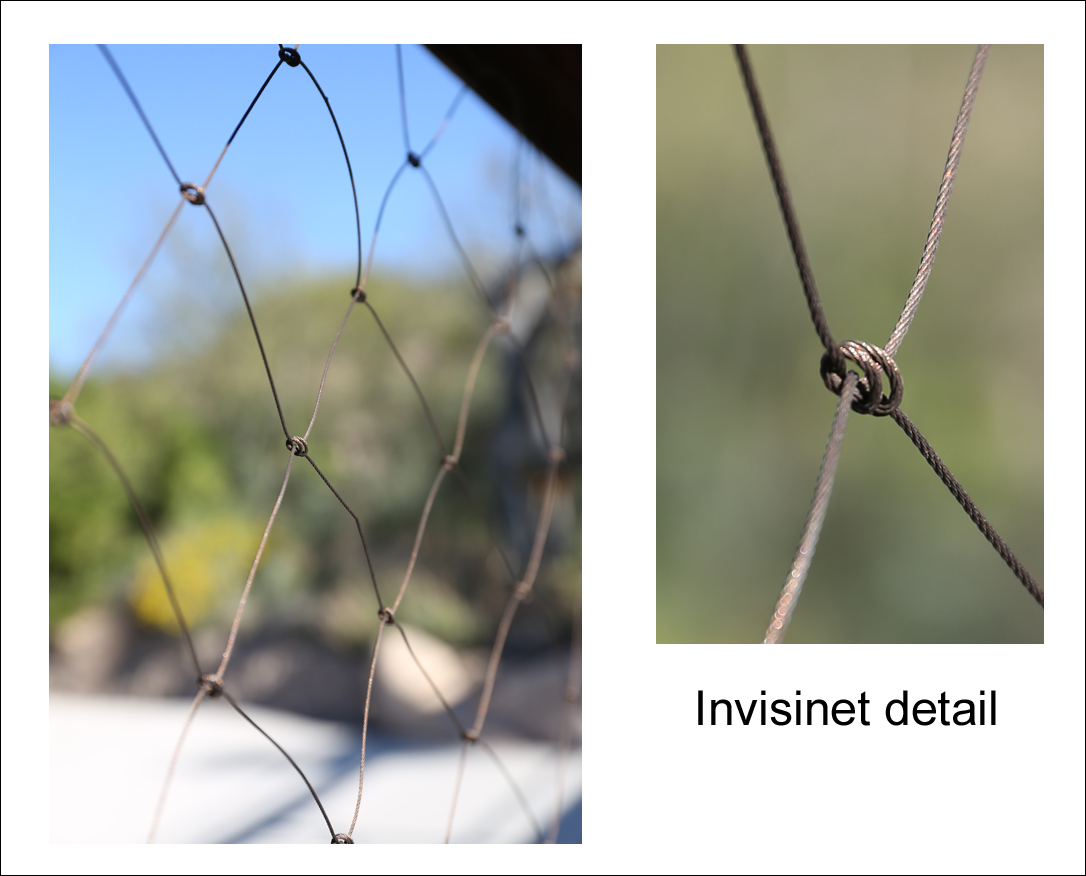
As promised, here you go. The first photo is a wide angle view of the top of the coyote exhibit, which shows just how invisible the thin fencing can be. The second photo is a closeup of a section of it used on the walkway that leads down to Desert Loop Trail. The left half is the photo as taken (up close) and the right half is the center section of that photo cropped in to show detail.
 
In retrospect, I just now realized I should have held my finger next to the Invisinet to show just how thin it is. But it is very, very thin.
 
As a photographer I love open, natural looking barriers. My local Arizona Sonora Desert Museum has long been an innovator in this regard. Their coyote exhibit uses Invisinet which they designed. It is a fine mesh fence that is so thin it is practically invisible. It is connected to poles shaped like dead cactus so the effect is impressive. I am surprised they have not sold this to other zoos. However I guess it won't work for some animals. Originally they had it in the javelina exhibit as well, but after several years they had to replace it with a thicker mesh fence (which sadly is quite visible).


In retrospect, I just now realized I should have held my finger next to the Invisinet to show just how thin it is. But it is very, very thin.

I LOVE the Invisinet used at the Arizona-Sonora Desert Museum. As AzDocent pointed out and showed in his photos, it's practically invisible when taking pictures. I wish more zoos used it.
 
The one at use at Desert Museum is their own design and is the thinnest I have seen - off the top of my head I do not recall seeing it anywhere else. So I am not sure the specific version I am referring to is the same as the general category of this type of thing that Zooplantman refers to. The one Desert Museum invented has certainly been around less than 20 years. When they first came up with it, they had it manufactured by prisoners at one of Arizona's prisons (which made labor quite cheap obviously). I have not heard that since it first came out years ago so I do not know if that is still the case.
it was invented by the ASDM in 1996, so just over twenty years. They patented it and several different versions were developed. All are "Invisinet".
 
Back
Top