Mr Gharial's species research

Mr Gharial

Well-Known Member
5+ year member
Have you ever made a fantasy zoo and realized halfway through that you've missed a species that you wanted to include? Or worse, only realized this afterwards?

Do you want to make a new fantasy zoo and you're having trouble researching which species you can include?

Well look no further than Mr Gharial's species research thread!

Mr Gharial (that's me!) is a psychopath who clearly has nothing better to do with his life than spending his hours scrolling through Zootierliste and Zoochat looking into which species would be available for his next fantasy zoo project.

Now, Mr Gharial is putting his time to good use (well, a slightly better use). By helping YOU with finding out which animals would be available for YOUR next zoo!

Mr Gharial is going to stop talking in the third person now...

Now regretfully I've done this before and forgot to include all regions (I was specifically looking into Caribbean and Madagascar animals, and I didn't think it important to write down all other regions or the animals that inhabited it). So how does this work? I scroll through ALL of Zootierliste and see which animals are realistically available in European zoos. While I do this, I also organise these animals into continents and regions. So by the end of it, I'll have a species list of every region in the world for you to use!

There are some downsides to this of course. The first being that this only showcases animals in European collections. ZTL has gone worldwide, but the American collections aren't near fully developed enough to make an American-based version of this.
Another downside to this is that I am bound by the limits of Zootierliste. And I can only see vertebrate animals and if an animal is readily available in the private trade but rarer in zoos, I wouldn't know.
For some areas, more invertebrates are included, as I've either done more research into it for previous projects, or I've visited zoos themed around this area that included more invertebrates. But other than that, help and additions are greatly appreciated!

Now I can only start uploading these AFTER I've finished scrolling through all of ZTL, so this project will be partially delayed. Though I can upload the first selection early because I did a lot of previous research into it.

Finally, my continents and regions may be questionable, and are more based on biomes and mountains than countries and continental plates.

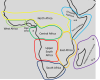
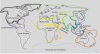
Here's my division of the continents for this project:
Continents.png

Oceans will also be included, but I'll have to look at trends in the distribution maps to find out how I'm going to divide the ocean.

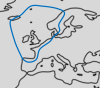
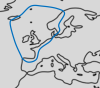
The one region I did finish (and also the region that includes the most included invertebrates) is the North Sea and the Bay of Biscay:
North sea plus.png

The first region will be uploaded somewhere this week, and I'll continue to look through Zootierliste for, well, a month or two probably. I'm currently going into the Carnivores so I'm halfway through the mammals.

Some notes:
There are some animals present in captivity that I won't include, like Octopuses (who, to my knowledge, don't reproduce in captivity and are always wild-caught) or Whales (which are very unethical to keep in my eyes and are on their way out in captivity).
There are a few animals for which I'll include additional information (Like the European eel which doesn't reproduce in captivity, but can still be kept ethically, which I'll go into a little further later).

Of course, I'll still make mistakes. I'm only working with the information present on ZTL, including how many animals a collection has. For example, there are a lot of rare species that only have one holder, but that holder might have a group of over 200 animals, so I'll include it in the list. But if group size isn't included on ZTL, then I won't include it because the collection might only have a single individual. If you see a species missing that you think would be available in a new zoo, feel free to correct me. And on other things too, of course.

I also won't be including import animals. Those familiar with my project will know I usually include some animals not or rarely present in European collections if there's proof of these animals being imported from other countries. So the Chinese pangolin, for example, isn't included even though I would consider importing them from Taiwan "realistic"

I hope I've cleared everything up going into this project but if there are still any questions feel free to ask them! Hopefully this will become a good resource for all Fantasy-zooers.
 

Attachments

  • Continents.png
    Continents.png
    357.3 KB · Views: 719
  • North sea plus.png
    North sea plus.png
    305.4 KB · Views: 7
Very, and I mean VERY, excited for this thread even as someone based in North America. I am currently revamping my current spec zoo (and semi-actively seeking species unique to NA that may be realistically imported)... whilst finishing the writeups of the original plan with which my thread is connected. Whether I will post the revamp is entirely up in the air... anyway, this should be a very useful fountain of information for myself and other members of the spec zoo design community.
 
I'm now well into the carnivores and I'm noticing a few more 'flaws' in this plan. But this mostly comes down to details and nuance.

Firstly, for some species I'm noting down subspecies distribution rather than full species distribution. For the Pallas' cat and Golden jackal, for example, only the Siberian Pallas' cat and European golden jackal are held. The European golden jackal only occurs in Asia minor and the Balkans. And the Siberian Pallas' cat only occurs in and around the Goby desert. However, you can always include these species in regions that their non-subspecific regions. The Pallas' cat is a stable for the Himalayas, for example, but I didn't include it there because it technically doesn't occur there.

For some species I'm also including only subspecies, even though the non-subspecific are also readily held in captivity. So I'm including the Amur and Sumatran tiger, but not the Tiger with no Subspecies status. In other cases I am including both, like the the Binturong and the Palawan binturong.

I also won't include extinct distributions. So the European brown bear or European mink aren't included in Central Europe because they don't occur here anymore. Again, it's more nuanced than what I'm presenting so I highly suggest looking into the distribution yourself too so you can get the full picture.

Secondly, for all 'continents' I'm also including a list for animals that occur in all (or at least the majority) of the selected regions. This also lacks some required nuance. For example, the Typical striped grass mouse occurs on the borders of tropical Africa:
Africa 1.png
^ my division of Sub-saharan Africa
Striped grass mouse.png
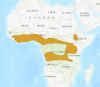
^ distribution of the Typical striped grass mouse.

As you can see, it technically occurs in North, West, Central, East AND Upper south Africa, as well as the Ethiopian highland and the Niger delta. So I put it in continent-wide even though it really only occurs on the borders.

In all cases, look into the species yourself and don't treat this thread as some sacred guideline. A lot of species may only be in or out of a region on a technicality. Look at neighbouring regions to be safe and look at non-subspecific animals to be safe.

Very, and I mean VERY, excited for this thread even as someone based in North America. I am currently revamping my current spec zoo (and semi-actively seeking species unique to NA that may be realistically imported)... whilst finishing the writeups of the original plan with which my thread is connected. Whether I will post the revamp is entirely up in the air... anyway, this should be a very useful fountain of information for myself and other members of the spec zoo design community.

Very happy to hear the interest is there! Though I should add that for most of these species, I'm counting what would be realistic for a European zoo. An animal like an Emu or Capibara is easily available for any European zoo and could be transported to other continents with no issues, but that's not the case for all the animals I'm including.

Example: the Spanish red deer is only held in Spain and Portugal. But there are enough of them in Iberian zoos for me to say it would be realistic to get this subspecies into Central European zoos. But it would be much less realistic to get this rarer subspecies into American collections.


What I'm trying to say is: Take all of this future thread with a few grains of salt
 

Attachments

  • Africa 1.png
    Africa 1.png
    430.6 KB · Views: 51
  • Striped grass mouse.png
    Striped grass mouse.png
    847.8 KB · Views: 45
Last edited:
Alright, now it's time for some audience participation! I've just finished going through all the mammals and I noticed a few missing animals. That's when I remembered that domesticated animals exist, and that's where the Camel, Yak and Water buffalo are located.

I was originally not going to include domesticated animals, but that's before I realized that.

Now, domesticated breeds are way too difficult to look into, so I'm asking you guys for help. So far all I can think of is:

- Domestic yak (Himalayas/Tibetan plateau)
- Domesticated Bactrian camel (Gobi desert)
- Domesticated dromedary (Sahara, Arabia, West Asia, Horn of Africa)
- Domesticated water buffalo (Mainland SEA and India)
- Heck cattle (All of Europe) (Recreation of the extinct Aurochs)
- Heck horse (Eastern Europe, Siberia) (Recreation of the extinct Tarpan)

I also might include Zebu for India, Scottish highland cattle for Central Europe and Ankole cattle for East Africa. Are there any other domesticated animals you guys feel like I should include?
 
is this a thread where i can ask for help on species choices for specific areas??

In the future: Yes. The species lists for the regions should be available eventually, but I'm currently still combing through all that should be available.

I'm currently through all the mammals, and I'll be starting on birds soon. I'll also be visiting some private collections and going past pet shops to get some additional non-ZTL info.

Mammals took me about a week, and they're the second smallest group on Zootierliste. So if may be about a month or two until the full list will be available
 
In the future: Yes. The species lists for the regions should be available eventually, but I'm currently still combing through all that should be available.

I'm currently through all the mammals, and I'll be starting on birds soon. I'll also be visiting some private collections and going past pet shops to get some additional non-ZTL info.

Mammals took me about a week, and they're the second smallest group on Zootierliste. So if may be about a month or two until the full list will be available
Will sections of this list be released at different times or all at once when the full list is completed?
 
Will sections of this list be released at different times or all at once when the full list is completed?

The lists should all be done at the same time, because ZTL works alphabetically and not regionally. But they probably won't be released all at once. I'll probably still do some cleanup and I'll have to type them out while still making them look tidy. They'll be released over the span of a few weeks (probably one or two a day)
 
Another update: I'm sometimes not including subspecific animals if the non-ssp animal occurs in the same region. I'm not including the Red-necked Sulawesi ground-dove (Gallicolumba tristigmata bimaculata) because the Sulawesi ground-dove (Gallicolumba tristigmata) occurs only on Sulawesi, subspecies included.

In the opposite case, if a region includes a specific subspecies, I won't include the non-ssp animal there. Like the Rock pigeon, which is included in West Asia and the Sahara as the non-ssp animal, but not in Europe. While the Western rock pigeon is included in Southern Europe, but not in the Sahara or West Asia.

Sometimes, multiple subspecies will be included. Like the Scottish red deer and the Central European red deer (both in Central Europe), because they occur in different areas within the region.

Finally, sometimes both ssp and non-ssp will be included in the same region if the ssp occurs only in a specific area of that region. There aren't any examples of this yet, but it could happen for, for example, the Korean ring-necked pheasant and the non-ssp ring-necked pheasant both in Central China (Korean rnp for Korea, and the non-ssp for non-peninsular China), or the Taiwanese Reeves' muntjac and non-ssp Reeves' muntjac both in Southern China (Taiwanese for Taiwan and non-ssp for mainland China). Neither of these are included because these subspecies don't have enough holders for me to include them, but I can't find any other examples so far.


Finally, a question for you guys: Should I start uploading the North Sea/Bay of Biscay list now, with only fish, seals and sea turtles? Or upload it after I've finished the birds, and include sea- and shorebirds.
 
Finally, a question for you guys: Should I start uploading the North Sea/Bay of Biscay list now, with only fish, seals and sea turtles? Or upload it after I've finished the birds, and include sea- and shorebirds.

Personally I think it would be worthwhile to wait for the list including the birds, given that this region has quite a few interesting sea and shorebird species.
 
I'm currently putting the North sea / Bay of Biscay list together, and it should be out in an hour or so.

I should warn you: I've organised my animals more by what type of animal they are, rather than by taxonomy. So the fish are separated by Open water fish, Rock-dwelling fish and Sand-dwelling fish. As well as "oddball fish" who I couldn't really catagorise into a specific place. As I mentioned before, this list was made before I had the idea of starting this research project so it isn't as well organised or as reliable in terms of animal availability.

After I've uploaded the list: If you feel like any species are missing feel free to let me know!
 
Species list North sea and the Bay of Biscay
(Marine waters and coasts from Northern Spain to Central Norway to Iceland)
North sea plus.png

Sharks and rays:
Atlantic nurse shark
Nursehound
Small-spotted catshark
Common smooth-hound
Starry smooth-hound
Tope shark
Spiny dogfish

Common guitarfish
Blonde ray
Small-eyed ray
Spotted ray
Thornback ray
Thorny skate
Undulate ray
Common stingray
Common eagle ray

Open water fish:
Atlantic herring
European pilchard

Atlantic salmon
North Atlantic brown trout

Atlantic cod
Whiting
Pollack
Pouting
Saithe

Sand smelt

Garpike

John dory

European seabass
Atlantic wreckfish

Atlantic horse mackerel
Greater amberjack
Short dorsal fin pompano

Meagre
Brown meagre
Shi drum

Flathead grey mullet
Golden grey mullet
Thicklip grey mullet

Atlantic mackerel

Annular seabream
Axillary seabream
Black seabream
Blackspot seabream
Bogue
Common dentex
Common pandora
Red porgy
Common two-banded seabream
Gilthead seabream
Goldline
Saddled seabream
Sharpsnout seabream
Striped seabream
White seabream
Zebra seabream

Sand-dwelling fish:
Angler

Brill
Common topknot
Atlantic halibut
Common dab
European flounder
European plaice
Lemon dab
Common sole

Greater weever
Lesser weever

Rock-dwelling fish:
Fivebeard rockling
Three-bearded rockling

European eel*
Mediterranean moray
European conger

Blackbelly rosefish
Black scorpionfish
Largescaled scorpionfish
Small red scorpionfish

Grey gurnard
Tub gurnard
Longspined bullhead
Shorthorn sculpin
Hooknose
Lumpfish

European eelpout
Rock gunnel
Black-faced blenny
Butterfly blenny
Peacock blenny
Ringneck blenny
Rusty blenny
Shanny
Tompot blenny

Black goby
Common goby
Giant goby
Red-mouthed goby
Rock goby
Sand goby
Two-spotted goby

Oddball fish:
European sea sturgeon

Lesser forkbeard

Common ling

Sea stickleback
Three-spined stickleback

Longspine snipefish
Broadnosed pipefish
Greater pipefish
Lesser pipefish
Long-snouted seahorse
Short-snouted seahorse
Snake pipefish

Grey triggerfish

Comber
Dusky grouper
Painted comber

Red mullet
Striped red mullet

Atlantic wolffish

Common dragonet

Boarfish

Axillary wrasse
Ballan wrasse
Corkwing wrasse
Cuckoo wrasse
Five-spotted wrasse
Goldsinny wrasse
Grey wrasse
Mediterranean rainbow wrasse
Rock cook

Mammals and reptiles:
Atlantic grey seal
Eastern Atlantic harbour seal

Green sea turtle
Loggerhead turtle

Seaducks:
Atlantic harlequin duck
Barrow’s goldeneye duck
Eurasian goldeneye
Eurasian goosander
European eider
Long-tailed duck
Smew

Walking shorebirds:
Eurasian Oystercatcher
Black-winged stilt
Pied avocet
Common ringed plover
Northern lapwing
Black-tailed godwit
Common redshank
Eurasian curlew
Ruff
Eurasian spoonbill
Barnacle goose

Perching shorebirds:
Atlantic puffin
Common murre
European herring gull
Black-headed gull
Northern gannet
Eurasian great cormorant

Crustaceans:
European green crab
(Carcinus maenas)
Edible crab
(Cancer pagurus)
Velvet swimming crab
(Necora puber)
Spiny spider crab
(Maja brachydactyla)
Greater spider crab
(Hyas araneus)
Leach’s spider crab
(Inachus phalangium)
Long-legged spider crab
(Macropodia rostrata)

Common hermit crab
(Pagurus bernhardus)

European lobster
(Homarus gammarus)
Norway lobster
(Nephrops norvegicus)
European spiny lobster
(Palinurus elephas)
Small European locust lobster
(Scyllarus arctus)

Common prawn
(Palaemon serratus)

Pelagic gooseneck barnacle
(Lepas anatifera)

Soft-skinned invertebrates:
Common starfish
(Asterias rubens)
Common brittle star
(Ophiothrix fragilis)
Black brittle star
(Ophiocomina nigra)
Serpent star
(Ophiura ophiura)
Spiny starfish
(Marthasterias glacialis)
Cushion star
(Asterina gibbosa)
Mediterranean red sea star
(Echinaster sepositus)

Atlantic black sea cucumber
(Holothuria forskali)

Mediterranean fan worm
(Sabella spallanzanii)
Peacock worm
(Sabella pavonina)

European common cuttlefish
(Sepia officinalis)

Moon jelly
(Aurelia aurita)

Armoured invertebrates:
Common periwinkle
(Littorina littorea)
Netted dogwhelk
(Tritia reticulata)
Common Atlantic slippersnail
(Crepidula fornicata)
Common European limpet
(Patella vulgata)
Green ormer
(Haliotis tuberculata)

Blue mussel
(Mytilus edulis)
Queen scallop
(Aequipecten opercularis)
Great scallop
(Pecten maximus)
Common cockle
(Cerastoderma edule)

Purple sea urchin
(Paracentrotus lividus)
Green sea urchin
(Psammechinus miliaris)
European edible sea urchin
(Echinus esculentus)
Violet sea urchin
(Sphaerechinus granularis)

Corals and animals that aren’t corals but sure do look like corals don’t judge me:
Snakelocks anemone
(Anemonia viridis)
Atlantic beadlet anemone
(Actinia equina)
Dahlia anemone
(Urticina felina)
Plumose anemone
(Metridium senile)
Jewel anemone
(Corynactis viridis)
Yellow cluster anemone
(Parazoanthus axinellae)
Parasitic anemone
(Calliactis parasitica)
Strawberry anemone
(Actinia fragacea)

Pink sea fan
(Eunicella verrucosa)
Dead man’s fingers
(Alcyonium digitatum)

Vase tunicate
(Ciona intestinalis)


Invertebrates additional:
I've seen the invertebrates in zoos and aquariums like Aquarium de la Rochelle, Aquarium-Museum de Nancy, Ecomare, Wildlands, Fort Kijkduin and the Sea Lifes of Belgium and the Netherlands. Others are present in the ZC gallery. Because of the restrictions of ZTL and the fact that a lot of ZooChatters don't label invertebrates I have no idea in how many zoos or in what amounts these species are held. Additions are very welcome!


* = The European eel does not breed in captivity. It is a Critically Endangered migratory fish and is often wild-caught by zoos and aquariums. Keeping European eels in aquaria and allowing them to grow to breeding age before releasing them back into European waters is actually very helpful to European eel conservation.
 

Attachments

  • North sea plus.png
    North sea plus.png
    305.4 KB · Views: 11
Last edited:
With our first species list in I'd also like to encourage you all to upload photos of invertebrate animals at your zoo to the gallery, or send invertebrate species lists to my PM so I can work these into the project. Identified corals are REALLY appreciated as these are especially hard to research
 
No Razorbill, Thick-billed Murre, or Black Guillemot?

Razorbill: Held in two zoos in Europe, with a total of three individuals. Not included

Thick-billed murre: Not held in Europe. Not included

Black guillemot: Not held in Europe. Not included

I'm only counting European collections for this project. And even if I were counting American collections, none of these three would be included as these three are also only held in one or two collections there with no information on how many individuals these zoos hold
 
Razorbill: Held in two zoos in Europe, with a total of three individuals. Not included

Thick-billed murre: Not held in Europe. Not included

Black guillemot: Not held in Europe. Not included

I'm only counting European collections for this project. And even if I were counting American collections, none of these three would be included as these three are also only held in one or two collections there with no information on how many individuals these zoos hold

Hmm, I suppose that's fair.

There are some animals present in captivity that I won't include, like Octopuses (who, to my knowledge, don't reproduce in captivity and are always wild-caught)

One, that's half true as some octopi have been bred in captivity. Most places tend to not bother as octopi are prolific reproducers that only live 2 or 3 years at most. It's easier to just collect a specimen or two from the wild as need be than to spend the effort successfully raising the larvae.
Secondly, if that's your reason for not including octopi, you do realize no less than three-quarters of the list you just posted meets the same criteria?
 
  • Like
Reactions: CMP
If that's your reason for not including octopi, you do realize no less than three-quarters of the list you just posted meets the same criteria?

Well, this list is based on what species are already held in captivity and could be shipped over from other zoos
 
Well, this list is based on what species are already held in captivity and could be shipped over from other zoos

Secondly, if that's your reason for not including octopi, you do realize no less than three-quarters of the list you just posted meets the same criteria?
I think @GreatArgus is referring to the fact that most fish (And many, if not most of the other) species in captivity are raised/kept in the same way octopus are. It is much easier to source them from the wild than raise them in captivity. Many have complex life cycles and needs that are difficult to simulate in a captive environment.

As a result, a large portion of fish species and others are just sourced from nearby waters, and probably aren't too likely to be widely transferred. (Although I think MBA did source some 'deep'-water fish from Japan)

I'm really enjoying the project so far. It is something I've long thought about, so thanks for taking up this task!
 
Last edited:
Well, this list is based on what species are already held in captivity and could be shipped over from other zoos

That doesn't work when literally the only reason the majority of those species listed continue to be present due to collection from the wild. With no wild collection a large number of the species you listed would be absent in half a decade. It would be easier to breed octopi for display than trying to captive supply most of the species on your list.
You're also double-standarding yourself by saying European Eel is fine because you're re-releasing them later.
 
animals that aren’t corals but sure do look like corals don’t judge me
Well, that would be because anemones are in the same class as corals, and corals are a polyphyletic group, so no judgement, you are right in calling them corals! Same with the sea fan and dead man's fingers. Tunicates are actually chordates, but being such oddballs, it definitely makes sense to group them here with other sedentary aquatic (Practically plants) animals.
 
Back
Top