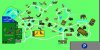
The entrance
The entrance is the first area you will see when entering this zoo. It's a fairly tall building with a round glass ceiling that lets in real sunlight. In the middle of the building is a decorated island of fake rocks and real plants, with some thicc barriers that can be used to sit on. It houses Goldfish (Carassius auratus) and Razorback musk turtle (Sternotherus carinatus). To your left is a souvenir shop in a cozy setting. To your right are toilets and some sign that explain what this zoo is and its mission (conserving and educating about biodiversity in fauna and flora). Once outside this building, you are met with a large real size model of a brachiosaurus and its young in the middle of the path. To your right, a enclosure for Eurasian otters (lutra lutra lutra) with a small underwater viewing area between fake logs.
You can now choose to go either left, or continue walking with a large glass viewing chance for the rare Black backed jakal (Canis mesomelas). From here on out your in the right park area, where you can take many different routes to see the animals you want to see. If you go forward towards the mountain area, on your left is a big aviary for the very rare Shoebil stork (Balaeniceps rex). To your right a open but lush enclosure for the Binturong (Arctictis binturong). If you wouldve gone left, you can see to your left a open but again lush enclosure for the Eastern bongo (Tragelaphus eurycerus isaaci) that lives together with Congo blue duikers (Philantomba monticola congica). To your right are two enclosures next to eachother, in which one shows the Southern cassowary ( Casuarius casuarius) and next to it a enclosure for the Parma wallaby (Notamacropus parma). At the shoebill aviary, you can also choose to go right, and you'll be greeted by a overhang, with on your left a open exhibit for the North chinese leopard (Panthera pardus japonensis). Walking a bit further is a large open viewing area for the elephant valley, home for a herd of Asian elephants (Elephas maximus). There is also a elephant house next to it, where you can see the elephants in the indoor enclosurses. In the elephant house you walk on a bridge, with under you a group of Aldabra giant tortoise (Aldabrachelys gigantea). The elephant house also has a glass roof letting through real sunrays, as there are plenty of live plants avaible, and a small water feature for African darters (Anhinga rufa). In this lushy forest are sometimes birds, lizards or other animals freeranging from other parts of the zoo if something were to go wrong (injured or pregnant) so they can keep a better eye on them. For the extremely sick or rare birds there will be a portion away from the visitors at the bird house.
Close to the elephant house is the monkey house. Here you can find large open (with real foliage) enclosures for Borneon orangutan (Pongo pygmaeus) which live together with White handed gibbons (Hylobates lar). Next to that another large open exhibit for the colourful Mandrils (Mandrillus sphinx). The last outside exhibit here will be a open lush area for Western lowland gorillas (Gorilla gorilla gorilla). Inside of the monkey house you can find all the indoor enclosures of the monkeys, and in the middle a lush island with again real plants for Emperor tamarins (Saguinus imperator). There is also a toilet avaibale in this building. Outside the building is also a small food stand a sitting area next to the outside gorilla enclosure. A little further you can find a large enclosure for the rare Sloth bear (Melursus ursinus).
The last stop in the right park area is a museum for prehistoric animals, with real skeletons, fossils and minerals from millions of years ago. There will also be lifesize as paleo accurate as possible statues of these animals. It will show some popular species like brachiosaurus, woolly mammoth, triceratops and spinosaurus, but also show and tell about other bizarre prehistoric animals.
Next up will be the mountain area.