
Cissa-thalassina
Member
Pili Palas Nature World is a small tropical zoo near Menai Bridge on the Isle of Anglesey, North Wales. The facility’s main attractions include a butterfly house, a collection of rehomed parrots, and two reptile rooms. Perhaps most interestingly to zoo-goers, the zoo participates in the red squirrel conservation programme, and houses two squirrels as part of the initiative. I visited for the first time on 23rd July 2025, and thought I’d share a few details about the facility, as well as the species list I compiled of all the animals signed or observed. A quick note that the species list will include the invertebrates on display in the dedicated ‘Bug Zone’, but not the butterflies, as there was no comprehensive signage for this area.
Butterfly House
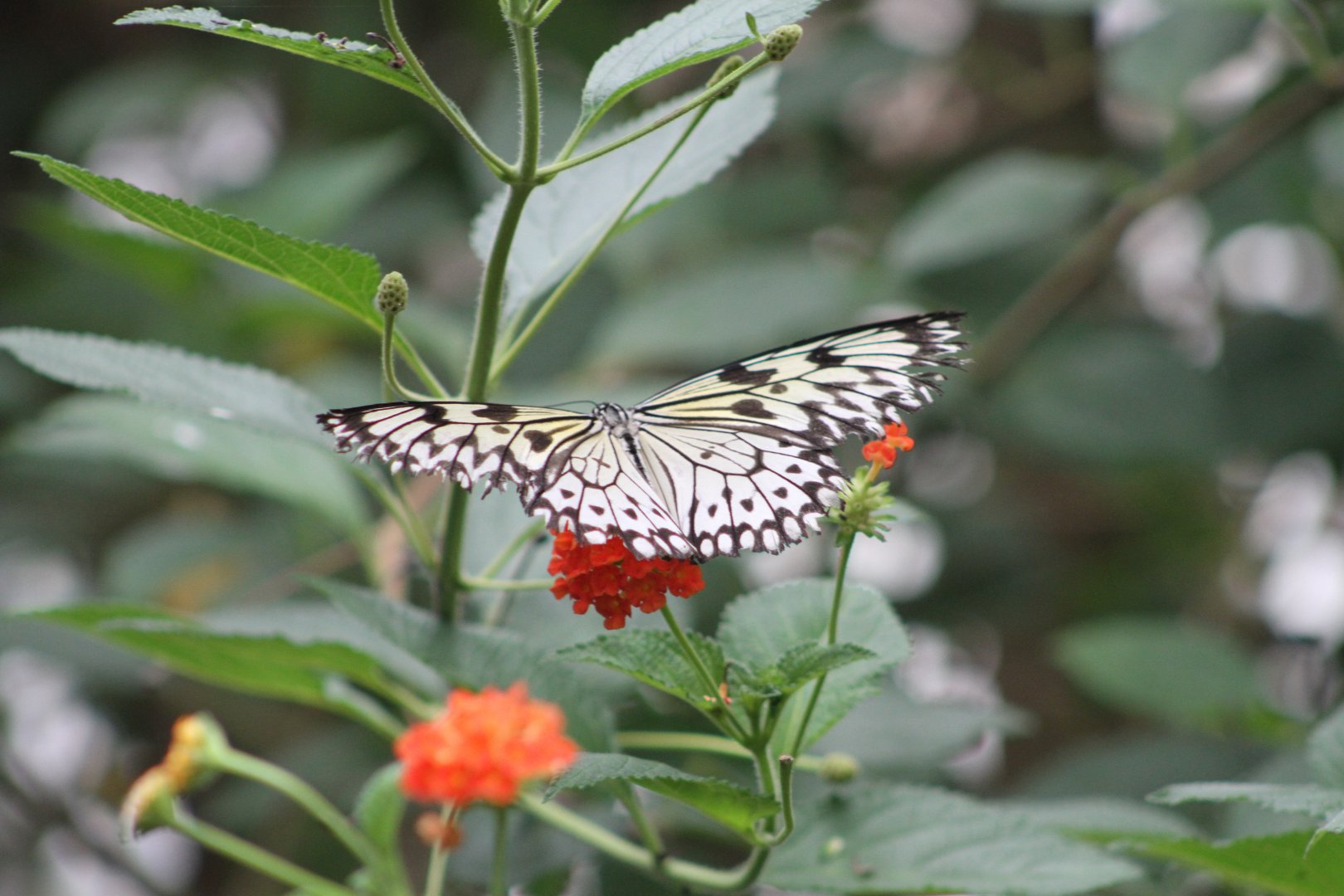
Having purchased or scanned their ticket at reception, visitors walk down a short corridor and a door to the left, entering directly into the Butterfly House. This is a standard set-up that will be familiar to those who have visited larger zoos – a lushly planted greenhouse housing a range of tropical butterfly species. There is a bridge allowing guests to traverse the winding water feature, and several doorways leading to adjoining exhibits. This area is also home to several free-flying bird species.
Zebra finch (Taeniopygia castanotis)
Common emerald dove (Chalcophaps indica)
Java sparrow (Padda oryzivora)
Yellow bishop (Euplectes capensis)
There are also multiple ponds housing koi (Cyprinus sp.).
Bird House
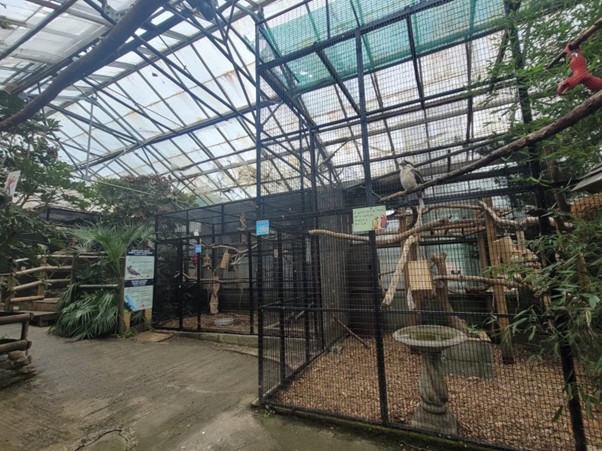
An entryway branching off from the left of the butterfly house leads to the bird house. This is a small collection of aviaries located in the same building as the aviaries. According to signage, all of the parrots on display are rehomed ex-pets. During my visit, there was also a laughing kookaburra (Dacelo novaeguineae) free-flying in this area. An African grey parrot (Psittacus erithacus) and Ducorps cockatoo (Cacatua ducorpsii) were housed together. Also on display were blue-fronted Amazon parrots (Amazona aestiva), though these were not directly visible from the bird house, and were only viewable from a door near the entrance or via the outdoor playground. Additionally, there was a small pond in the room housing yellow-bellied sliders (Trachemys scripta scripta).
Laughing kookaburra (Dacelo novaeguineae)
Blue and gold macaws (Ara ararauna)
African grey parrot (Psittacus erithacus)
Ducorps cockatoo (Cacatua ducorpsii)
Sulphur-crested cockatoo (Cacatua galerita)
Yellow-bellied slider (Trachemys scripta scripta)
Blue-fronted Amazon parrots (Amazona aestiva)
Lizard Land
Another small room branching off from the butterfly house includes walls lined with vivaria housing a small collection of reptiles. Prior to the opening of the Tropical House in 2023, this room housed the majority of the zoo’s reptile collection, now accommodating five small herp species, some of which are used as ambassador animals during meet and greets. There are multiple individuals housed in the painted agama (Laudakia stellio brachydactyla) exhibit.
Panther chameleon (Furcifer pardalis)
Painted agama (Laudakia stellio brachydactyla)
Many-coloured bush anole (Polychrus marmoratus)
Blue-tongued skink (Tiliqua gigas evanescens)
Green basilisk (Basiliscus plumifrons)
Meerkat Tunnel
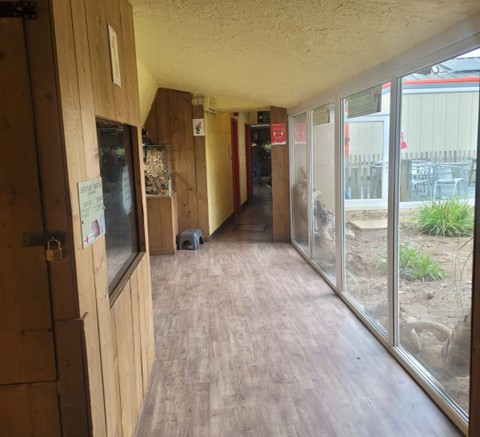
On exiting the butterfly house and its associated rooms, visitors come to the meerkat tunnel corridor. This is an indoor walkway, with the right-hand wall being entirely made up of a viewing window into the meerkat exhibit. This is a standard sandy area with burrows and vantage points. The left-hand wall is lined with three terraria housing small mammals. The first of these terraria is signed as previously housing lesser tenrec (Echinops telfairi) but is currently under maintenance. The other two house mouse species.
Meerkats (Suricata suricatta)
Eurasian harvest mouse (Micromys minutus)
African zebra mouse (Lemniscomys barbarous)
Bug Zone
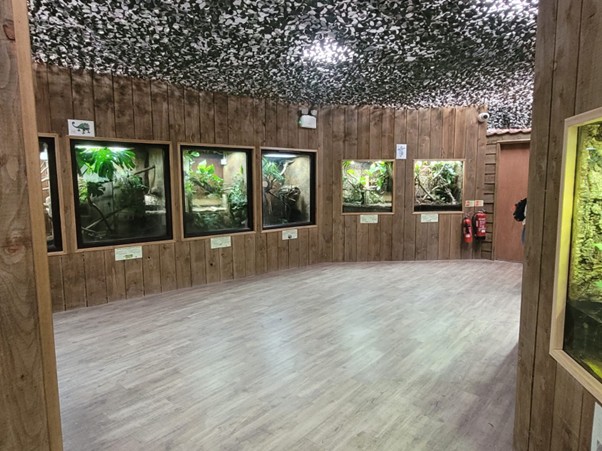
The bug zone is located at the end of the butterfly tunnel, and consists of an open-plan area with enclosures for a number of invertebrate species. The room also contains a large desk from which talks and meet-and-greets are conducted. Also accessible from this room is the entrance to the adjoining tropical house. The exhibits in this area are set at varying heights in wood-panelled walls, and a number of the species on display are used as ambassador animals. This area has the highest species density of all of the zoo’s sections.
Giant African train millipede (Archispirostreptus gigas)
Giant African land snail (Achatina fulica)
Madagascan hissing cockroach (Gromphadorhina portentosa)
Purple jewel beetle (Chlorocala africana oertzeni)
Ethiopian bell crickets (Homoeogryllus xanthographus)
Macleays spectre stick insect (Extatosoma tiaratum)
Giant hooded katydid (Siliquofera grandis)
Giant spiny stick insect (Eurycantha calcarata)
Jungle nymph (Heteropteryx dilatata)
Sun beetle (Pachnoda marginata)
Tropical House
The tropical house is not a traditional heated greenhouse, such as the butterfly house – instead, this area is a room similar to the bug zone, with walls lined with vivaria. The first exhibit on entry is an aquarium housing guppies and neon tetra, which are also present in the aquatic section of the Chinese crocodile lizard (Shinisaurus crocodilurus) tank. The remaining vivaria house various herp species. The far wall contains a window into a keeper food preparation area. The Vietnam forest scorpion (Heterometrus laoticus) is the only species I have listed that was not viewed during my visit.
Guppy (Poecilia reticulata)
Neon tetra (Paracheirodon innesi)
Chinese crocodile lizard (Shinisaurus crocodilurus)
Henkel’s leaf-tailed gecko (Uroplatus henkeli)
Greenbottle blue tarantula (Chromatopelma cyaneopubescens)
Scorpion gecko (Pristurus carteri)
Phantasmal dart frog (Epipedobates tricolor)
Toad headed agama (Phrynocephalus przewalskii)
Vietnam forest scorpion (Heterometrus laoticus)
Fire-bellied toad (Bombina orientalis)
Giant day gecko (Phelsuma grandis)
Antiguan anole (Anolis leachii)
Rhinoceros ratsnake (Gonyosoma boulengeri)
Cone headed lizard (Laemanctus longipes)
Green tree python (Morelia viridis)
Royal python (Python regius)
Burmese python (Python bivittatus)
Green iguana (Iguana iguana)
Pets Corner
A darkened corridor from the Bug Zone leads to the indoor section of Pets Corner, a small domestics section. Domestic guinea pigs and rabbits are given both indoor and outside access, while Kunekune pigs (Sus scrofa domesticus) and continental giant rabbits (Lepus curpaeums) are housed in outdoor paddocks. This outdoor area of the section also includes the entrance to the subsequent farmyard walkthrough.
Domestic rabbit
Domestic guinea pig
Kunekune pig (Sus scrofa domesticus)
Continental giant rabbit (Lepus curpaeums)
Farmyard Walkthrough
Accessibly via a gate at the bottom of the outdoor Pets Corner section, this area is a walkthrough containing further domestic species.
West African pygmy goat (Capra aegagrus hircus)
Domestic duck
Domestic fowl
Nature Trail
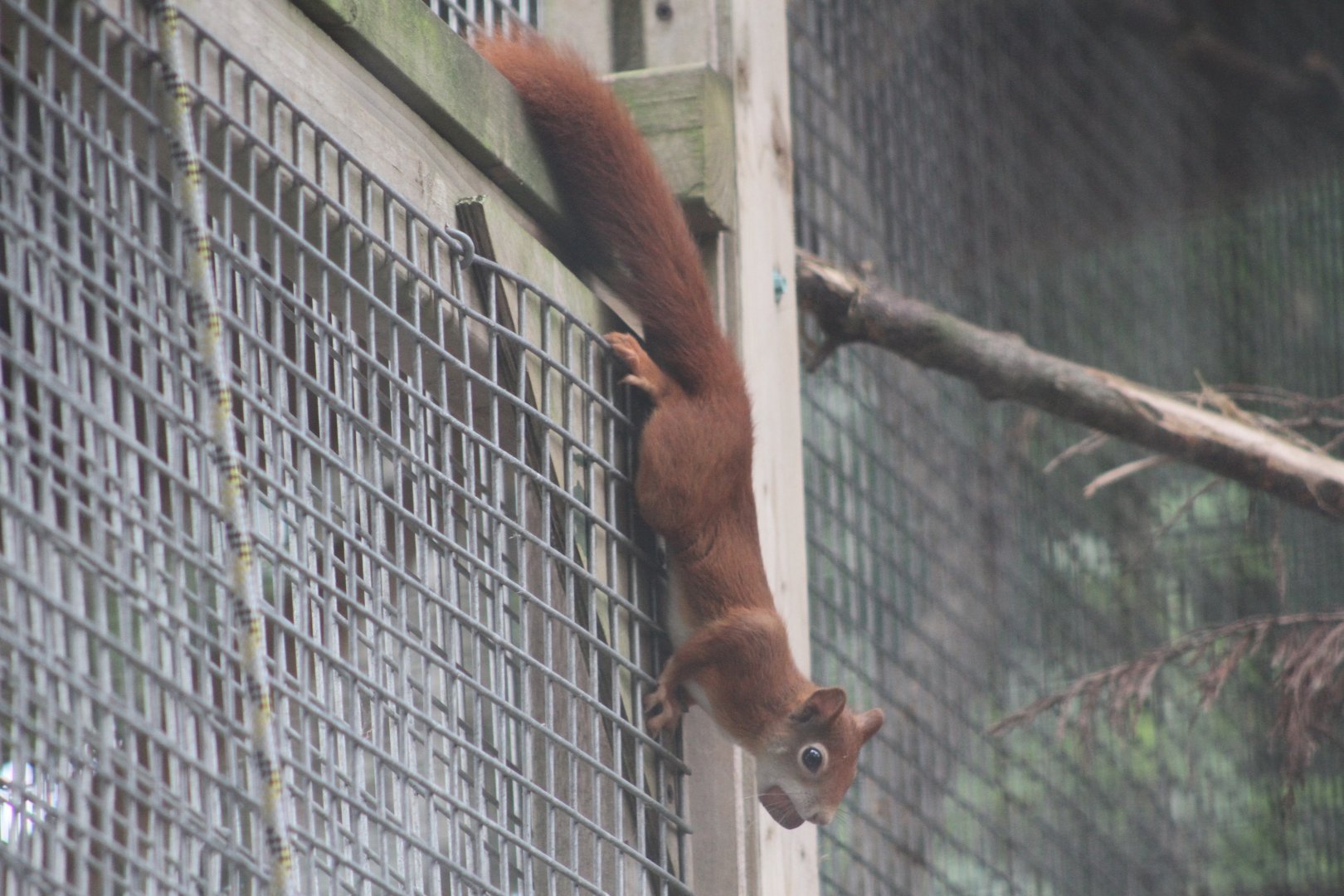
A forested nature trail runs the length of the facility outdoors. This includes wood piles for invertebrates, and ends with a secluded bird hide. This nature trail is also the site of the red squirrel exhibit, housing the species as part of North Wales’ reintroduction efforts. This is a spacious exhibit with a variety of climbing structures and foraging opportunities, as well as hides. Signage adjacent to the enclosure includes information about the species and associated conservation efforts.
Red squirrel (Sciurus vulgaris)
As a side note, this is my first time uploading a report or review, so please do let me know if there's anything I can expand upon, and constructive criticism is of course welcome! I also hope to reply to this thread in the next few days with a couple of my personal thoughts on the zoo.
Butterfly House
Having purchased or scanned their ticket at reception, visitors walk down a short corridor and a door to the left, entering directly into the Butterfly House. This is a standard set-up that will be familiar to those who have visited larger zoos – a lushly planted greenhouse housing a range of tropical butterfly species. There is a bridge allowing guests to traverse the winding water feature, and several doorways leading to adjoining exhibits. This area is also home to several free-flying bird species.
Zebra finch (Taeniopygia castanotis)
Common emerald dove (Chalcophaps indica)
Java sparrow (Padda oryzivora)
Yellow bishop (Euplectes capensis)
There are also multiple ponds housing koi (Cyprinus sp.).
Bird House
An entryway branching off from the left of the butterfly house leads to the bird house. This is a small collection of aviaries located in the same building as the aviaries. According to signage, all of the parrots on display are rehomed ex-pets. During my visit, there was also a laughing kookaburra (Dacelo novaeguineae) free-flying in this area. An African grey parrot (Psittacus erithacus) and Ducorps cockatoo (Cacatua ducorpsii) were housed together. Also on display were blue-fronted Amazon parrots (Amazona aestiva), though these were not directly visible from the bird house, and were only viewable from a door near the entrance or via the outdoor playground. Additionally, there was a small pond in the room housing yellow-bellied sliders (Trachemys scripta scripta).
Laughing kookaburra (Dacelo novaeguineae)
Blue and gold macaws (Ara ararauna)
African grey parrot (Psittacus erithacus)
Ducorps cockatoo (Cacatua ducorpsii)
Sulphur-crested cockatoo (Cacatua galerita)
Yellow-bellied slider (Trachemys scripta scripta)
Blue-fronted Amazon parrots (Amazona aestiva)
Lizard Land
Another small room branching off from the butterfly house includes walls lined with vivaria housing a small collection of reptiles. Prior to the opening of the Tropical House in 2023, this room housed the majority of the zoo’s reptile collection, now accommodating five small herp species, some of which are used as ambassador animals during meet and greets. There are multiple individuals housed in the painted agama (Laudakia stellio brachydactyla) exhibit.
Panther chameleon (Furcifer pardalis)
Painted agama (Laudakia stellio brachydactyla)
Many-coloured bush anole (Polychrus marmoratus)
Blue-tongued skink (Tiliqua gigas evanescens)
Green basilisk (Basiliscus plumifrons)
Meerkat Tunnel
On exiting the butterfly house and its associated rooms, visitors come to the meerkat tunnel corridor. This is an indoor walkway, with the right-hand wall being entirely made up of a viewing window into the meerkat exhibit. This is a standard sandy area with burrows and vantage points. The left-hand wall is lined with three terraria housing small mammals. The first of these terraria is signed as previously housing lesser tenrec (Echinops telfairi) but is currently under maintenance. The other two house mouse species.
Meerkats (Suricata suricatta)
Eurasian harvest mouse (Micromys minutus)
African zebra mouse (Lemniscomys barbarous)
Bug Zone
The bug zone is located at the end of the butterfly tunnel, and consists of an open-plan area with enclosures for a number of invertebrate species. The room also contains a large desk from which talks and meet-and-greets are conducted. Also accessible from this room is the entrance to the adjoining tropical house. The exhibits in this area are set at varying heights in wood-panelled walls, and a number of the species on display are used as ambassador animals. This area has the highest species density of all of the zoo’s sections.
Giant African train millipede (Archispirostreptus gigas)
Giant African land snail (Achatina fulica)
Madagascan hissing cockroach (Gromphadorhina portentosa)
Purple jewel beetle (Chlorocala africana oertzeni)
Ethiopian bell crickets (Homoeogryllus xanthographus)
Macleays spectre stick insect (Extatosoma tiaratum)
Giant hooded katydid (Siliquofera grandis)
Giant spiny stick insect (Eurycantha calcarata)
Jungle nymph (Heteropteryx dilatata)
Sun beetle (Pachnoda marginata)
Tropical House
The tropical house is not a traditional heated greenhouse, such as the butterfly house – instead, this area is a room similar to the bug zone, with walls lined with vivaria. The first exhibit on entry is an aquarium housing guppies and neon tetra, which are also present in the aquatic section of the Chinese crocodile lizard (Shinisaurus crocodilurus) tank. The remaining vivaria house various herp species. The far wall contains a window into a keeper food preparation area. The Vietnam forest scorpion (Heterometrus laoticus) is the only species I have listed that was not viewed during my visit.
Guppy (Poecilia reticulata)
Neon tetra (Paracheirodon innesi)
Chinese crocodile lizard (Shinisaurus crocodilurus)
Henkel’s leaf-tailed gecko (Uroplatus henkeli)
Greenbottle blue tarantula (Chromatopelma cyaneopubescens)
Scorpion gecko (Pristurus carteri)
Phantasmal dart frog (Epipedobates tricolor)
Toad headed agama (Phrynocephalus przewalskii)
Vietnam forest scorpion (Heterometrus laoticus)
Fire-bellied toad (Bombina orientalis)
Giant day gecko (Phelsuma grandis)
Antiguan anole (Anolis leachii)
Rhinoceros ratsnake (Gonyosoma boulengeri)
Cone headed lizard (Laemanctus longipes)
Green tree python (Morelia viridis)
Royal python (Python regius)
Burmese python (Python bivittatus)
Green iguana (Iguana iguana)
Pets Corner
A darkened corridor from the Bug Zone leads to the indoor section of Pets Corner, a small domestics section. Domestic guinea pigs and rabbits are given both indoor and outside access, while Kunekune pigs (Sus scrofa domesticus) and continental giant rabbits (Lepus curpaeums) are housed in outdoor paddocks. This outdoor area of the section also includes the entrance to the subsequent farmyard walkthrough.
Domestic rabbit
Domestic guinea pig
Kunekune pig (Sus scrofa domesticus)
Continental giant rabbit (Lepus curpaeums)
Farmyard Walkthrough
Accessibly via a gate at the bottom of the outdoor Pets Corner section, this area is a walkthrough containing further domestic species.
West African pygmy goat (Capra aegagrus hircus)
Domestic duck
Domestic fowl
Nature Trail
A forested nature trail runs the length of the facility outdoors. This includes wood piles for invertebrates, and ends with a secluded bird hide. This nature trail is also the site of the red squirrel exhibit, housing the species as part of North Wales’ reintroduction efforts. This is a spacious exhibit with a variety of climbing structures and foraging opportunities, as well as hides. Signage adjacent to the enclosure includes information about the species and associated conservation efforts.
Red squirrel (Sciurus vulgaris)
As a side note, this is my first time uploading a report or review, so please do let me know if there's anything I can expand upon, and constructive criticism is of course welcome! I also hope to reply to this thread in the next few days with a couple of my personal thoughts on the zoo.


 I also visited the Sea Zoo while in North Wales which I really enjoyed, particularly the lumpsuckers which I believe have recently been moved into a bigger tank near the entrance.