
This review is based on my visit in April 2013.
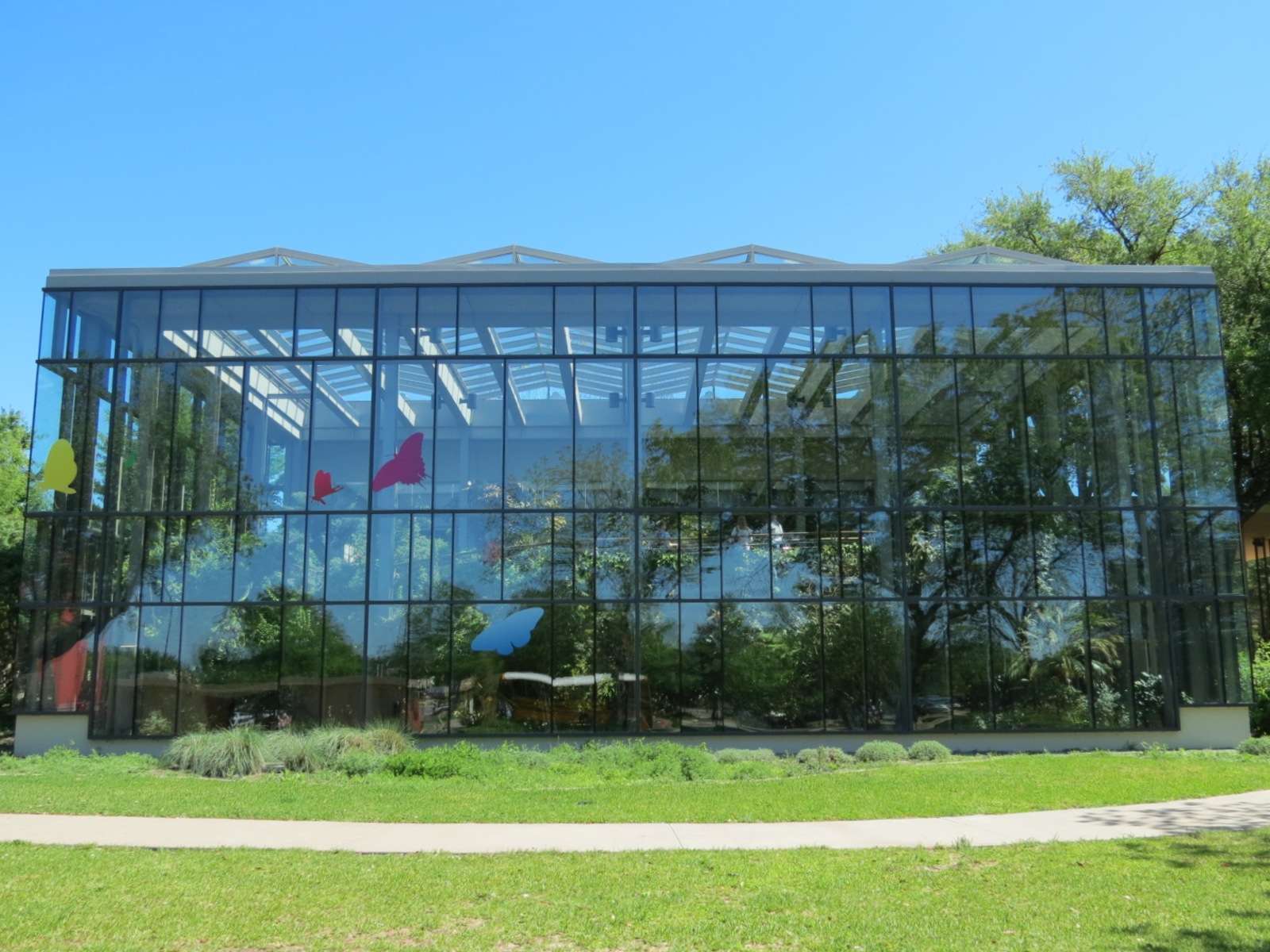
Texas Discovery Gardens is a small botanical garden within Fair Park in Dallas, two miles from Downtown. The most remarkable feature of the facility and the subject of this review is the Rosine Smith Sammons Butterfly House & Insectarium. It is part of the entrance complex, located across a path from the Children’s Aquarium at Fair Park (I will review that in a separate thread). The entrance complex is composed of several connected buildings, including the original (now altered) Horticulture Building from the 1936 Texas Centennial Exposition, the Grand Hall for plant shows added in 1958, a new Entrance addition in 2007, and the Butterfly House in 2009. Before 2009, the facility started an annual live butterfly exhibit in its conservatory in 1995; the Butterfly House occupies that space and is an enlargement of it, and the butterfly exhibit is now permanent. Visitors enter the complex from Fair Park through the 2007 addition, a buff-colored brick exterior with recreations of the original Art Deco plaster bas-reliefs of native Texas plants that adorned the original Horticulture building. Inside is a modern two-story hall adorned with several hanging metal sculptures of plants and butterflies. The ticketing desk here leads to a hallway with a few galleries and eventually out of the building complex to the gardens. This entrance hall also has a motley collection of about 10 terrariums on pedastals for insects and a few reptiles. For a nicely-designed new hall such as this, the unremarkable terrariums seem like an underwhelming afterthought. However, things improve drastically with the Butterfly House itself; it is the largest permanent display space for this type of animal I have seen. It is reached from the entrance hall by ascending an attractive glass-railinged stairway beside a modern two-story mural of a butterfly’s life stages; at the top of the landing overlooking the hall are the first of the many modern interpretive graphic panels set on metal railings that are scattered throughout the rest of the house. Automatic glass sliding doors lead to a small waiting room; once the doors close behind visitors, a second set of automatic frosted glass sliding doors opens to reveal the panorama of the exhibit and the start of the visitor path that explores it. The path begins on a wide landing perched above the space at second-floor height. The landing is decked with recycled plastic planking and contained with modern metal and wood railings; this same treatment is used as the elevated path slowly descends in a large loop around the exhibit space. I don’t recall any other butterfly exhibits where the visitor path has a significant portion located at ‘flight-height’, affording more eye-level views of the inhabitants when they are active. The space certainly needs upper viewing areas since it is a large square conservatory (80 feet square?) with a tall ceiling (35 feet to the skylights?). Three sides are entirely enclosed with an attractive pattern of glass mullions, while the fourth side is the white brick of the adjoining entrance building. Four bays of angled skylights supported by simple concrete or steel columns crown the bright space. The interior temperature is maintained at 80-85 degrees F with humidity of 60-70 percent; the lush plant life within is certainly tropical but is not the wild assemblage of unusual exotics that many tropical conservatories feature. Instead, a focused permanent collection of flowering small-to-medium sized shrubs that butterflies enjoy is located in the ground-level planting areas, augmented by hundreds of temporary pots along the walkways. Larger plants punctuate the collection, such as fishtail palms and podocarpus, but are sparse enough to allow plenty of light to filter to the understory. The elevated walkway that slopes down to eventually reach the ground path also has many lush vines clinging to its metal railings. Once the path reaches the ground, it becomes a concrete one that meanders around the space and is occasionally lined with rough-hewn native stone blocks for sitting. This type of masonry is also handsomely used to contain a small pond and a broad set of steps that gradually ascends the gentle ground slope from it to the exhibit exit (which is another double set of automatic doors for ensuring that no butterflies leave with departing visitors). Next to the exit is a small window case set in the brick wall of the building for viewing several panels of hanging chrysalises with emerging butterflies. Viewing the butterflies in the main exhibit is excellent; there is a wealth of activity and species, and a variety of experiences including observing owl butterlies clinging to the architecture high above and longwings fluttering over the pond and blue morphos contrasting with the pink blooms nearby. Visitors are given a color page with a map of the gardens on one side and a butterfly identification guide on the other. The species illustrated are the common ones kept in the exhibit, although they can vary by shipment (shipments come from the U.S., El Salvador, Colombia, The Phillipines, and Malaysia). The species are:
Atlas Moth
Banded Orange
Blue Morpho
Blue & White Longwing
Chocolate Pansy
Common Cattleheart
Giant Swallowtail
Great Egg-fly
Great Mormon
Julia Longwing
Malachite
Malay Lacewing
Mexican Bluewing
Monarch
Owl Butterfly
Paper Kite
Pink Spotted Cattleheart
Queen
Red Cracker
Red Rim
Rusty-Tipped Page
Small Postman
Sunrise Longwing
Tailed Jay
The Clipper
Tiger Longwing
Zebra Longwing
Blue Morpho:

Chrysalises:
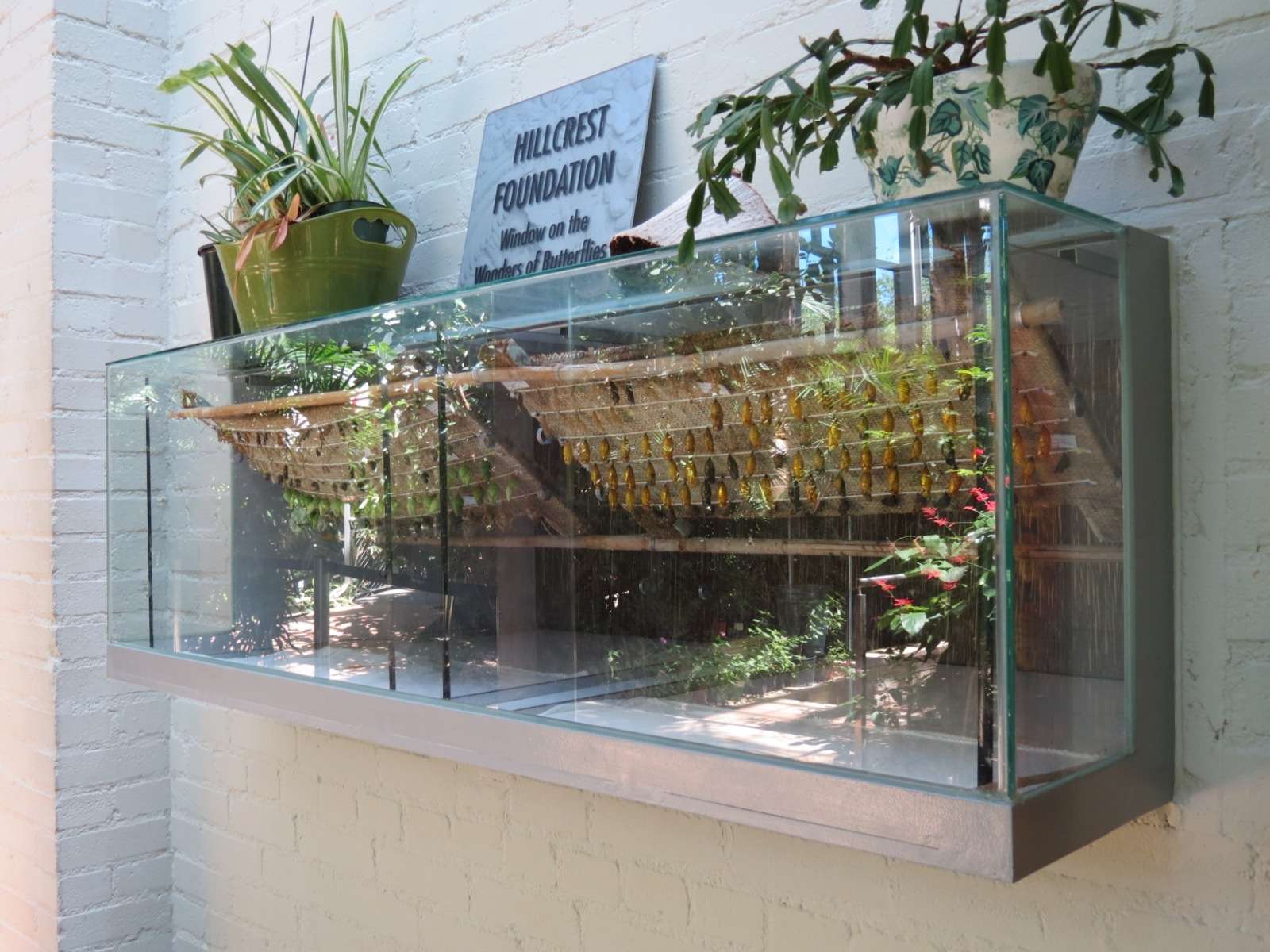
Exhibit Visitor Path Below Elevated Path:
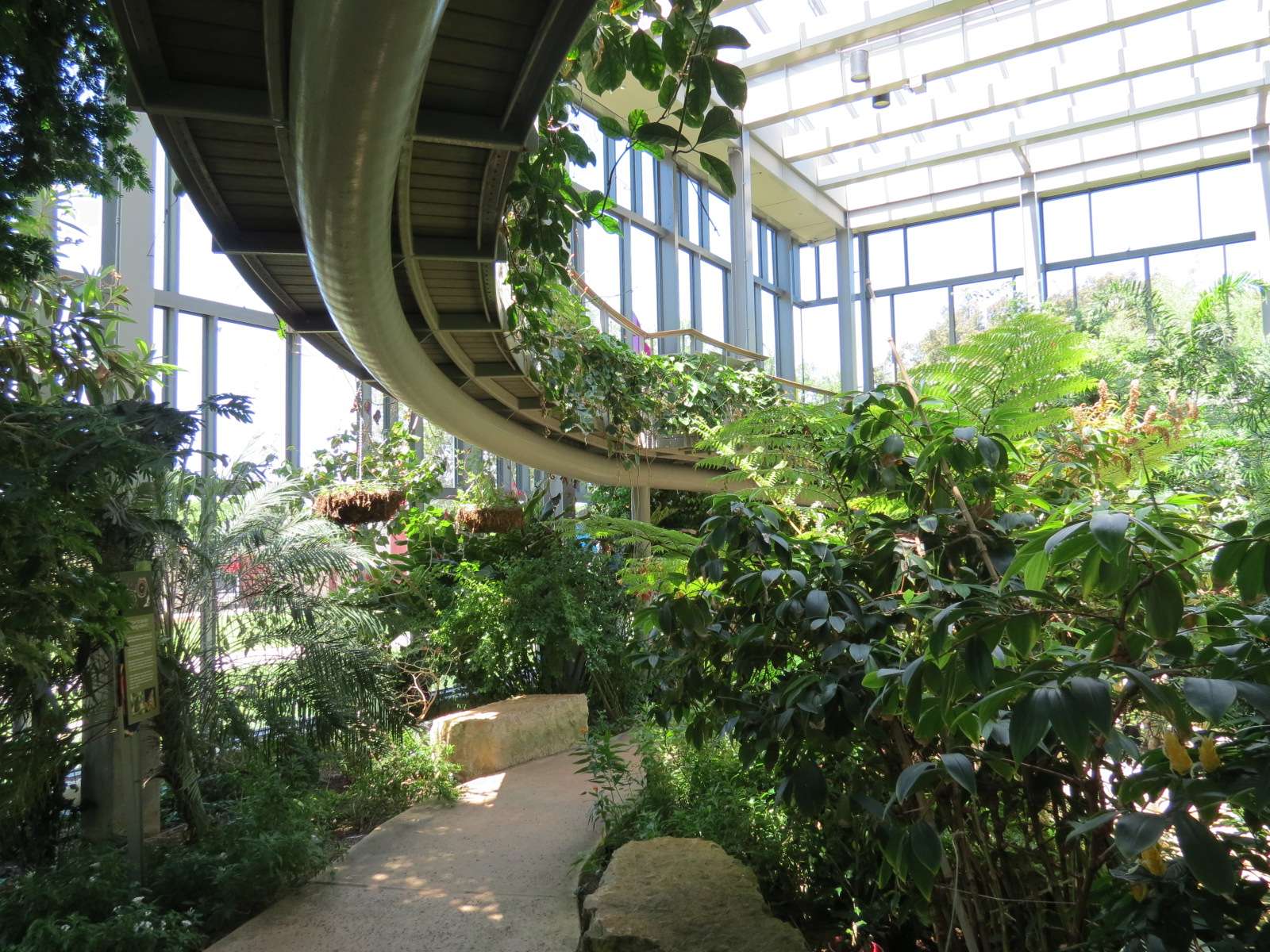
Exhibit Interior:

Exhibit Interior:

Exhibit Exterior:
The Butterfly House at Texas Discovery Gardens is worth visiting for people who are already visiting Fair Park and it is easy to combine seeing it with the other features of the park including the Children’s Aquarium. The $8 general adult admission includes the gardens and is priced a few dollars too high but not distractingly so. I don’t have a ranked list of stand-alone butterfly houses – I can’t include them in the same list as zoos or aquariums – but if I did this one would be at the top! I have posted additional pictures in the gallery.
Texas Discovery Gardens is a small botanical garden within Fair Park in Dallas, two miles from Downtown. The most remarkable feature of the facility and the subject of this review is the Rosine Smith Sammons Butterfly House & Insectarium. It is part of the entrance complex, located across a path from the Children’s Aquarium at Fair Park (I will review that in a separate thread). The entrance complex is composed of several connected buildings, including the original (now altered) Horticulture Building from the 1936 Texas Centennial Exposition, the Grand Hall for plant shows added in 1958, a new Entrance addition in 2007, and the Butterfly House in 2009. Before 2009, the facility started an annual live butterfly exhibit in its conservatory in 1995; the Butterfly House occupies that space and is an enlargement of it, and the butterfly exhibit is now permanent. Visitors enter the complex from Fair Park through the 2007 addition, a buff-colored brick exterior with recreations of the original Art Deco plaster bas-reliefs of native Texas plants that adorned the original Horticulture building. Inside is a modern two-story hall adorned with several hanging metal sculptures of plants and butterflies. The ticketing desk here leads to a hallway with a few galleries and eventually out of the building complex to the gardens. This entrance hall also has a motley collection of about 10 terrariums on pedastals for insects and a few reptiles. For a nicely-designed new hall such as this, the unremarkable terrariums seem like an underwhelming afterthought. However, things improve drastically with the Butterfly House itself; it is the largest permanent display space for this type of animal I have seen. It is reached from the entrance hall by ascending an attractive glass-railinged stairway beside a modern two-story mural of a butterfly’s life stages; at the top of the landing overlooking the hall are the first of the many modern interpretive graphic panels set on metal railings that are scattered throughout the rest of the house. Automatic glass sliding doors lead to a small waiting room; once the doors close behind visitors, a second set of automatic frosted glass sliding doors opens to reveal the panorama of the exhibit and the start of the visitor path that explores it. The path begins on a wide landing perched above the space at second-floor height. The landing is decked with recycled plastic planking and contained with modern metal and wood railings; this same treatment is used as the elevated path slowly descends in a large loop around the exhibit space. I don’t recall any other butterfly exhibits where the visitor path has a significant portion located at ‘flight-height’, affording more eye-level views of the inhabitants when they are active. The space certainly needs upper viewing areas since it is a large square conservatory (80 feet square?) with a tall ceiling (35 feet to the skylights?). Three sides are entirely enclosed with an attractive pattern of glass mullions, while the fourth side is the white brick of the adjoining entrance building. Four bays of angled skylights supported by simple concrete or steel columns crown the bright space. The interior temperature is maintained at 80-85 degrees F with humidity of 60-70 percent; the lush plant life within is certainly tropical but is not the wild assemblage of unusual exotics that many tropical conservatories feature. Instead, a focused permanent collection of flowering small-to-medium sized shrubs that butterflies enjoy is located in the ground-level planting areas, augmented by hundreds of temporary pots along the walkways. Larger plants punctuate the collection, such as fishtail palms and podocarpus, but are sparse enough to allow plenty of light to filter to the understory. The elevated walkway that slopes down to eventually reach the ground path also has many lush vines clinging to its metal railings. Once the path reaches the ground, it becomes a concrete one that meanders around the space and is occasionally lined with rough-hewn native stone blocks for sitting. This type of masonry is also handsomely used to contain a small pond and a broad set of steps that gradually ascends the gentle ground slope from it to the exhibit exit (which is another double set of automatic doors for ensuring that no butterflies leave with departing visitors). Next to the exit is a small window case set in the brick wall of the building for viewing several panels of hanging chrysalises with emerging butterflies. Viewing the butterflies in the main exhibit is excellent; there is a wealth of activity and species, and a variety of experiences including observing owl butterlies clinging to the architecture high above and longwings fluttering over the pond and blue morphos contrasting with the pink blooms nearby. Visitors are given a color page with a map of the gardens on one side and a butterfly identification guide on the other. The species illustrated are the common ones kept in the exhibit, although they can vary by shipment (shipments come from the U.S., El Salvador, Colombia, The Phillipines, and Malaysia). The species are:
Atlas Moth
Banded Orange
Blue Morpho
Blue & White Longwing
Chocolate Pansy
Common Cattleheart
Giant Swallowtail
Great Egg-fly
Great Mormon
Julia Longwing
Malachite
Malay Lacewing
Mexican Bluewing
Monarch
Owl Butterfly
Paper Kite
Pink Spotted Cattleheart
Queen
Red Cracker
Red Rim
Rusty-Tipped Page
Small Postman
Sunrise Longwing
Tailed Jay
The Clipper
Tiger Longwing
Zebra Longwing
Blue Morpho:
Chrysalises:
Exhibit Visitor Path Below Elevated Path:
Exhibit Interior:
Exhibit Interior:
Exhibit Exterior:

The Butterfly House at Texas Discovery Gardens is worth visiting for people who are already visiting Fair Park and it is easy to combine seeing it with the other features of the park including the Children’s Aquarium. The $8 general adult admission includes the gardens and is priced a few dollars too high but not distractingly so. I don’t have a ranked list of stand-alone butterfly houses – I can’t include them in the same list as zoos or aquariums – but if I did this one would be at the top! I have posted additional pictures in the gallery.


