
This review is based on my visit in April 2013.
Children’s Aquarium at Fair Park is a mid-sized facility within Fair Park in Dallas, Texas, two miles from Downtown. Fair Park has been the site of the State Fair of Texas since 1886; it is also used for other festivals and events and features several year-round attractions, including this aquarium (and the Texas Discovery Gardens’ Butterfly House I reviewed in a separate thread). Architecturally, the 277 acre park is best known as the site of the 1936 Texas Centennial Exposition, which left a collection of Art Deco buildings and murals that remain the prominent feature of the park. The aquarium is housed in one of those buildings, which was built as an aquarium in 1936, making it one of the oldest ones in the United States (I’m not sure if it has been in continuous operation since that time). It certainly was open through most of the 2000’s, when it closed for renovation in 2009 and re-opened in 2010. The name of the aquarium is a misnomer since its exhibits are mostly presented in a traditional and restrained format that is not especially geared towards children; I suspect its name was changed during the recent renovation as a marketing effort to reposition it for the local market against the nearby Dallas World Aquarium and Grapevine SEA LIFE Aquarium. In fact, SEA LIFE is a superior facility when it comes to entertaining rugrats, with all the bright graphics and interactive elements and low viewing heights of the exhibits that this one mostly lacks. However this aquarium is still worth a visit for the enthusiast as well as for children and features an interesting collection. It is operated by the Zoological Society of Dallas, whose growing reputation may explain the earnest presentation seen here, in parallel with the Dallas Zoo that they also operate.
Aquarium Exterior:
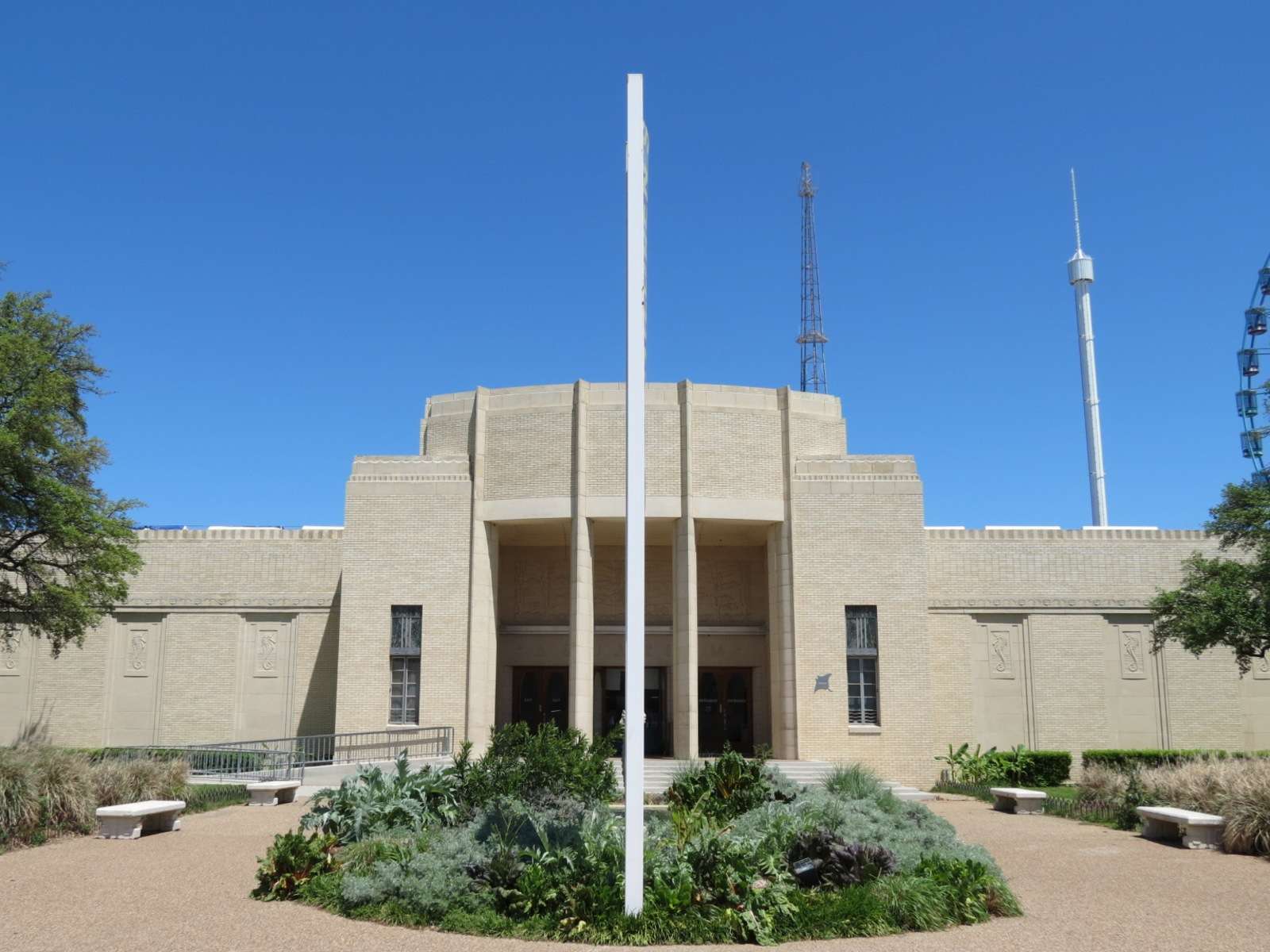
The building fronts a main path through the park and the façade is a low symmetrical block composed of simple buff-colored brick with several decorative plaster medallions of seahorses. A few similar seahorse statues form a small fountain in a planting bed on axis with the taller curved portico in the center of the façade that forms the building entrance. This exterior is typical of the rather spare Art Deco of the later period; neither this or the interior is the grand and richly-decorated edifice of its contemporary in Chicago, the Shedd Aquarium. In the shelter of the portico is a handsome plaster bas-relief of fish and the simple title of ‘Aquarium’ spelled out in large stylized letters; beneath these are the three openings for the small ticket window, the entrance door, and the exit door. The interior is essentially one large simple barrel-vaulted room that is entered at the center of its long side, with the original exhibit spaces lining the outside walls of its perimeter. This space was made asymmetrical decades ago when one side of the large room was lengthened even further, although the barrel vault ends here and the ceiling becomes a dark painted void with exposed utilities hanging above. The recent renovation added exhibits in parts of the center of this wide hall, helping to divide it into essentially five rooms, although these partitions do not reach all the way to the tall ceiling. There are basically two types of exhibits throughout the interior of the hall: those that occupy the perimeter in the historic spaces of the original configuration, and those that have been added in the partitions in the center of the room. The perimeter exhibits are all wall exhibits that are viewed through rectangular windows; most of the windows are about the same size, although the spaces that they view vary depending on whether the recent renovation divided some into further smaller exhibits or combined several adjoining exhibits so that two windows view one larger space. I am guessing that each original exhibit space was about 7 or 9 feet wide by 7 feet and about 5 to 7 feet deep, and many are still their original dimensions. The treatment of the window frames is consistent throughout: glossy black frames and ledges that reflect too much of the room’s other backlit graphics are topped with simple backlit graphics panels above them. The panels are bright and fairly informative with species identifications, but their placement is too difficult for most children to read (do children read them anyway?). Multiple species are printed on single panels so that keeping them accurate is probably a spotty affair when one resident changes; I saw several examples of this problem. Unfortunately, the majority of the interiors of the perimeter exhibits are too sparse to be considered as successful exhibitry, but there are exceptions. A nice unseen feature is that they are lit from above by skylights. The partition exhibits in the center of the room show a greater variety of forms and sizes, although all are still small-to-medium sized, and they are wall exhibits set in modern partitions in various shades of aqua that are painted with bold white graphics and text concerning nearby aquarium residents. These graphics are far easier for children to access. Detailing within these exhibits is also rather simplified, although several are intended to be abstract presentations. The addition of the partitions is a successful intervention, making the experience more dynamic and allowing the organization of the exhibits into five themed zones: Freshwater, Intertidal, Shore, Nearshore, and Offshore. Consistent signs and banners clearly announce each themed zone. By my count, there are a total of 59 exhibits in the aquarium, and I will list each within the themed zone it occupies, state those that have their own themed title, and make comments for some.
Intertidal is the zone directly inside the entrance and serves as the introduction. It has 6 exhibits:
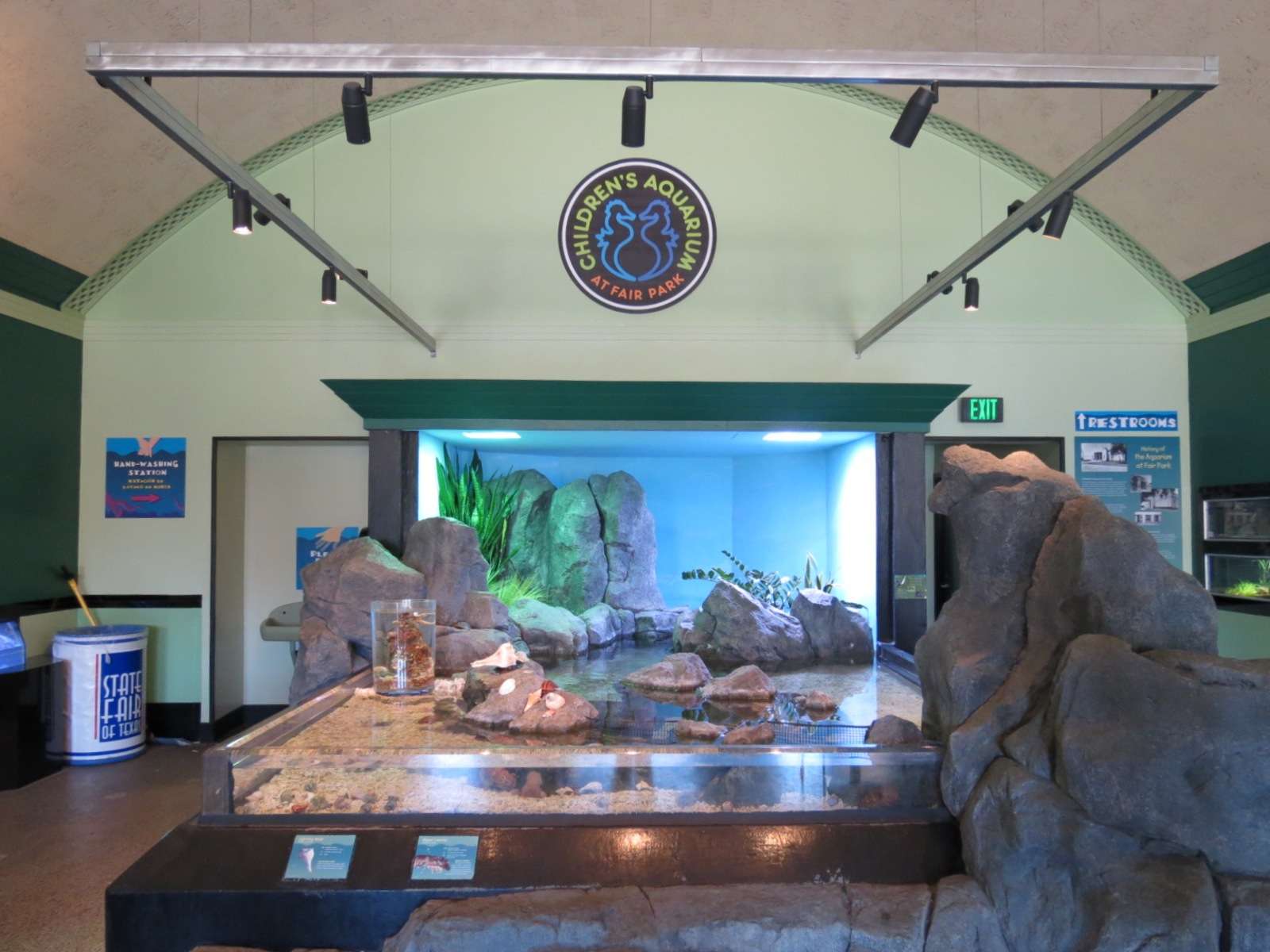
Two adjoining low open-top tanks are the only touchtanks in the interior and are the main conceit to making this a child-friendly aquarium. Both are contained with low acrylic panels set around a rocky assembly with sandy bottom. One contains horseshoe crab, blue damsel, three-stripe damsel, and yellow-tail damsel. The other contains horseshoe crab, slipper lobster, lightning whelk, chocolate sea star, warty sea anemone, and pencil urchin. I imagine many other tidepool denizens come and go
The other Intertidal exhibits are partition tanks:
Upside-down jellyfish and neon goby, in a small shelf tank
Lined seahorse
Unidentified schooling fish in a round column tank
A mangrove exhibit in a concave semi-circular open-top exhibit containing giant red hermit crab, highhat, tobaccofish, and Atlantic porkfish
Intertidal zone showing the two touchtanks:
Freshwater is the zone to the right of the entrance, occupying the entire shorter wing of the hall. It has 18 exhibits:
2 of them are partition exhibits:
Texas Lake contains water snake, longear sunfish, blackstripe topminnow, and Western mosquitofish
Texas Bayou is a small sized but decently detailed habitat for an albino American alligator
The rest are perimeter exhibits:
Frogs & Turtles contains bullfrog, chicken turtle, red-eared slider, and softshell turtle
Guadelupe bass, butterfly peacock bass, and largemouth bass
Gila trout
Trinity River contains spotted gar, longnose gar, and sunfish in a detailed scenario of urban trash
Alligator snapping turtle, black crappie, and white crappie. The turtle weighs 190 pounds and is 75 years old
Red-bellied piranha and silver arowana
Mexican Fishes contains Ocampo cichlid, blackbelt cichlid, and Mexican swordtail
Amazon River contains electric eel, red hook silver dollar, silver dollar, severum cichlid, pinktail chalceus, gold tetra, cardinal tetra, serpae tetra, and cory cat
Lake Victoria cichlid
Australian rainbow, Australian lungfish, and Australian freshwater prawn
Charco palma pupfish
Texas blind salamander
American flag-fish
Blind cavefish
Rainbow darter
Pygmy sunfish
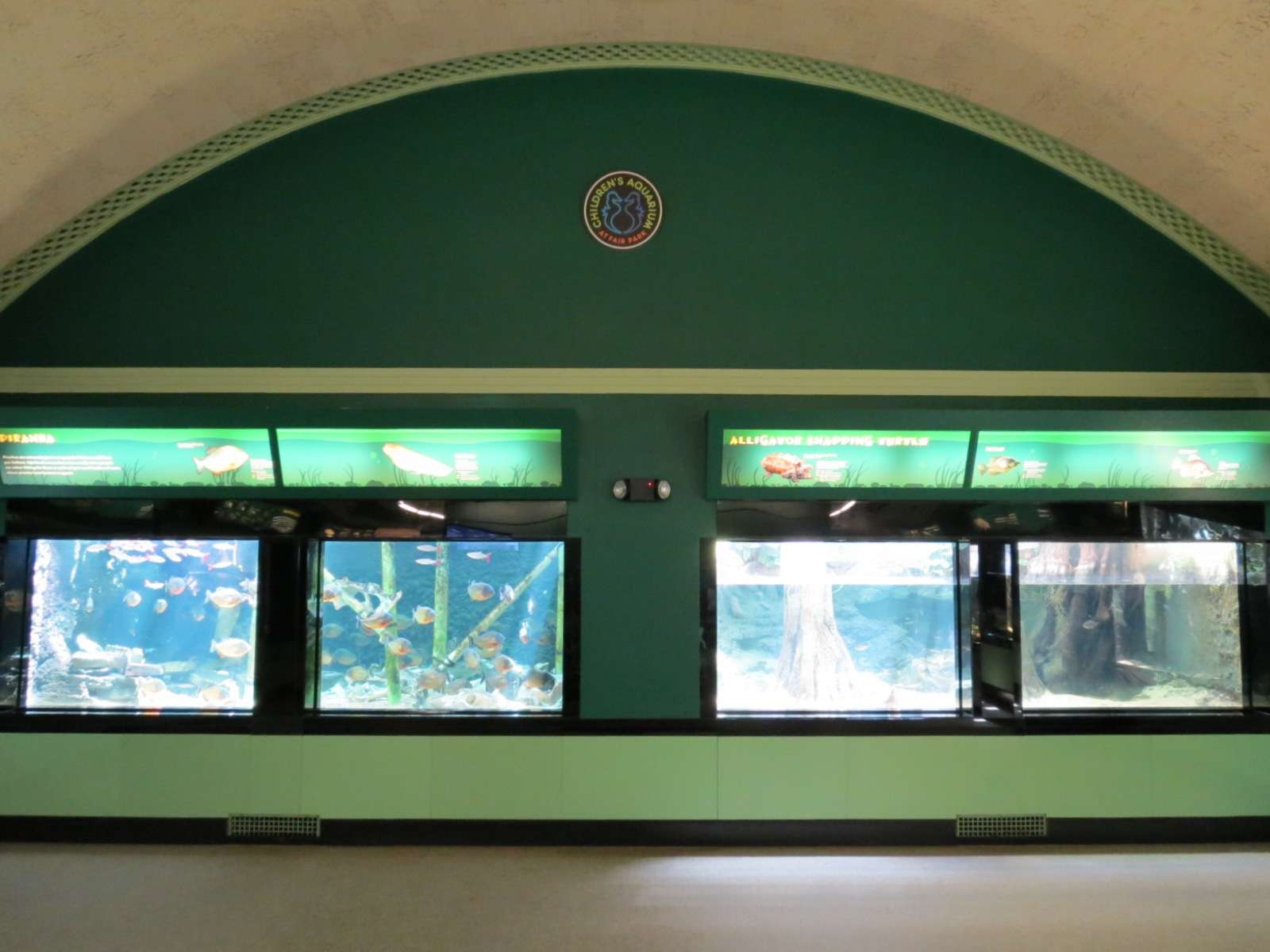
Freshwater zone, showing the Alligator Snapping Turtle Exhibit on right at Red-bellied Piranha Exhibit on left:
Shore is the zone to the left of the entrance, the first of three zones occupying the longer wing of the hall. It has 12 exhibits:
5 of them are partition exhibits:
Frogfish and mushroom coral
Sargassumfish
Blue damsel, three-stripe damsel, and yellow-tail damsel (the same combination as the touchtank in Intertidal zone)
Shark and skate eggcases
Coral catshark and ornate Wobbegong shark in a woefully small shelf tank
The rest are perimeter exhibits:
Asian Saltwater Marsh contains mudskipper, banded archerfish, silver moony, and spotted soat
Spiny lobster, soldierfish, cardinalfish, sweeper, short bigeye, and yellow ray
Caribbean Reef contains corallimorpharian, sea rods, sea plumes, button polyps, carpet anemone, red octocoral, bushy gorgonian, candelabra coral, and unidentified reef fish
Yellow seahorse
Pacific seahorse
Walking batfish
Rhinoceros Iguana, coconut crab, blue damsel, three-stripe damsel, yellow-tail damsel (there’s that combination again!), domino damsel, and black velvet damsel in a nice double-wide Indo-Pacific tropical beach exhibit, although the iguana is geographically incorrect
Shore and Nearshore zones, showing partition exhibits on the right and left, and perimeter exhibits in the background:

Nearshore is the zone after the Shore, and it is unclear whether several of the exhibits belong to one or the other. It has 15 exhibits:
8 of them are partition exhibits:
Giant Pacific octopus viewed through a round bubble window with a nicely detailed rocky grotto habitat that has a window beyond into the round column tank with wolf eel described below
Squat lobster and strawberry anemone
Sea pen and feather duster sea worm
Empty, signed for plumose anemone with an ‘Animals Coming Soon!’ sticker
Wolf eel, garibaldi, striped surf perch, and rockfish in a nicely detailed rocky habitat within a round column tank with a window into the octopus exhibit described above
Atlantic sea nettle
Empty, with an ‘Exhibit Under Maintenance’ sign, presumably for jellies
Moon jelly
The rest are perimeter exhibits:
Indo-Pacific Reef contains leather coral, xenia, green star polyp coral, branching coral, leafy plate coral, button polyps, corallimorpharian, lace coral, birds-nest coral, porous coral, jeweled finger coral, galaxy coral, velevet horn coral, star coral, Banggai cardinalfish, and some unidentified reef fish
Yellowhead jawfish and blue chromis
Laced moray in an abstract plain space with a series of clear tubes
Hawksbill sea turtle
Animal Partners contains carpet anemone, hepatus tang, yellow tang, and anemonefish
Sea of Cortez contains Clarion angelfish, convict surgeonfish, Guinea fowl puffer, and Cortez angelfish
Venomous Fishes contains red lionfish, clearfin lionfish, spotfin lionfish, and spotted scorpionfish
Offshore is the last zone and is beyond both the Shore and Nearshore zones at the end of the hall. It has 6 exhibits, all of them perimeter exhibits:
Queensland grouper and Florida pompano (strange combination!)
Chambered nautilus and pinecone fish
American lobster
Oil Rig Leg contains Florida pompano, French angelfish, lookdown, sargeant major, and Atlantic spadefish
Flower Garden Banks contains banded butterflyfish, foureye butterflyfish, reef butterflyfish, cocoa damselfish, orange-spotted filefish, queen parrotfish, princess parrotfish, stoplight parrotfish, long-spined porcupinefish, creolefish, and scrawled filefish
Coastal sharks contains bonnethead shark, whitetip reef shark, and nurse shark in the largest exhibit of the aquarium’s interior; it occupies the entire end of the hall, being three wide perimeter spaces combined. However, it is still not large enough for the sharks and is no deeper than most of the other exhibits. It features a plain sandy bottom and plain dark walls. It is not the feature exhibit that it should be, but that problem was solved during the recent renovation by creating a larger shark habitat in a new addition to the facility described below
Offshore zone, showing the Coastal Sharks Exhibit:

Stingray Bay is the only exterior exhibit area of the aquarium and is reached by a short hallway out the back of the building. It is sheltered by a large enclosed porch with a large curved metal vaulted ceiling painted light grey and surrounded by tall wood walls painted light grey; views into the surrounding park are limited to the openings between the walls and the arching canopy above. Much of the visitor area is a light grey deck. A small amount of decoration, such as mounted sharks and boat floats, hang from the walls. The overall impression is of a slightly nautical motif, presented in a fresh clean modern style. There are two exhibits in this area. The first is the more impressive shark habitat, which is larger and deeper than the one in the interior described above. It is an opne topped habitat that contains bonnethead shark, blacktip reef shark, nurse shark, zebra shark, and lookdown. It is contained in simulated rock walls and has some rocks and a sandy sloping bottom, and is roughly octagonal in shape. Visitors can view it from the deck above its surface, including a gap contained by railings that looks directly down into it on one end. There is also a glass panel for an underwater view on one side of the habitat, reached by descending stairs down from the deck and walking around the other exhibit for cownose rays. This ray tank is a fine touch tank and is roughly hexagonal in shape. Two sides have glass panels for underwater views of the deeper end (about 4’ deep), while three sides have ledges for visitors to pet the rays in the shallower end. Simulated rocks partially separate the two ends. Both exhibits are a nice addition to the aquarium.
Stingray Bay, showing the Cownose Ray Exhibit:

Children’s Aquarium in Fair Park is worth visiting for people who are already visiting Fair Park and it is easy to combine seeing it with the other features of the park including the Butterfly House at Texas Discovery Gardens. The $8 general adult admission is priced right. On my list of the 48 aquarium facilities I have visited, I rank this one at number 39. None of its exhibits make my top 25 list of individual fish exhibits. I have posted additional pictures in the gallery.
Children’s Aquarium at Fair Park is a mid-sized facility within Fair Park in Dallas, Texas, two miles from Downtown. Fair Park has been the site of the State Fair of Texas since 1886; it is also used for other festivals and events and features several year-round attractions, including this aquarium (and the Texas Discovery Gardens’ Butterfly House I reviewed in a separate thread). Architecturally, the 277 acre park is best known as the site of the 1936 Texas Centennial Exposition, which left a collection of Art Deco buildings and murals that remain the prominent feature of the park. The aquarium is housed in one of those buildings, which was built as an aquarium in 1936, making it one of the oldest ones in the United States (I’m not sure if it has been in continuous operation since that time). It certainly was open through most of the 2000’s, when it closed for renovation in 2009 and re-opened in 2010. The name of the aquarium is a misnomer since its exhibits are mostly presented in a traditional and restrained format that is not especially geared towards children; I suspect its name was changed during the recent renovation as a marketing effort to reposition it for the local market against the nearby Dallas World Aquarium and Grapevine SEA LIFE Aquarium. In fact, SEA LIFE is a superior facility when it comes to entertaining rugrats, with all the bright graphics and interactive elements and low viewing heights of the exhibits that this one mostly lacks. However this aquarium is still worth a visit for the enthusiast as well as for children and features an interesting collection. It is operated by the Zoological Society of Dallas, whose growing reputation may explain the earnest presentation seen here, in parallel with the Dallas Zoo that they also operate.
Aquarium Exterior:
The building fronts a main path through the park and the façade is a low symmetrical block composed of simple buff-colored brick with several decorative plaster medallions of seahorses. A few similar seahorse statues form a small fountain in a planting bed on axis with the taller curved portico in the center of the façade that forms the building entrance. This exterior is typical of the rather spare Art Deco of the later period; neither this or the interior is the grand and richly-decorated edifice of its contemporary in Chicago, the Shedd Aquarium. In the shelter of the portico is a handsome plaster bas-relief of fish and the simple title of ‘Aquarium’ spelled out in large stylized letters; beneath these are the three openings for the small ticket window, the entrance door, and the exit door. The interior is essentially one large simple barrel-vaulted room that is entered at the center of its long side, with the original exhibit spaces lining the outside walls of its perimeter. This space was made asymmetrical decades ago when one side of the large room was lengthened even further, although the barrel vault ends here and the ceiling becomes a dark painted void with exposed utilities hanging above. The recent renovation added exhibits in parts of the center of this wide hall, helping to divide it into essentially five rooms, although these partitions do not reach all the way to the tall ceiling. There are basically two types of exhibits throughout the interior of the hall: those that occupy the perimeter in the historic spaces of the original configuration, and those that have been added in the partitions in the center of the room. The perimeter exhibits are all wall exhibits that are viewed through rectangular windows; most of the windows are about the same size, although the spaces that they view vary depending on whether the recent renovation divided some into further smaller exhibits or combined several adjoining exhibits so that two windows view one larger space. I am guessing that each original exhibit space was about 7 or 9 feet wide by 7 feet and about 5 to 7 feet deep, and many are still their original dimensions. The treatment of the window frames is consistent throughout: glossy black frames and ledges that reflect too much of the room’s other backlit graphics are topped with simple backlit graphics panels above them. The panels are bright and fairly informative with species identifications, but their placement is too difficult for most children to read (do children read them anyway?). Multiple species are printed on single panels so that keeping them accurate is probably a spotty affair when one resident changes; I saw several examples of this problem. Unfortunately, the majority of the interiors of the perimeter exhibits are too sparse to be considered as successful exhibitry, but there are exceptions. A nice unseen feature is that they are lit from above by skylights. The partition exhibits in the center of the room show a greater variety of forms and sizes, although all are still small-to-medium sized, and they are wall exhibits set in modern partitions in various shades of aqua that are painted with bold white graphics and text concerning nearby aquarium residents. These graphics are far easier for children to access. Detailing within these exhibits is also rather simplified, although several are intended to be abstract presentations. The addition of the partitions is a successful intervention, making the experience more dynamic and allowing the organization of the exhibits into five themed zones: Freshwater, Intertidal, Shore, Nearshore, and Offshore. Consistent signs and banners clearly announce each themed zone. By my count, there are a total of 59 exhibits in the aquarium, and I will list each within the themed zone it occupies, state those that have their own themed title, and make comments for some.
Intertidal is the zone directly inside the entrance and serves as the introduction. It has 6 exhibits:
Two adjoining low open-top tanks are the only touchtanks in the interior and are the main conceit to making this a child-friendly aquarium. Both are contained with low acrylic panels set around a rocky assembly with sandy bottom. One contains horseshoe crab, blue damsel, three-stripe damsel, and yellow-tail damsel. The other contains horseshoe crab, slipper lobster, lightning whelk, chocolate sea star, warty sea anemone, and pencil urchin. I imagine many other tidepool denizens come and go
The other Intertidal exhibits are partition tanks:
Upside-down jellyfish and neon goby, in a small shelf tank
Lined seahorse
Unidentified schooling fish in a round column tank
A mangrove exhibit in a concave semi-circular open-top exhibit containing giant red hermit crab, highhat, tobaccofish, and Atlantic porkfish
Intertidal zone showing the two touchtanks:
Freshwater is the zone to the right of the entrance, occupying the entire shorter wing of the hall. It has 18 exhibits:
2 of them are partition exhibits:
Texas Lake contains water snake, longear sunfish, blackstripe topminnow, and Western mosquitofish
Texas Bayou is a small sized but decently detailed habitat for an albino American alligator
The rest are perimeter exhibits:
Frogs & Turtles contains bullfrog, chicken turtle, red-eared slider, and softshell turtle
Guadelupe bass, butterfly peacock bass, and largemouth bass
Gila trout
Trinity River contains spotted gar, longnose gar, and sunfish in a detailed scenario of urban trash
Alligator snapping turtle, black crappie, and white crappie. The turtle weighs 190 pounds and is 75 years old
Red-bellied piranha and silver arowana
Mexican Fishes contains Ocampo cichlid, blackbelt cichlid, and Mexican swordtail
Amazon River contains electric eel, red hook silver dollar, silver dollar, severum cichlid, pinktail chalceus, gold tetra, cardinal tetra, serpae tetra, and cory cat
Lake Victoria cichlid
Australian rainbow, Australian lungfish, and Australian freshwater prawn
Charco palma pupfish
Texas blind salamander
American flag-fish
Blind cavefish
Rainbow darter
Pygmy sunfish
Freshwater zone, showing the Alligator Snapping Turtle Exhibit on right at Red-bellied Piranha Exhibit on left:
Shore is the zone to the left of the entrance, the first of three zones occupying the longer wing of the hall. It has 12 exhibits:
5 of them are partition exhibits:
Frogfish and mushroom coral
Sargassumfish
Blue damsel, three-stripe damsel, and yellow-tail damsel (the same combination as the touchtank in Intertidal zone)
Shark and skate eggcases
Coral catshark and ornate Wobbegong shark in a woefully small shelf tank
The rest are perimeter exhibits:
Asian Saltwater Marsh contains mudskipper, banded archerfish, silver moony, and spotted soat
Spiny lobster, soldierfish, cardinalfish, sweeper, short bigeye, and yellow ray
Caribbean Reef contains corallimorpharian, sea rods, sea plumes, button polyps, carpet anemone, red octocoral, bushy gorgonian, candelabra coral, and unidentified reef fish
Yellow seahorse
Pacific seahorse
Walking batfish
Rhinoceros Iguana, coconut crab, blue damsel, three-stripe damsel, yellow-tail damsel (there’s that combination again!), domino damsel, and black velvet damsel in a nice double-wide Indo-Pacific tropical beach exhibit, although the iguana is geographically incorrect
Shore and Nearshore zones, showing partition exhibits on the right and left, and perimeter exhibits in the background:
Nearshore is the zone after the Shore, and it is unclear whether several of the exhibits belong to one or the other. It has 15 exhibits:
8 of them are partition exhibits:
Giant Pacific octopus viewed through a round bubble window with a nicely detailed rocky grotto habitat that has a window beyond into the round column tank with wolf eel described below
Squat lobster and strawberry anemone
Sea pen and feather duster sea worm
Empty, signed for plumose anemone with an ‘Animals Coming Soon!’ sticker
Wolf eel, garibaldi, striped surf perch, and rockfish in a nicely detailed rocky habitat within a round column tank with a window into the octopus exhibit described above
Atlantic sea nettle
Empty, with an ‘Exhibit Under Maintenance’ sign, presumably for jellies
Moon jelly
The rest are perimeter exhibits:
Indo-Pacific Reef contains leather coral, xenia, green star polyp coral, branching coral, leafy plate coral, button polyps, corallimorpharian, lace coral, birds-nest coral, porous coral, jeweled finger coral, galaxy coral, velevet horn coral, star coral, Banggai cardinalfish, and some unidentified reef fish
Yellowhead jawfish and blue chromis
Laced moray in an abstract plain space with a series of clear tubes
Hawksbill sea turtle
Animal Partners contains carpet anemone, hepatus tang, yellow tang, and anemonefish
Sea of Cortez contains Clarion angelfish, convict surgeonfish, Guinea fowl puffer, and Cortez angelfish
Venomous Fishes contains red lionfish, clearfin lionfish, spotfin lionfish, and spotted scorpionfish
Offshore is the last zone and is beyond both the Shore and Nearshore zones at the end of the hall. It has 6 exhibits, all of them perimeter exhibits:
Queensland grouper and Florida pompano (strange combination!)
Chambered nautilus and pinecone fish
American lobster
Oil Rig Leg contains Florida pompano, French angelfish, lookdown, sargeant major, and Atlantic spadefish
Flower Garden Banks contains banded butterflyfish, foureye butterflyfish, reef butterflyfish, cocoa damselfish, orange-spotted filefish, queen parrotfish, princess parrotfish, stoplight parrotfish, long-spined porcupinefish, creolefish, and scrawled filefish
Coastal sharks contains bonnethead shark, whitetip reef shark, and nurse shark in the largest exhibit of the aquarium’s interior; it occupies the entire end of the hall, being three wide perimeter spaces combined. However, it is still not large enough for the sharks and is no deeper than most of the other exhibits. It features a plain sandy bottom and plain dark walls. It is not the feature exhibit that it should be, but that problem was solved during the recent renovation by creating a larger shark habitat in a new addition to the facility described below
Offshore zone, showing the Coastal Sharks Exhibit:
Stingray Bay is the only exterior exhibit area of the aquarium and is reached by a short hallway out the back of the building. It is sheltered by a large enclosed porch with a large curved metal vaulted ceiling painted light grey and surrounded by tall wood walls painted light grey; views into the surrounding park are limited to the openings between the walls and the arching canopy above. Much of the visitor area is a light grey deck. A small amount of decoration, such as mounted sharks and boat floats, hang from the walls. The overall impression is of a slightly nautical motif, presented in a fresh clean modern style. There are two exhibits in this area. The first is the more impressive shark habitat, which is larger and deeper than the one in the interior described above. It is an opne topped habitat that contains bonnethead shark, blacktip reef shark, nurse shark, zebra shark, and lookdown. It is contained in simulated rock walls and has some rocks and a sandy sloping bottom, and is roughly octagonal in shape. Visitors can view it from the deck above its surface, including a gap contained by railings that looks directly down into it on one end. There is also a glass panel for an underwater view on one side of the habitat, reached by descending stairs down from the deck and walking around the other exhibit for cownose rays. This ray tank is a fine touch tank and is roughly hexagonal in shape. Two sides have glass panels for underwater views of the deeper end (about 4’ deep), while three sides have ledges for visitors to pet the rays in the shallower end. Simulated rocks partially separate the two ends. Both exhibits are a nice addition to the aquarium.
Stingray Bay, showing the Cownose Ray Exhibit:
Children’s Aquarium in Fair Park is worth visiting for people who are already visiting Fair Park and it is easy to combine seeing it with the other features of the park including the Butterfly House at Texas Discovery Gardens. The $8 general adult admission is priced right. On my list of the 48 aquarium facilities I have visited, I rank this one at number 39. None of its exhibits make my top 25 list of individual fish exhibits. I have posted additional pictures in the gallery.
