
San Francisco Zoo has a unique beachfront location on the Pacific Ocean within the 7mile by 7 mile city limits. Although the part of the zoo that faces the ocean is the parking lot, its informal park-like grounds are often enveloped in the frequent fog that hugs the coast here. The grounds feature large stands of mature Monterey cypress and eucalyptus trees that have grown large since the 1920s opening of the zoo; similar trees were used to reclaim the low dunes of the area as well as those of Golden Gate Park a few miles North which also abuts the ocean. Several large grassy clearings, some with ponds and selected Mediterranean climate exotic plantings on the edges, resemble those of that nearby popular park. In fact, one exhibit operated by the zoo which is not on its property is a large fenced field for bison that is an old attraction in Golden Gate Park. Separating Ocean Beach from the zoo is a road, and then a dilapidated building that at one time was a poolhouse; the zoo parking lot is built on the site of what was once the largest swimming pool in the world, a saltwater-fed 6.5 million gallon giant. It was built by the same man who funded the early zoo and at the same time. No trace of the pool itself exists, since the parking lot is a nice modern one built over it. The lot is part of the main entrance of the zoo, which was built in the last 10 years and is connected to the best exhibit complex immediatly adjacent to the zoo's entry; in fact visitors can get a view into the African Savanna outside the gates. The main entrance is not African themed, it actually is a modern interpretation of California craftsman bungalow style with its several entry buildings housing ticket booths and restrooms and gift shop. The landscape serves as a transition from the beachside location of the parking lot, composed of rough aggregate planters filled with coastal salt-and-wind-tolerant plantings. This entry area and the African Savanna were built at the same time, so the viewing areas into the animal exhibit are seamless with the entry experience while only providing a preview of the sights to come. Together these facilities form one of the best zoo entry experiences I have seen. In general, the best parts of the zoo are all toward this front section, which creates a good impression but is misleading because the rest of the facility does not live up to this promise. The grounds are attractive but haphazardly arranged, and there is a general feeling of quiet inactivity at the zoo. This is a shame since there are some strong highpoints in the fairly geographically-comprehensive collection. Most older exhibits have had little attention over the years, and renovations have often been of the bandage-slapped-over-bandage variety; even some of the newer individual exhibits have been conceived with lackluster results and often incorporate clumsy elements of past facilities. The current visitor map divides most of the zoo into regions, and I will use this as the basis of describing the zoo.
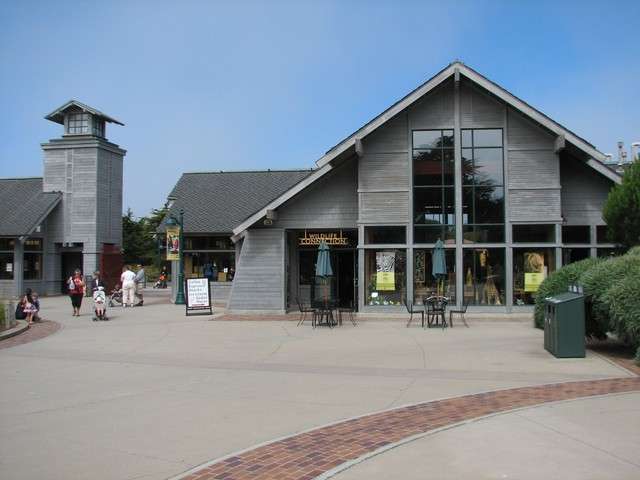
Part of the Main Entrance complex:
African Region is composed of 3 exhibits. African Savanna is the largest and best, and houses a mixed-species collection of reticulated giraffe, plains zebra, greater kudu, scimitar-horned oryx, ostrich, marabou stork, and East African crowned crane. It is full of activity and a great introduction to the zoo; this is the exhibit seen from several viewing areas at the zoo entrance. The large bowl-like habitat is circled by a path with several wood viewing structures and decks around it; in addition, rocky tunnels lead below the habitat to an open viewing area in the middle of the exhibit, which is a great immersive feature. The habitat is full of rocks and deadfalls, gentle grassy slopes, several ponds, and even has creeps next to the middle viewing area composed of rocks and logs for privacy for smaller animals (smaller antelope have been in the mix in the past) where the larger ones do not fit. A great collection of South African plants around the perimeter, especially near the rocky tunnel entrances, helps create the theme, including tree aloe, pincushion, narrow leaf sugarbush, broad leaf sugarbush, conebush, red hot poker, soap aloe, and silver tree; these are in contrast to the mature Monterey cypress trees that dominate the background as well as parts of the habitat itself. It is very interesting how the California native cypresses are used as stand-ins for African trees, since their high broad canopies slightly resemble those of some of the acacias familiar to these species. The whole exhibit could be considered a hybrid; its structures and proximity to the Craftsmen-style entrance are definitely not African pretenses, and there are no wrecked safari vehicles or Masai bomas or native drums in the viewing areas. Yet the landscape itself recalls the savanna in a unique way. The low hoofstock barn is in the far background, while the giraffe barn is near a path and can be entered by visitors when it is open for demonstration. Bronze statues of lions overlook the savanna, but the actual lions at the zoo are located in far older surroundings in a different region. Near the savanna is a medium-sized walkthrough African Aviary built at the same time; it contains Guenthers dik-dik, African open-billed stork, Hadada ibis, and Waldrapp ibis, and I also spotted some peafowl. It is a wood-and-netted high enclosure with thick planting and a small pond, entered on either side from a small shack. Nearby is the older exhibit in this region, Gorilla Preserve, from 1980. For its time, it was fairly nice, but today is average. It is a large grassy open yard dotted with trees and a few rock outcrops, and is viewed from several raised railings perched above its plain containment walls around much of the perimeter.
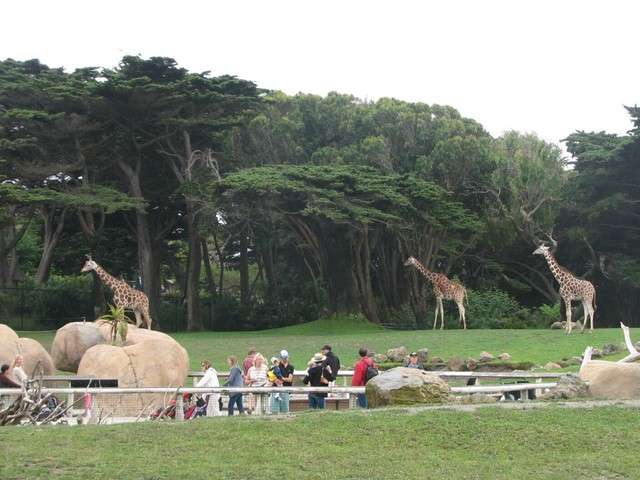
African Savanna Exhibit in African Region:
Primate Discovery Center consists of 3 adjacent exhibit areas from different eras. Lemur Forest is the newest and most successful, consisting of 3 steel-and-mesh plant-filled exhibits connected to one another and a very large open habitat that has a water moat on three sides. The mesh exhibits have climbing structures within, and matching ones also are in the shared yard. These exhibits are viewed from an attractive elevated boardwalk full of good graphics and even a keeper interaction area at the side of one of them. The species include ring-tailed lemur, red ruffed lemur, black-and-white ruffed lemur, and black lemur; all of them are on display in the main yard at one time. The main yard is also viewed from several areas around its perimeter, and it is filled with grass and many mature Monterey cypresses that the lemurs can climb as well, making it one of the best exhibits for these species I have seen, if not the most naturalistic one. The adjacent exhibit complex that gives this region of the zoo its name is an attractive one from 1985, a two-level mostly outdoor area of steel cages with curved roofs in an area of modern concrete stairways and terraces and walls. 1 exhibit is a small one indoors with a dark indoor viewing area: it is Aye-aye Forest, and it was not open when I visited. According to a docent, it is often closed, especially when there are signs of possible breeding. It is unfortunate since it is one of only 5 US zoos where they can be seen, but understandable. 5 of the outdoor exhibits are in a row and viewed from lower and upper levels through wire; they are not very large or detailed ones, but they do feature satisfactory height. They are for Francois langur, black howler monkey, siamang, temporarily empty, and lion-tailed macaque. 2 smaller one-level indoor exhibits behind glass are for emperor tamarin and pied tamarin. There is a large central tall building with curved roofs that used to be an interpretive graphics room but is now a gift shop. At the back of the building is a too-small outdoor wire cage for black-and-white colobus monkey; I think it was originally a smaller holding area for a much larger steel-and-mesh former exhibit, whose foundations can still be seen. The best exhibits in this complex are two adjacent planted yards within walled enclosures without overhead containment for mandrill and Patas monkey, the latter being notably larger and more detailed than the others. Both can be viewed from several areas around their perimeters. The last exhibit complex in this region is from the 1960s and it is awful; 2 small round moated yards with some ugly play equipment for chimpanzee. There is a third identical yard in the back but it is no longer seen from a closed path, so I am not sure if it is occupied or not; either way, these habitats are a lowpoint of the zoo.
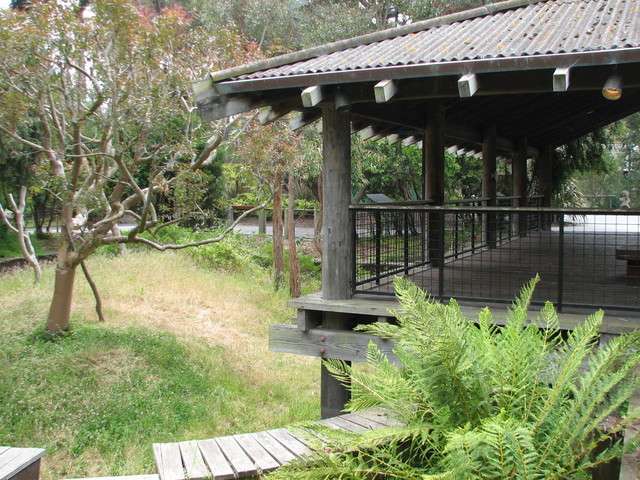
Patas Monkey Exhibit in Primate Discovery Center:

Childrens Zoo is a fine and rather large area of various facilities connected by small winding paths. Most of it was built or renovated in the last 20 years. It has a single entrance, although it can also be accessed from an education building that adjoins it and the zoo entrance area. It begins with an area of exhibits for companion animals, including small wood-and-wire houses for domestic mice and lovebirds as well as a low-fenced yard for rabbits and guinea pigs. Nature Trail is a nearby loop path with an average fenced yard for wild turkey; it also has about 15 stations with log benches or little fenced enclosures. When the stations are staffed by young volunteers, each features a small animal, many of them for supervised contact. I am not very sensitive to youth education programs, but this one seems to be an excellent and accessible way for youngsters to enjoy and learn about animals from their older peers. Nearby is a rope spiderweb play structure at the entrance to a small unimpressive building; it is the Insect Zoo, and although its exhibit room and small terrariums are clearly over 30 years old, its collection is very fine compared to many other zoos. Small feature exhibits in glass-and-wood boxes are for honey bee (connected via a tube to the outside world), dampwood termite, red harvester ant, and wood ant. The glass terrariums are for:
Anise swallowtail caterpillar
Antilles pinktoe tarantula
Australian walkingstick
Black widow spider
Chilean rose tarantula
Costa Rica zebra tarantula
Costa Rican tiger rump tarantula
Darkling beetle
Dermestid beetle
Dung beetle
Giant African millipede
Giant desert centipede
Giant hairy scorpion
Giant water bug
Grey death feigner
Indian ornamental tarantula
Jumping spider
Land hermit crab
Leaf insect
Madagascar hissing cockroach
Mexican redknee tarantula
Oriental cockroach
Silk moth
Thai walkingstick
Thorny phasmid
Trinidad wood cockroach
Velvet ant
White-eyed assassin bug
Yellow spotted water beetle
Clearly this should be renamed to include arachnids, but it is a nice feature. There is also an area of exhibits along a path for native American animals, including a nice waterfowl lagoon, a small open yard and pond for freshwater aquatic turtles, and small wood-and-wire planted exhibits for white-nosed coati, macaw (scarlet?), and squirrel monkey. Family Farm is a nice complex of barns connected by a very large domestics contact yard on the edge of another waterfowl pond. There are additional paddocks for other domestics beyond the edges of the contact area, and one barn has a wall terrarium for rat snake as well. Hawk Hill is a small grassy area with perches for tethered raptors, who normally live in small wire cages nearby. The zoo seems to have a good collection and education program with them. A small wood-and-wire aviary for turkey vulture is also adjacent. The raptor area leads to the Animal Resource Center, another barn-like building similar to the others around the Childrens Zoo. This one is only open at certain times, but its front windows view the interior and its many cages for the small animals used in the education programs. It also serves as the housing for terrariums for San Francisco garter snake and Western pond turtle conservation programs. The last exhibit area of the Childrens Zoo is the best: it is composed of side-by-side open yards behind simulated rock and glass railings for meerkat and black-tailed prairie dog. Between them are play elements for digging in sand and drinking while protected by a lookout, as well as sandstone bank cutaway displays of the tunnel systems both species create. There are also a few little tunnels to walk through and a spyhole in the rock that is directed at a simulated cobra atop a nearby rock. Although the close grouping of these two species is not geographically correct, their common attributes are illuminated well here.
Black-tailed Prairie Dog Exhibit in Childrens Zoo:

A large area of the map that is adjacent to the Childrens Zoo is not identified as a specific region, and has a variety of minor features. The Mothers Building is a 1920s Mediterranean Revival formal edifice that is empty and deteriorating badly; it was originally a facility for mothers caring for their infants, and later a gift shop. It is on the edge of a large lawn and playground area that includes a small historic food stand that is still in use, the Playfield Café. Also nearby is the Carousel, a 1920s Dentzel model housed in a round wood domed structure. A larger and more modern food facility is Leaping Lemur Café, in a large wood domed structure that must have been inspired by the historic one nearby. In front of this café is a nice average yard behind low fencing for flamingo. Beyond that is a standard row of 5 small older cages for birds: one for green-winged macaw, one for white-cheeked turaco, marbled teal, and long-tailed glossy-starling, one for kookaburra, plumed whistling duck, and white-faced whistling duck, one for lesser vasa parrot, and one for great hornbill. A much larger bird exhibit ends this unnamed region of the zoo: it used to be a walkthrough bird feeding exhibit that began the Australian exhibit area, but it now houses Southern ground hornbill. Some of the outback theming is still on the outside, including the former entrance shacks. However, the former interior path and railings appear to be gone. It is still a fairly nice exhibit within its roomy wood-and-netting enclosure. It is hard to believe that the popularity of similar bird-feeding (usually lorikeets) exhibits did not justify keeping this one open!
Outback Trail is an area of 3 Australian exhibits. It begins with Koala Crossing, a large yard with trees surrounded by an undulating low wood wall to contain koalas. One side of it is viewed from a raised deck, which also adjoins a small modern wood building with a window into a small interior holding room with standard perches and a eucalyptus mural on the walls. Australian Walkabout is a large mixed-species yard that slopes away from a long curved path for viewing Eastern gray kangaroo, red kangaroo, and common wallaroo (there also may be emu inside). Adjacent is a smaller sloped fenced yard with heavy tree cover for double-wattled cassowary. All 3 exhibits are average but nice, and are more believable with the large stands of eucalyptus in the background.
Koala Crossing in Outback Trail:
South America is on the edge of one of the informal park-like clearings on the property, and features a large marshy lagoon for American white pelican that is quite scenic. Nearby is the Tropical Forest Aviary, a 1940 large white stucco building in the modern style of its time that is currently closed for asbestos removal! In past visits I recall the interior being a large skylit room with a lush jungle interior, mostly for free-flying birds but also featuring a few reptile exhibits. Outside is a long fenced yard that is empty, next to a 1940 rocky pool that is also empty; it was formerly a pinniped exhibit, and I think most recently was used for rehabilitating local elephant seals. Puente al Sur is a more modern exhibit complex of a few enclosures, and begins with a small building with window views into a small room for great currasow who also have access to a small aviary in the back. There is also a window view into a giant anteater bedroom. Back outside, there is a small fenced yard for giant anteater, and a much larger fenced grassy yard for giant anteater and black-necked swan and a species of duck. These are viewed across a small pond from a deck, and the yard is sloped and fairly naturalistic. There is also a wood-and netted aviary for Maguari stork here. Although Puente al Sur has a theme, like much of the zoo it is not especially evocative of that theme, is several exhibits short of feeling like a complete experience, and is generally of cheap exhibit quality.
Bear Country is also on the edge of the same clearing as South America and begins with a row of 5 similar moated bear grottos from 1940 that are certainly past their prime. For what they are, they do have a good ground-to-wall ratio, meaning that they feel more open (not larger) than many others I have seen. The first is for Andean bear; next are three that have been joined for polar bear; and finally, one for grizzly bear, which is combined with a recent and larger adjoining exhibit yard for the same species. Four of the five still have concrete substrate, with the exception being the middle grotto for polar bear. The newer exhibit is called Grizzly Gulch, and is viewed from several modern concrete-framed windows as well as some set in a simulated rock outcrop. The yard is large and fenced with unpainted galvanized fencing, so that it is too obvious; however, the space and reasonable naturalism and natural substrate are far superior to the grottos. Inside it are fallen logs, grass, and plentiful shrubs. There is also a rock mound with a waterfall-from–nowhere spilling down it, into a nice shallow pool that adjoins a viewing window in a small modern pavilion for watching any splash play. Viewing area features include a bronze statue of a bear, a flagpole for the state flag (which features the grizzly) and a bronze wall sculpture with a dedication above it to Monarch (the last known wild grizzly of the state who was captured and became the inspiration for the state flag depiction in the late 1800s). There are also some nice paving details such as bear tracks that are continued in the exhibit pool floor, but the overall design of the features and viewing areas is a bit hodge-podge. Nearby is Eagle Island, a small wooded island in the middle of a historic scenic pond area for bald eagle. The resident can not fly, so does not escape the uncaged habitat. At one time, the zoo had a great bald eagle breeding and releasing program with over 100 chicks raised, but it was not on this island, which I think has always been for injured or unreturnable birds. Oddly, there is also a nice average yard for warthog nearby, which at one time was seen further from a path that connected several other hoofstock yards nearby; the path is now closed for no apparent reason. Terrace Café is another 1940 modern-style building, a food facility with outdoor terrace seating overlooking the waterway and bear grottos beyond. Part of Bear Country and South America is circled by Little Puffer, a historic miniature train with a scenic route.
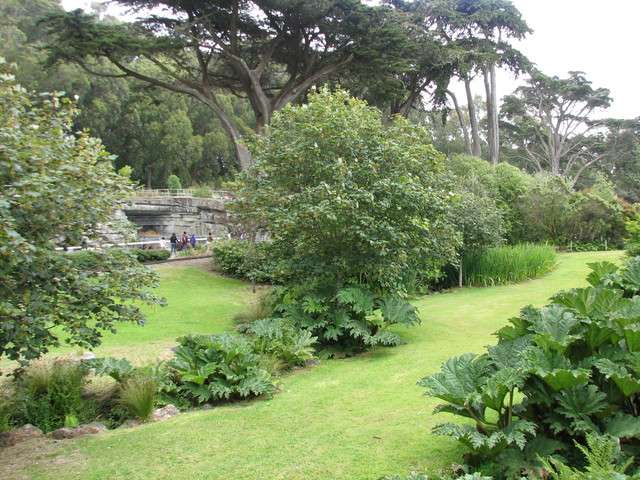
The grounds in Bear Country, with bear grottos in the background:
Cat Kingdom is the most concentrated region of exhibits and is centered on a formal plaza surrounded by two historic 1940 buildings. The area has more varieties of animals than felines, so it is not well-named, and it is the most disappointing region of the zoo with many poor enclosures. I am not convinced that it was ever really satisfactory, or that careful renovation would be worthwhile for the bland structures. The plaza itself has a large circular fountain at one end and a staircase flanked by historic lion sculptures. A few sets of long-abandoned small grottos are nearby, as if awaiting careful preservation in this preservation-obsessed city. The majority of the plaza is a long rectangular low-fenced yard for a large colony of Magellanic penguins, mostly occupied by a shallow pool but also featuring a dry island with a burrow mound. It is not attractive, but notable for being the home of the male-male pair that were a couple for 6 years before they broke up! The other end of the plaza has a small round yard behind glass railings for river otter which has been decently renovated but is rather small. Pachyderms is one of the flanking buildings, and its interior is thankfully closed. On its exterior are several poor plain-walled rectangular yards with little detail. One is for a gray seal, who is 40 years old and has outlived the usual life expectancy. Apparently it is kinder to let a senior live out its life in familiar surroundings than move it to a better exhibit, and this one is a dump. It has a small oval pool in the center of a concrete yard, with a giant cloudy sky mural painted on the entire side of the bland building which forms the backdrop. Blech! Next door is a Bairds tapir exhibit that is nearly as bad but lacks a mural. Next to that is a similar one that is mercifully empty. A much larger yard is for greater one-horned rhinoceros and is probably the result of combining several former smaller yards; it is viewed behind hefty steel pole-and-cable fencing and has some old clumsy rockwork behind a swimming pool with a waterfall and trees that at least obscure the stucco building behind. There is also a smaller yard for black swan on the side of the building. Lion House is the other building on the other side of the plaza, and it is nearly as unattractive. This building can still be entered for part of the day, and inside is a large rectangular room with all the small indoor bedrooms for the felines behind bars. It is very archaic and I see little benefit in allowing any public access to this area. Three of the smallest bedrooms are for fishing cat, and they rotate into a small outdoor wire cage on the front side of the building facing the plaza which is small and below average in detail, although it does have a pond inside. There are 4 large cat grottos on the backside of the building, and they are for Sumatran tiger, two for African lion (separate), and Siberian tiger. They are average grottos for their era, but they all have natural substrate and grass, trees, and shrubs. They were formerly viewed across moats, but the front viewing areas have been converted to window views set in rather slick metal frames and arbors set on a concrete base, which adds a great deal of height to the moat depth; of course, they were added after one of the Siberian tigers escaped by climbing the moat and killing a visitor a few years ago. There are also multiple bands of electrified wire around the top of the rockwork walls, and the Siberian tiger exhibit even has a fence several feet in front of the moat so that they can not approach it! There is also a snow leopard exhibit on the side of the building, a rather mundane yard against the building with little detail, contained by wood-and-netting with a small window viewing shelter on one side. The feline viewing at the zoo was once more extensive because a separate newer area at the back of the zoo had many small netted enclosures for breeding smaller cats, but access to it is now closed. Near the grottos are a few larger average hoofstock yards: a grassy sloped fenced one for giant eland with a moat in front, and a steel-pole-and-cable fronted one with a separate back yard for Eastern black rhinoceros. When it was renovated not long ago, a small hippo exhibit next to it was included, but it is now empty. Near the Cat Kingdom plaza is also a nice large grassy yard for blackbuck, but it is unsigned and only viewed from one side; a path that led further around it and to other hoofstock yards (eventually reaching the previously described warthog exhibit) is closed.
San Francisco Zoo is obviously an aging and ailing facility, and the reasons for this seem complex. It is operated by a society but owned by the city, so subject to random budget constraints; city support resources seem to be siphoned elsewhere for other improvement projects most of the time. The region in general has many people who do not support the idea of animals in captivity; in addition, many locals I have met have never visited the zoo. The region is also home to so many other attractions that this one gets lost in the mix. However, its prescence is certainly obvious to the many public transit riders, since one of the main light rail lines ends a block from the zoo and is titled as such, resulting in free advertising. The weather may also be a factor; many summer days are gloomy here, while just a few miles inland it is sunny and warmer, discouraging some visitors. Recent incidents have certainly not helped, with the famous tiger mauling and later escape and killing, the grizzly bear exhibit intrusion, and awareness of antiquated habitats. It ranks at number 41 of the 55 zoos I have visited; this relatively high rank for the lower quality of the facility comes from its larger size and collection and unique grounds compared to others that are lower on the list. The front of the zoo also adds to its rank, with the African Savanna exhibit coming in at number 17 in my top 25 large mammals individual exhibit category, and its entrance area and Childrens Zoo being assets as well. If I had a top lemur exhibit list, it would make that list too, also near the front of the zoo. General adult admission is $15, which is $4 overpriced currently. I have added additional pictures in the gallery.
Part of the Main Entrance complex:

African Region is composed of 3 exhibits. African Savanna is the largest and best, and houses a mixed-species collection of reticulated giraffe, plains zebra, greater kudu, scimitar-horned oryx, ostrich, marabou stork, and East African crowned crane. It is full of activity and a great introduction to the zoo; this is the exhibit seen from several viewing areas at the zoo entrance. The large bowl-like habitat is circled by a path with several wood viewing structures and decks around it; in addition, rocky tunnels lead below the habitat to an open viewing area in the middle of the exhibit, which is a great immersive feature. The habitat is full of rocks and deadfalls, gentle grassy slopes, several ponds, and even has creeps next to the middle viewing area composed of rocks and logs for privacy for smaller animals (smaller antelope have been in the mix in the past) where the larger ones do not fit. A great collection of South African plants around the perimeter, especially near the rocky tunnel entrances, helps create the theme, including tree aloe, pincushion, narrow leaf sugarbush, broad leaf sugarbush, conebush, red hot poker, soap aloe, and silver tree; these are in contrast to the mature Monterey cypress trees that dominate the background as well as parts of the habitat itself. It is very interesting how the California native cypresses are used as stand-ins for African trees, since their high broad canopies slightly resemble those of some of the acacias familiar to these species. The whole exhibit could be considered a hybrid; its structures and proximity to the Craftsmen-style entrance are definitely not African pretenses, and there are no wrecked safari vehicles or Masai bomas or native drums in the viewing areas. Yet the landscape itself recalls the savanna in a unique way. The low hoofstock barn is in the far background, while the giraffe barn is near a path and can be entered by visitors when it is open for demonstration. Bronze statues of lions overlook the savanna, but the actual lions at the zoo are located in far older surroundings in a different region. Near the savanna is a medium-sized walkthrough African Aviary built at the same time; it contains Guenthers dik-dik, African open-billed stork, Hadada ibis, and Waldrapp ibis, and I also spotted some peafowl. It is a wood-and-netted high enclosure with thick planting and a small pond, entered on either side from a small shack. Nearby is the older exhibit in this region, Gorilla Preserve, from 1980. For its time, it was fairly nice, but today is average. It is a large grassy open yard dotted with trees and a few rock outcrops, and is viewed from several raised railings perched above its plain containment walls around much of the perimeter.
African Savanna Exhibit in African Region:

Primate Discovery Center consists of 3 adjacent exhibit areas from different eras. Lemur Forest is the newest and most successful, consisting of 3 steel-and-mesh plant-filled exhibits connected to one another and a very large open habitat that has a water moat on three sides. The mesh exhibits have climbing structures within, and matching ones also are in the shared yard. These exhibits are viewed from an attractive elevated boardwalk full of good graphics and even a keeper interaction area at the side of one of them. The species include ring-tailed lemur, red ruffed lemur, black-and-white ruffed lemur, and black lemur; all of them are on display in the main yard at one time. The main yard is also viewed from several areas around its perimeter, and it is filled with grass and many mature Monterey cypresses that the lemurs can climb as well, making it one of the best exhibits for these species I have seen, if not the most naturalistic one. The adjacent exhibit complex that gives this region of the zoo its name is an attractive one from 1985, a two-level mostly outdoor area of steel cages with curved roofs in an area of modern concrete stairways and terraces and walls. 1 exhibit is a small one indoors with a dark indoor viewing area: it is Aye-aye Forest, and it was not open when I visited. According to a docent, it is often closed, especially when there are signs of possible breeding. It is unfortunate since it is one of only 5 US zoos where they can be seen, but understandable. 5 of the outdoor exhibits are in a row and viewed from lower and upper levels through wire; they are not very large or detailed ones, but they do feature satisfactory height. They are for Francois langur, black howler monkey, siamang, temporarily empty, and lion-tailed macaque. 2 smaller one-level indoor exhibits behind glass are for emperor tamarin and pied tamarin. There is a large central tall building with curved roofs that used to be an interpretive graphics room but is now a gift shop. At the back of the building is a too-small outdoor wire cage for black-and-white colobus monkey; I think it was originally a smaller holding area for a much larger steel-and-mesh former exhibit, whose foundations can still be seen. The best exhibits in this complex are two adjacent planted yards within walled enclosures without overhead containment for mandrill and Patas monkey, the latter being notably larger and more detailed than the others. Both can be viewed from several areas around their perimeters. The last exhibit complex in this region is from the 1960s and it is awful; 2 small round moated yards with some ugly play equipment for chimpanzee. There is a third identical yard in the back but it is no longer seen from a closed path, so I am not sure if it is occupied or not; either way, these habitats are a lowpoint of the zoo.
Patas Monkey Exhibit in Primate Discovery Center:

Childrens Zoo is a fine and rather large area of various facilities connected by small winding paths. Most of it was built or renovated in the last 20 years. It has a single entrance, although it can also be accessed from an education building that adjoins it and the zoo entrance area. It begins with an area of exhibits for companion animals, including small wood-and-wire houses for domestic mice and lovebirds as well as a low-fenced yard for rabbits and guinea pigs. Nature Trail is a nearby loop path with an average fenced yard for wild turkey; it also has about 15 stations with log benches or little fenced enclosures. When the stations are staffed by young volunteers, each features a small animal, many of them for supervised contact. I am not very sensitive to youth education programs, but this one seems to be an excellent and accessible way for youngsters to enjoy and learn about animals from their older peers. Nearby is a rope spiderweb play structure at the entrance to a small unimpressive building; it is the Insect Zoo, and although its exhibit room and small terrariums are clearly over 30 years old, its collection is very fine compared to many other zoos. Small feature exhibits in glass-and-wood boxes are for honey bee (connected via a tube to the outside world), dampwood termite, red harvester ant, and wood ant. The glass terrariums are for:
Anise swallowtail caterpillar
Antilles pinktoe tarantula
Australian walkingstick
Black widow spider
Chilean rose tarantula
Costa Rica zebra tarantula
Costa Rican tiger rump tarantula
Darkling beetle
Dermestid beetle
Dung beetle
Giant African millipede
Giant desert centipede
Giant hairy scorpion
Giant water bug
Grey death feigner
Indian ornamental tarantula
Jumping spider
Land hermit crab
Leaf insect
Madagascar hissing cockroach
Mexican redknee tarantula
Oriental cockroach
Silk moth
Thai walkingstick
Thorny phasmid
Trinidad wood cockroach
Velvet ant
White-eyed assassin bug
Yellow spotted water beetle
Clearly this should be renamed to include arachnids, but it is a nice feature. There is also an area of exhibits along a path for native American animals, including a nice waterfowl lagoon, a small open yard and pond for freshwater aquatic turtles, and small wood-and-wire planted exhibits for white-nosed coati, macaw (scarlet?), and squirrel monkey. Family Farm is a nice complex of barns connected by a very large domestics contact yard on the edge of another waterfowl pond. There are additional paddocks for other domestics beyond the edges of the contact area, and one barn has a wall terrarium for rat snake as well. Hawk Hill is a small grassy area with perches for tethered raptors, who normally live in small wire cages nearby. The zoo seems to have a good collection and education program with them. A small wood-and-wire aviary for turkey vulture is also adjacent. The raptor area leads to the Animal Resource Center, another barn-like building similar to the others around the Childrens Zoo. This one is only open at certain times, but its front windows view the interior and its many cages for the small animals used in the education programs. It also serves as the housing for terrariums for San Francisco garter snake and Western pond turtle conservation programs. The last exhibit area of the Childrens Zoo is the best: it is composed of side-by-side open yards behind simulated rock and glass railings for meerkat and black-tailed prairie dog. Between them are play elements for digging in sand and drinking while protected by a lookout, as well as sandstone bank cutaway displays of the tunnel systems both species create. There are also a few little tunnels to walk through and a spyhole in the rock that is directed at a simulated cobra atop a nearby rock. Although the close grouping of these two species is not geographically correct, their common attributes are illuminated well here.
Black-tailed Prairie Dog Exhibit in Childrens Zoo:

A large area of the map that is adjacent to the Childrens Zoo is not identified as a specific region, and has a variety of minor features. The Mothers Building is a 1920s Mediterranean Revival formal edifice that is empty and deteriorating badly; it was originally a facility for mothers caring for their infants, and later a gift shop. It is on the edge of a large lawn and playground area that includes a small historic food stand that is still in use, the Playfield Café. Also nearby is the Carousel, a 1920s Dentzel model housed in a round wood domed structure. A larger and more modern food facility is Leaping Lemur Café, in a large wood domed structure that must have been inspired by the historic one nearby. In front of this café is a nice average yard behind low fencing for flamingo. Beyond that is a standard row of 5 small older cages for birds: one for green-winged macaw, one for white-cheeked turaco, marbled teal, and long-tailed glossy-starling, one for kookaburra, plumed whistling duck, and white-faced whistling duck, one for lesser vasa parrot, and one for great hornbill. A much larger bird exhibit ends this unnamed region of the zoo: it used to be a walkthrough bird feeding exhibit that began the Australian exhibit area, but it now houses Southern ground hornbill. Some of the outback theming is still on the outside, including the former entrance shacks. However, the former interior path and railings appear to be gone. It is still a fairly nice exhibit within its roomy wood-and-netting enclosure. It is hard to believe that the popularity of similar bird-feeding (usually lorikeets) exhibits did not justify keeping this one open!
Outback Trail is an area of 3 Australian exhibits. It begins with Koala Crossing, a large yard with trees surrounded by an undulating low wood wall to contain koalas. One side of it is viewed from a raised deck, which also adjoins a small modern wood building with a window into a small interior holding room with standard perches and a eucalyptus mural on the walls. Australian Walkabout is a large mixed-species yard that slopes away from a long curved path for viewing Eastern gray kangaroo, red kangaroo, and common wallaroo (there also may be emu inside). Adjacent is a smaller sloped fenced yard with heavy tree cover for double-wattled cassowary. All 3 exhibits are average but nice, and are more believable with the large stands of eucalyptus in the background.
Koala Crossing in Outback Trail:

South America is on the edge of one of the informal park-like clearings on the property, and features a large marshy lagoon for American white pelican that is quite scenic. Nearby is the Tropical Forest Aviary, a 1940 large white stucco building in the modern style of its time that is currently closed for asbestos removal! In past visits I recall the interior being a large skylit room with a lush jungle interior, mostly for free-flying birds but also featuring a few reptile exhibits. Outside is a long fenced yard that is empty, next to a 1940 rocky pool that is also empty; it was formerly a pinniped exhibit, and I think most recently was used for rehabilitating local elephant seals. Puente al Sur is a more modern exhibit complex of a few enclosures, and begins with a small building with window views into a small room for great currasow who also have access to a small aviary in the back. There is also a window view into a giant anteater bedroom. Back outside, there is a small fenced yard for giant anteater, and a much larger fenced grassy yard for giant anteater and black-necked swan and a species of duck. These are viewed across a small pond from a deck, and the yard is sloped and fairly naturalistic. There is also a wood-and netted aviary for Maguari stork here. Although Puente al Sur has a theme, like much of the zoo it is not especially evocative of that theme, is several exhibits short of feeling like a complete experience, and is generally of cheap exhibit quality.
Bear Country is also on the edge of the same clearing as South America and begins with a row of 5 similar moated bear grottos from 1940 that are certainly past their prime. For what they are, they do have a good ground-to-wall ratio, meaning that they feel more open (not larger) than many others I have seen. The first is for Andean bear; next are three that have been joined for polar bear; and finally, one for grizzly bear, which is combined with a recent and larger adjoining exhibit yard for the same species. Four of the five still have concrete substrate, with the exception being the middle grotto for polar bear. The newer exhibit is called Grizzly Gulch, and is viewed from several modern concrete-framed windows as well as some set in a simulated rock outcrop. The yard is large and fenced with unpainted galvanized fencing, so that it is too obvious; however, the space and reasonable naturalism and natural substrate are far superior to the grottos. Inside it are fallen logs, grass, and plentiful shrubs. There is also a rock mound with a waterfall-from–nowhere spilling down it, into a nice shallow pool that adjoins a viewing window in a small modern pavilion for watching any splash play. Viewing area features include a bronze statue of a bear, a flagpole for the state flag (which features the grizzly) and a bronze wall sculpture with a dedication above it to Monarch (the last known wild grizzly of the state who was captured and became the inspiration for the state flag depiction in the late 1800s). There are also some nice paving details such as bear tracks that are continued in the exhibit pool floor, but the overall design of the features and viewing areas is a bit hodge-podge. Nearby is Eagle Island, a small wooded island in the middle of a historic scenic pond area for bald eagle. The resident can not fly, so does not escape the uncaged habitat. At one time, the zoo had a great bald eagle breeding and releasing program with over 100 chicks raised, but it was not on this island, which I think has always been for injured or unreturnable birds. Oddly, there is also a nice average yard for warthog nearby, which at one time was seen further from a path that connected several other hoofstock yards nearby; the path is now closed for no apparent reason. Terrace Café is another 1940 modern-style building, a food facility with outdoor terrace seating overlooking the waterway and bear grottos beyond. Part of Bear Country and South America is circled by Little Puffer, a historic miniature train with a scenic route.
The grounds in Bear Country, with bear grottos in the background:

Cat Kingdom is the most concentrated region of exhibits and is centered on a formal plaza surrounded by two historic 1940 buildings. The area has more varieties of animals than felines, so it is not well-named, and it is the most disappointing region of the zoo with many poor enclosures. I am not convinced that it was ever really satisfactory, or that careful renovation would be worthwhile for the bland structures. The plaza itself has a large circular fountain at one end and a staircase flanked by historic lion sculptures. A few sets of long-abandoned small grottos are nearby, as if awaiting careful preservation in this preservation-obsessed city. The majority of the plaza is a long rectangular low-fenced yard for a large colony of Magellanic penguins, mostly occupied by a shallow pool but also featuring a dry island with a burrow mound. It is not attractive, but notable for being the home of the male-male pair that were a couple for 6 years before they broke up! The other end of the plaza has a small round yard behind glass railings for river otter which has been decently renovated but is rather small. Pachyderms is one of the flanking buildings, and its interior is thankfully closed. On its exterior are several poor plain-walled rectangular yards with little detail. One is for a gray seal, who is 40 years old and has outlived the usual life expectancy. Apparently it is kinder to let a senior live out its life in familiar surroundings than move it to a better exhibit, and this one is a dump. It has a small oval pool in the center of a concrete yard, with a giant cloudy sky mural painted on the entire side of the bland building which forms the backdrop. Blech! Next door is a Bairds tapir exhibit that is nearly as bad but lacks a mural. Next to that is a similar one that is mercifully empty. A much larger yard is for greater one-horned rhinoceros and is probably the result of combining several former smaller yards; it is viewed behind hefty steel pole-and-cable fencing and has some old clumsy rockwork behind a swimming pool with a waterfall and trees that at least obscure the stucco building behind. There is also a smaller yard for black swan on the side of the building. Lion House is the other building on the other side of the plaza, and it is nearly as unattractive. This building can still be entered for part of the day, and inside is a large rectangular room with all the small indoor bedrooms for the felines behind bars. It is very archaic and I see little benefit in allowing any public access to this area. Three of the smallest bedrooms are for fishing cat, and they rotate into a small outdoor wire cage on the front side of the building facing the plaza which is small and below average in detail, although it does have a pond inside. There are 4 large cat grottos on the backside of the building, and they are for Sumatran tiger, two for African lion (separate), and Siberian tiger. They are average grottos for their era, but they all have natural substrate and grass, trees, and shrubs. They were formerly viewed across moats, but the front viewing areas have been converted to window views set in rather slick metal frames and arbors set on a concrete base, which adds a great deal of height to the moat depth; of course, they were added after one of the Siberian tigers escaped by climbing the moat and killing a visitor a few years ago. There are also multiple bands of electrified wire around the top of the rockwork walls, and the Siberian tiger exhibit even has a fence several feet in front of the moat so that they can not approach it! There is also a snow leopard exhibit on the side of the building, a rather mundane yard against the building with little detail, contained by wood-and-netting with a small window viewing shelter on one side. The feline viewing at the zoo was once more extensive because a separate newer area at the back of the zoo had many small netted enclosures for breeding smaller cats, but access to it is now closed. Near the grottos are a few larger average hoofstock yards: a grassy sloped fenced one for giant eland with a moat in front, and a steel-pole-and-cable fronted one with a separate back yard for Eastern black rhinoceros. When it was renovated not long ago, a small hippo exhibit next to it was included, but it is now empty. Near the Cat Kingdom plaza is also a nice large grassy yard for blackbuck, but it is unsigned and only viewed from one side; a path that led further around it and to other hoofstock yards (eventually reaching the previously described warthog exhibit) is closed.
San Francisco Zoo is obviously an aging and ailing facility, and the reasons for this seem complex. It is operated by a society but owned by the city, so subject to random budget constraints; city support resources seem to be siphoned elsewhere for other improvement projects most of the time. The region in general has many people who do not support the idea of animals in captivity; in addition, many locals I have met have never visited the zoo. The region is also home to so many other attractions that this one gets lost in the mix. However, its prescence is certainly obvious to the many public transit riders, since one of the main light rail lines ends a block from the zoo and is titled as such, resulting in free advertising. The weather may also be a factor; many summer days are gloomy here, while just a few miles inland it is sunny and warmer, discouraging some visitors. Recent incidents have certainly not helped, with the famous tiger mauling and later escape and killing, the grizzly bear exhibit intrusion, and awareness of antiquated habitats. It ranks at number 41 of the 55 zoos I have visited; this relatively high rank for the lower quality of the facility comes from its larger size and collection and unique grounds compared to others that are lower on the list. The front of the zoo also adds to its rank, with the African Savanna exhibit coming in at number 17 in my top 25 large mammals individual exhibit category, and its entrance area and Childrens Zoo being assets as well. If I had a top lemur exhibit list, it would make that list too, also near the front of the zoo. General adult admission is $15, which is $4 overpriced currently. I have added additional pictures in the gallery.

