Sabre, the conclusions you are drawing seem to be from very little information, not to mention as well as very little observation of the animals.
Now, you asked for others thoughts by making this thread and I don't want you to think I am coming after you. I fully understand where you are coming from. I used ot be against Sea World and other places that held cetaceans. Here are some facts you need to know.
Orcas, like other cetaceans, are nomadic IN nature. But there is a reason for this. They MUST travel to find food. Generally, most cetacean species, including orcas, will stick to a certain territory if it provides them with their needs.

Traveling hundreds of miles a day is certainly not mandatory for a killer whale's health or wellbeing.
To say a whale looks sad is very anthropomorphic. I am not saying that I do not believe these animals can experience sadness, however, let's try to refrain from applying those traits right off the bat.
You say that sometimes the whales look pale. I have never heard this. But what you probably saw is shedding skin. Orcas, like all cetaceans, shed their skin. When it starts, it appears as pale patches, which are very prominent on the pecs, back and melon (head).
Many other animals are bred in captivity and are not endangered.
There is a lot of enrichment for Sea World's killer whales in and out of showtime. However you seem to be under the impression that a happy animal equals one that is constantly active. Cetaceans rest, just like other animals. AFTER a show, I would find it no surprise that the animals would be floating or doing slow laps. Shows themselves offer enrichment, both mental and physical. Shows are changed daily by using different whales for different segments and asking them to do different behaviours. Some tools used for "play" to stimulate the animals (in and out of shows) include: ice, hoses, "toys" like large floating discs, balls, bouys and barrels, interactions like rubdowns and mimic play, and training exercises.
You mention limp dorsals. The dorsal fin has nothing to do with how the animal may be feeling. It does not droop because an animal is "sad", but rather because of gravity. You see, the dorsal is made of cartilidge, like your nose and ears. There are some orcas that have flopped fins in the wild, but it's not very common. If the stiffness/droop of a killer whale's dorsal had something to do with their health (some activists are now saying it may be caused by dehydration), I would have some serious questions about that. For instance why was Oscar's (a Kamogawa SW whale) fin straight for such a long time before it began to droop? Or, why is Ulises' fin only curved at the top, while other Sea World males have completely flopped dorsals? Some females have flopped fins, like Katina. But Corky, another female whose fin stands nearly three to four feet, has a perfectly straight fin. Like people, the bodies of whales are different. Others' succumb to gravity much easier.
Orcas are extremely social as you may know. Recently I have been watching the Shamu Cam, and it is incredible to see the positive interaction between newly arrived Keet and a female, Orkid. Orcas in captivity interact with one another well, as long as they have a proper and stable pod dynamic, which needs a dominant female. Katina is the matriarch at Orlando, While Kasatka and Takara run the San Diego and San Antonio pods. A bad example is Loro Park, in Spain. They only have very young whales, and no matriach, so they have a bad dynamic.
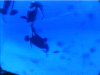
I have included a screen cap I just took tonight of Keet and Orkid, in San Diego, interacting. They are the ones face to face.


 ].)
].)