Today marked my first visit to the place in 20 years, and I'm happy to say things look very much improved over that previous visit. I could not find fault with the vast majority of what I saw, though some exhibits I wanted to visit were closed for renovation.
I would say, based on today's visit, that if the zoo can weather the financial storm caused by that absurd award in the tiger-attack case (and may the recipients of that award choke on it), they will come out the stronger for it, and will likely continue to grow and evolve.
WHAT I LIKED...
All the critters I looked at seemed very healthy, physically and mentally. I couldn't find any evidence of pacing behavior, or other signs of boredom. I also had the opportunity to ask pointed questions of numerous keepers, and was pleased to receive informative and honest answers. No dodging or sugar-coating here! In fact, this is one zoo which seems to be very big on 'enrichment,' such as tucking food treats into challenging-to-get-to spots in animals' toys.
The improvements, in such areas as the 'African Savannah,' were very noticeable. The portion of that area I saw, containing giraffe, ostrich, and a couple of pheasants, was among the most well-designed I'd ever seen. The Lemur Forest was another treat, offering loads of climbing and sheltering space and toys, as well as excellent photo opportunities (assuming you have something better than a 'toy' digital camera).
The children's zoo area has also been through much change. The Nature Trail is a great idea, though I feel they should be using volunteers who are a bit older to staff the areas. 'Hawk Hill' is another good one, but the staff could use serious improvements in their raptor-handling techniques (I'll get to that in a minute).
One thing I particularly like is the zoo makes extensive use of the native plants, growing right on their own property, for both food and walkway coverings. The Animal Resource Center actually has their own vegetable garden, which they draw from for food for the reptiles and other herbivores.
The food for us two-leggers is also pretty good, IF you know where to go and what to order. My contact recommended the 'Leaping Lemur' cafe, and the 'Daily Special,' and I'm pleased to say she was right on. Today's special was roasted chicken with mushroom sauce, mashed potato, and roasted veggies. Eminently edible, and a pretty good deal for about $8 ($10 or so with a drink).
I don't think too many people even knew the special existed. I saw way too many folks chowing down on these hideous-looking corn dogs, burgers, etc. Bleh...
WHAT I THINK NEEDS HELP...
I mentioned raptor-handling techniques above. I saw some serious problems with what they're currently doing, based on my own training.
For starters (and this is one that always drives me nucking futz): NO ONE I saw who was handling a bird had the leash tied off to the D-ring on their glove! All they did was get the jesses between their second and third fingers (which, granted, is correct), and simply coil the free end of the leash around their third and little finger.
I've seen a similar practice at Woodland Park Zoo, and I'm beginning to worry that it might be endemic to still more zoos. Granted, it used to be accepted practice -- decades ago! It has since been discredited in contemporary practice.
The reason it's such a Bad Thing, particularly with a flight-capable bird, is if the bird gets loose with the leash attached, they're dead. Period. No arguments, precious little opportunity for intervention. The leash will invariably get snagged in a tree or similar obstacle, and the bird will end up dangling upside down by it. This WILL kill them. Ask any falconer.
As one might imagine, it's a lot easier for the bird to pull out the unsecured slack loop of a leash than it is to pull apart a proper falconer's knot.
Second problem: Volunteers "towering" over some of the birds before picking them up. No creature likes to be towered over by anything bigger, and it will make a raptor far more edgy and harder to handle.
Third: Risky feeding technique. During the afternoon feeding, I watched one volunteer, who was giving their peregrine falcon half a quail at the time, reach down to pick up a dropped piece of said quail with her free hand, and offer it back to the bird with that same hand.
This is Not Good because you don't want a bird associating your fingers with food. The correct way to do it is either pass it back up through the lower part of your glove, or place it quickly on top while the bird is already distracted by horking down a different part of the meal. You DO NOT simply hand it to them!
One other thing I think could use improvement, honestly, is the gift shop. Their assortment of merchandise varied between the usual low-end/cheesy touristy stuff and beautifully-done but very high-priced stuff, such as a pair of carved-wood bald-eagle bookends ($119!)
Where's the middle ground in this? Used to be a lot of zoos would carry nice series of nature-print T-shirts, all with wonderful artwork on them of various animals. Why do I not see those any more? Or other stuff aimed at the middle range, such as birdwatching books or nature videos?
Another area I think could use some improvement can be found at "Eagle Island." The pond surrounding this island is almost completely choked over with pale-green algae growth. Not even the numerous free-wandering waterfowl in the park will have anything to do with it. It should be cleaned up.
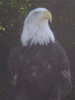
As for putting one of their bald eagles on exhibit on this island: I don't see a problem for the bird, but it's too far away for any type of decent viewing. I was able to get a good look -- barely -- only because my camera has a 400mm zoom lens. For those who are not as serious about their camera gear, or are just looking with unaided eyes, it's pretty much a lost cause.
As for their keeper talks -- where the keeper of a given exhibit shows up at said exhibit, at specific times of the day, to answer questions from the public and explain about the critter involved -- they're a great idea, but I think the zoo should look at making them year-round as opposed to summer-seasonal only.
That's all I can think of at the moment. If anyone has specific questions, please post them. I will answer as best I can.
Happy travels.
I would say, based on today's visit, that if the zoo can weather the financial storm caused by that absurd award in the tiger-attack case (and may the recipients of that award choke on it), they will come out the stronger for it, and will likely continue to grow and evolve.
WHAT I LIKED...
All the critters I looked at seemed very healthy, physically and mentally. I couldn't find any evidence of pacing behavior, or other signs of boredom. I also had the opportunity to ask pointed questions of numerous keepers, and was pleased to receive informative and honest answers. No dodging or sugar-coating here! In fact, this is one zoo which seems to be very big on 'enrichment,' such as tucking food treats into challenging-to-get-to spots in animals' toys.
The improvements, in such areas as the 'African Savannah,' were very noticeable. The portion of that area I saw, containing giraffe, ostrich, and a couple of pheasants, was among the most well-designed I'd ever seen. The Lemur Forest was another treat, offering loads of climbing and sheltering space and toys, as well as excellent photo opportunities (assuming you have something better than a 'toy' digital camera).
The children's zoo area has also been through much change. The Nature Trail is a great idea, though I feel they should be using volunteers who are a bit older to staff the areas. 'Hawk Hill' is another good one, but the staff could use serious improvements in their raptor-handling techniques (I'll get to that in a minute).
One thing I particularly like is the zoo makes extensive use of the native plants, growing right on their own property, for both food and walkway coverings. The Animal Resource Center actually has their own vegetable garden, which they draw from for food for the reptiles and other herbivores.
The food for us two-leggers is also pretty good, IF you know where to go and what to order. My contact recommended the 'Leaping Lemur' cafe, and the 'Daily Special,' and I'm pleased to say she was right on. Today's special was roasted chicken with mushroom sauce, mashed potato, and roasted veggies. Eminently edible, and a pretty good deal for about $8 ($10 or so with a drink).
I don't think too many people even knew the special existed. I saw way too many folks chowing down on these hideous-looking corn dogs, burgers, etc. Bleh...
WHAT I THINK NEEDS HELP...
I mentioned raptor-handling techniques above. I saw some serious problems with what they're currently doing, based on my own training.
For starters (and this is one that always drives me nucking futz): NO ONE I saw who was handling a bird had the leash tied off to the D-ring on their glove! All they did was get the jesses between their second and third fingers (which, granted, is correct), and simply coil the free end of the leash around their third and little finger.
I've seen a similar practice at Woodland Park Zoo, and I'm beginning to worry that it might be endemic to still more zoos. Granted, it used to be accepted practice -- decades ago! It has since been discredited in contemporary practice.
The reason it's such a Bad Thing, particularly with a flight-capable bird, is if the bird gets loose with the leash attached, they're dead. Period. No arguments, precious little opportunity for intervention. The leash will invariably get snagged in a tree or similar obstacle, and the bird will end up dangling upside down by it. This WILL kill them. Ask any falconer.
As one might imagine, it's a lot easier for the bird to pull out the unsecured slack loop of a leash than it is to pull apart a proper falconer's knot.
Second problem: Volunteers "towering" over some of the birds before picking them up. No creature likes to be towered over by anything bigger, and it will make a raptor far more edgy and harder to handle.
Third: Risky feeding technique. During the afternoon feeding, I watched one volunteer, who was giving their peregrine falcon half a quail at the time, reach down to pick up a dropped piece of said quail with her free hand, and offer it back to the bird with that same hand.
This is Not Good because you don't want a bird associating your fingers with food. The correct way to do it is either pass it back up through the lower part of your glove, or place it quickly on top while the bird is already distracted by horking down a different part of the meal. You DO NOT simply hand it to them!
One other thing I think could use improvement, honestly, is the gift shop. Their assortment of merchandise varied between the usual low-end/cheesy touristy stuff and beautifully-done but very high-priced stuff, such as a pair of carved-wood bald-eagle bookends ($119!)
Where's the middle ground in this? Used to be a lot of zoos would carry nice series of nature-print T-shirts, all with wonderful artwork on them of various animals. Why do I not see those any more? Or other stuff aimed at the middle range, such as birdwatching books or nature videos?
Another area I think could use some improvement can be found at "Eagle Island." The pond surrounding this island is almost completely choked over with pale-green algae growth. Not even the numerous free-wandering waterfowl in the park will have anything to do with it. It should be cleaned up.
As for putting one of their bald eagles on exhibit on this island: I don't see a problem for the bird, but it's too far away for any type of decent viewing. I was able to get a good look -- barely -- only because my camera has a 400mm zoom lens. For those who are not as serious about their camera gear, or are just looking with unaided eyes, it's pretty much a lost cause.
As for their keeper talks -- where the keeper of a given exhibit shows up at said exhibit, at specific times of the day, to answer questions from the public and explain about the critter involved -- they're a great idea, but I think the zoo should look at making them year-round as opposed to summer-seasonal only.
That's all I can think of at the moment. If anyone has specific questions, please post them. I will answer as best I can.
Happy travels.