
Kestrel
Well-Known Member
Over the 86 year history of the National Zoo has housed numerous species from across the globe, including some very rare species. The peak of the zoos fame and prestige occurred during the period when the zoo was directed by the late Deshabandu Lyn de Alwis. During his 30-year span of service from 1955 to 1985 as zoo director the zoo housed a whopping 2000 species including fish. Lyn de Alwis was highly regarded in the zoo community for his many accomplishments such as designing the Singapore Zoo and Night Safari, as the Director of the Department of Wildlife Conservation and the Dehiwala Zoo, and as the Chairman of the IUCN/SSC AsESG.
This is far from a complete list, I will try my best to update the list once I am able to obtain more information.
I will be dividing this list according to the time period when the species were on display at the zoo (this has been divided according to the most recent information I was able to obtain, therefore some of these species may span over several time periods.)
1. Species that the zoo opened with
Malayan Tiger
Sun bear
2. Species that were housed during the tenure of director Lyn de Alwis (1955-1985)
Mammals:
Western Gorilla*
gazelle
clouded leopard
Kodiak Island brown bear
Rheas
Red Panda
Goral
Woolly monkey
Gelada
Bharal
Black-backed white stork
North China Leopard
Chinese mountain cat
Okapi???**
Javan rhino???***
Spotted hyaena
Brown fur seal
King colobus
Malabar giant squirrel
Birds:
Eurasian hoopoe
Spotted woodpecker
Purple Turaco
Black-necked swan
Bronze winged pigeon
Crested partridge
White-rumped Shama
Humboldt's penguin
Luzon bleeding-heart
Red-tailed black cockatoo
Palawan peacock-pheasant
Germain's peacock-pheasant
White-naped crane
Black-backed white stork****
American flamingo
Vernal hanging parrot
Lord Derby's parakeet
African grey parrot
Brown eared pheasant
Mottled wood owl
Fish:
Blue tang
Pyjama-striped trigger
Yellow longnose butterflyfish
Crown-of-thorns starfish
Mantis shrimp
Tin-foil Barbs
Tiger Barbs
Atlantic tarpon
Mudskippers
Ruby barb
Cherry Barb
Electric eel*****
Herptiles:
Chinese giant salamander******
Gila monster
Mangrove monitor
Red-tailed boa
Burmese python
*Dehiwala has only housed 2 Western gorillas. Mimbo and Lima were acquired for the zoo by Carr Hartley, Senior Partner of Tanganyika Game Ltd from Cameroon when he read about them in the newspapers, after their parents were shot dead by poachers. They were transported via Kenya and were accompanied by Patrick Hartley, Carr Hartley's son. It is unclear if there gorilla or diehli it is most likely that they were the former sub species rather than the latter.
**It is unclear if the zoo was able to acquire the Okapi. The only information I could find was regarding the zoos desire to acquire Okapi from Copenhagen. There is no information regarding the species being at the zoo.
***Like the Okapi it is unclear if the zoo was able to acquire Javan rhinos. The only information I could find was regarding the zoos desire to acquire the species. There is no information regarding the species being at the zoo. It is highly unlikely they they were able to acquire and display the species.
****I was unable to find any information regarding the species Black-backed white stork, the text I was using as a source goes on to say the following; "Black-backed white stork from China and Japan (of which perhaps there are only half a dozen in captivity)". It is most likely that the text is referring to Oriental stork (Ciconia boyciana).
*****A trio of Electric eels were acquired for the zoo by Dr. Christopher Coates of the New York aquarium.
******A pair of Chinese giant salamanders were obtained from China during the peak of democratic relations between the 2 countries in 1982.
3. Species that were kept after between 1985 - 2022
Mammals:
Drill
Mandrill
De Brazza's monkey
Lesser spot-nosed monkey
Grivet
Celebes crested macaque
Formosan rock macaque
Rhesus macaque
Stump-tailed macaque
Southern pig-tailed macaque
Bengal slow loris
Black-and-white ruffed lemur
Gray mouse lemur
Collared mangabey
Colombian white-faced capuchin
Hose's langur*
Dusky leaf monkey
Capped langur
Patigonian mara
Capybara
Gaur
Persian Onager**
Grévy's zebra
Brazilian tapir from Belgium
Collared peccary
Bush dog***
Maned wolf****
American black bear
Asiatic black bear (moon bear)
Striped hyena
Asian small-clawed otter
Binturong
Meerkats
Small Indian civet
South American coati
Ocelot
Serval
Bob cat
Cheetah*****
Puma
African bush Elephant******
African forest elephant*******
Rock Hyrax
Indian flying fox
Birds:
Asian Fairy-blue bird
Great hornbill
Oriental pied hornbill
Cock-of-the-rock
Hyacinth macaw
Scheepmaker's crowned pigeon
Western crowned pigeon
Nicobar pigeon
Demoiselle crane
Black crowned crane
Lesser flamingo
American flamingo
Red-breasted goose
Himalayan monal
Edwards's pheasant
Swinhoe's pheasant
Elliot's pheasant
Crested fireback
Mikado pheasant
Palawan peacock-pheasant
Malayan peacock-pheasant
Grey peacock-pheasant
Green peafowl
American kestrel
Gyrfalcon
Secretarybird
Egyptian vulture
Hartlaub's turaco
Livingstone's turaco
Fischer's turaco
Guinea turaco
Great horned owl
Snowy owl
Golden eagle
Baikal teal
Eurasian teal
Keel-billed toucan
Toco toucan
White-throated toucan
Channel-billed toucan
Black-necked aracari
Green aracari
Orange-fronted hanging parrot
Blue-crowned hanging parrot
Yellow-throated hanging parrot
Great hanging parrot
Golden-mantled racket-tail
Large fig parrot
Double-eyed fig parrot
Edwards's fig parrot
Salvadori's fig parrot
Finsch's pygmy parrot
Blue-naped parrot
Great-billed parrot
Rainbow lorries
Hadada ibis
Pin-tailed whydah
African penguin
Gentoo penguin
Bali myna
Herptiles:
Argentine black and white tegu
King cobra
Javan spitting cobra
Mexican beaded lizard
Elongated tortoise
Hermann's tortoise
Argentine boa
Green tree python
Siamese crocodile
Spectacled caiman
Antsingy leaf chameleon
Brown leaf chameleon
Domergue's leaf chameleon
Lined flat-tail gecko
Satanic leaf-tailed gecko
*Hose's langur are an extremely rare species in captivity, and are native to the island of Borneo. The zoo owned had at least 4 langur, the only information I could find was of 2 exports of the langur out of the country; 2 were sent to Myanmar in 1994 and 2 were sent to Belgium in 1995. I can not find any more information about this species being kept in captivity anywhere else not even in their native range.
**Persian Onager are also a rare species in this part of the world. The zoo was able to imported pair from the Netherlands in 1986.
***The Bush dogs that were on display at the zoo originated in Germany. A pair was imported in 1987. There have been no subsequent importations or any records of births.
****Surprisingly the national zoo imported a total of 6 Maned wolf within the span of 2 years. 5 wolves were imported from England in 1993 and an another individual was imported from Germany in 1996. According to my recollection the species was on display till the early 2010's.
*****There have been numerous importations of cheetahs over the zoos lifetime. The latest importation of Cheetahs in 2019, when 4 cheetahs were donations by Tama zoo in Japan and were supposed to be housed at Dehiwala. However after they were sent to Ridiyagama Safari Park to quarantine they remained at the Safari Park to this date. I believe they are off display at the Safari park.
******6 African bush Elephants were imported in 1992, 4 from Botswana and 2 from South Africa. Before the importation of the 6 elephants in 1992 there were at least 5 African elephants already at the zoo. However these 5 elephants did not remain in the country for very long 3 of them were exported to Japan and one each to Botswana and South Africa. The elephant that was sent to Botswana was Bibi, she was sent to Abu camp where she lived until her death. The last African elephant in Sri Lanka is Joa (Joe) who was from Botswana. Joa (Joe) was moved to Ridiyagama Safari Park around 2019.
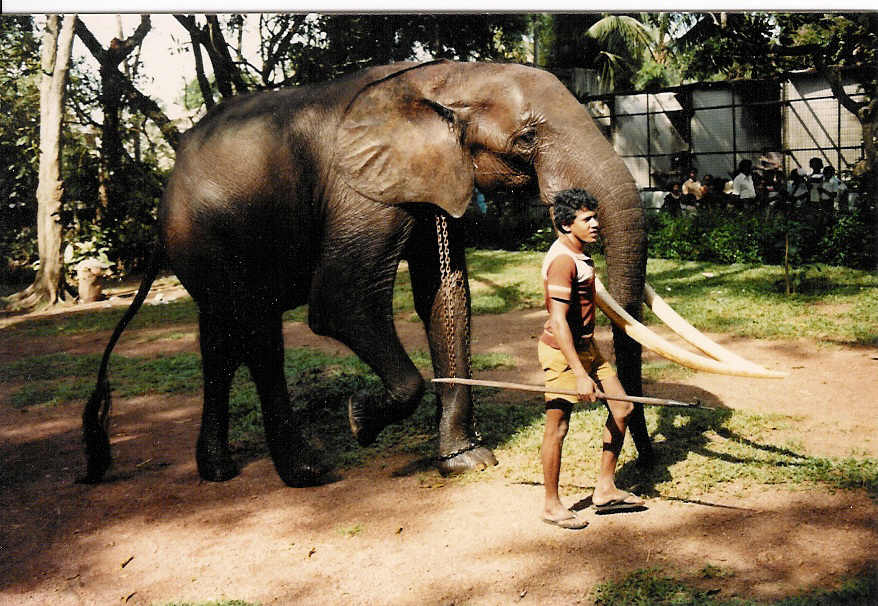
*******In addition to having African bush elephants Dehiwala zoo also owned at least 2 African Forest Elephants. One of these elephants was Babar, who died in the early 1990's of a tusk infection after tripping one day and breaking one tusk off to the gum. A picture of Babar can be seen below. (all credits to Wayne Jackson)
This is far from a complete list, I will try my best to update the list once I am able to obtain more information.
I will be dividing this list according to the time period when the species were on display at the zoo (this has been divided according to the most recent information I was able to obtain, therefore some of these species may span over several time periods.)
1. Species that the zoo opened with
Malayan Tiger
Sun bear
2. Species that were housed during the tenure of director Lyn de Alwis (1955-1985)
Mammals:
Western Gorilla*
gazelle
clouded leopard
Kodiak Island brown bear
Rheas
Red Panda
Goral
Woolly monkey
Gelada
Bharal
Black-backed white stork
North China Leopard
Chinese mountain cat
Okapi???**
Javan rhino???***
Spotted hyaena
Brown fur seal
King colobus
Malabar giant squirrel
Birds:
Eurasian hoopoe
Spotted woodpecker
Purple Turaco
Black-necked swan
Bronze winged pigeon
Crested partridge
White-rumped Shama
Humboldt's penguin
Luzon bleeding-heart
Red-tailed black cockatoo
Palawan peacock-pheasant
Germain's peacock-pheasant
White-naped crane
Black-backed white stork****
American flamingo
Vernal hanging parrot
Lord Derby's parakeet
African grey parrot
Brown eared pheasant
Mottled wood owl
Fish:
Blue tang
Pyjama-striped trigger
Yellow longnose butterflyfish
Crown-of-thorns starfish
Mantis shrimp
Tin-foil Barbs
Tiger Barbs
Atlantic tarpon
Mudskippers
Ruby barb
Cherry Barb
Electric eel*****
Herptiles:
Chinese giant salamander******
Gila monster
Mangrove monitor
Red-tailed boa
Burmese python
*Dehiwala has only housed 2 Western gorillas. Mimbo and Lima were acquired for the zoo by Carr Hartley, Senior Partner of Tanganyika Game Ltd from Cameroon when he read about them in the newspapers, after their parents were shot dead by poachers. They were transported via Kenya and were accompanied by Patrick Hartley, Carr Hartley's son. It is unclear if there gorilla or diehli it is most likely that they were the former sub species rather than the latter.
**It is unclear if the zoo was able to acquire the Okapi. The only information I could find was regarding the zoos desire to acquire Okapi from Copenhagen. There is no information regarding the species being at the zoo.
***Like the Okapi it is unclear if the zoo was able to acquire Javan rhinos. The only information I could find was regarding the zoos desire to acquire the species. There is no information regarding the species being at the zoo. It is highly unlikely they they were able to acquire and display the species.
****I was unable to find any information regarding the species Black-backed white stork, the text I was using as a source goes on to say the following; "Black-backed white stork from China and Japan (of which perhaps there are only half a dozen in captivity)". It is most likely that the text is referring to Oriental stork (Ciconia boyciana).
*****A trio of Electric eels were acquired for the zoo by Dr. Christopher Coates of the New York aquarium.
******A pair of Chinese giant salamanders were obtained from China during the peak of democratic relations between the 2 countries in 1982.
3. Species that were kept after between 1985 - 2022
Mammals:
Drill
Mandrill
De Brazza's monkey
Lesser spot-nosed monkey
Grivet
Celebes crested macaque
Formosan rock macaque
Rhesus macaque
Stump-tailed macaque
Southern pig-tailed macaque
Bengal slow loris
Black-and-white ruffed lemur
Gray mouse lemur
Collared mangabey
Colombian white-faced capuchin
Hose's langur*
Dusky leaf monkey
Capped langur
Patigonian mara
Capybara
Gaur
Persian Onager**
Grévy's zebra
Brazilian tapir from Belgium
Collared peccary
Bush dog***
Maned wolf****
American black bear
Asiatic black bear (moon bear)
Striped hyena
Asian small-clawed otter
Binturong
Meerkats
Small Indian civet
South American coati
Ocelot
Serval
Bob cat
Cheetah*****
Puma
African bush Elephant******
African forest elephant*******
Rock Hyrax
Indian flying fox
Birds:
Asian Fairy-blue bird
Great hornbill
Oriental pied hornbill
Cock-of-the-rock
Hyacinth macaw
Scheepmaker's crowned pigeon
Western crowned pigeon
Nicobar pigeon
Demoiselle crane
Black crowned crane
Lesser flamingo
American flamingo
Red-breasted goose
Himalayan monal
Edwards's pheasant
Swinhoe's pheasant
Elliot's pheasant
Crested fireback
Mikado pheasant
Palawan peacock-pheasant
Malayan peacock-pheasant
Grey peacock-pheasant
Green peafowl
American kestrel
Gyrfalcon
Secretarybird
Egyptian vulture
Hartlaub's turaco
Livingstone's turaco
Fischer's turaco
Guinea turaco
Great horned owl
Snowy owl
Golden eagle
Baikal teal
Eurasian teal
Keel-billed toucan
Toco toucan
White-throated toucan
Channel-billed toucan
Black-necked aracari
Green aracari
Orange-fronted hanging parrot
Blue-crowned hanging parrot
Yellow-throated hanging parrot
Great hanging parrot
Golden-mantled racket-tail
Large fig parrot
Double-eyed fig parrot
Edwards's fig parrot
Salvadori's fig parrot
Finsch's pygmy parrot
Blue-naped parrot
Great-billed parrot
Rainbow lorries
Hadada ibis
Pin-tailed whydah
African penguin
Gentoo penguin
Bali myna
Herptiles:
Argentine black and white tegu
King cobra
Javan spitting cobra
Mexican beaded lizard
Elongated tortoise
Hermann's tortoise
Argentine boa
Green tree python
Siamese crocodile
Spectacled caiman
Antsingy leaf chameleon
Brown leaf chameleon
Domergue's leaf chameleon
Lined flat-tail gecko
Satanic leaf-tailed gecko
*Hose's langur are an extremely rare species in captivity, and are native to the island of Borneo. The zoo owned had at least 4 langur, the only information I could find was of 2 exports of the langur out of the country; 2 were sent to Myanmar in 1994 and 2 were sent to Belgium in 1995. I can not find any more information about this species being kept in captivity anywhere else not even in their native range.
**Persian Onager are also a rare species in this part of the world. The zoo was able to imported pair from the Netherlands in 1986.
***The Bush dogs that were on display at the zoo originated in Germany. A pair was imported in 1987. There have been no subsequent importations or any records of births.
****Surprisingly the national zoo imported a total of 6 Maned wolf within the span of 2 years. 5 wolves were imported from England in 1993 and an another individual was imported from Germany in 1996. According to my recollection the species was on display till the early 2010's.
*****There have been numerous importations of cheetahs over the zoos lifetime. The latest importation of Cheetahs in 2019, when 4 cheetahs were donations by Tama zoo in Japan and were supposed to be housed at Dehiwala. However after they were sent to Ridiyagama Safari Park to quarantine they remained at the Safari Park to this date. I believe they are off display at the Safari park.
******6 African bush Elephants were imported in 1992, 4 from Botswana and 2 from South Africa. Before the importation of the 6 elephants in 1992 there were at least 5 African elephants already at the zoo. However these 5 elephants did not remain in the country for very long 3 of them were exported to Japan and one each to Botswana and South Africa. The elephant that was sent to Botswana was Bibi, she was sent to Abu camp where she lived until her death. The last African elephant in Sri Lanka is Joa (Joe) who was from Botswana. Joa (Joe) was moved to Ridiyagama Safari Park around 2019.
*******In addition to having African bush elephants Dehiwala zoo also owned at least 2 African Forest Elephants. One of these elephants was Babar, who died in the early 1990's of a tusk infection after tripping one day and breaking one tusk off to the gum. A picture of Babar can be seen below. (all credits to Wayne Jackson)
