
I saw another thread on a similar thing, so I thought I'd make a thread about what I have seen myself.
It's old news now that Generative Artificial Intelligence has become a fact of life in the post-COVID era with ever-evolving technologies. AI imagery has found its place on the internet somehow, and even one popularised by large political figures. ChatGPT, for many people, is another tool in the box - like Microsoft Word or Office. Bing has pushed forward with adding AI features to its search engine, and Google is following along, although staying put in the United States for now.
And with all of this there are still some other forms of gAI. Some neural networks will process the lyrics you type in to turn it into a musical piece..... and some will go further than the now-traditional text-to-image 'wizardry'... and turn your words [or your pictures] into a moving video.
And so it has been that YouTube in particular, the largest video-hosting site on the internet, has been smothered by the influx of such videos, including those with animal subjects.
At a glance, the idea of using AI to generate an animal video is a bit of a 'pointless' one - because since the internet's beginnings there has never been much of a shortage of animal content. So often times, AI animal videos will end up one of two ways; one being as B-roll in a lower-rate faceless channel, which rattles off the relevant Wikipedia article [or ChatGPT output] to AI-generated footage of the relevant animal. Sometimes it obeys the laws of physics, other times it doesn't.
The second way I think is a bit more consequential. Instead of creating AI-generated animal content to depict something 'mundane' or 'believable', the animals in the content are depicted doing that which is unbelievable or extraordinary. The kind of thing that makes one wonder, "Wow! I never knew [animal]s did that!" Before inevitably reaching the comments which rightfully lambast the channel.
And one thing I have noticed is that when one channel tries out a 'type of content' that works, so then will other channels follow suit. Some forms of content I have seen:
Nesting Birds
The content has something of a monotonous skeleton, but the birds used are limitless, as we will soon see. The general skeleton of the content is that we see a presumed mother bird perched on a branch in a small nest [always cup-shaped, made out of sticks], who uses /her/ wings to shield /her/ chicks. For more variation, these videos take place 'rain or shine', and even in snow-storms. And as implied above many of the birds used in these videos fall within reason, say a parrot or a dove or such. The absurdity really kicks in when the quintessential cup-nest is combined with the wrong weather pattern and the wrong bird. Ever wanted to see a flamingo in a cup nest guard its chicks in a blizzard? Thanks to gAI, now you can.

Large Animals
Just as humanity's oldest artwork featured the large bison, horses, and mammoths who made themselves obvious on the plains of Europe, so does some of their newest form of 'content' feature charismatic megafauna. One popular format of Large Animal AI Video is that a large animal of choice is stuck on a cliff face [say an elephant]. So naturally a whole crew of people and a construction vehicle of some sort have come to save the day. To be expected are various scenes where the cliff, people, vehicle and animal change in appearance; you may even have one scene where the vehicle is on one end of the cliff and then goes to the animal's original position. But the way most of these videos end is that the animal, now lifted to safety, is surrounding by a crowd in applause. All the while remaining very calm as if it's having a publicity shot and is used to this.
Some large animal videos are plainly absurd; say an elephant using a ladder to climb onto the roof of a house [with no damage whatsoever]; or a giraffe calf riding on its mother's back as if it were an anteater. I have seen both of what I have described. But most large animal videos fall into the nebulous 'rescue' category. Like where the animal is caught in a mud pool or by a constricting snake.
And that is to say, most of these videos are short. But there do exist some long form videos which usually attempt to tell some sort of narrative story. One popular variation of the rescue genre I've seen is the barnacle sub-genre. Simply put, the animal is covered in barnacles and has to be helped.

For some channels, barnacle videos are the bread and butter incarnate. If not barnacles then the animal has some other form of skin-disease or, in one case I've seen, is covered in bees who have turned it into a hive. The channels never acknowledge that barnacles do not grow on fur. The animals in the video are all too happy to get helped by the good samaritans coming over, and they never need be tranquilised.
And as if the absurdity was not obvious enough, some even feel the need to put the flamingo in the snowstorm, so to speak. One barnacle rescue video I found features a tapir wandering the ice plains of the Arctic! As always crying out for help, totally receptive, nobody bothering to question its extreme wanderlust.

How to properly deceive
I have had one relative send me a nesting bird AI video before, but she quickly found out it was fake. So surely she would be wiser from this experience? I have found one video that proves otherwise.
Until the AI era, many videos on YouTube were those of the 'anecdotal story' variety. A dramatic anecdote is told by means of clip art, stock footage and stock images. Did the story ever happen in real life? Who knows.
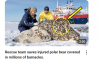
One video I was sent by said relative recently was a similar anecdotal story about a whale.....covered in millions of barnacles and in pain; and for bonus points her calf went over to the ocean samaritans to get help. They take the baleen whale to a marine mammal center to get a surgery for her belly and rehabilitation, before being sent back to the wild. Before long she figured out it was AI too.
By the sound of the barnacles I assume you'd assume it was another such of the videos I have been describing already. But the video itself was presented in the traditional anecdotal story format - in that there are real video clips of scientists, divers, whales, and such. So the use of real footage leads to the intelligent assumption that all in the video is real. And so when the AI generated images of the whale with its millions of barnacles show up, it isn't as much a surprise then. It is deception, but as opposed to the blatant absurdity most AI animal videos present, it manages to reel in those who might've seen a lowbrow AI animal video as well.
My thoughts
I have said it before and I shall say it again here - I hold the belief that Artificial Intelligence can provide much good in automating tasks for human scientists, and making various processes quicker and more economically viable. I think Artificial Intelligence has many prospective uses in wildlife conservation.
But what disappoints me... the technology that was used to create AI that generates images and videos had much potential for science. We do use that potential to identify different individual animals and their body conditions, and such. But this is not what is being invested into! The AI that is making the most money today is that of Generative Artificial Intelligence; which I feel remains incapacitated to create data of the same level as natural data, and is often used as to deceive! Why watch Attenborough when you can watch elephants fly south for the winter?
I think most AI animal videos play into a theoretical part of nature that has long been idealised by humanity - that non-human animals act in human mannerisms often. It's an idea many people find enjoyable; but I find that when you take this fantasy and utilise it to bend reality using gAI, it has much problematic potential behind it.
I have said it before and I have said it again; I think now that we are in the era of gAI, we are in the midst of a war on truth. Whilst major publishing companies are challenging the right to exist of the Internet Archive, one of the few remaining resources of high-quality, natural information on the internet, they operate in an utter disregard of what is to replace it. As well as making sure that real-life informational facilities continue to exist for the high-quality information they not only present but contain, zoos included, I feel it's only right that the 'underdogs' of the internet take a stand against the rapid expansion of generative AI's influence; and devote themselves to the premise the internet was founded on: an efficient way to achieve high-quality information.
It's old news now that Generative Artificial Intelligence has become a fact of life in the post-COVID era with ever-evolving technologies. AI imagery has found its place on the internet somehow, and even one popularised by large political figures. ChatGPT, for many people, is another tool in the box - like Microsoft Word or Office. Bing has pushed forward with adding AI features to its search engine, and Google is following along, although staying put in the United States for now.
And with all of this there are still some other forms of gAI. Some neural networks will process the lyrics you type in to turn it into a musical piece..... and some will go further than the now-traditional text-to-image 'wizardry'... and turn your words [or your pictures] into a moving video.
And so it has been that YouTube in particular, the largest video-hosting site on the internet, has been smothered by the influx of such videos, including those with animal subjects.
At a glance, the idea of using AI to generate an animal video is a bit of a 'pointless' one - because since the internet's beginnings there has never been much of a shortage of animal content. So often times, AI animal videos will end up one of two ways; one being as B-roll in a lower-rate faceless channel, which rattles off the relevant Wikipedia article [or ChatGPT output] to AI-generated footage of the relevant animal. Sometimes it obeys the laws of physics, other times it doesn't.
The second way I think is a bit more consequential. Instead of creating AI-generated animal content to depict something 'mundane' or 'believable', the animals in the content are depicted doing that which is unbelievable or extraordinary. The kind of thing that makes one wonder, "Wow! I never knew [animal]s did that!" Before inevitably reaching the comments which rightfully lambast the channel.
And one thing I have noticed is that when one channel tries out a 'type of content' that works, so then will other channels follow suit. Some forms of content I have seen:
Nesting Birds
The content has something of a monotonous skeleton, but the birds used are limitless, as we will soon see. The general skeleton of the content is that we see a presumed mother bird perched on a branch in a small nest [always cup-shaped, made out of sticks], who uses /her/ wings to shield /her/ chicks. For more variation, these videos take place 'rain or shine', and even in snow-storms. And as implied above many of the birds used in these videos fall within reason, say a parrot or a dove or such. The absurdity really kicks in when the quintessential cup-nest is combined with the wrong weather pattern and the wrong bird. Ever wanted to see a flamingo in a cup nest guard its chicks in a blizzard? Thanks to gAI, now you can.
Large Animals
Just as humanity's oldest artwork featured the large bison, horses, and mammoths who made themselves obvious on the plains of Europe, so does some of their newest form of 'content' feature charismatic megafauna. One popular format of Large Animal AI Video is that a large animal of choice is stuck on a cliff face [say an elephant]. So naturally a whole crew of people and a construction vehicle of some sort have come to save the day. To be expected are various scenes where the cliff, people, vehicle and animal change in appearance; you may even have one scene where the vehicle is on one end of the cliff and then goes to the animal's original position. But the way most of these videos end is that the animal, now lifted to safety, is surrounding by a crowd in applause. All the while remaining very calm as if it's having a publicity shot and is used to this.
Some large animal videos are plainly absurd; say an elephant using a ladder to climb onto the roof of a house [with no damage whatsoever]; or a giraffe calf riding on its mother's back as if it were an anteater. I have seen both of what I have described. But most large animal videos fall into the nebulous 'rescue' category. Like where the animal is caught in a mud pool or by a constricting snake.
And that is to say, most of these videos are short. But there do exist some long form videos which usually attempt to tell some sort of narrative story. One popular variation of the rescue genre I've seen is the barnacle sub-genre. Simply put, the animal is covered in barnacles and has to be helped.
For some channels, barnacle videos are the bread and butter incarnate. If not barnacles then the animal has some other form of skin-disease or, in one case I've seen, is covered in bees who have turned it into a hive. The channels never acknowledge that barnacles do not grow on fur. The animals in the video are all too happy to get helped by the good samaritans coming over, and they never need be tranquilised.
And as if the absurdity was not obvious enough, some even feel the need to put the flamingo in the snowstorm, so to speak. One barnacle rescue video I found features a tapir wandering the ice plains of the Arctic! As always crying out for help, totally receptive, nobody bothering to question its extreme wanderlust.
How to properly deceive
I have had one relative send me a nesting bird AI video before, but she quickly found out it was fake. So surely she would be wiser from this experience? I have found one video that proves otherwise.
Until the AI era, many videos on YouTube were those of the 'anecdotal story' variety. A dramatic anecdote is told by means of clip art, stock footage and stock images. Did the story ever happen in real life? Who knows.
One video I was sent by said relative recently was a similar anecdotal story about a whale.....covered in millions of barnacles and in pain; and for bonus points her calf went over to the ocean samaritans to get help. They take the baleen whale to a marine mammal center to get a surgery for her belly and rehabilitation, before being sent back to the wild. Before long she figured out it was AI too.
By the sound of the barnacles I assume you'd assume it was another such of the videos I have been describing already. But the video itself was presented in the traditional anecdotal story format - in that there are real video clips of scientists, divers, whales, and such. So the use of real footage leads to the intelligent assumption that all in the video is real. And so when the AI generated images of the whale with its millions of barnacles show up, it isn't as much a surprise then. It is deception, but as opposed to the blatant absurdity most AI animal videos present, it manages to reel in those who might've seen a lowbrow AI animal video as well.
My thoughts
I have said it before and I shall say it again here - I hold the belief that Artificial Intelligence can provide much good in automating tasks for human scientists, and making various processes quicker and more economically viable. I think Artificial Intelligence has many prospective uses in wildlife conservation.
But what disappoints me... the technology that was used to create AI that generates images and videos had much potential for science. We do use that potential to identify different individual animals and their body conditions, and such. But this is not what is being invested into! The AI that is making the most money today is that of Generative Artificial Intelligence; which I feel remains incapacitated to create data of the same level as natural data, and is often used as to deceive! Why watch Attenborough when you can watch elephants fly south for the winter?
I think most AI animal videos play into a theoretical part of nature that has long been idealised by humanity - that non-human animals act in human mannerisms often. It's an idea many people find enjoyable; but I find that when you take this fantasy and utilise it to bend reality using gAI, it has much problematic potential behind it.
I have said it before and I have said it again; I think now that we are in the era of gAI, we are in the midst of a war on truth. Whilst major publishing companies are challenging the right to exist of the Internet Archive, one of the few remaining resources of high-quality, natural information on the internet, they operate in an utter disregard of what is to replace it. As well as making sure that real-life informational facilities continue to exist for the high-quality information they not only present but contain, zoos included, I feel it's only right that the 'underdogs' of the internet take a stand against the rapid expansion of generative AI's influence; and devote themselves to the premise the internet was founded on: an efficient way to achieve high-quality information.
Attachments



Last edited: