
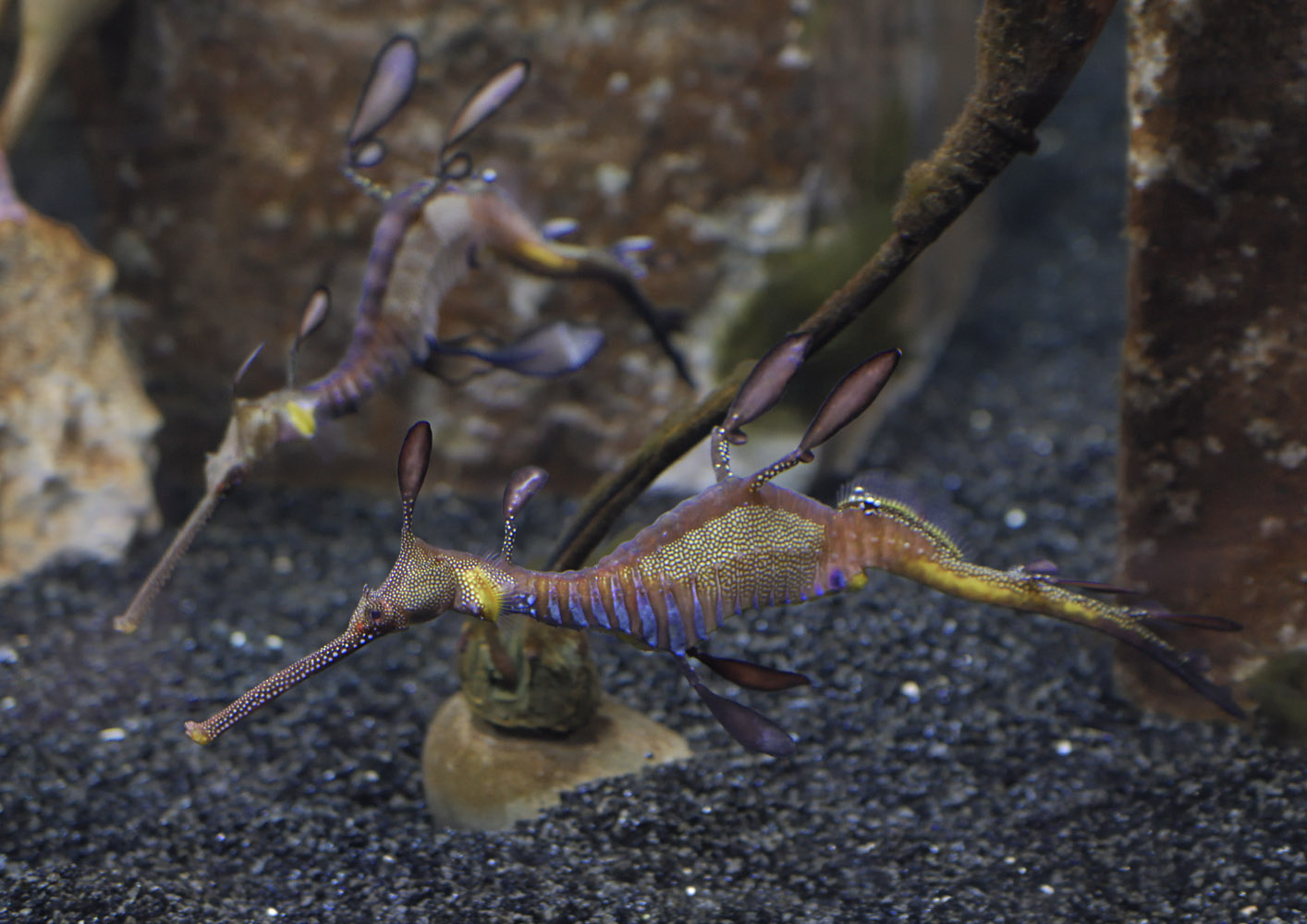
Last month I went back to Weymouth Sea Life Centre to get better photos of the weedy sea dragons. On my previous visit, in October 2021, I had got some decent close-ups of these marvellous fishes, but I wanted to show all their wonderful weediness as well as their beautiful colours.
They have a large purpose-built tank. My friend @devilfish posted an outline of the design in our Gallery before it was built. Sea Life Centres in Australia have a lot of experience with sea dragons and have published husbandry guidelines which make clear that their tanks must be at least 1.75m deep for breeding, to allow a pair to court before the female places her eggs on the male's brood patch (they don't have pouches like seahorses).
This time I noticed that the 2 largest dragons kept the others at the back of the tank, and generally stayed low in the water, but I was able to get plenty of photos of them late in afternoon, when it was quiet. I should add that I used my 40mm f/2.8 macro Nikkor on my D500 body, the settings were generally 1/20s at f/3.5, ISO 1250 with -0.7 EV compensation - these figures sow that the light was not good, and the very dark grey gravel in the tank did not help. Note that I always shoot 16-bit Nikon RAW files (.NEF) with Auto White Balance.
At first glance, the images on my computer screen looked fine (after I had deleted the majority which were blurred or out of focus). But on closer inspection, I could see that the gravel appeared to be dark blue. It took me some time to realise that this is the phenomenon that divers observe; red light is dispersed more than blue light, so colours become bluer in deeper water.
Nikon's Studio NX software makes it easy to reset the colour temperature by choosing a new grey point - but you have to choose carefully. The image below shows four screenshots of a .tif file, the first is unmodified, the second is my first attempt - showing the reds are still there, the third is a better balanced choice (after I had searched for published photos of the species). Enlarge the image to see the details.
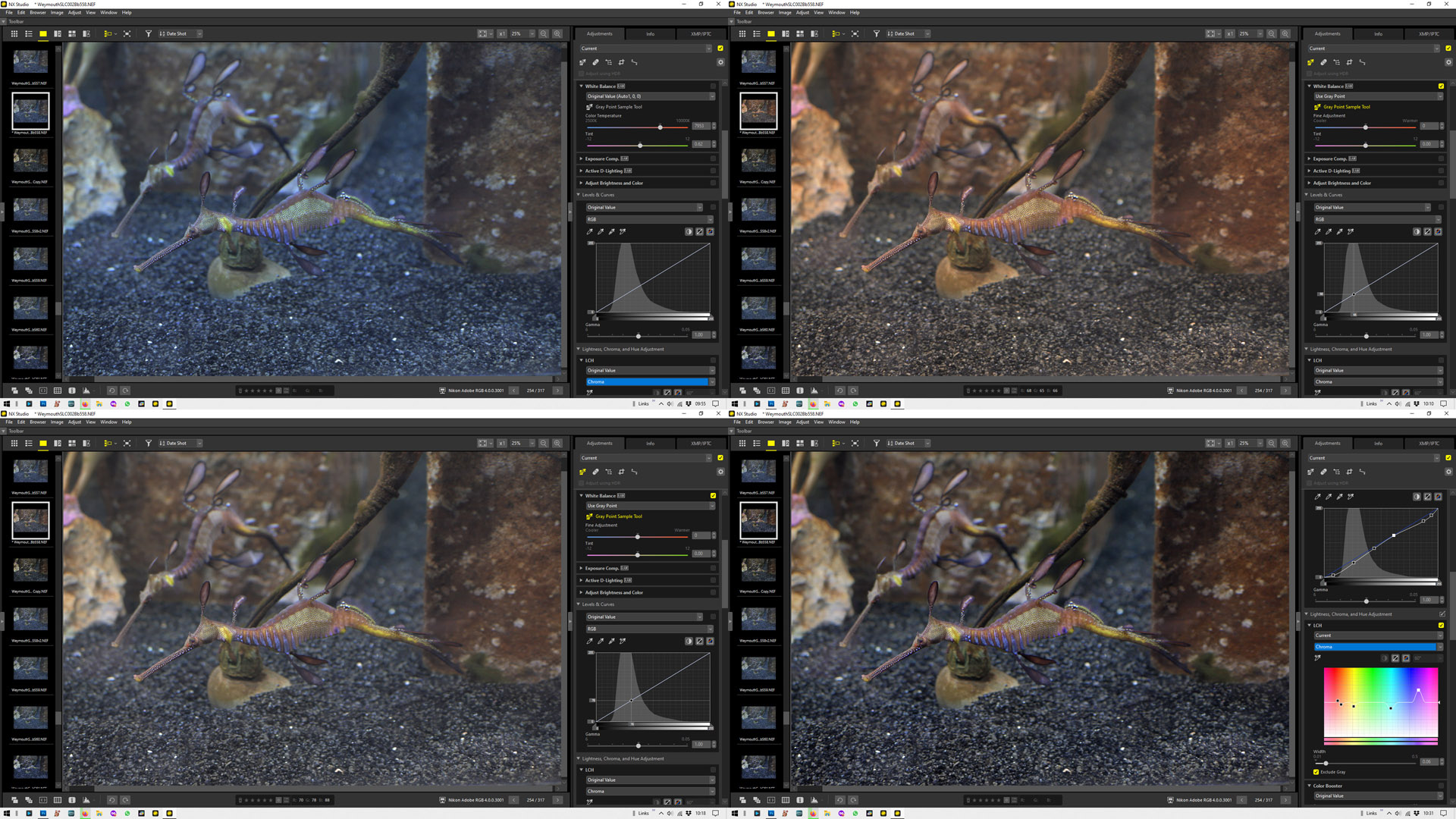 The fourth photo has been adjusted for better contrast and I used the LCH controls to boost the violet/blue and tone down the cyan, yellow and orange a little. Finally I used Photoshop to crop and fine-tune the image before reducing the size and bit-depth to make a jpg for our Gallery.
They have a large purpose-built tank. My friend @devilfish posted an outline of the design in our Gallery before it was built. Sea Life Centres in Australia have a lot of experience with sea dragons and have published husbandry guidelines which make clear that their tanks must be at least 1.75m deep for breeding, to allow a pair to court before the female places her eggs on the male's brood patch (they don't have pouches like seahorses).
This time I noticed that the 2 largest dragons kept the others at the back of the tank, and generally stayed low in the water, but I was able to get plenty of photos of them late in afternoon, when it was quiet. I should add that I used my 40mm f/2.8 macro Nikkor on my D500 body, the settings were generally 1/20s at f/3.5, ISO 1250 with -0.7 EV compensation - these figures sow that the light was not good, and the very dark grey gravel in the tank did not help. Note that I always shoot 16-bit Nikon RAW files (.NEF) with Auto White Balance.
At first glance, the images on my computer screen looked fine (after I had deleted the majority which were blurred or out of focus). But on closer inspection, I could see that the gravel appeared to be dark blue. It took me some time to realise that this is the phenomenon that divers observe; red light is dispersed more than blue light, so colours become bluer in deeper water.
Nikon's Studio NX software makes it easy to reset the colour temperature by choosing a new grey point - but you have to choose carefully. The image below shows four screenshots of a .tif file, the first is unmodified, the second is my first attempt - showing the reds are still there, the third is a better balanced choice (after I had searched for published photos of the species). Enlarge the image to see the details.
Weedy sea dragon photo workflow
Screen shots from NX Studio showing colour corrections.
