
At the request of my friend Snowleopard, I am posting my impressions of Schonbrunn. I am using the term “impressions” instead of “review” for good reason. I did not step inside the indoor exhibits which make up a major portion of the zoo. I did not even go in the restaurant, as I left early to catch a train to Salzburg. Therefore I am unqualified to post a review in any proper sense of the word.
I realize to many readers that skipping huge sections of this historic zoo is heresy. As discussed elsewhere, my interest in zoos is not as strong as it used to be and my main interest has always been wild cats, so I have no need to see everything per se. Seeing it all would have required staying the full day and then spending a second night in Vienna, but I much rather wanted to spend extra nights in Salzburg. (In retrospect this was a good move as Salzburg is many times more pleasing than Vienna). Also going inside in mid winter with camera gear is a pain, because I would have to pack up the camera inside my photo backpack before entering the building to prevent condensation. If I wanted to take photos inside I would have to wait at least half an hour while the camera slowly acclimated inside the backpack. Then the same procedure going out. Just not worth the trouble.
The main reason in my opinion to visit this zoo is for the history. That is not to say it is a bad zoo. It is not and would be worth a look even without the history. However, based on the outside portions I saw, it is not what I would consider world class and is almost certainly NOT the best zoo in Europe as author Sheridan contends. I would say it is a good zoo, maybe even a very good zoo, but not the best of the best. Rather than do an exhibit-by-exhibit listing, I will name a few unique features that set it apart.
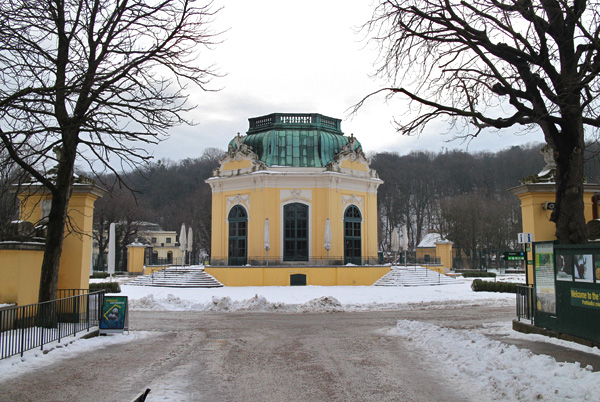
The Pavilion turned restaurant near the front is a unique historical feature. Visitors can dine where the emperor dined. I did not enter, but after seeing a photo of the ceiling mural in a book I wish I had popped in for a look.
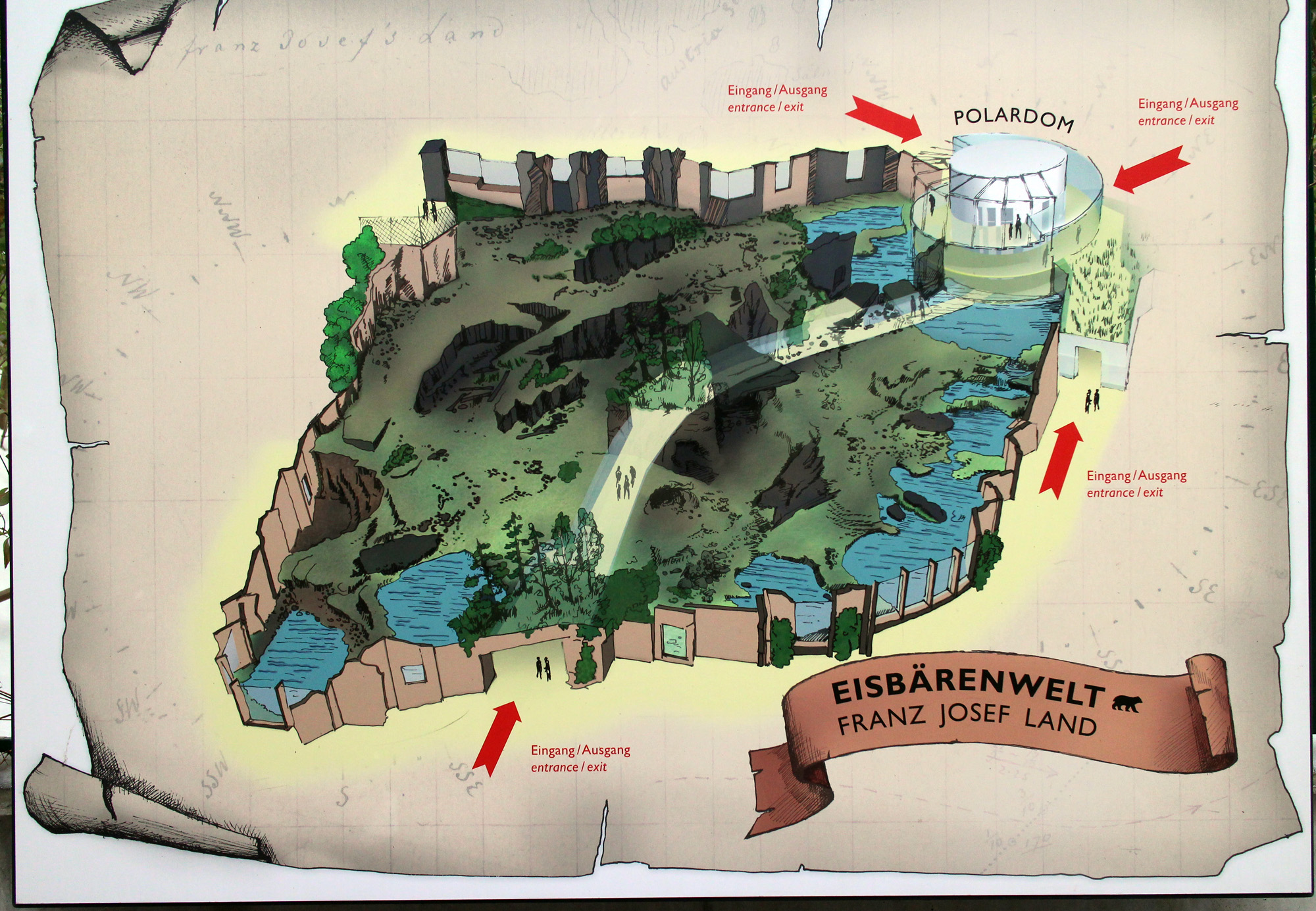
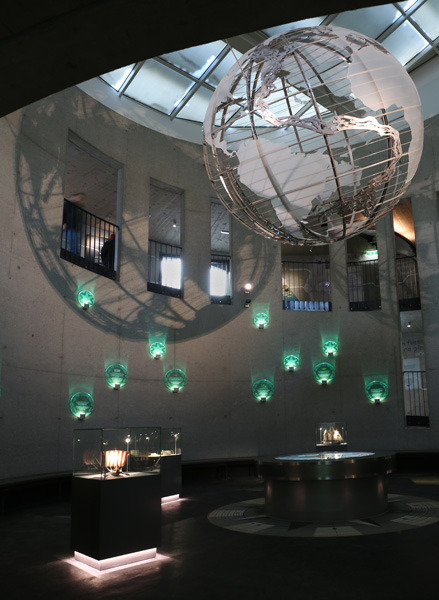
Franz Josef Land, the polar bear exhibit, is a standout feature. The large complex has adjoining outdoor yards and a large pool with viewing from above and underwater. The latter is done from a long indoor hallway that runs through the middle of the exhibit (so I guess I did go inside at least one building, though thankfully it was cool enough to not cause camera issues). An attractive round area with a spiral walkway interprets early arctic explorers. There is also a small indoor penguin exhibit (not sure the species) which IMO does not add anything. Along the walls inside are several interpretive elements that are quite nice, including a section on climate change that starts off by saying it is a fact (in spite of the opinion of current political leaders from a certain world superpower).
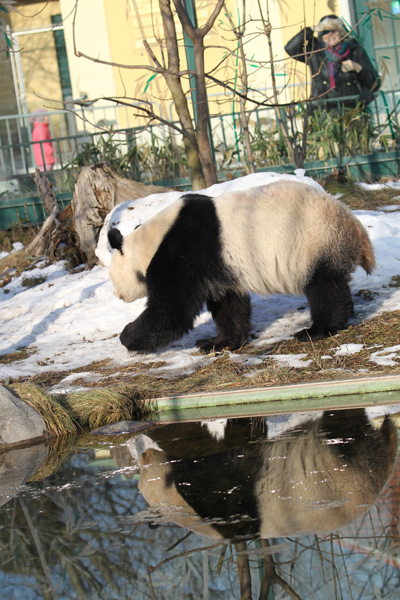
Giant pandas are THE big ticket item for any zoo lucky enough to get them. The two neighboring exhibits looked nice with winter snow, though I am unsure what I would think of them in summer. Each exhibit has a good sized pond which is a nice feature. Considering the expense and bureaucracy involved in getting pandas, as well as their popularity with the public, I am surprised that exhibits for pandas in general are not better. I have seen perhaps half of those in the western world (Memphis, San Diego, Smithsonian, Edinburgh, Vienna) and none are what I would call outstanding. All are somewhat smallish, not tiny, but small. This one is not outstanding either, but is better IMO than San Diego or Memphis or Edinburgh. For most of my time the panda was frustratingly locked in the indoor area (which I did not go in), but just as I was leaving shortly before 2pm it was finally let outside.
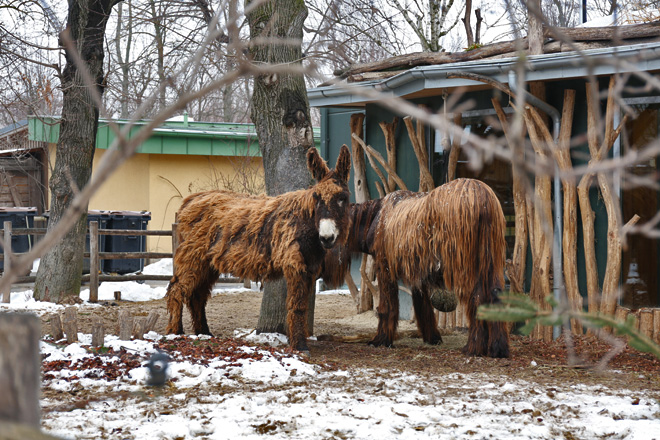
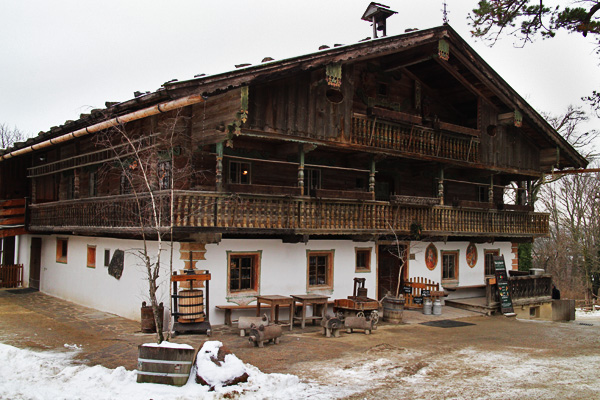
A small portion of the main grounds and the entire portion of the upper grounds are devoted to rare breeds of domestic livestock. I have mixed feelings about this. Certainly someone should preserve and propagate rare breeds, but I would prefer it be done in public farms or living history museums rather than take up space in zoos. I would rather see zoo areas given over to wild animal propagation, but others may disagree with my assessment. The upper area also features a picturesque Austrian farmhouse, which is a nice touch (especially for us foreign visitors).
Historic animal enclosures, whose size would be deemed inhumane today, are preserved but adjoin larger yards. This I like as it is an ideal way to present the history yet give the animals the room they need. A prime example is the Siberian tiger exhibit, which is a large yard that is bounded on one side by a wall of what would have been (I think) four previous big cat cages. These now have a large cutout in back that opens into the main yard, but provide a nice contrast of how far animal welfare has come. Next to the tiger yard is a fair sized exhibit for Amur leopard (which I am guessing used to house snow leopard, as I have seen photos of these online but there are none at the zoo now).

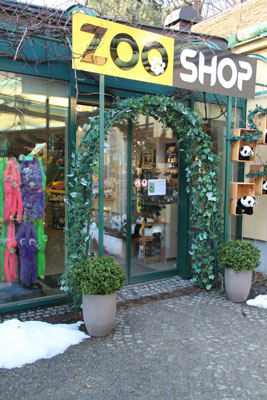
I did go in the gift shop on my way out, which I am sad to report is nothing special (there is a thread devoted to gift shops that reports this is widespread). Considering the historical significance of this zoo, I really hoped for something special. Most of it was given over to stuffed animals and other children toys, just like zoo gift shops anywhere. The very small book section only had two books of interest: the Sheridan book on zoos of Europe (which I did not buy for fear I would run out of cash and not be able to eat on the last day of my trip) and a much more affordable book called Schonbrunn Zoo: Myth and Fact, available in either German or English (which I bought two copies of, one for me and one for Snowleopard). The small but detailed book is quite enjoyable and a recommended read.
I realize to many readers that skipping huge sections of this historic zoo is heresy. As discussed elsewhere, my interest in zoos is not as strong as it used to be and my main interest has always been wild cats, so I have no need to see everything per se. Seeing it all would have required staying the full day and then spending a second night in Vienna, but I much rather wanted to spend extra nights in Salzburg. (In retrospect this was a good move as Salzburg is many times more pleasing than Vienna). Also going inside in mid winter with camera gear is a pain, because I would have to pack up the camera inside my photo backpack before entering the building to prevent condensation. If I wanted to take photos inside I would have to wait at least half an hour while the camera slowly acclimated inside the backpack. Then the same procedure going out. Just not worth the trouble.
The main reason in my opinion to visit this zoo is for the history. That is not to say it is a bad zoo. It is not and would be worth a look even without the history. However, based on the outside portions I saw, it is not what I would consider world class and is almost certainly NOT the best zoo in Europe as author Sheridan contends. I would say it is a good zoo, maybe even a very good zoo, but not the best of the best. Rather than do an exhibit-by-exhibit listing, I will name a few unique features that set it apart.
The Pavilion turned restaurant near the front is a unique historical feature. Visitors can dine where the emperor dined. I did not enter, but after seeing a photo of the ceiling mural in a book I wish I had popped in for a look.
Franz Josef Land, the polar bear exhibit, is a standout feature. The large complex has adjoining outdoor yards and a large pool with viewing from above and underwater. The latter is done from a long indoor hallway that runs through the middle of the exhibit (so I guess I did go inside at least one building, though thankfully it was cool enough to not cause camera issues). An attractive round area with a spiral walkway interprets early arctic explorers. There is also a small indoor penguin exhibit (not sure the species) which IMO does not add anything. Along the walls inside are several interpretive elements that are quite nice, including a section on climate change that starts off by saying it is a fact (in spite of the opinion of current political leaders from a certain world superpower).
Giant pandas are THE big ticket item for any zoo lucky enough to get them. The two neighboring exhibits looked nice with winter snow, though I am unsure what I would think of them in summer. Each exhibit has a good sized pond which is a nice feature. Considering the expense and bureaucracy involved in getting pandas, as well as their popularity with the public, I am surprised that exhibits for pandas in general are not better. I have seen perhaps half of those in the western world (Memphis, San Diego, Smithsonian, Edinburgh, Vienna) and none are what I would call outstanding. All are somewhat smallish, not tiny, but small. This one is not outstanding either, but is better IMO than San Diego or Memphis or Edinburgh. For most of my time the panda was frustratingly locked in the indoor area (which I did not go in), but just as I was leaving shortly before 2pm it was finally let outside.
A small portion of the main grounds and the entire portion of the upper grounds are devoted to rare breeds of domestic livestock. I have mixed feelings about this. Certainly someone should preserve and propagate rare breeds, but I would prefer it be done in public farms or living history museums rather than take up space in zoos. I would rather see zoo areas given over to wild animal propagation, but others may disagree with my assessment. The upper area also features a picturesque Austrian farmhouse, which is a nice touch (especially for us foreign visitors).
Historic animal enclosures, whose size would be deemed inhumane today, are preserved but adjoin larger yards. This I like as it is an ideal way to present the history yet give the animals the room they need. A prime example is the Siberian tiger exhibit, which is a large yard that is bounded on one side by a wall of what would have been (I think) four previous big cat cages. These now have a large cutout in back that opens into the main yard, but provide a nice contrast of how far animal welfare has come. Next to the tiger yard is a fair sized exhibit for Amur leopard (which I am guessing used to house snow leopard, as I have seen photos of these online but there are none at the zoo now).
I did go in the gift shop on my way out, which I am sad to report is nothing special (there is a thread devoted to gift shops that reports this is widespread). Considering the historical significance of this zoo, I really hoped for something special. Most of it was given over to stuffed animals and other children toys, just like zoo gift shops anywhere. The very small book section only had two books of interest: the Sheridan book on zoos of Europe (which I did not buy for fear I would run out of cash and not be able to eat on the last day of my trip) and a much more affordable book called Schonbrunn Zoo: Myth and Fact, available in either German or English (which I bought two copies of, one for me and one for Snowleopard). The small but detailed book is quite enjoyable and a recommended read.


 . The penguin exhibit was already built long before the new polar bear enclosure and contains Europe's biggest and most successful rockhopper penguin breeding colony.


