It was always integral to the master plan to provide new and vastly superior house and enclosures for the Great Apes (gibbons inclusive).
You are using an out of date browser. It may not display this or other websites correctly.
You should upgrade or use an alternative browser.
You should upgrade or use an alternative browser.
Zürich Zoo Zurich Zoo News 2018
- Thread starter aramacao
- Start date

Two koalas and a male tiger have arrived at the zoo. The Australia exhibits have been finished for a while. For an overview of Masoala species, refer to
Tier- & Pflanzenlexikon
and click "Lebensraum", then "Masoala Regenwald".
Tier- & Pflanzenlexikon
and click "Lebensraum", then "Masoala Regenwald".

Australia species list published on zoo website.
Follow link -> "Lebensraum / Anlage im Zoo" -> "Australien"
So Moloch have been replaced by Northern pilbara rock monitor (4th holding in Europe according to ZTL), no surprises there. The mammal and bird line-up is pathetically weak for such a major zoo, with Bennet wallaby, koala, emu, kookaburra and rainbow lorikeet.....

The Australia development has opened (to the press, public opening tomorrow) and pictures have been published:
 (or speculate) : None of these species are in Zurich. The zoo supports the project financially though apparently not by also partaking in the breeding efforts itself. Instead, the new Australia section features Benett's wallaby, emu (both in a walk-through enclosure), koala, perentie, pilbara rock monitor, bobtail (Tiliqua rugosa), kookaburra, rainbow lorikeet, and European rabbit (as invasive). The eucalypt leaves for the koalas come from plantations in the region.
- Australian Open – die Koalas sind da! (pictures on top, for more pictures click 'Bilder' further down below)
- Anlage Australien
(or speculate) : None of these species are in Zurich. The zoo supports the project financially though apparently not by also partaking in the breeding efforts itself. Instead, the new Australia section features Benett's wallaby, emu (both in a walk-through enclosure), koala, perentie, pilbara rock monitor, bobtail (Tiliqua rugosa), kookaburra, rainbow lorikeet, and European rabbit (as invasive). The eucalypt leaves for the koalas come from plantations in the region.
The Australian house does not have European rabbit yet, but for now keeps Domestic rabbit.
Construction for the new Lewa savanna is well underway now as well.
A complete overview of the new Australia section can now be seen in the gallery:
Zürich Zoo | ZooChat
Construction for the new Lewa savanna is well underway now as well.
A complete overview of the new Australia section can now be seen in the gallery:
Zürich Zoo | ZooChat

What did you think of the Australia exhibit @lintworm? From the photos, it looks like a smart renovation with some nice features, but perhaps not the knock-your-socks-off standard of exhibitry that really sets Zurich apart.
A little bit of mixed feelings. All enclosures look good, though the Wallaby one might be a bit overthemed and the way how the old Africa house looks young again is great. I remember how run down it looked just 4 years ago.... But though the work looks like high quality and something that will last, I was slightly disappointed... This has especially to do with the outdoor section, the Kookaburra aviary is on the small side and the walkthrough very boring with 2 Emu and a few Bennet's wallaby. There is also the Perentie outdoor enclosure, which given the Swiss weather will be empty for 9 months per year.... It would have been nicer imo to create a walkthrough aviary on where this outdoor enclosure and the Kookaburra aviary are now. In that way they could have shown more diversity, because that is certainly limited. The Ectotherm curator has done a good job, but the mammal and bird line-up is a bit boring....
Anybody can explain why no zoo keeps koalas on live trees, only on these horrible sticks with whatever?
It looked as if indoors, the Koala had access to a live Eucalyptus, at least one with leaves. They used the leaves to completely hide themselves
Walkthrough exhibit turned small, because wallabies and emus prefer to keep at least 10 meters or so from the visitor path. The stony theming forbids animals from grazing. Maybe grass will grow through the stone ground? And maybe the rabbits will do better in this area, too?
I hope the zoo installs some sight screens along part of the path and so makes more space usable for animals. I would also introduce tasmanian devils and/or tree kangaroos in place of rabbits and perenties (which will use their outdoor area only few weeks a year). More ambitious might be netting the walkthrough area as an aviary for lorikeets and other Australian birds.
The plan of 'Lewa savanna' suggests lots of space taken by artificial rocks 'kopje' and apparently Dahomey cows. The zoo already has plenty of fake and real rocks, cows in the children zoo and domestic yaks. If the zoo wanted to illustrate the problem of over-grazing of African savannas, why not present a herd of cattle sculptures, which might take about 100m2, need no maintenance and would provide an interesting photo opportunity? The space could go to live animals which need it more: black rhinos, hippos or whatever.
I hope the zoo installs some sight screens along part of the path and so makes more space usable for animals. I would also introduce tasmanian devils and/or tree kangaroos in place of rabbits and perenties (which will use their outdoor area only few weeks a year). More ambitious might be netting the walkthrough area as an aviary for lorikeets and other Australian birds.
The plan of 'Lewa savanna' suggests lots of space taken by artificial rocks 'kopje' and apparently Dahomey cows. The zoo already has plenty of fake and real rocks, cows in the children zoo and domestic yaks. If the zoo wanted to illustrate the problem of over-grazing of African savannas, why not present a herd of cattle sculptures, which might take about 100m2, need no maintenance and would provide an interesting photo opportunity? The space could go to live animals which need it more: black rhinos, hippos or whatever.
Re. Australian area … I cannot make any realistic assessment. I will have to see the final product first.
As for Lewa: Dahomey cattle and white rhino seem to conflict with the Lewa Downs theme. The Conservancy being supported has as its mainstay and iconic conservation ambassadors black rhinos. Aside E. Africa has dwarf zebu for cattle with nomadic pastoralist communities in Laikipia district and northern and central Kenya. I would still sincerely hope management reconsiders this. It would underline so much more the conservation ethic of the entire area.
BTW: black rhino can be maintained with other species when space is at hand … The exhibit might even and fairly easily be subdivided for other wildlife to cross, but not the rhino.
As for Lewa: Dahomey cattle and white rhino seem to conflict with the Lewa Downs theme. The Conservancy being supported has as its mainstay and iconic conservation ambassadors black rhinos. Aside E. Africa has dwarf zebu for cattle with nomadic pastoralist communities in Laikipia district and northern and central Kenya. I would still sincerely hope management reconsiders this. It would underline so much more the conservation ethic of the entire area.
BTW: black rhino can be maintained with other species when space is at hand … The exhibit might even and fairly easily be subdivided for other wildlife to cross, but not the rhino.
BTW: black rhino can be maintained with other species when space is at hand … The exhibit might even and fairly easily be subdivided for other wildlife to cross, but not the rhino.
It bugs me that my hometown zoo has decided to switch from black to white rhinos, specially when you keep in mind that the black ones are much more endangered and Zurich has had good (or at least not bad) breeding results.
I visited the zoo and the new Australia exhibits yesterday and updloaded some pictures.
(part I: Australia house)
The new Australia development consists of the refurbished and repurposed former Africa now Australia house, outdoor enclosures for koala and perentie, a combined emu and wallaby walkthrough, a combined indoor and outdoor rainbow lorikeet aviary, a smallish outdoor kookaboora aviary, and a small lawn for rabbits with underground access to one of the outdoor koala enclosures.
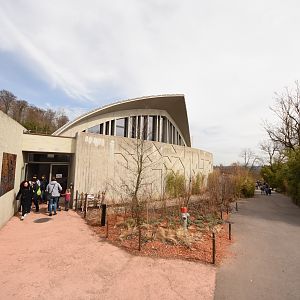
The strongest part of the development is the Australia house indoors: One large koala enclosure that can be separated off into two sections, two enclosures of different size for perentie, two terraria, one for pilbara monitors, the other housing shingleback skinks, and the entire back wall of the house's corridor full of educational material on invasive species. The three large enclosures mimic an Australian bush savanna. Rusty reds dominate with occasional patches of green, brown, and yellow from vegetation both alive and withered. Large glass panels reaching to a height well over 2 meters separate the visitors from the animals and apparently also limit the noise emissions from the former for the latter. The enclosures receive a combination of artificial illumination, as well as natural light through the building's two domes. The visitor area in comparison only has subdued light.
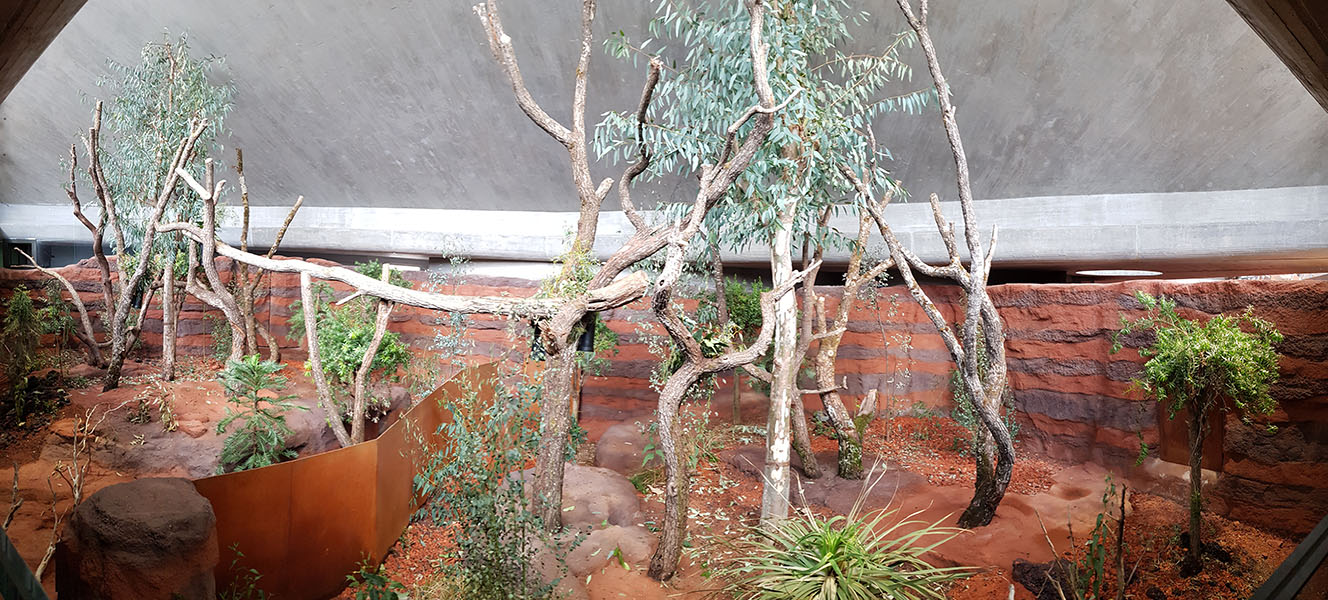 I consider the combined indoor koala enclosures to be the most accomplished part of the entire development. In each enclosure there is a live eucalypt tree surrounded by a number of tree trunks for climbing. Both koalas slept cuddeled up behind the trees' leaves - so the feature seems to be more than just decoration. I hope/suppose that once the trees grow a larger canopy, this will look even better. The two enclosures are separated by a rusty red iron (?) panel which blends in very nicely with its surroundings. At the top left end of the enclosure there is an access pipe to one of two outdoor enclosures which the animals apparently may use at their discretion, provided outside temperatures are warm enough.
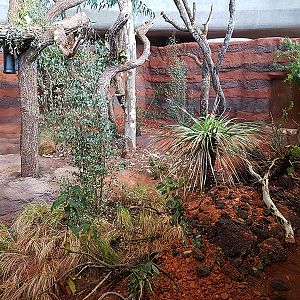
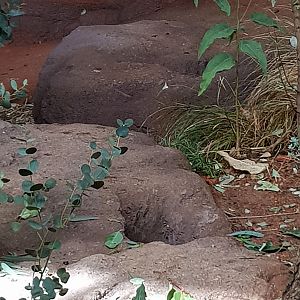 The ground in the enclosure is very richly structured. Something I have not ever seen before in a koala enclosure. There are hard surfaces and soft surfaces, patches of sand, gravel, rock, grass, and scrub. There are even prefabricated burrows dotted all across the two enclosures. It would seem that the zoo is planning with something more for this enclosure - and indeed, the info board across from the enclosure with any further ado reads "Koalas and rabbit-bandicoots (bilbies) belong to roughly 320 different types of marsupials...". If my suspicion is correct, then the inclusion of (live) rabbits to the area suddenly makes a lot more sense.

The two perentie enclosures replicate the design and look of the koala enclosures - except for missing a 'tree layer' and having a slightly more arid feel to them. The two enclosures are separated by the massive black and red striped mock-rock wall used throughout the development and the perenties can switch between the two through a small tunnel/crack. This mock rock wall is a lot less ugly than I had originally feared and it actually works quite well in setting a common theme throughout the entire development (together with the red and brown gravel) - alas I am still no fan. It is also interesting to note that the top end of the mock rock wall in the perentie enclosures is planted with grass (whereas the koala wall is not) - whether there is any deeper meaning to this I do not know. Of course I would hope, that this is a giveaway sign of the zoo having plans for introducing birds into this house - not least because birds form a special part of the history of this house - alas I am not sure whether holding birds in a perentie enclosure is a good idea (...for the birds that is).
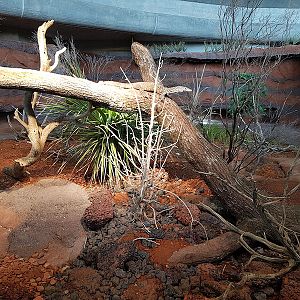
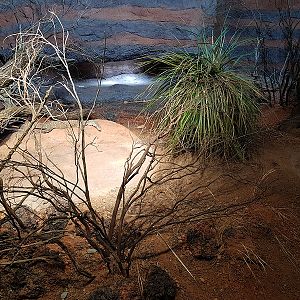 Of the two enclosures, the smaller, right one imo matches the koala enclosure in beauty and quality. The larger middle enclosure however, unfortunately suffers massively from strong reflections in the glass viewing pane due to the large outside viewing window into the rabbit enclosure directly opposite (this formerly was the window into the shoebill aviary, sigh), and furthermore - for some reason I cannot quite pinpoint - its 'interior design', i.e. the ensemble of shrubs and grasses and logs and basking spots just didn't seem to quite match the 'feng-shui' of the other two enclosures. The perenties are exceptional animals. Active and inquisitive, long and slender, of considerable size (though they still have a lot of growing to do), and beautifully painted. I can only congratulate the zoo on selecting this species.
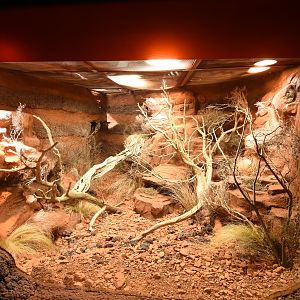
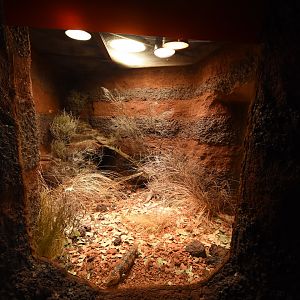 The terraria for pilbara monitors (Varanus pilbarensis) and shingleback skinks. The pilbara terrarium is quite large with a canyon/clifface feel to it and again of excellent quality, while the skink terrarium has more of a cave feel due to its smaller dimensions but equal height. Both terraria are deeper than wide (approx. 2m by 3m, 1m by 1.5m). The shingleback terrarium is considerably smaller than the one in the exotarium and it only houses a lone animal - in contrast to the large group in the exotarium - in other words the current inhabitant is clearly a temporary solution.
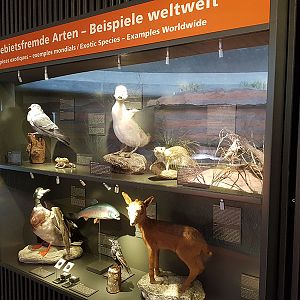
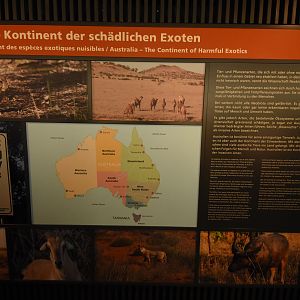 Finally the education. This is also well done - perhaps even a standard above the education in the rest of the zoo. The theme is invasives and the various education signs and info material attracted considerable attention from visitors.
(part I: Australia house)
The new Australia development consists of the refurbished and repurposed former Africa now Australia house, outdoor enclosures for koala and perentie, a combined emu and wallaby walkthrough, a combined indoor and outdoor rainbow lorikeet aviary, a smallish outdoor kookaboora aviary, and a small lawn for rabbits with underground access to one of the outdoor koala enclosures.
The strongest part of the development is the Australia house indoors: One large koala enclosure that can be separated off into two sections, two enclosures of different size for perentie, two terraria, one for pilbara monitors, the other housing shingleback skinks, and the entire back wall of the house's corridor full of educational material on invasive species. The three large enclosures mimic an Australian bush savanna. Rusty reds dominate with occasional patches of green, brown, and yellow from vegetation both alive and withered. Large glass panels reaching to a height well over 2 meters separate the visitors from the animals and apparently also limit the noise emissions from the former for the latter. The enclosures receive a combination of artificial illumination, as well as natural light through the building's two domes. The visitor area in comparison only has subdued light.
Australia: Koala indoors panorama (170 deg.)
Indoor savanna enclosure for koala. Can be split into two enclosures. Each half has one live...
The two perentie enclosures replicate the design and look of the koala enclosures - except for missing a 'tree layer' and having a slightly more arid feel to them. The two enclosures are separated by the massive black and red striped mock-rock wall used throughout the development and the perenties can switch between the two through a small tunnel/crack. This mock rock wall is a lot less ugly than I had originally feared and it actually works quite well in setting a common theme throughout the entire development (together with the red and brown gravel) - alas I am still no fan. It is also interesting to note that the top end of the mock rock wall in the perentie enclosures is planted with grass (whereas the koala wall is not) - whether there is any deeper meaning to this I do not know. Of course I would hope, that this is a giveaway sign of the zoo having plans for introducing birds into this house - not least because birds form a special part of the history of this house - alas I am not sure whether holding birds in a perentie enclosure is a good idea (...for the birds that is).
The shingleback terrarium is considerably smaller than the one in the exotarium and it only houses a lone animal - in contrast to the large group in the exotarium - in other words the current inhabitant is clearly a temporary solution.
I saw two Shinglebacks there last week, if memory serves me correctly

Thank you lintworm and zoomaniac for the clarifications.
On to part II: lorikeet aviary and outdoor enclosures
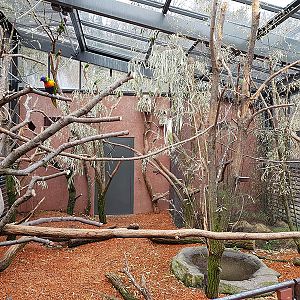
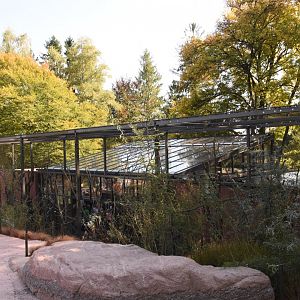
After exiting the Australia house one approaches the rainbow lorikeet aviary on the left and the entrance to the walkthrough emu and wallaby exhibit on the right. The lorikeet aviary consists of a decent size walk-in indoors aviary in the style of a classical greenhouse and a generously sized, elongated outdoor aviary directly attached to the greenhouse building; all of which were already open to the public a year ago. The indoors portion left a rather shabby and dingy impression on me - even though objectively it is neither. Perhaps this impression is due to the sparse vegetation and the decrepit plants - which (barely) seem to cling on to dear life - in combination with the inhabitants' rather shrill symphony of squeaking. At my visit two corners of the exhibit were cordoned off by nets, presumably to protect the vegetation from the birds an allow it to establish itself. Healthier vegetation would go a long way in improving the overall feel of the exhibit, so fingers crossed. Twice a day, three days a week, visitors have the opportunity to feed the loris under supervision. The zoo seems to have found a good balance here, because while the birds are rather inquisitive and closely scout visitors, they are not too in-your-face about it and at my visit always kept a reasonable distance of say half a meter. Thus, while the loris came pleasingly close, their behavior didn't seem (overly) unnatural and fixated on humans. Planting in (and in front of) the outdoor aviary currently is even sparser than indoors and it remains to be seen how this part of the exhibit will develop - overall it felt quite spacious but otherwise underwhelming.

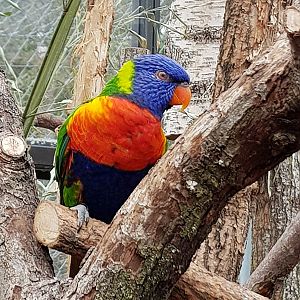
close encounters of the bird kind

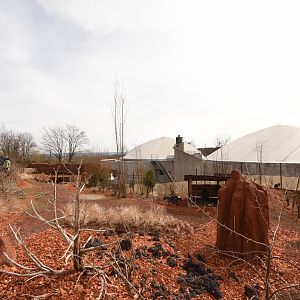
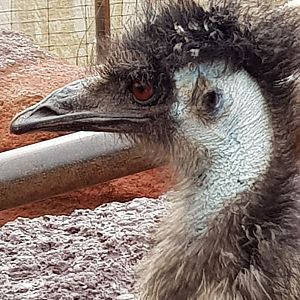
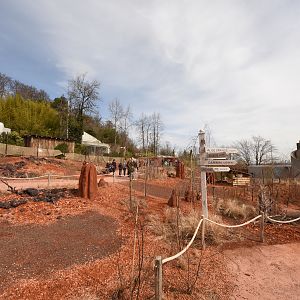 On to the walk-through exhibit for emu and red-necked wallabies. At roughly 2000 square meters the exhibit is quite large, leaving the animals adequate though by no means generous opportunities to retreat, despite the winding and thus rather space-filling visitor path through the exhibit. Except for the signature mock-rock wall entry and exit the exhibit is delimited with a wire fence and a semitransparent fabric that partially obstructs the view. The whole area is (very) heavily themed (there is even a fake nest with fake green emu eggs). The ground is structured with a repeat of the reddish-brown mixture of gravel and dirt from the Australia house, there are patches and tufts of grass, as well as bushes, scrubs, and small trees. There are fake termite mounds everywhere as well as 'outback' huts and shelters for both animals and visitors. The enclosure presumably attempts to mimic a semi-desert landscape, which imo doesn't work very well because wherever the eye wanders lush greens intrude on this fantasy from the zoo's own park landscape and the surrounding forest. Perhaps this will improve once the planted bushes and scrubs develop and get the chance of setting a more dominant tone on the enclosure and that as vegetation takes hold, the exhibit will result in a somewhat greener, lusher version of itself (which e.g. is what happened with the 'Gir forest' lion enclosure) that doesn't clash quite as violently with its surrounds, thus evening out this ungainly discrepancy. The visual clash of the conflicting real and recreated biomes aside, I would say that the theming is rather expertly executed: the exhibit is so heavily themed, it should feel nauseating, but it doesn't. In fact overall it is surprisingly pleasant. On my visit, the emus were already making full use of the enclosure - completely oblivious to and undisturbed by visitors, literally walking through clutches of people. It is an impressive demonstration of zero flight distance behavior, and the emu is a thoroughly extraordinary animal up-close with its horizontal body posture, punk hairdo, and blue skin. The wallabies' flight distance on the other hand most definitely appears larger than zero, as they had not yet started to explore the enclosure at all on my visit, sticking to their reasonably sized retreat area in the top-right corner of the exhibit. Time will have to tell how well this walk-through works, after the wallabies have become accustomed to the presence of visitors.

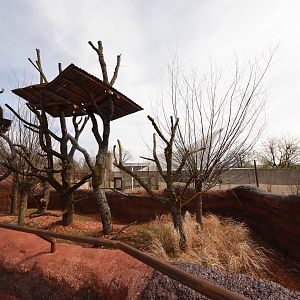
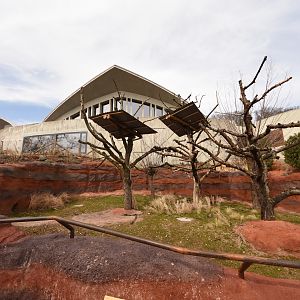
Integrated into the walk-through enclosure is one of two outdoor koala enclosures consisting of (dead) climbing trees and corrugated metal shade platforms. The walk-through koala enclosure is the one directly connected to the indoor enclosures via a mesh tunnel. The visitor barriers are quite low such that even small children can see over them, creating a feel of close proximity to the inhabitants (though there were no koalas present at my visit). Both enclosures integrate well with their surroundings, but are imo otherwise unremarkable.
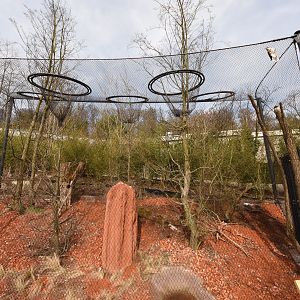
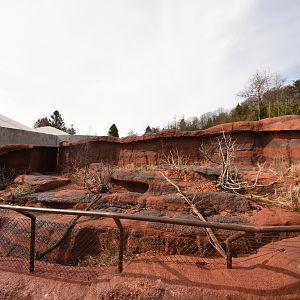
Finally the kookaburra aviary and the perentie outdoors at the end of the Australia house next to the spectacled bears and below the ape house. The kookaburra aviary seems adequate though smallish, and while there isn't a lot of space around it, one wonders nonetheless, why they didn't make it larger. One can get excellent views of the birds which were very showy. Add to that their size and unique kingfisher appearance and you have one very attractive species to exhibit. The center piece of the aviary is yet another mock termite mound. The perentie enclosure is a full-blown terraced extravaganza of the development's signature mock-rock. As with the indoors the signature mock-rock works surprisingly well aesthetically, though once again, I would have preferred something more natural(istic). The mock-rock btw. is supposed to be reminiscent of Bungle Bungle Range rock formations - i guess they just missed the correct scale by at least one order of magnitude. Next to the perentie enclosure is yet another mock termite mound, this time cut open to reveal a clutch of perentie eggs and hatchlings.
That's it. Final thoughts will follow in a third post.
(all images from the zoochat gallery or 929 Australien Zoo Zürich - vetschpartner Landschaftsarchitekten AG )
On to part II: lorikeet aviary and outdoor enclosures
After exiting the Australia house one approaches the rainbow lorikeet aviary on the left and the entrance to the walkthrough emu and wallaby exhibit on the right. The lorikeet aviary consists of a decent size walk-in indoors aviary in the style of a classical greenhouse and a generously sized, elongated outdoor aviary directly attached to the greenhouse building; all of which were already open to the public a year ago. The indoors portion left a rather shabby and dingy impression on me - even though objectively it is neither. Perhaps this impression is due to the sparse vegetation and the decrepit plants - which (barely) seem to cling on to dear life - in combination with the inhabitants' rather shrill symphony of squeaking. At my visit two corners of the exhibit were cordoned off by nets, presumably to protect the vegetation from the birds an allow it to establish itself. Healthier vegetation would go a long way in improving the overall feel of the exhibit, so fingers crossed. Twice a day, three days a week, visitors have the opportunity to feed the loris under supervision. The zoo seems to have found a good balance here, because while the birds are rather inquisitive and closely scout visitors, they are not too in-your-face about it and at my visit always kept a reasonable distance of say half a meter. Thus, while the loris came pleasingly close, their behavior didn't seem (overly) unnatural and fixated on humans. Planting in (and in front of) the outdoor aviary currently is even sparser than indoors and it remains to be seen how this part of the exhibit will develop - overall it felt quite spacious but otherwise underwhelming.
close encounters of the bird kind
Finally the kookaburra aviary and the perentie outdoors at the end of the Australia house next to the spectacled bears and below the ape house. The kookaburra aviary seems adequate though smallish, and while there isn't a lot of space around it, one wonders nonetheless, why they didn't make it larger. One can get excellent views of the birds which were very showy. Add to that their size and unique kingfisher appearance and you have one very attractive species to exhibit. The center piece of the aviary is yet another mock termite mound. The perentie enclosure is a full-blown terraced extravaganza of the development's signature mock-rock. As with the indoors the signature mock-rock works surprisingly well aesthetically, though once again, I would have preferred something more natural(istic). The mock-rock btw. is supposed to be reminiscent of Bungle Bungle Range rock formations - i guess they just missed the correct scale by at least one order of magnitude. Next to the perentie enclosure is yet another mock termite mound, this time cut open to reveal a clutch of perentie eggs and hatchlings.
That's it. Final thoughts will follow in a third post.
(all images from the zoochat gallery or 929 Australien Zoo Zürich - vetschpartner Landschaftsarchitekten AG )
Part III: Concluding thoughts
So what is my verdict on the newest addition to Zurich? Does it achieve 'the knock-your-socks-off standard of exhibitry that really sets Zurich apart' - or is it a case for 'mixed feelings'? I would say a little of both. The koala enclosures are certainly the best I have ever seen in a zoo (with the exception of Australian sanctuaries and rescue centers with 'free ranging' koalas in fenced in sections of actual koala habitat). Most notably, they contain live trees for the koalas to roam in both indoors and out (though the outdoors trees currently are only stumps and have a considerable amount of growing to do). Similarly, I would place the perentie enclosures amongst the most aesthetically appealing for large monitors in any zoo. The wallaby and emu walkthrough also attempts something I have not seen elsewhere for these species: the 'naturalistic' and planted recreation of an arid, semi-desert habitat in a temperate and rather humid climate - instead of a green (forest) pasture (nothing wrong with that) and beyond the standard 'cement-and-mock-rock-desert' paradigm. The development furthermore significantly extends the diversity of the zoo's collection with representatives of the two most recognized groups of marsupials (koalas, macropods), a large monitor species, emu, and kookaburra (kingfishers). The zoo also significantly increases its collection of rarities with the perenties, pilbaras, and koalas (fun fact: Zurich is the only holder of both koala and Galapagos giant tortoise in Europe). Furthermore, the koala enclosure is clearly designed for more than just koalas and the zoo's attempts at moloch husbandry according to @arafan seem to be ongoing, so there is a reasonable prospect for further species additions in the future. While many on this site lament the somewhat limited number of species in the Australia development, I doubt that this is the impression that will stick with someone on a (first) zoo visit. The zoo is very good at creating enclosures that invite the visitor to linger and observe and it is becoming increasingly difficult to do so and fit the entire zoo into a day's visit. As I see it, with Australia, there are even more great exhibits to experience (rather than only a few species to see there). Indeed, 'what really sets Zurich apart' may be precisely the commitment to designing enclosures that invite - and challenge - visitors to linger, observe, and every now and then even interact. Seen this way I think Australia can be considered a success, and the addition of a walkthrough and the lorikeet feeding make a lot of sense.
So what of the mixed feelings? The zoo's masterplan among other things is premised an a strategy of species number reduction in order to increase the space and attention available to those species that remain. While I commend the overall strategy it sometimes feels as if what originally was primarily a means to an end, has at times taken on a life of its own and is seen through 'just to make a point'. The elephant park is probably the most notable example of this, but Australia also is no exception. It just feels strange that the zoo doesn't exhibit the flagship species of its conservation effort associated with the development: the Tasmanian devil. Even more so, since this is an attractive and sufficiently attainable species to exhibit. Assuming a wallaby, emu, and wombat mixed enclosure is doable, this imo is another missed opportunity. Last not least, I think it's a shame the zoo missed the opportunity to exhibit echidna and with them monotremes. Having said that, I think it makes sense that there are no tree kangaroos or cassowaries (which many on here hoped for), since the zoo decided to lean into the arid nature of Australian habitats (I guess there is quite a bit of irony in this remark regarding koalas - indeed, while aesthetically rather excellent, I am not sure whether the indoor koala enclosures meaningfully represent any actually existing koala habitat). Next to the lorikeet aviary there is about 500m2 of undeveloped zoo grounds which together with another ~500m2 land occupied by the lorikeet aviary could have become a nice second Australia house, with vivaria and indoors enclosures for additional Australian reptiles, birds, and mammals (but this would likely have at least doubled the necessary budget and the zoo needs to raise a lot of money for Lewa). Time will tell, what will happen with the remaining 500m2. In the lorikeet aviary presumably there would be space for some ground-dwelling inhabitant or additional bird species. Also the rabbit lawn where the shoebill aviary used to be could be redeveloped into an aviary or other indoor enclosure. So there are definitely opportunities for extensions - though additions to masterplan projects have only very rarely been done by the zoo in the last twenty years. The most glaring omission however, imo are free flying birds in the Australia house. Afaik Zurich zoo was the first worldwide to house free flying birds together with rhino and hippo in this very house, and quite successfully so. Together with the free flight section of the exotarium and Masoala, free flying birds in open indoors enclosures imo should have been treated as a signature concept in Zurich. Unfortunately, this tradition has not been followed up upon in neither the elephant park nor Australia, and I fear if there will again be no free flying birds in the Lewa giraffe house, the zoo will have altogether squandered what was originally a wonderful opportunity to set itself apart. I am aware that there must be significant obstacles and challenges to such cohabitations (disturbance of the koalas and predation by the perenties in the case of Australia, birds escaping and husbandry logistics in the case of the elephant park and Lewa). At the same time I believe that, if the zoo gave sufficient priority to this, solutions could be found - not least because other zoos are indeed following up on this concept.
Overall, I would say both the strengths, shortcomings, and compromises of Australia are very much signature Zurich. As such, I think the development fits nicely into the existing zoo and it will be interesting to hear the verdict from first time visitors.
So what is my verdict on the newest addition to Zurich? Does it achieve 'the knock-your-socks-off standard of exhibitry that really sets Zurich apart' - or is it a case for 'mixed feelings'? I would say a little of both. The koala enclosures are certainly the best I have ever seen in a zoo (with the exception of Australian sanctuaries and rescue centers with 'free ranging' koalas in fenced in sections of actual koala habitat). Most notably, they contain live trees for the koalas to roam in both indoors and out (though the outdoors trees currently are only stumps and have a considerable amount of growing to do). Similarly, I would place the perentie enclosures amongst the most aesthetically appealing for large monitors in any zoo. The wallaby and emu walkthrough also attempts something I have not seen elsewhere for these species: the 'naturalistic' and planted recreation of an arid, semi-desert habitat in a temperate and rather humid climate - instead of a green (forest) pasture (nothing wrong with that) and beyond the standard 'cement-and-mock-rock-desert' paradigm. The development furthermore significantly extends the diversity of the zoo's collection with representatives of the two most recognized groups of marsupials (koalas, macropods), a large monitor species, emu, and kookaburra (kingfishers). The zoo also significantly increases its collection of rarities with the perenties, pilbaras, and koalas (fun fact: Zurich is the only holder of both koala and Galapagos giant tortoise in Europe). Furthermore, the koala enclosure is clearly designed for more than just koalas and the zoo's attempts at moloch husbandry according to @arafan seem to be ongoing, so there is a reasonable prospect for further species additions in the future. While many on this site lament the somewhat limited number of species in the Australia development, I doubt that this is the impression that will stick with someone on a (first) zoo visit. The zoo is very good at creating enclosures that invite the visitor to linger and observe and it is becoming increasingly difficult to do so and fit the entire zoo into a day's visit. As I see it, with Australia, there are even more great exhibits to experience (rather than only a few species to see there). Indeed, 'what really sets Zurich apart' may be precisely the commitment to designing enclosures that invite - and challenge - visitors to linger, observe, and every now and then even interact. Seen this way I think Australia can be considered a success, and the addition of a walkthrough and the lorikeet feeding make a lot of sense.
So what of the mixed feelings? The zoo's masterplan among other things is premised an a strategy of species number reduction in order to increase the space and attention available to those species that remain. While I commend the overall strategy it sometimes feels as if what originally was primarily a means to an end, has at times taken on a life of its own and is seen through 'just to make a point'. The elephant park is probably the most notable example of this, but Australia also is no exception. It just feels strange that the zoo doesn't exhibit the flagship species of its conservation effort associated with the development: the Tasmanian devil. Even more so, since this is an attractive and sufficiently attainable species to exhibit. Assuming a wallaby, emu, and wombat mixed enclosure is doable, this imo is another missed opportunity. Last not least, I think it's a shame the zoo missed the opportunity to exhibit echidna and with them monotremes. Having said that, I think it makes sense that there are no tree kangaroos or cassowaries (which many on here hoped for), since the zoo decided to lean into the arid nature of Australian habitats (I guess there is quite a bit of irony in this remark regarding koalas - indeed, while aesthetically rather excellent, I am not sure whether the indoor koala enclosures meaningfully represent any actually existing koala habitat). Next to the lorikeet aviary there is about 500m2 of undeveloped zoo grounds which together with another ~500m2 land occupied by the lorikeet aviary could have become a nice second Australia house, with vivaria and indoors enclosures for additional Australian reptiles, birds, and mammals (but this would likely have at least doubled the necessary budget and the zoo needs to raise a lot of money for Lewa). Time will tell, what will happen with the remaining 500m2. In the lorikeet aviary presumably there would be space for some ground-dwelling inhabitant or additional bird species. Also the rabbit lawn where the shoebill aviary used to be could be redeveloped into an aviary or other indoor enclosure. So there are definitely opportunities for extensions - though additions to masterplan projects have only very rarely been done by the zoo in the last twenty years. The most glaring omission however, imo are free flying birds in the Australia house. Afaik Zurich zoo was the first worldwide to house free flying birds together with rhino and hippo in this very house, and quite successfully so. Together with the free flight section of the exotarium and Masoala, free flying birds in open indoors enclosures imo should have been treated as a signature concept in Zurich. Unfortunately, this tradition has not been followed up upon in neither the elephant park nor Australia, and I fear if there will again be no free flying birds in the Lewa giraffe house, the zoo will have altogether squandered what was originally a wonderful opportunity to set itself apart. I am aware that there must be significant obstacles and challenges to such cohabitations (disturbance of the koalas and predation by the perenties in the case of Australia, birds escaping and husbandry logistics in the case of the elephant park and Lewa). At the same time I believe that, if the zoo gave sufficient priority to this, solutions could be found - not least because other zoos are indeed following up on this concept.
Overall, I would say both the strengths, shortcomings, and compromises of Australia are very much signature Zurich. As such, I think the development fits nicely into the existing zoo and it will be interesting to hear the verdict from first time visitors.
Last edited:
...one thing I forgot to mention are termites: considering (a) the dozens of highly visible fake termite mounds in the Australia development (but also in the Pantanal section), (b) the fact that the zoo does not yet have any exhibit with colony building insects, (c) that when executed properly, these constitute excellent and engaging exhibits, and (d) the huge importance of colony building insects for most terrestrial biomes, an exhibit for at the very least either termites, ants, or bees imo is well overdue at Zurich.