
SpinyLiving
Well-Known Member
What about the red-touch-yellow kill-a-fellow red-touch-black venom lack trick for the coral snake? It should be changed to red-yellow mean fellow red-black eagle snack red-white Albini Coral 
That reminded me the infallible method for distinguish a brown bear from a black bear: you must go and kick the bear in its ass, run away and climb to a tree. If the bear climb the tree and eat you, it's a black bear, if it shoot down the tree and eat you, it's a brown bear
Stag beetles are able to powerful bites, overall the females. Hercules beetles also can do some harm on a hand holding them. Weevils are mostly specialized feeders, overall the few species that are enough big and colorful for catch the attention of peoples. Most longhorns are nocturnal and many are specialized feeders that needs certain species of rotting log, and all longhorns that are enough big for catch the attention of people have a powerful bite.
Almost none dipteran is enough big for catch the attention of the average visitor of these kind of places. Soldierflies are breeded for making compost (in the case of the so well known Hermetia illucens), not for show the insects itself. Almost all craneflies have dull colours and almost all visitors would think in them as giant mosquitoes, and will be afraid of them, no matter of how many signage do you put explaining that they are harmless. This happens almost always that I see people reacting to wild craneflies.
Any? Including a free-breeding colony of Automeris, megalopygids and other species whose caterpillars can be extremely painful?
Not much more limited than most insect groups... For making this thread you only considered hervibory and "stinglessly", but many other characteristics must be taken in account. Few hymenopterans are enough big to catch the visitor attention, and the ones that are enough big are not suitable for mixed exhibits (Pepsis would harm spiders, Megascolia would harm beetles, Vespa would harm visitors, etc). The only sawlies that are enough big for be attractive to visitors are Siricidae, but they are all temperate species that can't go in a tropical hall as the one you plan.
Nobody will ever look at aphids. Same for scale insects, even for the few species that are enough big, nobody will watch an insect that pass it's life completely quiet and fixed to a substrate. Stinkbugs usually will damage too much the plants into a closed environment as is a greenhouse (and of course aphids and scale insect even more). Most cicadas are difficult to breed in captivity, they need a good replica of the climate of the zones that they come from. And insects that pass most of it's life cicle underground are not what the visitors want watch. Fulgorids and some flatids are probably better substitutes than most cicadas.
No matter than only three or four of the hundreds of species of cockroaches are domestic pests. Average people will think in the whole group as in something horrendous and creepy. Believe me, I once tried to make a person that was very afraid of roaches to curate himself by showing some of the most beautiful cockroaches in the world, such as Paraplectana coccinella and Melyroidea magnifica. It didn't worked. People will not want to enter in a walkthrough exhibit with cockroaches. Plus, almost every species are nocturnal and will remain hidden during visitor time.
All of them? You will risk to put some Heteropteryx dilatata in a walkthrough exhibit? The visitors will try to touch them, and they will close their powerful spiny hind legs on the visitor fingers. Then you will have some troubles... and maybe authorities will force you to close the place after some accidents...
Nobody will care about tiny dull spinners that pass the day hidden in silk funnels under stones and are impossible to see unless specifically searched. Zorapterans and barklice are similarly inconspicuous and hidden and too small for attract visitors. For psocopterans only some tropical species are colorful, colonial and diurnal, but even them are too small for get attention.
I'm not totally sure. Venomous insects in walkthrough exhibits works fine in the case of monarch butterflies and postmans, but a non-flying grasshopper is a subject that many kids will try to catch with their hands, unlike butterflies that can fly quickly. The defensive liquid that most grasshoppers produce in the mouth when caught is, as better, unpleasant, and I think that in colorful big species such as Romalea, Phymateus, etc, can be toxic? (maybe Batto can correct me). Anyway this time I'm agree with you, many grasshoppers would be suitable. But also take in account that most big katydids have a powerful bite.
The stoneflies cycle of life are extremely difficult to replicate. They need clean, generally current and generally cold waters. Adults are too inactive to catch the visitor attention, and all are dull-coloured.
I don't know any herbivorous mecopteran. The only ones that maaaaybe catch the attention of visitors are panorpids (combination of medium size, strange shape and colorful wings), and these are all predatory.
Nobody will look at any species of secretive, small and dull insect such as every species of silverfishes (Zygentoma) and bronzefishes (Microcoryphia).
For the life cycle, same than Plecoptera. But adding the inconvenience of an adult lifespan from some hours to some days. Visitors will not care about the (always hidding) nymphs, they will only look at the (too inactive) adults, that in very few species will be enough big gor attract visitors.
You are ruling out predatory species by definition. I don't see a true reason for do it. Predatory species that feed on small prey items or specialized on unwanted prey items (for example jewel wasp on cockroaches) can mix successfully with other species in a walkthrough. If you exhibit only bigger insects you can introduce damselflies (would be cool a Megaloprepus coerulatus flying in this kind of exhibit), or mantids and neuropterans that are specialized in smaller preys that you provide plenty of (fruitflies, house flies, springtails, L1 nymphs of crickets/roaches, etc... all of them available commercially). See next image of my terrarium many years ago (when I was in the age of keeping terrariums, hehehe). The small-prey-feeder Empusa never was got interested in a big and hard Blaps lethifera...
View attachment 360072
By the way, what the heck is "Notoptera"????????
What I think is that if every zoo shows their non-butterfly insects in closed terrariums at sight level, it's for a reason... or for various, both thinking in the visibility and easiness to find and to care the insects, as thinking in the average visitor reaction of being surrounded of free ranging insects.
The thing that Chlidonias said about behavious of visitors that are afraid of what they visit is completely true. I remember a family visiting the pinned specimen collection of fabulous tropical insect at Faunia... about four times each minute they limited themselves to express loudly how creepy and horrendous are the creatures that they was looking at, even if they are jewel beetles or longhorns with rainbow colours and with no spines...


You could start by researching and personally visiting existing insectaria both before and behind the scenes to learn how to exhibit arthropods to the general public:do you think there is a way we can make this work?
Wow, I hadn't even thought about individual terrariums. Having both a free roaming area and some individual exhibits afterwards actually doesn't sound like a bad idea. However, I think some stick insects can be free roaming, as long as they are a species with no spikes or foul chemicals.Yes, there is a way that can make this work, just displaying showy species that attract visitors, that are completely harmless and that don't remain hidden, but the chances are much more limited than tought in your original plan. Probably only some damselflies, orthopterans, maybe scutellerid bugs, flatids/fulgorids, some tropical antlions, chafers and other scarabs, and maybe some frog beetles and tropical weevils are the only non-lepidopteran that can be realistically and profitably used in this kind of exhibit. Individual terrariums for tarantulas/stick insects/assasin bugs/etc will be needed as an addition for the most of the species inside the walktrough exhibit if you want to display an enough number of attractive and easy to get species, as it's done in many insectariums and butterfly houses.
Notoptera is the group that contains Grylloblattodea and Mantophasmatodea.I searched with Google. I see, "notoptera" is just the Order Grylloblattodea, that I doubt that have the least reason of change its name. Anyway these insects are not crowd-attactors, only freaks like many zoochatters (including me) would find them as something special.
In a terrarium they're relatively easy to spot because you know where to look at 
How do you think harvestmen would fare? A lot of them are diurnal, large, colorful and completely harmless to humans.Yes, free-ranging non-toxic stick insects are a good idea if they don't breed like rats and became a nuisance for the plants, but the problem is that visitors will not see them
A nice example of a free-ranging butterfly pavilion with terrariums included inside of it is the "Eden garden" in Faunia, Spain. But I'm sure plenty of others will have similar disposition.
Thanks for the taxonomic explanation! I forgot completely about the existence of Mantophasmatodea, a group that I only noticed two or three times in my life mentioned casually in some article or in the net...
That sounds like a nice idea. How do you think lubber grasshoppers would fare?What about giant pill millipedes of beautiful emerald colour from Madagascar? Completely harmless to humans, plants and other insects, big, beautiful, not menacing-looking, sociable, and a large group together is a beautiful sight, they also tend to not hide too much... and are commercially available! All are advantages!
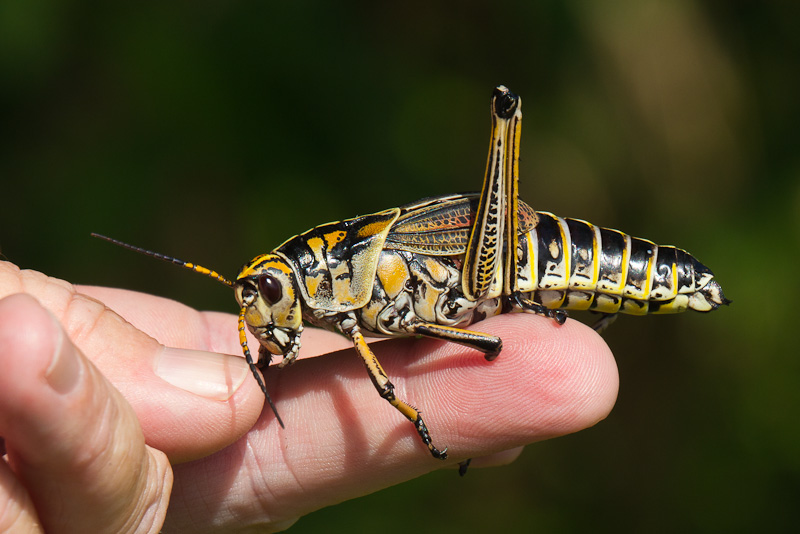

Not very well, if one jumped and landed on someone, it might not end well for the grasshopper...That sounds like a nice idea. How do you think lubber grasshoppers would fare?
Large, colorful, harmless, very visible and easy to see. The only problem I can see might be the damage to plants...
Yeah. The poison only activates if you eat one which I highly doubt would happen. That and their jumps are very short.I think that lubber grasshoppers are good candidates, tough maybe being poisonous (as discussed before) could be somewhat a problem, but probably not. The risk of one jumping into a person is low I think - if they feel threatened, they will jump in the opposite direction...
