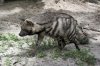
Hyenas in the USA

I've been visiting Hera the Striped hyena at the Naples (FL) Zoo a lot this year. She's gorgeous. The AZA doesn't seem to care much for diversity in species these days.
Cincinatti Zoo exhibits the Aardwolf.

She is beautiful. I really wish they were more popular in zoos.
(Also, hey! I follow you on flickr.)
 
Two non-AZA zoos with Spotted Hyena are Space Farms Zoo and Wildlife World Zoo.

LEO Zoo, a private zoo in CT, has Striped Hyena as well. The entire US population should be the East African subspecies, except for Utica which keeps Arabian.

Afaik Cincinnati is indeed the only remaining US zoo with Aardwolf (Eastern).

~Thylo
 
Does anybody know about the hyenas at the Phoenix zoo? I was there yesterday but didn’t see them.

Two males, Huckleberry and Cahli. Different parents but related on both sides. They've been at Phoenix since 2015. They're both in their mid-20's if they're still alive; however, that's quite old for hyenas so it's entirely possible that one or both have passed on.
 
Does anybody know about the hyenas at the Phoenix zoo? I was there yesterday but didn’t see them.

I was just in Arizona visiting. I didn’t go to the Phoenix Zoo, but went to Wildlife World in Litchfield Park. They had two spotted hyenas there. It was the first time I’ve seen them in person. One walked over and started sniffing in our direction. It was very curiuos. Probably my favorite animal there.
 
Wildwood Wildlife Park has Striped Hyenas, I saw them when I went there a few years ago, but I'm not 100% sure if they still have them. I would like the visit sometime within the next year, so I could easily check.
 
Hmm... I have a photo that I tried to attach from my iPhone but it’s not allowing me. This hyena definitely had spots and not stripes. But maybe that’s common with the stripes as well?

IMG_1167.jpg
Here’s the photo.
 
Last edited by a moderator:
Lincoln Park had hyenas for a while, although I can't recall ever seeing them outside. They were in the McCormick Bear Habitats before the area was reconstructed for Polar bears.

I think part of the lack of focus on Hyenas is the influx of African Wild Dogs, which fill the same niche for the general, uninformed public, and have a much better-supported AZA and are much more heavily endangered.
 
One of the biggest problems facing Spotted Hyenas in the AZA is that a huge portion of them descend from UC Berkeley's bloodlines (stemming from 20 imported individuals). There are other bloodlines but it's few. Because of the lack of founders they are pretty closely related even with the new imports. The genetic diversity is pretty poor.

Another problem is large portion of the population cannot breed due to age or being sterile. 18 seems to be the age cut off for breeding. There are a number of males about to hit that age and they will be out of the breeding stock too.

Breeding success is another huge problem. Only a handful of pairs are breeding which is further reducing genetic diversity for future generations. If a female isn't bred by 5 she is unlikely to breed. The population is not offsetting its losses with births and with so many in the upper age range. Even what they have been able to import is not helping enough.

Good news is they are trying to recruit more zoo's to house them in larger clans to simulate the wild and hopefully increase breeding. More imports are encouraged to improve the genetics.

On the flip side the African Wild Dogs are in a better position so its easier to get them. The population is nearly triple the hyenas. They have larger litters and breed more readily. Yet they too face their own difficulties.

The larger litter sizes can result in more pups then were needed from a pair and can wildly swing the sex ratio of the population. But they also suffer from very high infant mortality rates which makes it difficult to guess how many pups are going to be produced. Makes it hard for planning breeding among the whole population. A few pairs might breed and produce 40 new dogs which may or may not survive and be equally balanced in genetics. It can be a very unpredictable population.

Females also see to be more prone to reproductive problems than other canines. This is a big problem in a unpredictable population. Every breeding female lost needs to be replaced by a viable female but there isnt always a female capable of taking over her reproductive success. It's hard to strike the right balance with wild dogs.

Their window for breeding is short. Females are usually done by 7 while males tend to stop at 9. They have to be careful not to wait too long to allow them to breed. Plus they dont live as long as hyenas.
 
How many of that original hyena stock bred because 20 individuals (with new additions along the way) sounds like a pretty great founding population to me. Many large mammals don't seem lucky enough to even have a founding population of 10...

Thank you for the information on the two species' captive breeding btw.

~Thylo
 
How many of that original hyena stock bred because 20 individuals (with new additions along the way) sounds like a pretty great founding population to me. Many large mammals don't seem lucky enough to even have a founding population of 10...

Thank you for the information on the two species' captive breeding btw.

~Thylo

Many or perhaps most of the 20 UC Berkeley hyenas bred, but overall the population was poorly managed from the start. A lot of inbreeding occurred, a few genetic lines became overrepresented while others were lost or permanently tied to each other. The result is a good number of founders, but a high level of relatedness, and thus no way to keep gene diversity stable.
 
There are two Striped Hyenas, Tuli and Puru, at Lion Camp in the San Diego Zoo Safari Park. These isn’t a set rotation schedule since there are the Lion pairs, whom also live there. Currently it’s Tuli and Puru, Izu and Etosha, and Mina and Oshana. Best chances are to arrive early mornings from what I’ve been told in case they are exploring the exhibit.
 
Back
Top