You are using an out of date browser. It may not display this or other websites correctly.
You should upgrade or use an alternative browser.
You should upgrade or use an alternative browser.
Burgers' Zoo free-ranging species in Burgers Bush, Desert and Mangrove
- Thread starter lintworm
- Start date


The zoo has a single male from Zurich.
Update: the Scarlet Ibis are also back into the bush!
Four males, from Avifauna
 a very new arrival, as they didn’t have any ibis at all a few months ago!
PicanBird
Well-Known Member
They do have them behind the scenes I believe (scarlet)The zoo has a single male from Zurich.
Four males, from Avifauna
For the madagascar I have reasons to believe we are also getting two females soon

@KevinVar and I also saw the seedfinches and hanging-parrots on our visit on the 17th - the seedfinches (at least one male, potentially two males) near the entrance and near the rice paddies, and both hanging-parrots near the nectar feeder in the dense area just underneath the roof.
We found a very good place for getting good views of passerines was a certain position in the small "side loop" of the area just underneath the roof: if you stand in the right spot you get a good top-down view of an entire slope with many perches and a table where the birds get fed. We saw a chestnut-backed thrush, 2 rose-bellied buntings (m+f), 2 Montserrat oriole and a white-rumped shama there, among the very numerous bulbuls, robin-chats and fairy-bluebirds (we counted 9 in the perches around that area at a certain point). White-eared catbird still remains most reliable around the waterfall area, screaming piha near the entrance and orange-crowned fruit dove near the hanging log bridge. Still haven't managed the leafbird, but I believe that and the honeycreepers are now the only birds I haven't seen in the bush - besides the crested ibises of course.
The mangrove seemed very quiet - we didn't see any grassquits (and I can't remember hearing them either, though I might be wrong). The indigo bunting was fairly easy (in the densely planted area), as were the new honeycreepers.
We found a very good place for getting good views of passerines was a certain position in the small "side loop" of the area just underneath the roof: if you stand in the right spot you get a good top-down view of an entire slope with many perches and a table where the birds get fed. We saw a chestnut-backed thrush, 2 rose-bellied buntings (m+f), 2 Montserrat oriole and a white-rumped shama there, among the very numerous bulbuls, robin-chats and fairy-bluebirds (we counted 9 in the perches around that area at a certain point). White-eared catbird still remains most reliable around the waterfall area, screaming piha near the entrance and orange-crowned fruit dove near the hanging log bridge. Still haven't managed the leafbird, but I believe that and the honeycreepers are now the only birds I haven't seen in the bush - besides the crested ibises of course.
The mangrove seemed very quiet - we didn't see any grassquits (and I can't remember hearing them either, though I might be wrong). The indigo bunting was fairly easy (in the densely planted area), as were the new honeycreepers.
Last edited:

They've released 10 white-throated geckos and 3 allisons anoles in the mangrove!
Burgers' Zoo
Burgers' Zoo
Burgers' Zoo
Burgers' Zoo

We found a very good place for getting good views of passerines was a certain position in the small "side loop" of the area just underneath the roof: if you stand in the right spot you get a good top-down view of an entire slope with many perches and a table where the birds get fed. We saw a chestnut-backed thrush, 2 rose-bellied buntings (m+f), 2 Montserrat oriole and a white-rumped shama there, among the very numerous bulbuls, robin-chats and fairy-bluebirds (we counted 9 in the perches around that area at a certain point). White-eared catbird still remains most reliable around the waterfall area, screaming piha near the entrance and orange-crowned fruit dove near the hanging log bridge. Still haven't managed the leafbird, but I believe that and the honeycreepers are now the only birds I haven't seen in the bush - besides the crested ibises of course.
That is indeed a good spot, I saw Montserrat oriole, Rose-bellied bunting, Chestnut-backed thrush and Blue-crowned hanging parrot there.
They've released 10 white-throated geckos and 3 allisons anoles in the mangrove!
Burgers' Zoo
Burgers' Zoo
Added to the main list.
The Yellow-legged honeycreepers in the Bush were very easy to see today, they were at the feeder next to the Caiman cave, around the viewing platform and in trees around the small loop described by @Vision above.
The White-eared catbirds are currently making a nest just below the viewing platform and this nest is easily visible from the stairs.

Yesterday I did not manage to find any of the new additions in the Mangrove during a very short visit, but I had some more time in the Bush and managed to find a few less regularly seen species like the honeycreeper, oriole, rose-bellied bunting and catbird. I also found all the free-range reptiles bar the geckos.
Some updates from my visit yesterday:
BUSH
No changes in the collection specieswise, but there is a second Madagascar crested ibis now.
Overall I managed to spot all but 5 bird species yesterday, missing the close to impossible White-eye, Leafbird and Laughing thrush. I also missed the Rose-bellied bunting and surprisingly also the Orange-fronted fruit doves. The catbird was again seen on the Bush terrace. The Chacalaca around the Desert entrance. The Madagascar crested ibis was first seen around the Livingstone bridge (oppposite Bush restaurant) and later in the small loop near the roof. I saw a seedcracker on the rice paddy and a female between the Waterfall tunnel and the Desert entrance. A tree has been felled near the view point, this used to be a Green imperial pigeon favourite, they were now hanging around the Bush terrace. I saw a hanging parrot next to the Leaf turtle pond. I also saw a Green iguana for the first time in years, it was feeding at the viewpoint.
DESERT
Rose-bellied buntings have been released in the Desert, presumably surplus stock from the Bush, where they are breeding quite well.
MANGROVE
Four-eyed fish are back in the small stream right after the bridge. Red-eared slider and Fulvous whistling duck are currently behind the scenes.
The Striped basilisk tend to hang out around the small stream and we saw both there. No anoles or geckoes and apparently the geckoes haven't been seen by anybody yet . I also saw a Tropical gar, which I had missed until now, it was hidden below the small wooden bridge from where the Manatee are fed.
BUSH
No changes in the collection specieswise, but there is a second Madagascar crested ibis now.
Overall I managed to spot all but 5 bird species yesterday, missing the close to impossible White-eye, Leafbird and Laughing thrush. I also missed the Rose-bellied bunting and surprisingly also the Orange-fronted fruit doves. The catbird was again seen on the Bush terrace. The Chacalaca around the Desert entrance. The Madagascar crested ibis was first seen around the Livingstone bridge (oppposite Bush restaurant) and later in the small loop near the roof. I saw a seedcracker on the rice paddy and a female between the Waterfall tunnel and the Desert entrance. A tree has been felled near the view point, this used to be a Green imperial pigeon favourite, they were now hanging around the Bush terrace. I saw a hanging parrot next to the Leaf turtle pond. I also saw a Green iguana for the first time in years, it was feeding at the viewpoint.
DESERT
Rose-bellied buntings have been released in the Desert, presumably surplus stock from the Bush, where they are breeding quite well.
MANGROVE
Four-eyed fish are back in the small stream right after the bridge. Red-eared slider and Fulvous whistling duck are currently behind the scenes.
The Striped basilisk tend to hang out around the small stream and we saw both there. No anoles or geckoes and apparently the geckoes haven't been seen by anybody yet
. I also saw a Tropical gar, which I had missed until now, it was hidden below the small wooden bridge from where the Manatee are fed.
PicanBird
Well-Known Member
Some updates from my visit yesterday:
BUSH
No changes in the collection specieswise, but there is a second Madagascar crested ibis now.
Overall I managed to spot all but 5 bird species yesterday, missing the close to impossible White-eye, Leafbird and Laughing thrush. I also missed the Rose-bellied bunting and surprisingly also the Orange-fronted fruit doves. The catbird was again seen on the Bush terrace. The Chacalaca around the Desert entrance. The Madagascar crested ibis was first seen around the Livingstone bridge (oppposite Bush restaurant) and later in the small loop near the roof. I saw a seedcracker on the rice paddy and a female between the Waterfall tunnel and the Desert entrance. A tree has been felled near the view point, this used to be a Green imperial pigeon favourite, they were now hanging around the Bush terrace. I saw a hanging parrot next to the Leaf turtle pond. I also saw a Green iguana for the first time in years, it was feeding at the viewpoint.
DESERT
Rose-bellied buntings have been released in the Desert, presumably surplus stock from the Bush, where they are breeding quite well.
MANGROVE
Four-eyed fish are back in the small stream right after the bridge. Red-eared slider and Fulvous whistling duck are currently behind the scenes.
The Striped basilisk tend to hang out around the small stream and we saw both there. No anoles or geckoes and apparently the geckoes haven't been seen by anybody yet
Bush:
Glad to hear the hanging parrots have found a somewhat territory in that area. Makes it easier for me to find them (as I still have not spotted them, eventhough I am almost daily around there)
Desert:
The rose-bellied bunting were indeed surplus + some extra from avifauna.
Mangrove:
The ducks were moved because they kept destroying the holes for the crabs and stepped on some upside-down jellies.
Both alligator gars can be spotted under that wooden deck.
The geckos are indeed 'lost' in the Mangrove. Hopefully they thrive in an unknown location!
Which pool exactly is the leaf turtle pond in the Bush? Because I cannot remember leaf turtles from my visit last fall.
That is the slightly hidden pond next to the entrance to the Giraffe stables. The turtles are unsigned and can be tricky to see as it is a rather dark spot.

So how has this heatwave across Europe been affecting the zoos? I'm on holiday for a week now and am still considering a trip to Dierenrijk and Wuppertal, as well as maybe a return to Pairi Daiza (open 'til 9 pm during the week in July) and either Beeks Bergen or Burgers. I don't want to find the majority of my targets hiding in the shade all day if it's too hot.
That is the slightly hidden pond next to the entrance to the Giraffe stables. The turtles are unsigned and can be tricky to see as it is a rather dark spot.
Thank you, I need to look better and check for that one next time I'm at Burgers.
Normally we were going today but we decided to postpone because of the heat.
As many people still struggle to find certain species in the Bush, I have compiled the following list of where every species is most likely to be found, based on my own experience as well as information in this thread.
Map of the bush (based on a map originally by Burgers' Zoo and then modified by first Lisanne de Boer (Van Hall Larenstein) and me):

Legend
1-26 Path numbers
B bird house, this is where the signage is located
F Feeding stations
O Observation platform
R Rice paddy
T Turtle enclosure
"Toegang" = entrance
"Avonturenpad" = adventure trail
MAMMALS
Rodriquez fruit bat
Encounter rate: high
Similar species: Lyles' fruit bat
Single animals can be found in hanging in all vegetation from approx. 2 meters high to the canopy. Can be seen flying during the day as well, being most active in the early morning and late afternoon.
Lyles' fruit bat looks similar, but is larger, more golden brown and has a more pointed nose.
Lyles' fruit bat
Encounter rate: low
Similar species: Rodriquez fruit bat
A few old individuals remain. They are seen mostly higher up in trees than the Rodriquez fruit bats and are most often seen in the area around the Bush restaurant terrace
Rodriquez fruit bat look similar but are distinctly smaller, darker brown with a more stump nose.
Seba's short-tailed bat
Encounter rate: very low
Similar species: none
A large bachelor group roosts in an artifical cave that cannot be seen by visitors. The only chance of seeing this species in the Bush is during the Pasar Malam event in December-January when the Bush is open in the night time.
BIRDS
Red-shouldered teal
Encounter rate: very high
Similar species: none
Currently the only duck species in the Bush. The animals are basically always present in the Capybara enclosure. If not they are likely around the Turtle enclosure or in the stream between the Turtle enclosure and the Bush restaurant
Chaco chacalaca
Encounter rate: low
Similar species: none
An unmistakeable species that can be tricky to spot. This species is most easily seen in the early morning when it often hangs around the Desert tunnel, Aardvark enclosure or path 9. During the day often hidden in vegetation, but it is worth checking the feeding stations next to path 6 & 8 and beneath the jeep. When calling they are easily located.
Crested wood partridge
Encounter rate: medium - high
Similar species: none
Unmistakeable small partridge that can be found in many places in the bush. These birds often stick to the vegetation, but are often seen around path 3,4,5, 6, around the bird house and in or around the Aardvark enclosure. Individuals can turn up anywhere.
Madagascar crested ibis
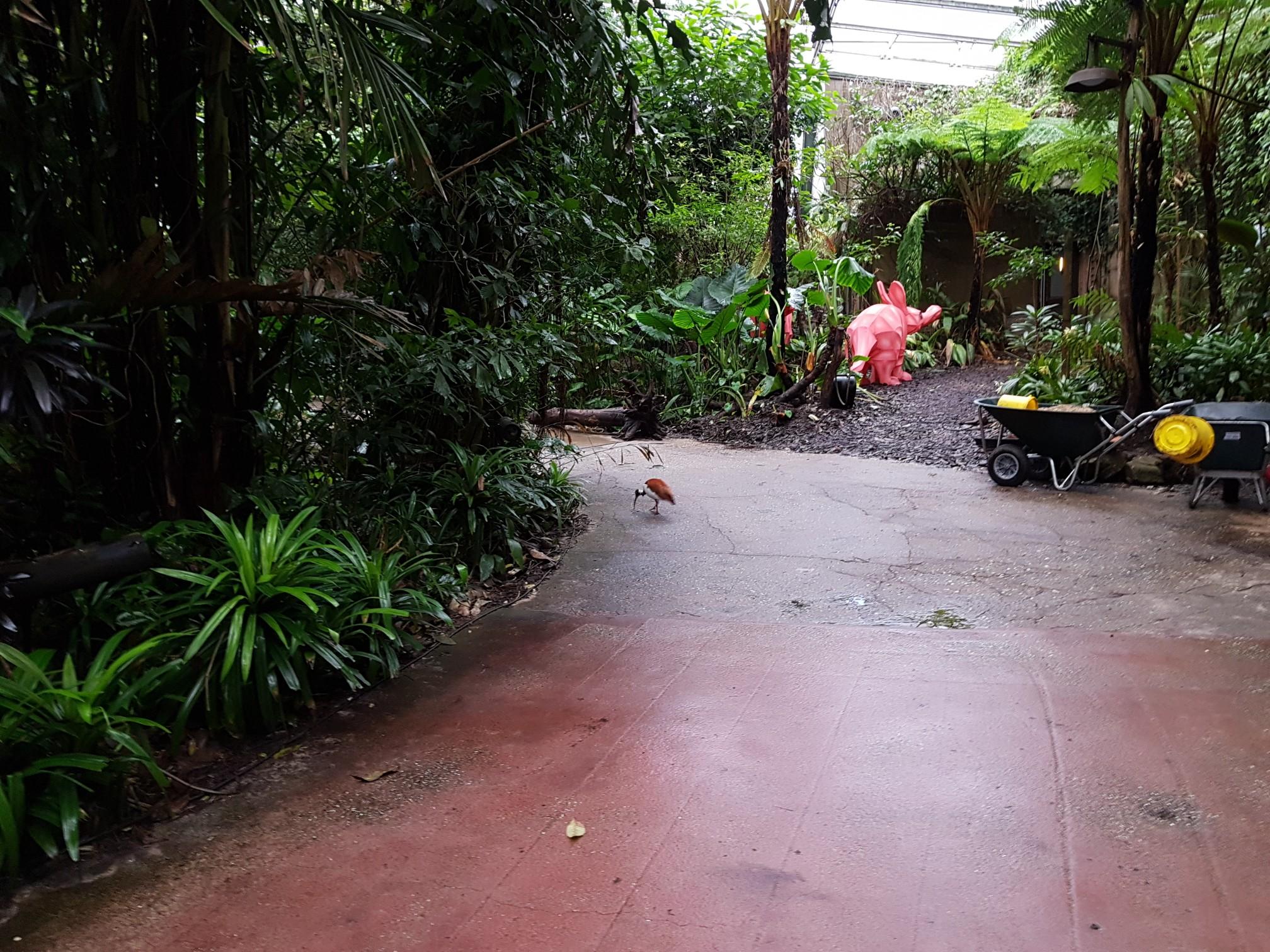
Encounter rate: medium
Similar species: none
A mostly terrestrial ibis that can be tricky to find. Recently both birds have often been seen at the turtle enclosure. Otherwise individuals can be found walking on any of the visitor paths, but it is also worth scanning the undergrowth around path 6 and the Turtle enclosure.
Scarlet ibis
Encounter rate: medium
Similar species: none
The only big red birds in the Bush. They are most often found in the trees between the Turtle pond and Bush terrace along the small stream. They can also be expected at the Rice paddies and around the Capybara enclosure
Sun bittern
Encounter rate: medium
Similar species: none
A species that can sometimes be tricky to find. It is most often seen around the Capybara enclosure, especially on the fake fallen tree. Other spots are path 20 and the Turtle enclosure.
Victoria crowned pigeon
Encounter rate: high
Similar species: none
An unmistakeable large blue pigeon. An individual can often be found on a nest at the bridge at 22b. Often seen on the bush terrace and around the Turtle enclosure as well. They can turn up anywhere though.
Green naped pheasant pigeon
Encounter rate: low
Similar species: none
This terrestrial pigeon can be hard to find on some days. The best chance is checking the Bush terrace or along paths 6, 9, 10, 22, 23, but can turn up anywhere.
Pinon imperial pigeon
Encounter rate: medium
Similar species: Green imperial pigeon
A large pigeon that sticks to the canopy and can therefore be tricky to spot. Birds tend to be reliably seen in the canopy around paths 22a, 23, 24, 25 and around the bush terrace.
Larger and greyer, rather than greenish, than Green imperial pigeon, with a clear red ring around the eye. It also lacks the reddish neck of Green imperial pigeon.
Green imperial pigeon
Encounter rate: high
Similar species: Pinon imperial pigeon
These pigeons stick to the canopy, but can be reliably seen in the trees around the observation platform and are also often seen around the Bush terrace. The highly distinctive call is also an easy way to find them.
Smaller and with a distinct greenish back compared to Pinon imperial pigeon, also lacks red eye ring but has a reddish neck.
Luzon bleeding heart pigeon
Encounter rate: high
Similar species: none
A terrestrial pigeon that can be seen walking around practically anywhere. It is particularly common around paths 1,3, 6, 10, 23, but can be seen everywhere
Green winged pigeon
Encounter rate: very high
Similar species: none
By far the most common pigeon that cannot be missed.
Nicobar pigeon
Encounter rate: very high
Similar species: none
A common pigeon that can be seen on the ground as well as in trees, common everywhere, but especially easily seen around the Otter enclosure and the Bush terrace.
Orange-fronted fruit dove
Encounter rate: low
Similar species: none
An arboreal pigeon that is not very easily seen. It is most often observed around the entrance to the Zebra stables, path 15, 16, 17 and on parh 9.
Blue-crowned hanging parrot
Encounter rate: low
Similar species: none
Currently the only parrot in the Bush. This small species is easy to miss, but it is worth checking the feeding station at path 6, and paths 24 and 25a but can be expected anywhere... The flight is distinctively straight and fast and in flight the birds are often noisy.
Red-crested turaco
Encounter rate: high
Similar species: none
Despite the fact there is not a very high number of Turaco around they are quite reliably seen. The best areas include the Bush terrace and paths 1, 3, 4, 6, 8, 9, 22, 23
Speckled mousebird
Encounter rate: very high
Similar species: none
A distinctve brown bird that is easily seen, especially around 3, 5, 6, 26 and the Bush terrace.
White-eared catbird
Encounter rate: low
Similar species: none
A rather localized bird which is almost exclusively seen in the area ranging from the observation platform to the Bush terrace and the Capybara enclosure. Especially the feeding station next to the Bird house is a good spot.
White rumped shama
Encounter rate: medium
Similar species: Montserrat oriole
A songbird that can be hard to find, though there tend to be some animals around paths 22b, 23 and 24.
Male Monterrat oriole are similar in colouration, but lack the white rump and have a much thicker bill.
Snowy-crowned robin chat
Encounter rate: very high
Similar species: none
The second most common bird in the Bush and is present everywhere.
Chestnut-backed ground trush
Encounter rate: medium
Similar species: none
A rather uncommon bird, which is often seen around the stairs leading to the observation platform. Individuals can pop up anywhere, but can be expected around path 3, 5, 6, 23
Fairy bluebird
Encounter rate: very high
Similar species: Screaming piha
Birds are commonly seen throughout the Bush.
Female Fairy bluebirds can at a distance be mistaken for Screaming piha, but on closer inspection are bluish, not greyish, and slightly smaller.
Golden-fronted leafbird
Encounter rate: very low
Similar species: none
Only one female is kept and she is very hard to see, as she mostly sticks to the canopy. The best chance is trying from the observation platform, where she is sometimes sitting in the roof structure. Otherwise the trees around the Otter enclosure and close to the Jeep are worth checking.
Blue-crowned laughing thrush
Encounter rate: very low
Similar species: none
Currently only one individual is present, which often associates with the ubiquitoes Red-whiskered bulbul. The best chance of seeing this bird is around the patches of Bamboo along path 23 and 25.
Red-rumped cacique
Encounter rate: very high
Similar species: none
A small group is kept, but this bird cannot be missed around its nesting tree at the Bush terrace. Foraging birds are very noisy and often around the area with the Rice paddy and Otters.
Montserrat oriole
Encounter rate: medium
Similar species: White-rumped shama
A species that has become more easy to see recently due to breeding results in 2018 and 2019. It is most often seen around paths 23 and 24. But the feeding station next to the Bird house and the Capybara bridge are also good spots.
Screaming piha
Encounter rate: high
Similar species: Fairy bluebird
A secretive bird, sitting motionless in trees, that can be fairly reliably seen by locating its loud call. There are multiple calling males which often hang around paths 1, 4, 24, 25a. Birds also occasionally pop up throughout the bush, most notably around path 9, 22a.
This species can from a distance be confused with female Fairy bluebird, but is clearly grey, not bluish, and slightly larger.
Purple honeycreeper
Encounter rate: medium
Similar species: none
A small species that often sticks to the canopy, but regularly descends lower. These birds are very active and can pop up anywhere. Good places include the feeding stations at paths 6 and 14. Also regularly seen around path 24 and 25
Madagascar red fody
Encounter rate: very high
Similar species: House sparrow, Brazilian tanager
This bird is less ubiquitous then before, but still common, especially around the Bush terrace and paths 1, 5, 6, 8, 23, 24, 25
Females and non-breeding males can be confused with House sparrows, but are smaller, have a more buffy ground color and a smaller bill. The only other smaller red bird is the male Brazilian tanager which is larger, has a clear white patch on a larger bill and a uniform black back.
Brazilian tanager
Encounter rate: medium
Similar species: Madagascar red fody
A pair of this species is kept and is almost exclusively found around paths 1, 3, 4, 5, 6, 23
Chestnut-bellied seedfinch
Encounter rate: low
Similar species: Rose-bellied bunting
A small passerine that is most easily seen around the Rice paddy, especially when seeds are present. It can also be sometimes seen at path 25b and between the waterfall and the Desert tunnel.
Female Seedfinches look similar to female Rose-bellied bunting, but are smaller, with a heavier bill and lack the white eye-ring.
Red-whiskered bulbul
Encounter rate: very high
Similar species: none
The most common bird in the Bush and it is ubiquitous anywhere. It is especially common around path 26 where many nests are located.
Blue-backed grassquit
Encounter rate: high
Similar species: none
A small passerine that mostly sticks to the areas close to the roof and is often seen in the roof structure around paths 3, 4, 5, 7.
Rose-bellied bunting
Encounter rate: low-medium
Similar species: Black-bellied seedfinch
An increasingly common species that is now relatively often found, especially around path 6, 8, 9 but also at path 26. The feeding station at path 6 is especially good. Individuals can turn up anywhere though.
White eye spec.
Encounter rate: very low
Similar species: none
A small bird that mostly sticks to higher levels of the vegetation. Only a few individuals remain. Best chance may be around path 6, 23, 24, 25
REPTILES AND AMPHIBIANS
Green iguana
Encounter rate: low
Similar species: none
An increasingly hard to find reptile. It used to be fairly reliable around path 5, especially on the rocky outcrop there. It might still be found around paths 4, 5, 7, 8, especially on the sandy stretches next to the roof, as well as around the observation platform.
Guadeloupe anole
Encounter rate: high
Similar species: none
A small lizard that is present throughout the Bush, but reliably seen in the vegetation around the Red-footed tortoise enclosure, on the Observation deck, around the feeding station at path 14 and around path 4.
Plumed basilisk
Encounter rate: medium
Similar species: none
This species is restricted to the netted area around the Caiman enclosure. Good spots are the stream between the tortoise and Caiman enclosure, the beaches in the Caiman enclosures, as well as carefully scanning the trees in that area.
Common house gecko
Encounter rate: very low
Similar species: none
Nocturnal and thus practically impossible to find.
Montserrat whistling frog
Encounter rate: very low
Similar species: none
A very common frog, but because of its nocturnal habits it is practically impossible to see one. Its whistles might be heard during the Pasar Malam when the zoo is open during darkness.
Spotted running frog
Encounter rate: very low
Similar species: none
A nocturnal frog that is practically impossible to see.
Location of several unsigned reptiles and fish
Capybara & former Manatee enclosure
Yellow-spotted Amazon river turtle
Pirapitanga
Tambaqui
Zebra cichlid
Guppy
Redtail catfish
Caiman enclosure
Occelated stingray
Plecostomus spec.
Zebra cichlid
Guppy
Turtle enclosure
Asian leaf turtle
Ponds around Livingstone bridge (22b)
African lungfish
Nile tilapia
Labeobarbus intermedius
Map of the bush (based on a map originally by Burgers' Zoo and then modified by first Lisanne de Boer (Van Hall Larenstein) and me):
Legend
1-26 Path numbers
B bird house, this is where the signage is located
F Feeding stations
O Observation platform
R Rice paddy
T Turtle enclosure
"Toegang" = entrance
"Avonturenpad" = adventure trail
MAMMALS
Rodriquez fruit bat
Encounter rate: high
Similar species: Lyles' fruit bat
Single animals can be found in hanging in all vegetation from approx. 2 meters high to the canopy. Can be seen flying during the day as well, being most active in the early morning and late afternoon.
Lyles' fruit bat looks similar, but is larger, more golden brown and has a more pointed nose.
Lyles' fruit bat
Encounter rate: low
Similar species: Rodriquez fruit bat
A few old individuals remain. They are seen mostly higher up in trees than the Rodriquez fruit bats and are most often seen in the area around the Bush restaurant terrace
Rodriquez fruit bat look similar but are distinctly smaller, darker brown with a more stump nose.
Seba's short-tailed bat
Encounter rate: very low
Similar species: none
A large bachelor group roosts in an artifical cave that cannot be seen by visitors. The only chance of seeing this species in the Bush is during the Pasar Malam event in December-January when the Bush is open in the night time.
BIRDS
Red-shouldered teal
Encounter rate: very high
Similar species: none
Currently the only duck species in the Bush. The animals are basically always present in the Capybara enclosure. If not they are likely around the Turtle enclosure or in the stream between the Turtle enclosure and the Bush restaurant
Chaco chacalaca
Encounter rate: low
Similar species: none
An unmistakeable species that can be tricky to spot. This species is most easily seen in the early morning when it often hangs around the Desert tunnel, Aardvark enclosure or path 9. During the day often hidden in vegetation, but it is worth checking the feeding stations next to path 6 & 8 and beneath the jeep. When calling they are easily located.
Crested wood partridge
Encounter rate: medium - high
Similar species: none
Unmistakeable small partridge that can be found in many places in the bush. These birds often stick to the vegetation, but are often seen around path 3,4,5, 6, around the bird house and in or around the Aardvark enclosure. Individuals can turn up anywhere.
Madagascar crested ibis
Encounter rate: medium
Similar species: none
A mostly terrestrial ibis that can be tricky to find. Recently both birds have often been seen at the turtle enclosure. Otherwise individuals can be found walking on any of the visitor paths, but it is also worth scanning the undergrowth around path 6 and the Turtle enclosure.
Scarlet ibis
Encounter rate: medium
Similar species: none
The only big red birds in the Bush. They are most often found in the trees between the Turtle pond and Bush terrace along the small stream. They can also be expected at the Rice paddies and around the Capybara enclosure
Sun bittern
Encounter rate: medium
Similar species: none
A species that can sometimes be tricky to find. It is most often seen around the Capybara enclosure, especially on the fake fallen tree. Other spots are path 20 and the Turtle enclosure.
Victoria crowned pigeon
Encounter rate: high
Similar species: none
An unmistakeable large blue pigeon. An individual can often be found on a nest at the bridge at 22b. Often seen on the bush terrace and around the Turtle enclosure as well. They can turn up anywhere though.
Green naped pheasant pigeon
Encounter rate: low
Similar species: none
This terrestrial pigeon can be hard to find on some days. The best chance is checking the Bush terrace or along paths 6, 9, 10, 22, 23, but can turn up anywhere.
Pinon imperial pigeon
Encounter rate: medium
Similar species: Green imperial pigeon
A large pigeon that sticks to the canopy and can therefore be tricky to spot. Birds tend to be reliably seen in the canopy around paths 22a, 23, 24, 25 and around the bush terrace.
Larger and greyer, rather than greenish, than Green imperial pigeon, with a clear red ring around the eye. It also lacks the reddish neck of Green imperial pigeon.
Green imperial pigeon
Encounter rate: high
Similar species: Pinon imperial pigeon
These pigeons stick to the canopy, but can be reliably seen in the trees around the observation platform and are also often seen around the Bush terrace. The highly distinctive call is also an easy way to find them.
Smaller and with a distinct greenish back compared to Pinon imperial pigeon, also lacks red eye ring but has a reddish neck.
Luzon bleeding heart pigeon
Encounter rate: high
Similar species: none
A terrestrial pigeon that can be seen walking around practically anywhere. It is particularly common around paths 1,3, 6, 10, 23, but can be seen everywhere
Green winged pigeon
Encounter rate: very high
Similar species: none
By far the most common pigeon that cannot be missed.
Nicobar pigeon
Encounter rate: very high
Similar species: none
A common pigeon that can be seen on the ground as well as in trees, common everywhere, but especially easily seen around the Otter enclosure and the Bush terrace.
Orange-fronted fruit dove
Encounter rate: low
Similar species: none
An arboreal pigeon that is not very easily seen. It is most often observed around the entrance to the Zebra stables, path 15, 16, 17 and on parh 9.
Blue-crowned hanging parrot
Encounter rate: low
Similar species: none
Currently the only parrot in the Bush. This small species is easy to miss, but it is worth checking the feeding station at path 6, and paths 24 and 25a but can be expected anywhere... The flight is distinctively straight and fast and in flight the birds are often noisy.
Red-crested turaco
Encounter rate: high
Similar species: none
Despite the fact there is not a very high number of Turaco around they are quite reliably seen. The best areas include the Bush terrace and paths 1, 3, 4, 6, 8, 9, 22, 23
Speckled mousebird
Encounter rate: very high
Similar species: none
A distinctve brown bird that is easily seen, especially around 3, 5, 6, 26 and the Bush terrace.
White-eared catbird
Encounter rate: low
Similar species: none
A rather localized bird which is almost exclusively seen in the area ranging from the observation platform to the Bush terrace and the Capybara enclosure. Especially the feeding station next to the Bird house is a good spot.
White rumped shama
Encounter rate: medium
Similar species: Montserrat oriole
A songbird that can be hard to find, though there tend to be some animals around paths 22b, 23 and 24.
Male Monterrat oriole are similar in colouration, but lack the white rump and have a much thicker bill.
Snowy-crowned robin chat
Encounter rate: very high
Similar species: none
The second most common bird in the Bush and is present everywhere.
Chestnut-backed ground trush
Encounter rate: medium
Similar species: none
A rather uncommon bird, which is often seen around the stairs leading to the observation platform. Individuals can pop up anywhere, but can be expected around path 3, 5, 6, 23
Fairy bluebird
Encounter rate: very high
Similar species: Screaming piha
Birds are commonly seen throughout the Bush.
Female Fairy bluebirds can at a distance be mistaken for Screaming piha, but on closer inspection are bluish, not greyish, and slightly smaller.
Golden-fronted leafbird
Encounter rate: very low
Similar species: none
Only one female is kept and she is very hard to see, as she mostly sticks to the canopy. The best chance is trying from the observation platform, where she is sometimes sitting in the roof structure. Otherwise the trees around the Otter enclosure and close to the Jeep are worth checking.
Blue-crowned laughing thrush
Encounter rate: very low
Similar species: none
Currently only one individual is present, which often associates with the ubiquitoes Red-whiskered bulbul. The best chance of seeing this bird is around the patches of Bamboo along path 23 and 25.
Red-rumped cacique
Encounter rate: very high
Similar species: none
A small group is kept, but this bird cannot be missed around its nesting tree at the Bush terrace. Foraging birds are very noisy and often around the area with the Rice paddy and Otters.
Montserrat oriole
Encounter rate: medium
Similar species: White-rumped shama
A species that has become more easy to see recently due to breeding results in 2018 and 2019. It is most often seen around paths 23 and 24. But the feeding station next to the Bird house and the Capybara bridge are also good spots.
Screaming piha
Encounter rate: high
Similar species: Fairy bluebird
A secretive bird, sitting motionless in trees, that can be fairly reliably seen by locating its loud call. There are multiple calling males which often hang around paths 1, 4, 24, 25a. Birds also occasionally pop up throughout the bush, most notably around path 9, 22a.
This species can from a distance be confused with female Fairy bluebird, but is clearly grey, not bluish, and slightly larger.
Purple honeycreeper
Encounter rate: medium
Similar species: none
A small species that often sticks to the canopy, but regularly descends lower. These birds are very active and can pop up anywhere. Good places include the feeding stations at paths 6 and 14. Also regularly seen around path 24 and 25
Madagascar red fody
Encounter rate: very high
Similar species: House sparrow, Brazilian tanager
This bird is less ubiquitous then before, but still common, especially around the Bush terrace and paths 1, 5, 6, 8, 23, 24, 25
Females and non-breeding males can be confused with House sparrows, but are smaller, have a more buffy ground color and a smaller bill. The only other smaller red bird is the male Brazilian tanager which is larger, has a clear white patch on a larger bill and a uniform black back.
Brazilian tanager
Encounter rate: medium
Similar species: Madagascar red fody
A pair of this species is kept and is almost exclusively found around paths 1, 3, 4, 5, 6, 23
Chestnut-bellied seedfinch
Encounter rate: low
Similar species: Rose-bellied bunting
A small passerine that is most easily seen around the Rice paddy, especially when seeds are present. It can also be sometimes seen at path 25b and between the waterfall and the Desert tunnel.
Female Seedfinches look similar to female Rose-bellied bunting, but are smaller, with a heavier bill and lack the white eye-ring.
Red-whiskered bulbul
Encounter rate: very high
Similar species: none
The most common bird in the Bush and it is ubiquitous anywhere. It is especially common around path 26 where many nests are located.
Blue-backed grassquit
Encounter rate: high
Similar species: none
A small passerine that mostly sticks to the areas close to the roof and is often seen in the roof structure around paths 3, 4, 5, 7.
Rose-bellied bunting
Encounter rate: low-medium
Similar species: Black-bellied seedfinch
An increasingly common species that is now relatively often found, especially around path 6, 8, 9 but also at path 26. The feeding station at path 6 is especially good. Individuals can turn up anywhere though.
White eye spec.
Encounter rate: very low
Similar species: none
A small bird that mostly sticks to higher levels of the vegetation. Only a few individuals remain. Best chance may be around path 6, 23, 24, 25
REPTILES AND AMPHIBIANS
Green iguana
Encounter rate: low
Similar species: none
An increasingly hard to find reptile. It used to be fairly reliable around path 5, especially on the rocky outcrop there. It might still be found around paths 4, 5, 7, 8, especially on the sandy stretches next to the roof, as well as around the observation platform.
Guadeloupe anole
Encounter rate: high
Similar species: none
A small lizard that is present throughout the Bush, but reliably seen in the vegetation around the Red-footed tortoise enclosure, on the Observation deck, around the feeding station at path 14 and around path 4.
Plumed basilisk
Encounter rate: medium
Similar species: none
This species is restricted to the netted area around the Caiman enclosure. Good spots are the stream between the tortoise and Caiman enclosure, the beaches in the Caiman enclosures, as well as carefully scanning the trees in that area.
Common house gecko
Encounter rate: very low
Similar species: none
Nocturnal and thus practically impossible to find.
Montserrat whistling frog
Encounter rate: very low
Similar species: none
A very common frog, but because of its nocturnal habits it is practically impossible to see one. Its whistles might be heard during the Pasar Malam when the zoo is open during darkness.
Spotted running frog
Encounter rate: very low
Similar species: none
A nocturnal frog that is practically impossible to see.
Location of several unsigned reptiles and fish
Capybara & former Manatee enclosure
Yellow-spotted Amazon river turtle
Pirapitanga
Tambaqui
Zebra cichlid
Guppy
Redtail catfish
Caiman enclosure
Occelated stingray
Plecostomus spec.
Zebra cichlid
Guppy
Turtle enclosure
Asian leaf turtle
Ponds around Livingstone bridge (22b)
African lungfish
Nile tilapia
Labeobarbus intermedius
Last edited:
Currently only one individual is present
What happened to the other laughingthrushes? Did they not adapt well to the Bush?
What happened to the other laughingthrushes? Did they not adapt well to the Bush?
I was just informed only 1 is currently left (I saw her last Sunday). What happened to the other 4 females I don't know...
I have updated the location list based on recent visits. Especially the Madagascar crested ibis have been hanging around the turtle enclosure a lot and in this area is also where the Parrots are found a lot, as well as path 6. Even the Red-shouldered teals have made an excursion to the Turtle enclosure...
PicanBird
Well-Known Member
The red-shouldered teals also seem to be exploring the restaurant terrance more oftenI have updated the location list based on recent visits. Especially the Madagascar crested ibis have been hanging around the turtle enclosure a lot and in this area is also where the Parrots are found a lot, as well as path 6. Even the Red-shouldered teals have made an excursion to the Turtle enclosure...
The Blue honeycreeper and the lyles flying fox aren’t in the bush anymore. But they are still in the list, this should be removed.
What is your source? Both species were still present in August, in the case of the honeycreeper a larger number of them.
Sorry I meant Red-legged honeycreeper. The lyles flying fox is already gone since the start ot this year, this was mentioned on zoochat (this thread) and also on other zooforumsWhat is your source? Both species were still present in August, in the case of the honeycreeper a larger number of them.