Pairi Daiza – the Good, the Bad, the Ugly and the really Strange
I have been thinking a lot about my visit to Pairi Daiza as I have been editing and processing my photos. I wanted to find a way to summarise my feelings about the whole experience, without repeating the excellent reviews that ZooChatters have written already in this Forum.
Then I realised that the key was to start with the exhibit for Egyptian fruit bats in the Crypt. I missed it completely on my first day, in spite of the bat symbol on the map. It was only when I was reading the threads here that I realised my mistake, so I visited it next day.
The Crypt really is a crypt, the basement of the old tower behind the bird show area. Entering through a passage from the lake side, you pass through light baffles and find yourself on a balcony in a large, dimly-lit, vaulted stone chamber. I felt a definite
frisson of surprise at the structure with the fruit bats flying around inside it. It was a doubly Gothic experience: the building was a medieval monastery and I remembered that 'Monk' Lewis wrote the most famous Gothic novel in English. In spite of my resolution that I would concentrate on the animals, as I mentioned in my previous post, I could not avoid the special nature of Pairi Daiza here. It took me a moment to get my bearings and to find one of the flights of steps down to floor level, so I took a deep breath (never the best idea in a bat exhibit) and went down and across the stone floor to the passage leading to the rest of the exhibits (mouse lemurs, naked mole rats and amphibians, plus curiosities called 'treasures' – which I ignored, of course).
It struck me that this was typical of Pairi Daiza. It is good, in the sense of providing a very suitable space for the bats. It is bad, for visitors who hate the macabre and are scared by Dracula and vampire stories. It could certainly be considered tasteless and ugly too. And it is also really strange.
So I have decided to describe my reaction to Pairi Daiza, by using Sergio Leone's categories and grouping my experiences into the Good, the Bad and the Ugly, plus an extra one - the Strange. I stress that these are my personal opinions, please feel free to disagree or to add your own opinions.
The Good
All the rare parrots, although I am pleased that new aviaries are being built for them as I don't think that the aviaries by the Gift Shop and in The Oasis are ideal.
The Steller's sea lions in their splendid pool.
The birds of paradise in the Tropicalia greenhouse.
The shoebills, particularly the pair in the excellent aviary between the giraffe paddock and Mersus Emergo (the shipshape reptile house).
The long enclosure for the pair of Siberian white cranes between the boardwalk and the koalas.
The planting in many of the enclosures, especially the big live trees in the outdoor orang enclosures, the tall old pollards near the end of long elephant paddock and the creepers and the live tree inside the second gorilla volcano.
On top of everything, the sheer range of species is most impressive, although there is an element of the Noah's Ark two-by-two arrangement.
The Bad
The map, which is OK for the main areas, but utterly inadequate if you want to locate any of lesser known species such as the beavers, impalas or the different cranes. I believe there is also an app, but reviewers describe it as poor. Pairi Daiza really needs something like its own localised satnav system for visitors.
The geographical zoning, which always ends up with anomalies such as wombats between the Komodo dragons and the porcupines. And why is there no South American zone?
The giant otter exhibit - too small, with poor viewing of the otters when they are not in the water. It's also in the Chinese zone (see above).
The clouded leopard enclosure, which is a long glass box furnished with soil and dead branches, giving the poor animal no real cover.
The large puddle near the birds of prey, which houses the whooper swans.
The enclosures for the meerkats and dwarf mongooses in The Oasis, which are floored with fist-sized rocks and just a few little patches of sand, giving the animals little chance to dig.
The visitors feeding the red river hogs in the African village and then stretching over the wall to stroke the piglets.
The large ploughshare tortoise in Mersus Emergo. There are big signs in its enclosure saying that it is the rarest tortoise in the World. So why is on its own, when it could be in a potential breeding group in another zoo or back in Madagascar?
The Ugly
The music: each area of the park has its own type. I really disliked the light classical stuff near the entrance and some of the frenzied African drumming, and I blame my rotten photos of the yellow-spotted newts in the Crypt on the nasty arrangement of 'Greensleeves' and English folk tunes which really distracted me. It was a relief to hear some of the real animals - the parrots and birds of paradise, the baritone and bass barking of the Steller's sea lions and the raucous duet of the Florida sandhill cranes.
The horrible barriers in the middle of the water moats around the zoo. They seem to be palisades of rusty iron bars, reminding me of the reinforcing rods used to strengthen concrete pillars in modern buildings.
The penguin enclosure tucked away in the corner of the seal's area of the Lake, attracting very little attention from visitors.
The thatched hut aviary for grey parrots in the African village, which is a very dark and impoverished environment for these intelligent and endangered birds
The dark, narrow passages of the Aquarium (Nautilus) and the number of smaller tanks (particularly the cylindrical ones) make it seem cramped and old-fashioned when compared to the rest of the zoo.
Mersus Emergo (as above), in particular the small and dark turtle tanks, the abundance of plastic plants and the way that different coloured lights are used in the same vivarium.
White tigers (need I say more?).
The Strange
The odd combinations in mixed species exhibits, such as the zebra finches in the amethystine python enclosure in Mersus Emergo and the great white pelican with pygmy hippo (that exhibit certainly qualifies for Bad and Ugly too).
The large water moat in front of the window of the new puma enclosure. Has anyone ever seen a puma in a pool?
The two keepers walking around the zoo with a kea bouncing after them.
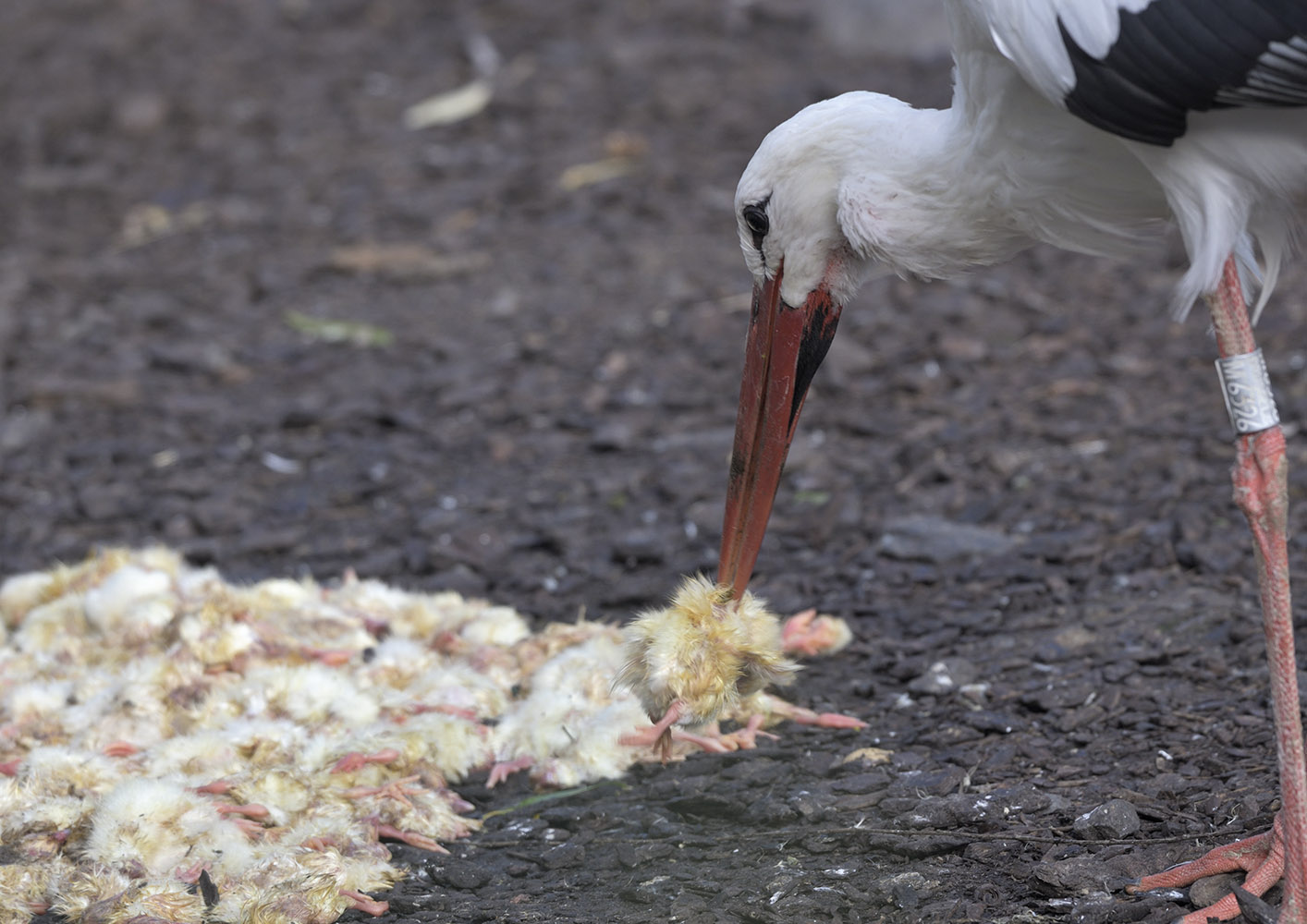
The large pile of dead day-old chicks which I saw in the Manchurian (or red-crowned) crane and Père David's deer exhibit, late in the afternoon. I saw the cranes take one each, then several wild white storks helped themselves, so did a grey heron and a black-headed gull, while pair of moorhens happily walked all over them. I still can't work out why there were there. Why encourage scavengers?

 The rare macaws aviaries, particularly the Spix one, are not very good for viewing either. The over-simplified map for such a complex collection. And as you say, why no South America?
