ZooChat 'Embrace the ABCs' Challenge - Mammals

Is it just for purposes of this challenge, or for the taxa in general, to use equus quagga or Plains Zebra instead of three-part names for the subspecies? I've never seen "Plains Zebra" used, only Grant's Zebra, equus quagga boehmi. Or is this somehow because I am in North America? If the name used were equus boehmi, we'd lack this great "q" entry.
Yes, I guess I was wondering why in Europe and zoos listed herein, the more general species name is used instead of whatever subspecies that zoo holds, the way we use Grant's.
The general name for the species as a whole is Plains Zebra (well, one of the common names at least) - the different subspecies have individual names but they are all still Plains Zebra. As a very loose correlation which might be easier to understand, imagine you've got Boxers and Dalmations and Bassett Hounds - they are all different breeds but they are still all Domestic Dogs. Swap "dog breeds" for zebra subspecies" and that is how it works in simple terms (obviously in real taxonomy a dog breed is not equivalent to a subspecies, but I think you'll understand what I mean). The genus for the Plains Zebra is Equus, the species is quagga, the subspecies (in your example) is boehmi. It doesn't matter if you are talking about Grant's Zebra or Chapman's Zebra or whichever subspecies, they are all Equus quagga.

Also, if know subspecies of leopards and call them by name, ie Amur Leopard or Javan Leopard, why does the official name revert to the more general Panthera pardus? This especially confuses me, because the lion is a subspecies of the leopard but is recognized as Panthera leo, and not Panthera pardus, and the jaguar is a subspecies of the leopard but is recognized officially as Panthera onca and not Panthera pardus? This seems inconsistent for a science.
I think here you are just confusing the taxonomic levels. Leopards and Lions and Jaguars are all members of the genus Panthera but they are not subspecies of Leopards, they are all separate species. Imagine the dog scenario again. Panthera is the whole group, which in the dog correlation would be Domestic Dog, Grey Wolf, Red Wolf, Coyote, etc - all separate species.
 
@Chlidonias,Thank you for spending the time on this very fulsome explanation. I understand the different taxanomic levels. I think my question was perhaps a much more mundane one of language usage:. Why do we call a Damnation a Dalmation (Grant's or other subspecies by name), while Europe calls it a dog (Plains Zebra)?

I am admittedly a bit confused about where the leopard falls on the taxanomic levels, but this is really probably not important in the greater scheme. When I started to sink deeper into this species, I found that there are two seemingly-equally-regarded recent theories that place leopards and jaguars on different levels in the species cladogram, swapping places if you will. I would have expected this to place one in a higher taxonomic level over the other, thus dropping the other down a level no matter which theory you ascribed to--and why this doesn't alter their names for accuracy.. However I'm starting to suspect that you may advise me that they are not truly different levels and more like "cousins" either way. Similarly, I'm ttrying to reconcile why Panthera pardus is used as both a species and subspecies name, crossing two levels.

My questions may indeed be more related to current language usage than to classification and etymology. Back to the (useful!) dog analogy: Why would Europeans use the more general panthera pardus and call it a leopard instead of Panthers pardus fusca, Indian Leopard as we would here? Although more fuzzy as an argument than the zebra analogy, why does Europe call a Dalmation a Dog (Leopard), while in North America it would be called a Dalmation (Indian Leopard)?
 
Last edited:
Why do we call a Damnation a Dalmation, while Europe calls it a dog?

You appear to be labouring under the misapprehension that we don't use the names of dog breeds here in Europe :P we do. Similarly, people and zoos do use the terms for particular animal subspecies here - where appropriate. Sometimes when not appropriate too ;) as is the case with all of the collections which call their zoomix tigers "Bengal" tigers!

When I started to pore over this, I found that there are two seemingly-equally-regarded recent theories that place leopards and jaguars on different levels in the species cladogram, swapping places if you will. I would have expected this to place one in a higher taxonomic level over the other, thus dropping the other down a level no matter which theory you ascribed to.

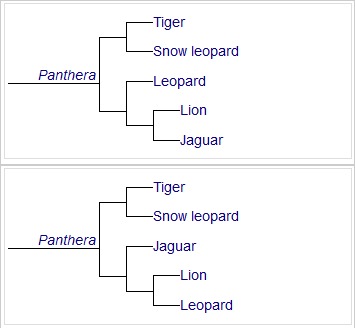
No, that's not how cladograms work - they merely show the relationships between last common ancestors. So for instance, using the two cladograms I suspect you are referring to.....

Two_cladograms_for_Panthera.png


The first cladogram suggests that lion and jaguar share a common ancestor more recently than either do with leopard, but does not imply that either species *are* leopards themselves or indeed that lion and jaguar are conspecific. Similarly, the second cladogram suggests that lion and leopard share a common ancestor more recently than either do with jaguar, but does not imply that either species *are* jaguars themselves or indeed that lion and leopard are conspecific.
 
@Chlidonias,Thank you for spending the time on this very fulsome explanation. I understand the different taxanomic levels. I think my question was perhaps a much more mundane one of language usage:. Why do we call a Damnation a Dalmation (Grant's or other subspecies by name), while Europe calls it a dog (Plains Zebra)?
Ah, so your confusion is specific to this challenge then. Sticking with the dog analogy, if this challenge was to see different species of domestic animals and one person saw a Boxer and another person saw a Dalmation - both would still put down "Domestic Dog" as their entry because the game is concerned only with the species. So (in the real challenge here) if an American sees a Grant's Zebra and a European sees a Chapman's Zebra, both put them down as Plains Zebra Equus quagga because that is how the game works - it isn't concerned with subspecies, only the genus and species.

Similarly, I'm ttrying to reconcile why Panthera pardus is used as both a species and subspecies name, crossing two levels.

My questions may indeed be more related to current language usage than to classification and etymology. Back to the (useful!) dog analogy: Why would Europeans use the more general panthera pardus and call it a leopard instead of Panthers pardus fusca, Indian Leopard as we would here? Although more fuzzy as an argument than the zebra analogy, why does Europe call a Dalmation a Dog (Leopard), while in North America it would be called a Dalmation (Indian Leopard)?
There is a subspecies named Panthera pardus pardus. If a species has subspecies (some don't - they are monotypic), but if a species has subspecies then one of those subspecies will always have a "doubled up" name. In this case that is Panthera pardus pardus. This is called the type subspecies (or the nominate subspecies), and belongs to the population from which the first animal (the type specimen) was described. Other subspecies are given different names - e.g. your Panthera pardus fusca. If you look up any animal which has subspecies, every single one will have a "doubled up" name as one of those subspecies.

Scientific names are universal - it doesn't matter if a person is American or European, or what language that person speaks, the scientific names are the same.
 
Last edited:
You appear to be labouring under the misapprehension that we don't use the names of dog breeds here in Europe :p we do. Similarly, people and zoos do use the terms for particular animal subspecies here - where appropriate. Sometimes when not appropriate too ;) as is the case with all of the collections which call their zoomix tigers "Bengal" tigers!


No, that's not how cladograms work - they merely show the relationships between last common ancestors. So for instance, using the two cladograms I suspect you are referring to.....

Two_cladograms_for_Panthera.png


The first cladogram suggests that lion and jaguar share a common ancestor more recently than either do with leopard, but does not imply that either species *are* leopards themselves or indeed that lion and jaguar are conspecific. Similarly, the second cladogram suggests that lion and leopard share a common ancestor more recently than either do with jaguar, but does not imply that either species *are* jaguars themselves or indeed that lion and leopard are conspecific.

Ok, this solves my confusion about a cladogram not representing taxon levels. Eureka!

Dear @TLD, I know very well you use the names of dog breeds in Europe, lol as I was once all but mauled, tarred, and feathered in a disturbing, no-holds-barred, jaw-dropping attack over the breed of my own dog, o_O one that left me utterly speechless for some time.o_O In this case, I was merely continuing @Chlidonias' analogy to dogs to make my questions clearer.;)

Since the rules here required a description of the signage use, it seemed that Plains Zebra is the common term of use in Europe. So common is Grant's used here that I had no idea what a Plains Zebra was when I first saw the term. @Chlidonias is right--you effectively use the species name for all the zebra sub-species, while we use the subspecies' name itself:.

"I say Grant's Zebra, you say Plains Zebra,
You say Plains Zebra, I say Grant's Zebra,
Plains Zebra! Grant's Zebra!
Grant's Zebra! Plains Zebra!
Let's call the whole thing off.":cool:

With thanks to Ira Gershwin, I nevertheless still don't quite understand the deliberately different usage but will call off my inquiry in the interest of British-American relations. The use of "Bengal," is obvious, a given, a euphemism! :)
 
Last edited:
Since the rules here required a description of the signage use, it seemed that Plains Zebra is the common term of use in Europe. So common is Grant's used here that I had no idea what a Plains Zebra was when I first saw the term here. @Chlidonias is right--you effectively use the species name for all the sub-species, where we use the subspecies' name itself:.

"I say Grant's Zebra, you say Plains Zebra,
You say Plains Zebra, I say Grant's Zebra,
Plains Zebra! Grant's Zebra!
Grant's Zebra! Plains Zebra!
Let's call the whole thing off.":cool:

I think most places I've come across use the subspecific common name, actually :) so as Chli says, the usage of "Plains" is more a challenge-specific thing rather than the term zoos predominantly use.

For instance:

Tierpark Gettorf:

full


Burger's Zoo:

full


Safaripark Beekse Bergen:

full
 
Ah,then so your confusion is specific to this challenge. Sticking with the dog analogy, if this challenge was to see different species of domestic animals and one person saw a Boxer and another person saw a Dalmation - both would still put down "Domestic Dog" as their entry because the game is concerned only with the species. So (in the real challenge here) if an American sees a Grant's Zebra and a European sees a Chapman's Zebra, both put them down as Plains Zebra Equus quagga because that is how the game works - it isn't concerned with subspecies, only the genus and species.

Àaaaaaaaahhhhhhhh...........yes..........:)

There is a subspecies named Panthera pardus pardus. If a species has subspecies (some don't - they are monotypic), but if a species has subspecies then one of those subspecies will always have a "doubled up" name. In this case that is Panthera pardus pardus. This is called the type subspecies, and belongs to the population from which the first animal (the type specimen) was described. Other subspecies are given different names - e.g. your Panthera pardus fusca. If you look up any animal which has subspecies, every single one will have a "doubled up" name as one of those subspecies.

Complete and utter resolution. Serenity.
ToMAYto, ToMAHto. I'm good.:D

:cool::cool:
 
Last edited:
I think most places I've come across use the subspecific common name, actually :) so as Chli says, the usage of "Plains" is more a challenge-specific thing rather than the term zoos predominantly use.

For instance:

Tierpark Gettorf:

full


Burger's Zoo:

full


Safaripark Beekse Bergen:

full

I love these! Thank you! All the references to Plains Zebra were challenge-required. You do call them Grant's too!:D

It's reassuring to know that I now understand the terminology used in this game that so many of you have now completed!
 
Last edited:
Far, far too late to this party, but...

ZSL London Zoo (6 March 2020)

Nasua nasua, South American Coati
Gorilla gorilla, Western Lowland Gorilla
Perodicticus potto, Potto
Loris lydekkerianus, Grey Slender Loris
Tamandua tetradactyla, Southern Tamandua

Current List

A:
B:
C:
D:
E:
F:
G: Gorilla gorilla, Western Lowland Gorilla (3 pts, ZSL London Zoo, 6 March 2020)
H:
I:
J:
K:
L: Loris lydekkerianus, Grey Slender Loris (3 pts, ZSL London Zoo, 6 March 2020)
M:
N: Nasua nasua, South American Coati (3 pts, ZSL London Zoo, 6 March 2020)
O:
P: Perodicticus potto, Potto (3 pts, ZSL London Zoo, 6 March 2020)
Q:
R:
S:
T: Tamandua tetradactyla, Southern Tamandua (3 pts, ZSL London Zoo, 6 March 2020)
U:
V:
W:
X:
Y:
Z:

Points: 15
 
Hamerton Zoological Park, 13/03/2020

Equus quagga - Plains Zebra

...and after two-and-a-half months, and a couple of lucky visits (as actually today is the only one I planned specifically with this thread in mind!), that's the set. :D

I did see the Jaguarundi, so even without the spontaneous Wild ZP visit this would still have been the day I completed the list.


A: Ateles paniscus - Red-faced Spider Monkey (Welsh Mountain Zoo, 23rd Feb 2020)
B: Bison bonasus - European Bison (Whipsnade, 19th Jan 2020)
C: Crocuta crocuta - Spotted Hyaena (YWP, 18th Jan 2020)
D: Dama dama - Fallow Deer (Whipsnade, 19th Jan 2020)
E: Equus grevyi - Grevy's Zebra (Whipsnade, 19th Jan 2020)
F: Ateles fusciceps - Colombian Spider Monkey (Chester, 31st Jan 2020)
G: Gulo gulo - Wolverine (Whipsnade, 19th Jan 2020)
H: Hydrochoerus hydrochaeris - Greater Capybara (YWP, 18th Jan 2020)
I: Hydropotes inermis - Chinese Water Deer (Whipsnade, 19th Jan 2020)
J: Okapia johnstoni - Okapi (Chester, 31st Jan 2020)
K: Kobus leche - Lechwe (YWP, 18th Jan 2020)
L: Lynx lynx - Northern Lynx (Whipsnade, 19th Jan 2020)
M: Micromys minutus - Eurasian Harvest Mouse (WWT Slimbridge, 25th Jan 2020)
N: Nasua nasua - Ring-tailed Coati (Wild Zoological Park, 1st Mar 2020)
O: Orycteropus afer - Aardvark (Chester, 31st Jan 2020)
P: Papio papio - Guinea Baboon (YWP, 18th Jan 2020)
Q: Equus quagga - Plains Zebra (Hamerton, 13th Mar 2020)
R: Rhinoceros unicornis - Indian Rhinoceros (Chester, 31st Jan 2020)
S: Suricatta suricata - Meerkat (YWP, 18th Jan 2020)
T: Tapirus terrestris - Brazilian Tapir (Chester, 31st Jan 2020)
U: Ursus maritimus - Polar Bear (YWP, 18th Jan 2020)
V: Varecia variegata - Black-and-White Ruffed Lemur (Chester, 31st Jan 2020)
W: Wallabia bicolor - Swamp Wallaby (Welsh Mountain Zoo, 23rd Feb 2020)
X: Sapajus xanthosternos - Buffy-headed Capuchin (Dudley Zoo, 1st Mar 2020)
Y: Herpailurus yagouaroundi - Jaguarundi (Wild Zoological Park, 1st Mar 2020)
Z: Zalophus californianus - California Sea Lion (Whipsnade, 19th Jan 2020)

Have checked and I believe the correct points total from the above list is 58, plus (if no-one's posted while I've been working all this out) 4 for completing second, to give 62. :)

Didn't miss out on too many extras, I think only A could I have done better from the visits I've had - scoring higher otherwise would have meant forfeiting the chance of bonus points and possibly not finishing in time so wasn't worth it! :D
 
I did see the Jaguarundi, so even without the spontaneous Wild ZP visit this would still have been the day I completed the list.

Although, I actually would have scored less without Wild ZP, as I would've had to sub in the more unusual but lower-scoring Notomys alexis for N.
 
Zoo Brno 12/3/2020
Mephitis mephitis, Striped Skunk
Varecia varegiata, Black-and-white ruffed lemur

Current list:

A: Atherurus africanus, African Brush-tailed Porcupine, 3pts, Prague
B: Bison bison, Bison, 3 points, Wien
C:Capra caucasica, Caucasian tur, 3pts, Prague
D: Dasyuroides byrnei, Kowari, 2pts, Jihlava
E: Eira barbara, Tayra, 2pts, Prague
F: Felis chaus, Jungle cat, 2pts, Jihlava
G: Gorilla gorilla, Lowland gorilla, 3pts, Prague
H: Hydrochaeris hydrochaeris, Capybara, 3pts, Jihlava
I:
J:
K: Kerodon rupestris, Rock cavy, 2pts, Jihlava
L: Lynx lynx, Eurasian Lynx. 3 points, Wien
M: Mephitis mephitis, Striped Skunk, 3pts Brno
N: Nasua narica, White-nosed coati. 3 points, Wien
O: Otolemur garnettii, Garnett's galago, 2pts, Jihlava
P: Phloeomys pallidus, Northern-Luzon Giant Cloud Rat. 3 points, Wien
Q: Equus quagga, Plains Zebra. 1 point, Wien
R:
S: Suricata suricatta, Meerkat. 3 points, Wien
T: Tapirus terrestis, South American tapir, 3pts, Jihlava
U: Ursus maritimus, Polar Bear. 2 points, Wien
V: Varecia variegata, Black-and-white ruffed lemur, 3 pts Brno
W: Wallabia bicolor, Swamp wallaby, 2pts, Prague
X: Xerus inauris, Cape ground squirrel 2pts, Prague
Y: Herpailurus yagouaroundi, Jaguarundi, 1pt, Prague
Z: Vulpes zerda, Fennec fox, 1pt, Jihlava


Points: 55

That is it for me, unless other competitors will be really slow in closing their lists...:D
 
Since the challenge is close to being finished, and yet we are in an enforced period of almost zero zoo visiting, I thought I'd take this opportunity to open up the feedback session. Your thoughts are welcome whether you actually played or just followed the action. I'm not inclined to make any major changes before the next iteration, but there's always room for tweaking.

*****

Prompts:

How does the challenge feel to play? What was fun about it? What would make it more enjoyable?

What are people's thoughts on the points structure? How about the bonuses?

Do the restrictions feel too restrictive? (I'm thinking of number of species per zoo, having to update your list before your next visit, and inabilty to change entries)

Is the element of racing against other players interesting? Could/should it be increased or decreased?

*****

Any big picture thoughts are also very welcome. I'm sure most of us are already looking forward to getting back out there. I'm thinking the next round should start once things have opened up in most areas again. Stay safe and remain indoors!
 
I didn't play this time around (Only because my first zoo visit was based around getting jaguarundi out of the way an failing miserably! :p ) but I enjoyed following along, and did have plans to knock off the challenge pretty quickly, if I'd got jaguarundi. I even had Z and W lined up in quick succession.

I think the structure was fine, and I look forward to partaking in the next iteration. :)
 
For one thing this challenge is a nice deviation from the usual annual challenges. A real strenght is that this challenge is not so much influenced by visiting a few major collections. Another element that I really liked is the tactical part. With this challenge I had to think ahead and plan my choices (though I made some major mistakes in hindsight: I never realised how vital Burgers' Safari was for my score until I had left the zoo!).

One thing I'm a bit unsure about is the "sense of urgency" as you called it. On one hand it did trigger my competitive spirit - resulting in a super fast visit to Ouwehands when I saw a chance to do so. However, it doesn't give a lot of time to catch up when you're falling behind. I understand that there's a delicate balance between creating urgency and allow for some opportunity to catch up again. It may have been a leaning a bit too much to the urgency side for me.

The point structure and most restrictions were fine for me. I'll definately participate again in the next edition!
 
As a mentioned before, this challenge add more excitement and educational part to my zoo visits. I even tried to reach Jaguarundy, but they canceled my fly to Poznan on 21/3 due to Corona. When you see certain number of zoos and mammal species, man stops pay much attention to Crocuta crocuta or Nasua nasua, but the game made me revisit their enclosures few times :)

I think, that the rules are adequate and the only reason, the challenge took more time is the winter season. I could add one or two more 3 pointers, like Jaculus jaculus in Bronx, but preferred to play safe.

Would love to play this challenge on yearly base, with the term to get maximum points, instead for timing. The current world maximum - 69 points is achievable and would be great to run for it. May be next year . The total maximum of 71 points is historically available, but I do not think there are current holdings of Urocitellus undulatus and Indri Indri .

Nevertheless, enjoyed the current format very much and hope we all be safe and in good health to play again soon :)
 
Back
Top