Newly discovered / described fossil species 2020

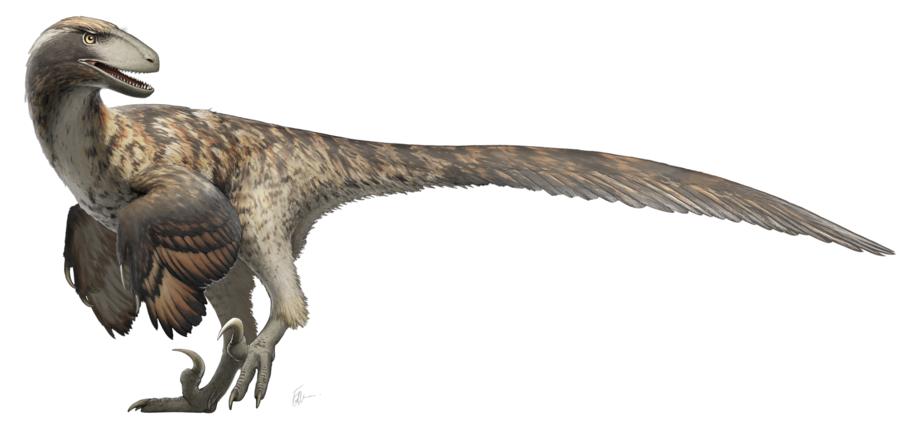
New study shows Deinonychus, the raptor that inspired Jurassic Park's "Velociraptors," didn't hunt in packs. However IMO it would be naive to completely rule out pack hunting in other dromaeosaurs.
1024px-Deinonychus_Restoration-1.jpg
I would say it would even by naive to rule it out in this species. After all, we only have some bones.
 
New study shows Deinonychus, the raptor that inspired Jurassic Park's "Velociraptors," didn't hunt in packs. However IMO it would be naive to completely rule out pack hunting in other dromaeosaurs.
1024px-Deinonychus_Restoration-1.jpg
I find this slightly silly, how can you be so sure? I’m not a big fan of pack hunting raptors, but it is like palaeontologists are going out of their way to avoid believing anything in Jurassic Park is even slightly accurate. The films weren’t masterpieces of accuracy, but neither was the Lion King! It will only lead to more misinterpreted headlines, like when they found tissue in a dinosaur bone that turned out to be contamination, leading to everybody screaming about Jurassic Park. There is more to dinosaurs than that one franchise!
 
New, unnamed elpahosaur theropod is the first of its kind from Australia.

image_8440_1-Elaphrosaur.jpg

New study shows large-bodied theropods, like the famous T. rex, were excellent power walkers.

01-trex-scotty_publicity_websize-credit--beth-zaiken.adapt.1900.1.jpg

New study shows extreme environmental change, not humans, was the most likely cause of extinction of megafauna in Sahul, the supercontinent formed by Australia and New Guinea.

image_4554-Australian-Megafauna.jpg

New study shows massive placoderm fish Titanichthys was likely a suspension-feeder.

image_8447e-Titanichthys.jpg

New study finds Australopithecus sediba used their hands for both climbing and human-like manipulation.

image_8453-Australopithecus-sediba.jpg

A team of archaeologists has unearthed a nearly complete skeleton of a Palaeoloxodon antiquus from Lower Saxony, Germany.

image_8045-Palaeoloxodon-antiquus.jpg

 
I wonder if this is true for other regions as well, like North America.

I saw a recent documentary that concluded that climate changes brought North American megafauna at the brink of extinction with human hunting giving the final blow.

However, the extinction of the American megafauna remains enigmatic to me. There have been many climatic changes during the Cenozoic and groups like horses and ground sloths always could cope with in, but went completely extinct from Alaska to Patagonia after the Pleistocene.
 
I think this one wasn't mentioned yet:

Name: Ucayalipithecus perdita
What: Parapithecid primate
When: ~ 35 - 32,000,000 ya (earliest Oligocene)
Where: Santa Rosa, Amazonia, Peru

The oldest known South American primates are known from Santa Rosa, just like the oldest caviomorphs. Perupithecus was described in 2015 and it's the most basal New World monkey with close affinities with some monkeys from the Eocene of North Africa. However, it's still a New World monkey. Ucayalipithecus on the other hand belongs to a extinct family of mainly North African monkeys. This means two types of monkey rafted across the Atlantic and the New World monkeys outcompeted the parapithecids in the end. Both species were quite small, marmoset to tamarin-sized.
 
Intriguing but ultimately speculative study suggests diplodocid tails were as long as they were to help coordinate herding.
Diplodocus%2Bmural%2Bweb%2Bres%2B%25C2%25A9%2BM.%2BWitton%2B2018.jpg

New study into the metabolic functions of Triassic dinosaurs Coelphysis and Plateosaurus. This analysis found support for 'elevated "ratite-like" metabolic rates and intermediate "monotreme-like" core temperature ranges in these species of early saurischian dinosaur.'
8370be8981ee6d8b67f4d855b14620c331d21939r1-1024-617v2_uhq.jpg

 
June 3, 2020: Fossilized stomach contents from an exceptionally preserved specimen of Borealopelta markmitchelli shows this nodosaurid dined on ferns before it died.
image_8501-Borealopelta-markmitchelli.jpg

June 4, 2020: An international team of researchers has sequenced and analyzed the genomes of 93 ancient Caribbean islanders and found evidence of at least three separate population dispersals into the region: two early dispersals into the Western Caribbean, one of which seems connected to earlier population dispersals in North America; and a third, more recent wave from South America.
image_8506-Early-Caribbean.jpg


June 5, 2020: Two new species of ceratopsian dinosaur (Navajoceratops sullivani and Terminocavus sealeyi). They lived roughly 75 million years ago in what is now New Mexico.
image_8505_1-Navajoceratops-Terminocavus.jpg

 
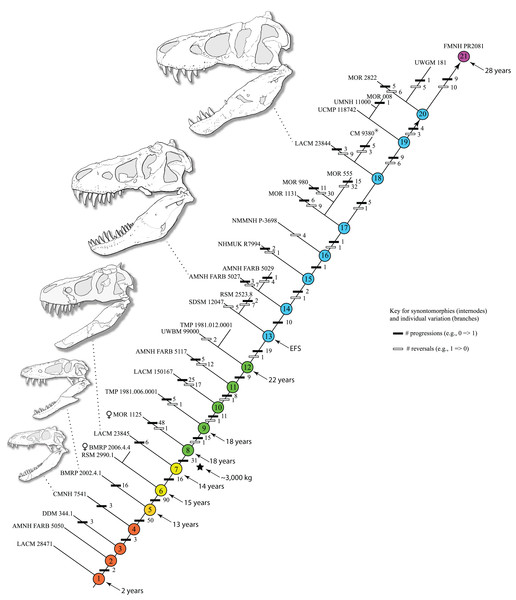
June 4, 2020: A study on T. rex ontogeny examines 44 specimens of this tyrannosaurid in order to produce a hypothesis on its growth. Among other things, the study finds between 13 and 15 years old the transition between shallow and deep skull shape occurred, that between 15 and 18 years is when T. rex exceeded the size of its close relatives, and that Nanotyrannus is invalid.
fig-2-1x.jpg


June 9, 2020: A study on the neuroanatomy of the spinosaurid dinosaur Irritator finds that it "had the ability for fast and well-controlled pitch-down head movements. These neuroanatomical features are consistent with fast, downward snatching movements in the act of predation, such as are needed for piscivory."
latest

 
June 10, 2020: First recorded evidence of pterosaurs from Columbia.
1-s2.0-S0195667120302123-gr4.sml


June 11, 2020: Trackways discovered in South Korea suggests at least one species of crocodylomorph evolved bipedalism.
image_8528_1-Batrachopus-grandis.jpg

June 11, 2020: New species bristle worm from the early Cambrian of China (Dannychaeta tucolus).
Dannychaeta_tucolus-novataxa_2020-Chen_Parry_Vinther_Zhai_Hou_et_Ma--%2540Cambriannelids.jpg

 
Last edited:
June 12, 2020: Study finds the first direct evidence that massive volcanic eruptions contributed to the Great Dying (the Permian–Triassic extinction event).
image_7102-Siberian-Traps.jpg

June 12, 2020: Fossilized footprints suggest carnivorous theropod dinosaurs as big as T. rex once roamed Queensland, Australia.
image_8557_2-Australian-Carnosaurs.jpg


June 17, 2020: Study of the fossilized eggs of two different non-avian dinosaurs, Protoceratops and Mussaurus, finds they laid soft-shelled eggs.
image_8549_1-Protoceratops.jpg

June 22, 2020: Redescription of Tanyrhinichthys mcallisteri, a long-rostrumed Pennsylvanian ray-finned fish.
image_8563-Tanyrhinichthys-mcallisteri.jpg

 
June 25, 2020: New genus and species of giant wombat-like marsupial (Mukupirna nambensis). It lived 25 million years ago (Chattian stage of the Oligocene epoch) in what is now the Namba Formation (Australia).
image_8578-Mukupirna-nambensis.jpg

June 26, 2020: Thylacosmilus atrox, an extinct marsupial that roamed what is now South America between 9 and 3 million years ago (Neogene period), was not the ecological analogue of saber-tooth cats, and likely did not use its impressive canines to dispatch its prey, according to new research led by University of Bristol scientists.
image_8582-Thylacosmilus-atrox.jpg

June 29, 2020: Paleontologists have discovered striking similarities between the fossilized bones of giant penguins that lived 62 million years ago (Danian stage of the Paleocene epoch) in what is now New Zealand and those of the plotopterids, a group of flightless seabirds that lived in what is now North America and Japan between 37 and 25 million years ago (Paleogene to Neogene period).
image_8590-Copepteryx.jpg

 
June 29, 2020: New study confirms a massive asteroid, not volcanism, as some theorized, caused the Cretaceous–Paleogene (K–Pg) extinction event that wiped out all non-avian dinosaurs.
image_8594-Chicxulub-Asteroid.jpg

July 06, 2020: New genus and species of tiny ornithodiran archosaur (Kongonaphon kely). It lived 237 million years ago (Triassic period) in what is now Madagascar. (Ornithodirans are a group of reptiles including dinosaurs, pterosaurs, and their close kin.)
image_8610_1-Kongonaphon-kely.jpg

July 08, 2020: Saurornitholestine dromaeosaurid theropods lived 70 million years ago (Maastrichtian stage of the Late Cretaceous epoch) in what is now northern Alaska (Prince Creek Formation). The specimen being described belonged to a juvenile.
image_8618_1-Saurornitholestine.jpg

 
Back
Top