List of zoos and aquariums at South korea today

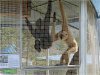
I found a photo of a rare gibbon at the zoo in Seoul:
Nomascus concolor / Black crested gibbon in Seoul Grand Park Zoo

My friend who posted this photo has doubts that it was labeled correctly by the zoo. Does anyone know more about this animal?

Also, are there any other parks in the world that keep Nomascus concolor?
That gibbon at the Seoul Zoo is correct Black crested gibbon(Nomascus concolor). However, there is quite a bit of confusion regarding the Korean name of the Black crested gibbon on the description of the Seoul Zoo.

Seoul Zoo wrote in its description sign as their Black crested gibbon's Korean name is "geomeun-son-gibbon"(검은손기번), and the word "geomeun-son" means "black hands." But generally on the Korean Internet, Black-crested Gibbon's "Black-crested" is translated into "geomeun-byeot,"(검은볏) and the name "geomeun-son" is usually used to call Black-handed Gibbon(Hylobates agilis). Just by looking at the English name.

However, there is no living Black-handed Gibbon at the Seoul Zoo. Seoul Zoo used to bring in several Black-handed Gibbon and raise them, and now one of them is stuffed and displayed at the Seoul Zoo's Centennial Memorial Hall.


Black-crested Gibbon is also in Seoul Children's Grand Park. But they also wrote down "geomeun-son-gibbon" on their sign.

But I heard a few years ago that the Seoul Zoo changed "geomeun-son-gibbon" to "geomeun-gibbon" on their sign. If that's true, it is thought that Seoul Zoo visitors will be less likely to confuse black-crested gibbon with black-handed gibbon.
 
I found a photo of a rare gibbon at the zoo in Seoul:
Nomascus concolor / Black crested gibbon in Seoul Grand Park Zoo

My friend who posted this photo has doubts that it was labeled correctly by the zoo. Does anyone know more about this animal?

Also, are there any other parks in the world that keep Nomascus concolor?
No, it is not a concolor. The use of this name is a result of all the white-cheeked and yellow-cheeked gibbons formerly being lumped into concolor. This is a female of one of those but they all look very similar so I'm not sure which species it is. (Female concolor are distinctively coloured and easily distinguishable from the other Nomascus species).
 
No, it is not a concolor. The use of this name is a result of all the white-cheeked and yellow-cheeked gibbons formerly being lumped into concolor. This is a female of one of those but they all look very similar so I'm not sure which species it is. (Female concolor are distinctively coloured and easily distinguishable from the other Nomascus species).
Well, I don't know much about primates. But when I looked up photos of other Nomascus species, they certainly looked alike. So, I will upload photos of the gibbons in genus Nomascus at Seoul Children's Grand Park and Seoul Zoo. As mentioned earlier, both places specify the species they are exhibiting as the Nomascus concolor.

DSC_0038.JPG DSC_0040.JPG
Seoul Children's Grand Park.
photo taken 2018. 08. 19.

DSC_0513.JPG DSC_0515.JPG
Seoul zoo.
photo taken 2018. 08. 20.​
 

Attachments

  • DSC_0038.JPG
    DSC_0038.JPG
    58.5 KB · Views: 25
  • DSC_0040.JPG
    DSC_0040.JPG
    71.8 KB · Views: 28
  • DSC_0513.JPG
    DSC_0513.JPG
    69 KB · Views: 30
  • DSC_0515.JPG
    DSC_0515.JPG
    72.5 KB · Views: 24
Well, I don't know much about primates. But when I looked up photos of other Nomascus species, they certainly looked alike. So, I will upload photos of the gibbons in genus Nomascus at Seoul Children's Grand Park and Seoul Zoo. As mentioned earlier, both places specify the species they are exhibiting as the Nomascus concolor.
The first one does appear to be a female N. concolor but I'd prefer a photo which shows the belly better (N. concolor is the only member of the genus where the female has a black belly, which appears to be the case with this animal).

However the other two photos appear to be Southern White-cheeked Gibbons - they are definitely not N. concolor because the female's body is entirely cream-coloured, and the male has white cheeks (male N. concolor are entirely black).

If all the gibbons there are being treated as N. concolor though, then I'd also not rule out hybrids.
 
@dt644 That’s 2 species of gibbon fairly rare in captivity, then (neither in the US, I believe). Are they easy to photograph at the zoos in Seoul?
 
I found a photo of a rare gibbon at the zoo in Seoul:
Nomascus concolor / Black crested gibbon in Seoul Grand Park Zoo

My friend who posted this photo has doubts that it was labeled correctly by the zoo. Does anyone know more about this animal?

Also, are there any other parks in the world that keep Nomascus concolor?
Some European zoos and those in S.E. Asia. Also, some rescue centers in f.i. Vietnam hold quite significant numbers of the species.
 
@dt644 That’s 2 species of gibbon fairly rare in captivity, then (neither in the US, I believe). Are they easy to photograph at the zoos in Seoul?
It's not hard to take pictures of those gibbons in that both places. But the flaw is their gibbon's exhibition environment is very poor.

Gibbons at Seoul Children's Grand Park are being raised in sunless indoor facilities, and gibbons at Seoul Zoo are being raised in indoor facilities full of old iron bars and iron nets. Last year, the Seoul Zoo built a nondisclosure gibbon exhibit on a small island in a reservoir just in front of the zoo's main gate, but I understand it is a exhibit that only accommodates lar gibbons.
 
Last edited:
@RatioTile

Just in case, I checked and found that the National Institute of Ecology had a lar gibbon and yellow-cheeked gibbon(Nomascus gabriellae).

A video of yellow-cheeked gibbon uploaded to the
official YouTube account of the National Institute of Ecology.
The location of the video is indoor exhibit, there is additional outdoor exhibit.​

When in winter that I visited here(2018.01.14), the gibbon exhibit was stopped. So I didn't see gibbons, but the breeding environment is the best of the domestic gibbon breeding facilities, so if you want to see Nomascus gibbon at Korea, I think you'd better see them here.
 
According to Zootierliste there are no Nomascus concolor in Europe, but France has some Nomascus siki.
 
Some European zoos and those in S.E. Asia. Also, some rescue centers in f.i. Vietnam hold quite significant numbers of the species.
I am extremely doubtful that there are any concolor in Europe and while they almost certainly are in some zoos in Asia I have never seen one anywhere; probably only China is likely to have captive animals given that c.90% of the global population is in Yunnan. I am also extremely doubtful that any rescue centres hold "significant numbers" of them, especially in Vietnam, given how few are left.
 
I am extremely doubtful that there are any concolor in Europe and while they almost certainly are in some zoos in Asia I have never seen one anywhere; probably only China is likely to have captive animals given that c.90% of the global population is in Yunnan. I am also extremely doubtful that any rescue centres hold "significant numbers" of them, especially in Vietnam, given how few are left.
I have to retract my assumption/mistake and I should have known better.

I just seriously got the the species N. concolor and N. leucogenys mixed up. The evidence going back to pre 2010 is that both have been separated into different species now. Rather curiously in various publications the name for concolor gibbon still crops up regularly (and confusingly so) in relation to Vietnam/Indochina. Sorry, to create any confusion and get ones' hopes up.

In Europe these gibbons all fall into the category are from the northern white-cheeked gibbons N. leucogenys of northern Vietnam. Hence, it is unlikely more than the odd one out could even end up in any captive facilities. Most definitely, the prime facility in central Vietnam Cuc Phuong only exhibits southern white-cheeked Nomascus siki, northern white-cheeked N. leucogenys, southern yellow-cheeked gabriellae and northern yellow-cheeked annamesis.

The link below is well out of date in naming H. concolor, but still evidence of the ever persistent incorrect naming or species designation:
Link: Nature Picture Library Black gibbon {Hylobates concolor} captive female, Endangered Primate Rescue Center, Cuc Phuong National Park, Vietnam - Matthew Maran
 
I found a paper comparing the species belonging to the genus Normacus in the ResearchGate. Although it was written 9 years ago, it seems to be convenient to use because photos of each species are attached.

A Comparative Study of Crested Gibbons (Nomascus)

Anyway, what I can make clear from this conversation is that the N. concolor at Seoul Zoo are very likely not to be N. concolor. If possible, I will contact the Seoul city about this soon.
 
I was able to send a complaint about Nomascus Gibbon on June 24 and receive a reply on June 27.

I did not know which of the two Seoul Zoo and Seoul Children's Grand Park to send the complaint to, so I sent the complaint to the Seoul Metropolitan Government, and the director of the Seoul Children's Grand Park replied to my complaint. According to the answer, the Seoul Children's Grand Park was already trying to identify the exact species, thinking that their gibbon was different from the Black-crested gibbon.

I don't know what's going on at the Seoul Zoo, but I think it's similar to the Seoul Children's Grand Park because it's an organization under the same Seoul Metropolitan City.

In addition, I will write a description of the Nomascus gibbons at Seoul Zoo and Seoul Children's Grand Park.

Seoul Children's Grand Park
  • Ogong: Female. Presumed to be over 15~17 years old. she has a habit of sucking her thumb.

Seoul Zoo
  • M2-5-1-9: Female. Born on November 28, 1998. Entered Seoul Zoo on December 13, 1999.
  • M2-5-1-10: Male. Date of birth unknown. Entered Seoul Zoo on May 16, 2000.

And can you separate the part of the conversation about Gibbon into different threads? Another kind of conversation got longer, so I think it would be better to move it.
 
I heard about another zoo in Korea that had Nomascus gibbon from another Korean zoo mania. It's a private zoo named "Eco Park" in Hampyeong county. According to a post that written in 2007, there has a pair of gibbon. And the female gibbon at here has a black abdomen, so I think she could be a concolor.

IMG_1551.jpg

IMG_1607.jpg

Pictures published in a post, written in 2007.

다운로드.jpg

Pictures published in a post, written in 2010.
As far as I know, this place is currently closed, and a picture of the visitor's post that written in 2017 showed Lar Gibbon, so I don't know if that Nomascus Gibbon is still alive.
 

Attachments

  • IMG_1551.jpg
    IMG_1551.jpg
    611.6 KB · Views: 23
  • IMG_1607.jpg
    IMG_1607.jpg
    547.5 KB · Views: 30
  • 다운로드.jpg
    다운로드.jpg
    82.3 KB · Views: 20
Can you post these pics in the thread on stupid and horrible exhibits?
If there's a thread like that, I can. But more than 90 percent of Korean zoos' exhibits will be there. I don't want to see terrible sight like that, so I don't go to small private zoos.

And that is why I keep putting off organizing a "list of Korean private zoos" in this thread.
 
I heard about another zoo in Korea that had Nomascus gibbon from another Korean zoo mania. It's a private zoo named "Eco Park" in Hampyeong county. According to a post that written in 2007, there has a pair of gibbon. And the female gibbon at here has a black abdomen, so I think she could be a concolor.
The female is likely a hybrid, given the colouration.
 
@RatioTile

I have a new information about the mongoose at Samjung The Park that I talked about last time, so I have to talk about that part.

According to an Internet article, Samjung The Park brought in nine mongoose in 2014. Later, when Samjung The Park officially opened in 2016, The Park wrote in the mongoose information panel that their mongoose species is "Banded mongoose."(Mungos mungo) but they were not banded mongoose, and there has been speculation among zoo manias in Korea that The Park's mongoose may be Indian grey mongoose(Herpestes edwardsi). Therefore, I believed in the speculation.

But the information that I get this time was that there was not only one species of mongoose in The Park's mongoose exhibit. The rare mongoose you're talked me seems to be a White-tailed mongoose(Ichneumia albicauda), and when I look at the pictures of mongoose at The Park taken in 2016 by other peoples, I could see more than two species of mongooses mixed in same exhibit, and also could see mongooses believed to be white-tailed mongoose.

Therefore, if that mongooses are still alive, they will still be in The Park. Because although The Park was closed, but The Park did not officially report their closure and said they will keep continue their animals.

DSC_0973.JPG

DSC_0265.JPG

The only pictures of The Park's mongoose that I took.
The above was taken on March 18, 2017. Below was taken on July 8, 2017.​


As previously stated, although I've been to The Park twice in 2017, I couldn't see the mongoose properly because they were hiding in the hideout on both visits, so couldn't take a good picture and it was difficult to ascertain exactly what kind of species the mongoose at there. I apologize for this. I'm so sorry.
 

Attachments

  • DSC_0973.JPG
    DSC_0973.JPG
    155 KB · Views: 21
  • DSC_0265.JPG
    DSC_0265.JPG
    159.4 KB · Views: 23
I will correct the error of what I said.

As far as I know, there are only indian gray mongoose and meerkat in Korea now.

Banded mongoose is also in Korean zoos now. Actually, The number of Banded Mongoose in korean zoo is second only to Meerkats, but I confused this species with Indian grey mongoose. As I said earlier, Korean zoo manias assumed that the mongooses at The Park would be Indian grey mongoose, but now I doubt whether the species is Indian grey mongoose.

According to an Internet article, Samjung The Park brought in nine mongoose in 2014. Later, when Samjung The Park officially opened in 2016,

The park officially opened on April 26, 2014. The history of The Park's opening was so long that I mistook the opening year.

Ironically, following the Nomascus gibbon, the mongoose has once again revealed the unprofessional part of the Korean zoo. As you can see, many Korean zoos often don't know what kind of animal species they has, so it's hard to get accurate information.
 
Back
Top