Conservation art project

amur leopard

Well-Known Member
5+ year member
Not sure if this is the right place to post this, but it is a bit of a blend of lots of different areas, so here goes.

Over the holidays and the next term I am going to start an art project focusing on endangered animals. It will hopefully be exhibited in a studio inside my school when it is finished, and I am essentially trying to deliver a message about the endangerment of so many fascinating species at our hands. I will start with around 30 species and if I have time will make more. They will be A3 except for the Amur leopard that others may have seen on the Art and Creative Photography Media page, which is A1 and still not quite finished.

I am looking for species that are highly endangered, preferably not too well-known and not just mammals - species from all classes would be great, because it would show that we have affected wildlife everywhere.
Does anyone have any suggestions?

Thanks in advance,

AL :)
 
Partula snails are a good candidate.

That's a thought, although they are not the most interesting subjects :D

Anyways, had a big long think and got together something like this:

Mammals:
1) Tonkin snub-nosed monkey
2) Amur leopard (already started)
3) Silky sifaka
4) Javan rhinoceros
5) Hirola
6) Vaquita

Birds:
7) Araripe manakin
8) Amsterdam albatross
9) ?
10) ?
11) ?
12) ?
13) ?

Reptiles:
14) Northern river terrapin
15) Jamaican rock iguana
16) Tarzan's chameleon
17) Ploughshare tortoise
18) Gharial

Amphibians:
19) Luristan newt
20) Archey's frog
21) Japanese giant salamander

Fish:
22) Beluga sturgeon
23) Giant grouper
24) Giant pangasius
25) Largetooth sawfish

Invertebrates:
26) Franklin's bumblebee
27) Partula spp. (Thanks @birdsandbats :) )
28) Singapore freshwater crab

Would appreciate some other suggestions, especially for the birds but I can replace or add elsewhere as well!

Thanks, AL
 
Kakapo,
Indian vulture,
California condor,
Lord howe island stick insect,
Bog turtle,
Anderson's salamander,
Lehmann's poison frog,
Golden mantella,
Mountain chicken frog
 
Kakapo,
Indian vulture,
California condor,
Lord howe island stick insect,
Bog turtle,
Anderson's salamander,
Lehmann's poison frog,
Golden mantella,
Mountain chicken frog

Thank you! This is really useful :)

Revised list:

Mammals:
1) Tonkin snub-nosed monkey
2) Amur leopard (already started)
3) Silky sifaka
4) Javan rhinoceros
5) Hirola
6) Vaquita

Birds:
7) Araripe manakin
8) Amsterdam albatross
9) Kakapo
10) Indian vulture
11) California condor
12) ?
13) ?

Reptiles:
14) Northern river terrapin
15) Jamaican rock iguana
16) Tarzan's chameleon
17) Ploughshare tortoise
18) Gharial

Amphibians:
19) Luristan newt
20) Archey's frog
21) Japanese giant salamander
22) Golden mantella
23) Anderson's salamander

Fish:
24) Beluga sturgeon
25) Giant grouper
26) Giant pangasius
27) Largetooth sawfish

Invertebrates:
28) Franklin's bumblebee
29) Partula spp. (Thanks @birdsandbats :) )
30) Singapore freshwater crab

And that takes the total to 30! Once I'm done those, I will post them on the media page and do some more! :)
 
Congratulations! The project sounds fantastic! :)

I see that there are two bird-species left, so I would suggest Mauritius kestrel (170-200 individuals, EN)* and Rapa fruit-dove (50-249, CR)*.

*IUCN
 
Congratulations! The project sounds fantastic! :)

I see that there are two bird-species left, so I would suggest Mauritius kestrel (170-200 individuals, EN)* and Rapa fruit-dove (50-249, CR)*.

*IUCN

Thank you for the suggestions - both very drawable as well!
And that fills all the spaces up for now until I finish them! Thanks for the suggestions! :)
 
The Javan rhino, Amur leopard and Hirola are all finished. You can find them in the Animal Art and Creative Photography section.
(Javan rhino - Finished! - ZooChat, And finished! - ZooChat and Hirola (Beatragus hunteri) drawing A3 - ZooChat respectively)

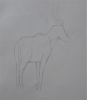
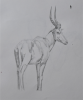
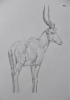
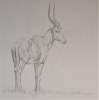
Anyway, I was wondering whether this is a good idea for a while, but I'll try it out. Here is a pictorial walkthrough of how I drew the Hirola from start to finish.

Step 1:

upload_2020-7-1_21-21-33.png

First, draw the rough outline of the Hirola. I sometimes draw it straight off the bat, starting with the main body area and then fanning out, but the most trusty way to do these things is to use rough shapes to fit the antelope around. For example, here, one would end up with a large egg shape for the body, a trapezium for the neck, a thin triangle for the head, and then draw in the legs. Drawing it straight off the bat can be quicker when you're used to it but often accounts for drawings being slightly misplaced on the sheet or things being out of proportion due to being too detail-focused. Generally use a sharp HB pencil.

Step 2:

upload_2020-7-1_21-26-38.png

Look for dark areas and sketch them in. Don't go into too much detail and keep the shading generally light. Tonal work is very important here because it lays the foundation for the lighter shading and the drawing as a whole. Generally use a blunt HB or 2B for this stage.

Step 3:

upload_2020-7-1_21-29-40.png

Now add the lighter areas and darken the darker areas slightly as well. As this was more of a sketch drawing, I didn't really do anything very elaborate, just mostly tonal work. Often areas of the animal will look slightly strange and artistic licence will be required. In this image, which was quite blurry and low-resolution, I had to make a few things up as well as lower the contrast in some areas, which is often necessary. The picture is also often in context in the photo, but less so in the drawing if you are not doing a background. This can mean that it is hard to evoke a bright edge against the white paper when in the photo it is against a darker background, making it stick out more. Generally use an HB for the lighter areas and 2B for the darker areas, sometimes verging on 4B.

Step 4:

upload_2020-7-1_21-33-23.png

Mostly just darkening, this stage is normally undertaken with a sharp, dark pencil, going over the dark edges and adding detail. This one normally involves the face more than anywhere else. Add grass or vegetation for context.

That is how I normally go about this sort of drawing. However, with larger drawings, the Amur leopard especially, I do separate bits in a high degree of detail and so I move around the drawing instead of completing an entire stage across the whole drawing.
Hope you liked it and would love to hear feedback, particularly if you do things differently. I know quite a few people who start with the lighter areas and then move onto the darker bits.

Also, does it actually look like a Hirola? I've had a few people say it looks more like an Impala, so... :D
 

Attachments

  • upload_2020-7-1_21-21-33.png
    upload_2020-7-1_21-21-33.png
    446.4 KB · Views: 26
  • upload_2020-7-1_21-26-38.png
    upload_2020-7-1_21-26-38.png
    562 KB · Views: 26
  • upload_2020-7-1_21-29-40.png
    upload_2020-7-1_21-29-40.png
    357.1 KB · Views: 26
  • upload_2020-7-1_21-33-23.png
    upload_2020-7-1_21-33-23.png
    512 KB · Views: 26
Vaquita is an excellent choice. Really one of the tragedies of our lifetime.

At this point, I am stuck between studying Zoonotic viruses and Cloning. Given the subjects I am studying currently I could do either, but I think the main reason for wanting to go into cloning are Vaquitas and Yangtze river dolphins. Such saddening stories of animals whose futures were compromised by our selfishness. I hope by going into cloning I would be able to make a difference and help re-establish these animals' populations on Earth, but the truth is I probably would just end up cloning peoples' dogs :(
Nevertheless, I am still thinking about it... :)
What do you think?
 
At this point, I am stuck between studying Zoonotic viruses and Cloning. Given the subjects I am studying currently I could do either, but I think the main reason for wanting to go into cloning are Vaquitas and Yangtze river dolphins. Such saddening stories of animals whose futures were compromised by our selfishness. I hope by going into cloning I would be able to make a difference and help re-establish these animals' populations on Earth, but the truth is I probably would just end up cloning peoples' dogs :(
Nevertheless, I am still thinking about it... :)
What do you think?
There's no way we have enough tissue to clone Vaquitas. Either way, I am completely opposed to the use of cloning in conservation.
 
There's no way we have enough tissue to clone Vaquitas. Either way, I am completely opposed to the use of cloning in conservation.

If vaquitas disappear they can be cloned, says environment chief.

There is enough genetic material to clone the vaquita - after all in theory they only need one specimen's mammary glands to be preserved by some form of freezing (liquid nitrogen most often used.)

Why are you opposed to cloning to resurrect a species that belongs in an ecosystem? I would agree that cloning dinosaurs or even mammoths is reckless and irresponsible, but cloning vaquitas or Yangtze river dolphins only returns an important species to its ecosystem. And of course cloning humans is not on in my book, especially if one harvests their organs... :eek:
The only ethical issue I can think of against cloning is that it is a slippery slope to more dangerous experiments...
 
If vaquitas disappear they can be cloned, says environment chief.

There is enough genetic material to clone the vaquita - after all in theory they only need one specimen's mammary glands to be preserved by some form of freezing (liquid nitrogen most often used.)

Why are you opposed to cloning to resurrect a species that belongs in an ecosystem? I would agree that cloning dinosaurs or even mammoths is reckless and irresponsible, but cloning vaquitas or Yangtze river dolphins only returns an important species to its ecosystem. And of course cloning humans is not on in my book, especially if one harvests their organs... :eek:
The only ethical issue I can think of against cloning is that it is a slippery slope to more dangerous experiments...
My biggest issue is that "extinction is forever" means nothing anymore. I think it will lead into people no longer caring about the environment because if something goes extinct we could just clone a new one. I have no doubt that cloning extinct species will lead to a future like this.
 
Back
Top