The Zoochat Photographic Guide to Monotremes and Marsupials

Turns out this animal is a misidentified Virginia Opossum, and not a common opossum: Virginia opossum
That's unexpected. I posted on the Smithsonian Zoo thread (Smithsonian National Zoo News 2020 [Smithsonian National Zoo]) but I'll repeat it here as well.

Basically, like everyone else on here, the only Virginia Opossums for which I am familiar with the appearance are the northern ones from the USA which, it turns out, are pretty different to the subspecies from the south of the range. There is a north-to-south range of colouration, so the northern animals tend to be white or grey with little or no pigment in the soft parts (tail and digits), while southern animals are much darker. In Mexico, where the distributions of the Virginia and Common Opossums overlaps considerably, they can be difficult to distinguish from one another because they are morphologically so similar and yet also both so variable in colouration.

I found a key to Mexican opossum species, and also checked out Fiona Reed's field guide, and the best distinguishing features of living animals are the cheek colour (always pure white in Virginia Opossum - easily seen in all the photos of the National Zoo's animal - but always yellowish or cream in Common Opossum) and the colour of the whiskers (a mix of black and white in Virginia Opossum - which can be seen in the better photos, including some on Zoochat - but all black in Common Opossum). I'd imagine it was these features that made somebody initially question the Common Opossum identity.

These features in addition to the genetic test make me perfectly happy to accept that the animal is a Virginia Opossum. I can still use the photo in the thread though, because it is of a different subspecies to the USA one already pictured.
 
I ended up making quite a few edits to the Didelphis post. The number of species remains the same, and the only species still unrepresented is the Guianan White-eared Opossum D. imperfecta, but I switched some photos around.

I moved the photo of the Smithsonian animal to the Virginia Opossum slot (so now that species has two photos of two subspecies), and for the Common Opossum I used a photo of a museum specimen by @carlos55 (black eared opossum didelphis marsupalis museo de historia natural - ZooChat).

While looking for photos of live Common Opossums I found (apart for all the ones of the Smithsonian's animal) three photos by @Giant Eland. One of an adult animal is actually an Andean White-eared Opossum D. pernigra (common opossum (Didelphis marsupialis) - ZooChat) which was good because the only other photos of that species showed a baby animal, so I swapped the adult one for the baby one.

The other two photos (common opossum (Didelphis marsupialis) - ZooChat and common opossum (Didelphis marsupialis) - ZooChat) are of baby animals in a Colombian zoo, and I'm not convinced of their identity. Common Opossums have entirely black ears - and the taxidermy photo by carlos55 shows that even the babies have black ears - so I suspect these two photos might show baby D. pernigra.

And related to that, the photo I have used for Big-eared Opossum D. aurita, also by @Giant Eland, is also of a baby animal (at a Brazilian zoo) which likewise has white ears whereas this species has black ears, and I suspect this is either D. albiventris or D. imperfecta. However I'm not sure if very young animals have black ears and this is the only photo on Zoochat labelled as a Big-eared Opossum, so I have left it in the thread with a note on possible misidentification.
 
@Chlidonias Appologies for misidentifications! I've added my wild taken photos of:
D. marsupialis- common opossum (Didelphis marsupialis) - ZooChat
& D. aurita- Big-eared Opossum (Didelphis aurita) - ZooChat

Good find on the adult D. pernigra!

The young D. aurita I posted (from Rio Zoo) is probably correct based on this: Big-eared Opossum from Rua José Alves Bezerra Filho on October 22, 2018 at 10:26 PM by Jéssica Morgado. Gambá filhote que foi resgatado de uma cachorra que matou a mãe e mais cinco filhotes. Dois foram resgatados e inseridos na natureza novamente. · iNaturalist
Apparently all young Didelphis have white ears.
 
@Chlidonias Appologies for misidentifications! I've added my wild taken photos of:
D. marsupialis- common opossum (Didelphis marsupialis) - ZooChat
& D. aurita- Big-eared Opossum (Didelphis aurita) - ZooChat

Good find on the adult D. pernigra!

The young D. aurita I posted (from Rio Zoo) is probably correct based on this: Big-eared Opossum from Rua José Alves Bezerra Filho on October 22, 2018 at 10:26 PM by Jéssica Morgado. Gambá filhote que foi resgatado de uma cachorra que matou a mãe e mais cinco filhotes. Dois foram resgatados e inseridos na natureza novamente. · iNaturalist
Apparently all young Didelphis have white ears.
That's great. I'll add in the two new photos (I'll retain the taxidermy photo by carlos55 as well).

For the ear colour of babies, I really wasn't sure one way or another and reference works don't tend to mention the ears except for adults.
 
@Chlidonias Great thanks!

Yea I had no idea and originally was just going off what the staff at the Rio Zoo had given me for an ID.

iNaturalist is quickly becoming a favorite reference of mine. They didn't have any photos of D. imperfecta on there to compare with. However given the location of the zoo and age of the animal I'd assume it was found locally which gives D. aurita the greatest likelihood.
 
A new paper has split the Australian populations of Sugar Glider Petaurus breviceps into three separate species (ariel, breviceps, notatus). I can't read the paper other than the abstract but a 2009 paper on Petaurus genetics, on which they partly based their work, found two divergent clades in Australia (equating to the new P. breviceps and P. notatus) plus found that ariel was more closely related to other Petaurus species; and found five divergent clades amongst the Sugar Gliders in New Guinea. I'll be making some changes to the Petaurus post in this thread to reflect this but it will be a little messy because I don't have access to the new paper in full and the New Guinea forms haven't been given any new name(s) as far as I'm aware.

However I think there are photos of all three Australian taxa in the galleries, as well as photos of New Guinea animals (and a 2019 genetic study I found says that probably all the animals in the USA trade are from the Sorong area in New Guinea: The origin of exotic pet sugar gliders (Petaurus breviceps) kept in the United States of America).


2009 paper: https://www.researchgate.net/public...pialia_Petauridae_in_Australia_and_New_Guinea

2020 paper (abstract): Integrative taxonomic investigation of Petaurus breviceps (Marsupialia: Petauridae) reveals three distinct species

2020 popular article: A rare discovery: we found the sugar glider is actually three species, but one is disappearing fast
 
Last edited:
However I think there are photos of all three Australian taxa in the galleries, as well as photos of New Guinea animals (and a 2019 genetic study I found says that probably all the animals in the USA trade are from the Sorong area in New Guinea: The origin of exotic pet sugar gliders (Petaurus breviceps) kept in the United States of America).
The Petaurus post is this one (#47): The Zoochat Photographic Guide to Monotremes and Marsupials


The only photos of wild Sugar Gliders were taken in the Northern Territory (so P. ariel) and in Victoria and tropical Queensland (so both P. notatus).


For the "true" P. breviceps there are no wild photos. The only photos which may show them are of a museum specimen at Queensland Museum (if it was collected locally) and live animals at Wildlife HQ (if they were collected locally), but I have no data on the origin of either. Both photos are by @WhistlingKite24

full


full


The popular article linked in the last posts says "Krefft's glider has a clearly defined dorsal stripe" and "The sugar glider, with a less-defined stripe..." which suggests that the second photo above is P. breviceps (less-defined stripe) and the museum photo isn't (clearly-defined stripe) but this feature doesn't appear to be reliable to me as an identification tool and wild photos of animals outside the range of P. breviceps can also show less-defined dorsal stripes. I've linked both photos within the Petaurus post but not the images themselves as I'm not sure.


I left the New Guinea populations under P. breviceps for want of somewhere better (otherwise I'd have had to head them as "Petaurus "breviceps" New Guinea" or something like that), and used a new photo by @Deer Forest2 from Qinhuangdao Wildlife Park in China as the Sugar Gliders traded in Asia are from New Guinea. (This replaces the photo I had used previously by @Maguari because it shows the whole animal).

full
 
I have now read the new paper on the Sugar Glider splits. Interestingly they also mention another genetic lineage in The Kimberley in Western Australia which exists alongside P. ariel and may be another cryptic species but the data for that one is extremely limited; and some unusual results from Cape York Peninsula which fall more-or-less within P. gracilis (the Mahogany Glider) genetically but are morphologically quite different, being only a quarter of the size.

They mention in passing the five genetic clades in New Guinea as found in the 2009 paper, but otherwise concentrate solely on the Australian populations.

I have put the Wildlife HQ photo (shown in the post above) in as a representative of the new split P. breviceps. It seems that with regards to the dorsal stripe in P. breviceps, it is only sharply defined on the head and then indistinct or absent on the back, whereas in P. notatus it is quite obvious as far along the back as to the hind legs. Also P. notatus has an obvious tapering tail, whereas P. breviceps has a tail of consistent width (this can't be seen in the Wildlife HQ photos, but I found a Youtube video of the same animals). Both features - dorsal stripe and tapering tail - can be seen in the photo below of a wild P. notatus in tropical Queensland which is used in the Petaurus post:

full


It seems like the white tail-tip may also a distinguishing feature, although I'm not sure this is reliable. It seems larger in P. notatus and small in P. breviceps. Interestingly, New Guinea animals seem to all lack the white tail tip (as can be seen in the photo in the previous post) so this is probably an easy way of distinguishing New Guinea from Australian animals at least.
 
Petaurus

The photo below by @Deer Forest2 at Qinhuangdao Wildlife Zoo, China, shows an animals from a western New Guinea population (animals traded in Asia and to the USA originate in the Sorong area, which is in the range of the named subspecies tafa: The origin of exotic pet sugar gliders (Petaurus breviceps) kept in the United States of America). Note also the lack of a white tail-tip.

full

Sugar glider (Petaurus breviceps) for taking photos - ZooChat

Does the new paper--which you said describes 5 clades which do not correspond with the traditional subspecies ranges--give new ranges for the taxa? From my understanding, Sorong is on the tip of Bird's Head Peninsula which is very deep within the traditional range of papuanus while tafa is restricted mostly to Papua New Guinea in the middle of the island. Again, this is based off of the now-outdated ranges, but I'm curious as to where you got the classification of tafa from.

~Thylo
 
Does the new paper--which you said describes 5 clades which do not correspond with the traditional subspecies ranges--give new ranges for the taxa? From my understanding, Sorong is on the tip of Bird's Head Peninsula which is very deep within the traditional range of papuanus while tafa is restricted mostly to Papua New Guinea in the middle of the island. Again, this is based off of the now-outdated ranges, but I'm curious as to where you got the classification of tafa from.
The 2009 paper discusses the New Guinea clades (the new paper merely mentions this in passing). The link to the 2009 paper is a few posts above and is open-access, and it has maps etc - including one (Figure 5) of the New Guinea subspecies versus genetic clades. However, I mixed up the numbers for tafa and papuanus so you are correct and I will fix that error!
 
Sulawesi Dwarf Cuscus Strigocuscus celebensis
Three subspecies: celebensis, feileri, sangirensis.

Found on Sulawesi and surrounding islands, with celebensis being found in southern and central Sulawesi and on Muna Island; feileri from northern Sulawesi; and sangirensis from the Sangihe Islands.


Photo by @alexkant at Tarsier Botanika, Philippines (unknown subspecies).

full

Sulawesi dwarf cuscus / Strigocuscus celebensis | ZooChat

Apologies, but surely this has to be some Phalanger. sp, no? It seems there's quite a few images in the ZC gallery which all seem to depict Phalanger rather than Strigocuscus.
Only this one (and the other of probably the same individual) by Giant Eland look like definite dwarf cusucs.
 
Apologies, but surely this has to be some Phalanger. sp, no? It seems there's quite a few images in the ZC gallery which all seem to depict Phalanger rather than Strigocuscus.
Only this one (and the other of probably the same individual) by Giant Eland look like definite dwarf cusucs.
I'll check this out when I have some time, and come back to it.
 
A new photo of Guianan Four-eyed Opossum Philander opossum by @RatioTile has been added into the thread (post #98 here: The Zoochat Photographic Guide to Monotremes and Marsupials).

full

Gray Four-Eyed Opossum (Philander opossum opossum) - ZooChat


The only photos of Philander previously in the Zoochat galleries were taken at Plzen Zoo but I don't know the country of origin of their animals so the actual species is unknown to me. (What was known as the Grey Four-eyed Opossum P. opossum has been split into four species - the "true" P. opossum is now restricted to the Guianan region in northeastern South America).
 
Apologies, but surely this has to be some Phalanger. sp, no? It seems there's quite a few images in the ZC gallery which all seem to depict Phalanger rather than Strigocuscus.
Only this one (and the other of probably the same individual) by Giant Eland look like definite dwarf cusucs.
I believe you are correct about the Tarsier Botanika photos. Unfortunately Phalanger species are very confusing (in terms of taxonomy, physical appearances, how photos are labeled on the internet, etc). I have been looking through Flannery's various books on possums without reaching much of a conclusion. It does seem like every small cuscus in an Asian zoo is just labeled as "Sulawesi Dwarf Cuscus", which is annoying.

I don't even know if the ones at Batu Secret Zoo which you linked to are actually Strigocuscus. What are you basing your "look like definite dwarf cuscus" upon? The hind-toes look more like a Phalanger species, and dwarf cuscus are supposed to be brown (or reddish in the Peleng species); they also have fur on the dorsal surface of the tail, although it is very fine and may not be apparent in a photo.

The photos by Alex at Tarsier Botanika look like they are probably one of the group which used to be Common Cuscus (now split into many species) - interestingly his collection of photos of "Sulawesi Dwarf Cuscus" from that visit also include a reddish animal which will be some other species again - The photosession at Tarsier Botanika in Tawala, Philippines).


The only photos I am "sure of" (in quotation marks, because I'm not completely sure!) are the ones of a possum at Taman Safari Bogor labeled as Sulawesi Dwarf Cuscus which, given the white tail, actually depict a very fat Northern Common Cuscus, e.g. the photo below:

full
 
Last edited:

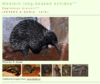
Western Long-beaked Echidna Zaglossus bruijnii

Monotypic.

Photo by @alexkant at Moscow Zoo, Russia.

full

Long-nosed echidna/ Zaglossus bruijni | ZooChat


Photo by @Giant Eland at Batu Secret Zoo, Indonesia.

full

Western long-beaked echidna (Zaglossus bruijni) | ZooChat

Looking back, I saw the photos of echidnas, and they seem to be unusually variable. Could there be unrecognized species?

Short-beaked echidna from New Guinea has little fur but spines, while Tasmanian form has lots of fur with scattered spines.

Western long-beaked echidna in Moscow is thin, gray and has few hair and few spines on legs, in contrast to fat, black, hairy and much more spiny one from Batu. Although the Moscow echidna could be geriatric?
 
Although the Moscow echidna could be geriatric?

It was actually not all that old when it died; from memory the various animals at Moscow (there were six imported in the mid-1990s, but all but one died rapidly) were quite sickly. There are several other photographs of the last Moscow animal on Zootierliste which show more body hair than the photograph in this thread would imply.

upload_2023-1-30_17-23-59.png
 

Attachments

  • upload_2023-1-30_17-23-59.png
    upload_2023-1-30_17-23-59.png
    210.6 KB · Views: 106
Back
Top