depict
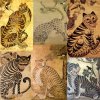
The connection between magpies and tigers in Korean culture is deeply related to the art styles that were popular in the 17th and 19th centuries. At that time, paintings by civilian unnamed artists were popular in Korea, which Korean folk arts are called 'Minwha" today, and many paintings were included
magpies,
tigers or leopards, and
pine trees in one paper. this paintings are called
'Hojakdo'(호작도) or
'Kkachi horangi'(까치호랑이).
View attachment 472641
Various kinds of Hojakdo.
The reason why the some painting is in leopard, not the tiger, and also some tigers has the stripes of the tiger and the spots of the leopard together is because Koreans thought tigers and leopards were same animal, and called tigers and leopards same name, "Beom."
source of picture is
Korean internet news.
As many artists have painted Hojakdo, so the styles of all Hojakdo are different, and there are many interpretations of this, but the best-known interpretation of Hojakdo is the resolution of the common people's discontent with those in powerful man.
In this interpretation, magpies represent the common peoples and tigers represent the powerful. In most paintings, magpies sit on pine trees higher than tigers, shouting to tigers, and tigers look angry at magpies, or tigers are depict comical and foolish. In other words, according to this interpretation, Hojakdo is a picture describe this: weak, but clever magpies are teasing strongest of all animals, but foolish tiger.
This interpretation is related to the times of the era when Hojakdo was popular. The Joseon Kingdom, which was on the Korean Peninsula at the time, was very confused in the 19th century when the king's maternal relatives took power and engaged in political activities freely, and there were many revolts. Therefore, many common people were satisfied by depict themselves for magpies and powerful people depict to foolish tigers.
And also, there is a Korean fairy tale that shows this point of view. to sum up as follows: A man saved the tiger from fell in pit trap, but the tiger tried to eat the man. Many animals and trees also said that tigers could eat men, but a magpie or hare said they had to recreate the situation at the time. So the tiger was go into pit again, but man doesn't help tiger again. So, the man was save his life by clever magpie or hare.
But that doesn't mean that the tigers of Hojakdo have only negative meanings. Although the situation at the time made the tiger a symbol of incompetent power, Koreans regarded the tiger as the king of powerful beasts, and servant, guard of the mountain god or the mountain god itself. Like they depicted powerful people as tiger.
And people thought magpie was also servant of mountain gods, and also thought in places where mountain gods cannot go directly, gods sent magpies to deliver good energy. So people believed that magpies were birds that brought good energy, and in Korea, magpies were 'tooth fairy.'
Therefore, Hojakdo also meant that the drive out the bad energy by tiger's strong energy, and bring in good energy by magpies. From respectful beings with strong power to bloodthirsty ones to foolish ones, tigers in Korean culture are described as very complex and three-dimensional. I think can make many books just by just collecting these stories.