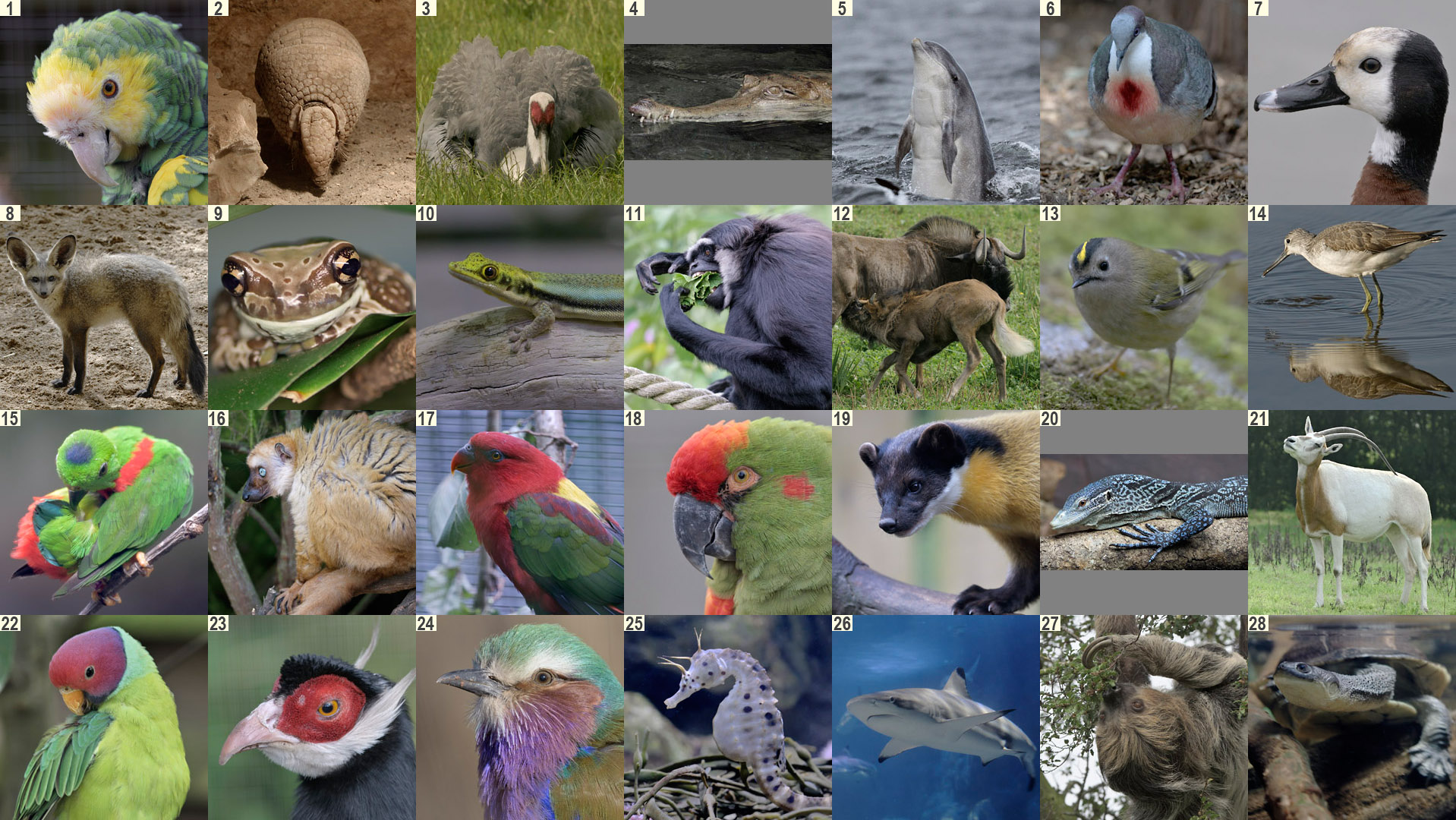
Mayday! Mayday! It's another photo puzzle!

They all show the body part in question. Yellow legs=/=white face. But I did try looking for yellow legs, but did not find any herons.

Maybe it's a Yellow-legged Gull? The pattern and alphabetical order would fit for that also, and its name is listed in ZTL.

I'm in agreement with the other answers so far, except that 11 seems like it could be a number of gibbon species.
 
Maybe it's a Yellow-legged Gull? The pattern and alphabetical order would fit for that also, and its name is listed in ZTL.
I'm in agreement with the other answers so far, except that 11 seems like it could be a number of gibbon species.
The legs are too long for any gull I have ever seen and are they really yellow?
 
I'm in agreement with the other answers so far, except that 11 seems like it could be a number of gibbon species.
As I said, the pictures show the body part that is in the name. In ZTL only lar gibbons and agile gibbons have hand in their alternative name and the hand in the puzzle don't seem white.

I also realized that it is dark-handed not black handed gibbon.
 
Last edited:
As I said, the pictures show the body part that is in the name.

You're right - I momentarily forgot that I quoted that, and was going off my earlier realization of just the body part pattern.

The legs are too long for any gull I have ever seen and are they really yellow?

That's why I only suggested it and didn't declare it; the pattern and order fit, but the legs looked odd to me for a gull. I operated under the assumption that maybe I was overthinking it, but if not that would make sense.

They look yellow to me :p
 
I would say Yellow-legged/Purple gallinule were it not for the fact it doesn't fit and I think ZTL lists it as Purple anyway.
 
If I remember correctly, Hylobates lar always has white fur on the hands. Hylobates agilis has hands with the same colour fur as the body, not always black or even very dark.
 
I guess I have to find out the type of bird it is before I find the specific animal. The only birds that fit the bill to me are gulls and herons.
 
Okay, let's go through this again

1 Yellow-shouldered amazon
2 (Mataco) three-banded armadillo
3 White-naped crane
4 West African slender-snouted crocodile
5 Atlantic bottle-nosed dolphin
6 Hairy-breasted bleeding heart dove
7 White-faced whistling duck
8 Bat-eared fox (idk which subspecies)
9 Golden-eyed tree frog
10 Yellow-headed day gecko
11 Agile/Black-handed gibbon
12 White-tailed gnu
13 Goldcrest
14 Greenshank
15 Blue-crowned hanging parrot
16 Blue-eyed black lemur
17 Yellow-backed chattering lory
18 Red-fronted Macaw
19 Yellow-throated marten (idk which subspecies)
20 Blue-spotted tree monitor
21 Scimitar-horned oryx
22 Plum-headed parrot
23 Brown eared pheasant
24 Lilac-breasted roller
25 Pot-bellied seahorse
26 Blacktip reef shark
27 Two-toed sloth
28 Snake-necked turtle (I cannot tell which species)

The odd one out is Brown eared pheasant, because the black does not describe the ears

All of them have body parts in their name

The order is listed alphabetically minus the adjectives/prefixes

How far are we, gentle lemur?
 
Last edited:
I think 14 may be a greenshank.
Got it! Well done :)
That means that the goldcrest is not the only species whose name is a compound noun (a name made of two words combined, or possibly more than two - particularly in German) as @Tetzoo Quizzer posted while I was typing.

The odd one out is Black eared pheasant, because the black does not describe the ears
All of them have body parts in their name
The order is listed alphabetically minus the adjectives/prefixes

Yes your list is correct now and the order is correct, as I said before.
You are right about the principle, each photo shows the part of the body which gives the creature its common name. Each name contains an adjectival phrase of two words describing that body part (with or without a hyphen) or is a compound noun combining the two words (I nearly included a redwing too, but the red is mainly on the underwing, not visible in my photo).
@PossumRoach is actually quite correct in naming the brown eared pheasant as the odd one out, as its ear tufts are white, the body feathers are brown, and of course they are not really ears in the first place. @Tetzoo Quizzer I would accept blue eared pheasant as a correct answer, because that would still be the odd one out, and it is very difficult to distinguish the species from the cropped image.
 
Isn't the hanging parrot in the wrong part of the order? Like I understand that it is in a section where an animal that would start with an H would be placed, but isn't it still a parrot in the first place?

I would like to congratulate @amur leopard ,@Strix , and @Tetzoo Quizzer for filling in the cracks of my list.
 
Isn't the hanging parrot in the wrong part of the order? Like I understand that it is in a section where an animal that would start with an H would be placed, but isn't it still a parrot in the first place?
Possibly, but I chose to use the h rather than than the p, half the hanging parrots on Zootierliste have hyphens, half do not. I admit that I was not consistent as the reef shark goes with s.
Incidentally it is a Roti Island snake -necked turtle (which is in the right place whether you prefer the s or the t).
 
Last edited:
Congratulations to @PossumRoach and thanks to all the other contributors :)

I am taking a break from puzzles now as lockdown nears its conclusion in the UK (crossing my fingers and touching wood of course). I hope to be able to take more photos now, but I do have something in mind for Christmastime . . . .
You have been warned ;)
 
Back
Top