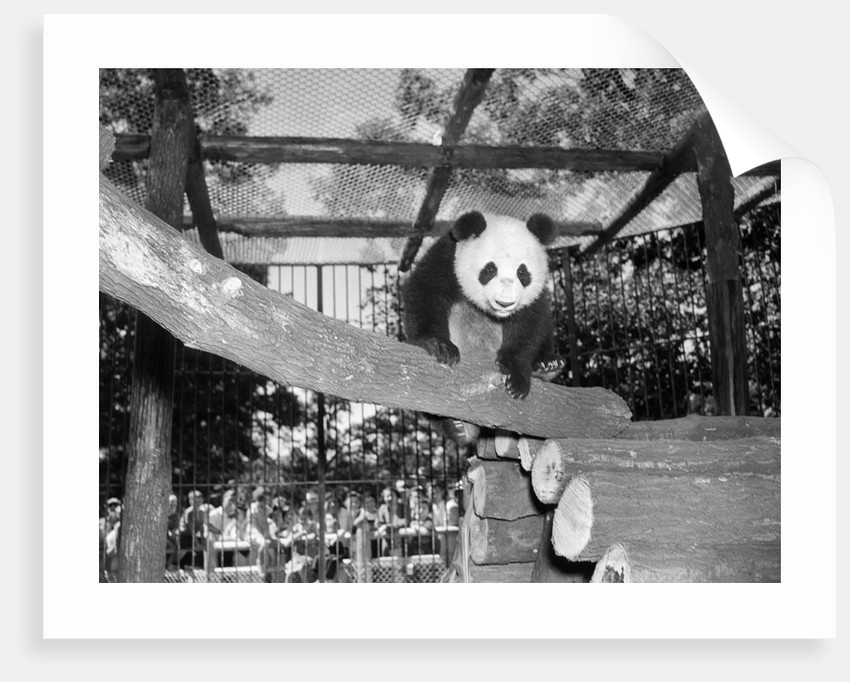
Brookfield has a more extensive history with pandas than documented here, though hardly exciting.
As mentioned, Su-Lin was located by Ruth Harkness, living from April 1937 to June[?] 1938, mistaken for a female; just a few weeks after Harkness returned from a second expedition with Mei-Mei, intended as a male companion for Su-lin, but also mistaken for female; the two pandas were introduced in front of cameras and did not get along. (One of them hit the other on the nose.) I do not believe they were held together after this. Su-Lin died shortly later of pneumonia; the panda's correct sex was identified and he remains on display at the Field Miuseum in their Hall of Mammals, displayed with a red panda.
In 1938 or so, Mei-Mei was joined by Mei-Lan, who some sources claim was misidentified as female as well but contemporary newspaper accounts (circa 1941) discuss Mei-Mei incorrectly as female and Mei-Lan as male and as a potential mate. Mei-Mei died within a few years however, and Mei-Lan remained the zoo's only panda afterward. He was moved to a new exhibit near the other bear grottos and on one occasion bit a keeper; he was actually considered to have a temper by the keepers. He died in 1953.
In 1955, Brookfield purchased Chi-Chi, however entry into the United States was refused by the Treasury Department due to the embargo on Chinese goods, leading Chi-Chi to her more famous home at the London Zoo.
Brookfield was also rumored to be under consideration when then-President Richard Nixon famously received pandas as a diplomatic gift but that, of course, became the beginning of the National Zoo's long relationship with pandas. I don't think it is believed now that Brookfield was ever seriously in the running, but some believed Brookfield's history with the species would have been significant.
I do not believe the zoo has discussed pandas since then.
(Interesting to think the acquiring of Chi-Chi was a few short years after Mei-lan's passing, and the China trip was near the time of Chi-Chi's death; had Brookfield improbably won out on both deals, they would have had pandas for all but two or three years between 1937 and 2000.)
While double checking my facts for this post, I also found out
here that Bronx and St. Louis had kept pandas sometime in the 1940s/1950s era as well, which as far as I know is new information for zoochat!
By the early 1950s, Heller writes, “the number of pandas in America had dwindled to zero: Su Lin and two others, Mei-Mei and Mei-Lan, had died at the Brookfield Zoo; the Bronx Zoo’s four were dead; and the Saint Louis Zoo had recently mourned its last one, Pao Pei.”