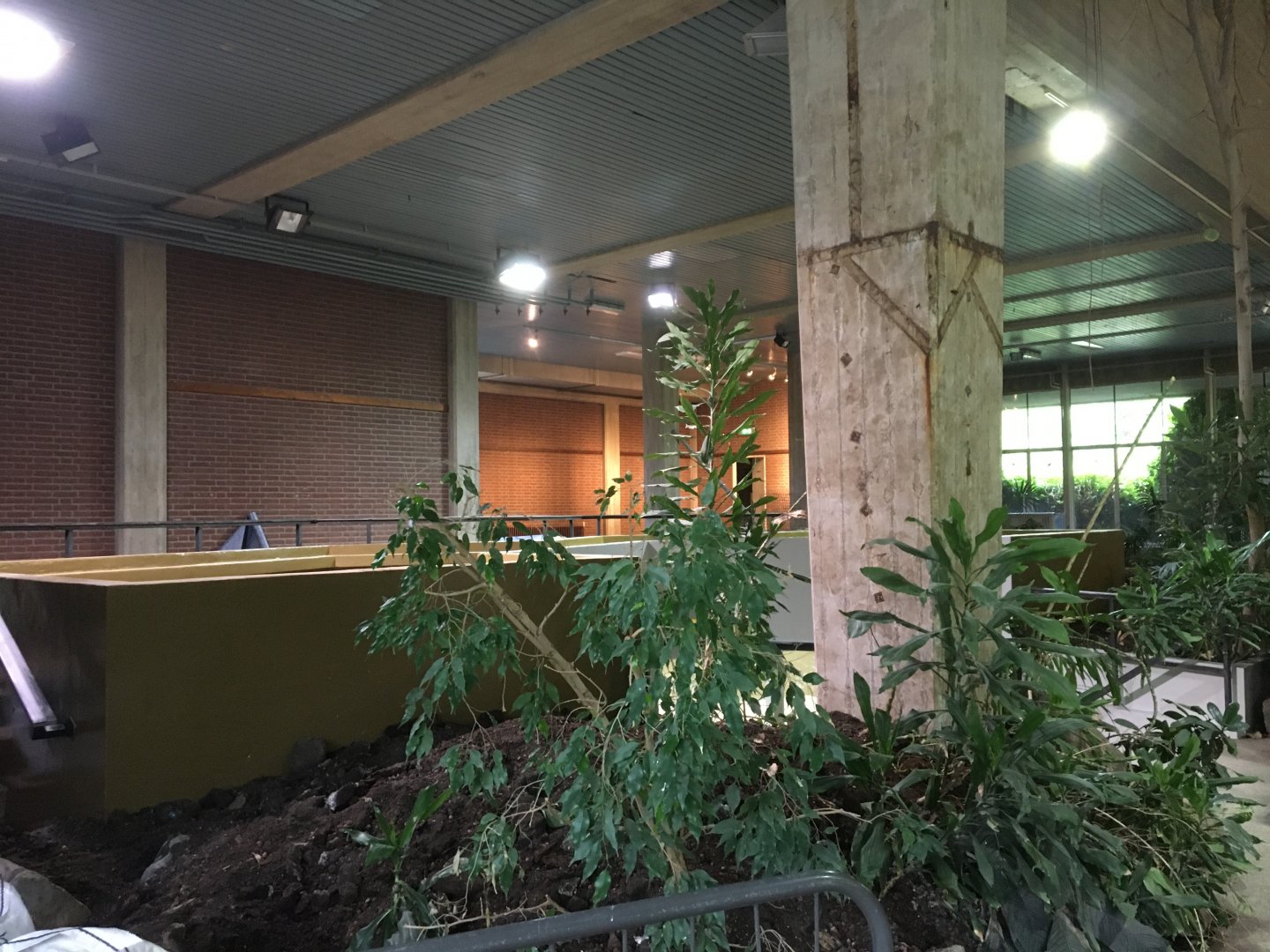
Two weeks ago I visited Artis again, mainly for the reopened Metzelaarskas/greenhouse (which had been closed for over 10 years!).
- Metzelaarskas / Tropical greenhouse:
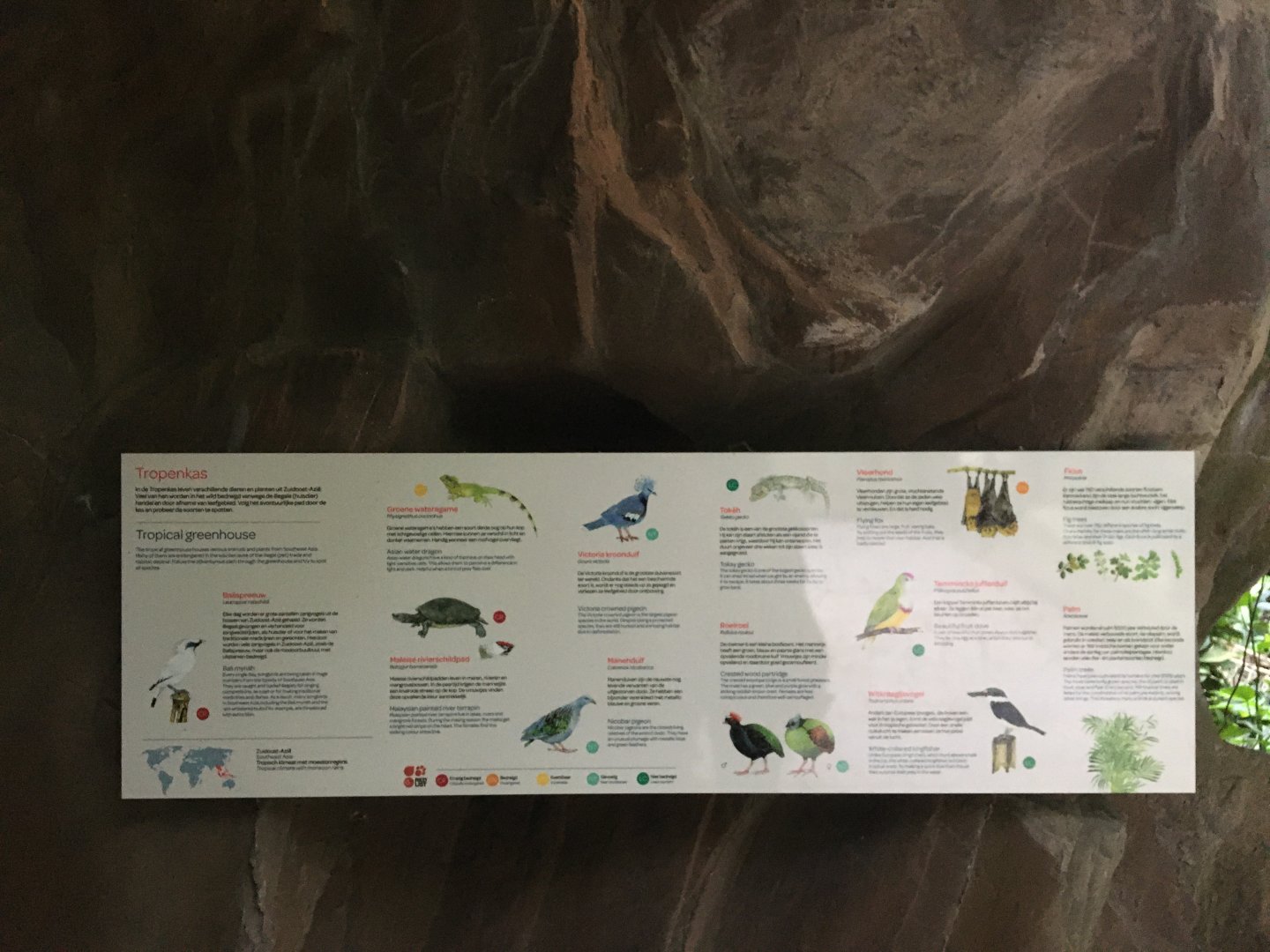
This is the greenhouse next to the butterfly greenhouse, in the past it was called the Metzelaarskas but now it's refered to as Tropenkas/Tropical greenhouse. You have to walk over a wooden walkway to enter the greenhouse. You are now standing on a stone bridge, underneath this bridge is a relatively large pond which supposedly houses the Malaysian painted river turtles (
Batagur borneoensis). I only saw one Giant gourami (
Osphronemus goramy) in the pond, this animal wasn't signed. In front of the bridge is a large rock formation which also has a small waterfall coming down from it. Behind this rock formation are all kinds of tropical plants, most of which were also in this greenhouse 10 years ago. Another thing that hasn't changed, is the walkway through the greenhouse. Once you "enter" the rock formation you can go to the left and walk on slippery rocks around the greenhouse. This brings you back to the rock formation in front of the bridge, due to corona you can now only exit the greenhouse through the vlindertuin/butterfly greenhouse. This was also possible in the past, but this door was sealed off eversince the Metzelaarskas was closed. I also noticed some sort of netting that was placed roughly 15 cm underneath the celing. I persume that the netting is put in place to prevent animals from escaping when the roof windows are opened, the Rodriguez flying foxes (
Pteropus rodricensis) hang from these nets.
I was able to spot almost all the animals that were signed in the greenhouse, but some of them are almost impossible to find/see. Most animals did come from the tropical part of the Vogelhuis/Birdhhouse and the fazanterie/pheasantry. I saw the following signed animals:
2 White-collared Kingfishers (
Todiramphus chloris), these used to live in the birdhouse.
Several Nicobar pigeons (
Caloenas nicobarica), 2 Victoria crowned-pigeons (
Goura victoria),
a pair of Crested partridges (
Rollulus rouloul) and 1 Bali myna (
Leucopsar rothschildi).
The Rodriguez flying foxes (
Pteropus rodricensis) were also easy to spot, they were either hanging from the nets, plants or feeding containers.
In addition to Malaysian painted river turtles (
Batagur borneoensis) 2 other reptile species can also be found in the greenhouse. Chinese water dragons (
Physignathus cocincinus) and
Tokay geckos (
Gekko gecko), I didn't see both species and the chance of ever spotting them is very small. I also didn't see any Malaysian painted river turtles (
Batagur borneoensis), they were most likely hiding underneath the bridge, one of the volunteers I spoke to told me that she had only seen 1. Beautiful fruit-doves (
Ptilinopus pulchellus) were also signed but I couldn't find them. The two White-winged ducks (
Asarcornis scutulata) that I had seen a week before my visit were nowhere to be found and they weren't signed either. I did hear that they are very good at hiding, so perhaps I was just unlucky. Lastly I saw several Red-whiskered bulbuls (
Pycnonotus jocosus) and heard Anthonys poison-arrow frogs (
Epipedobates anthonyi)
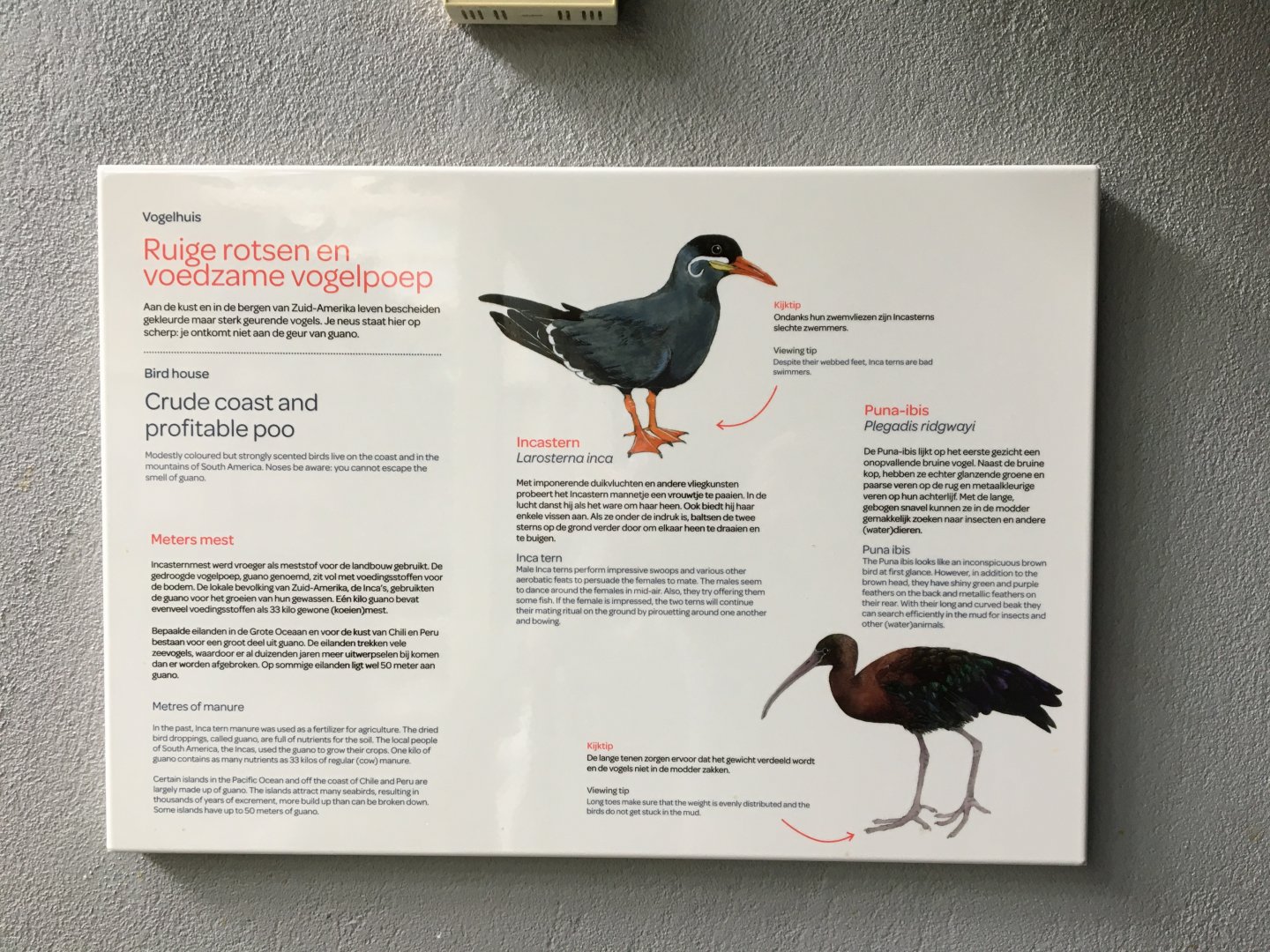
Signage in the Metzelaarskas.
- Reptielenhuis / Reptile house
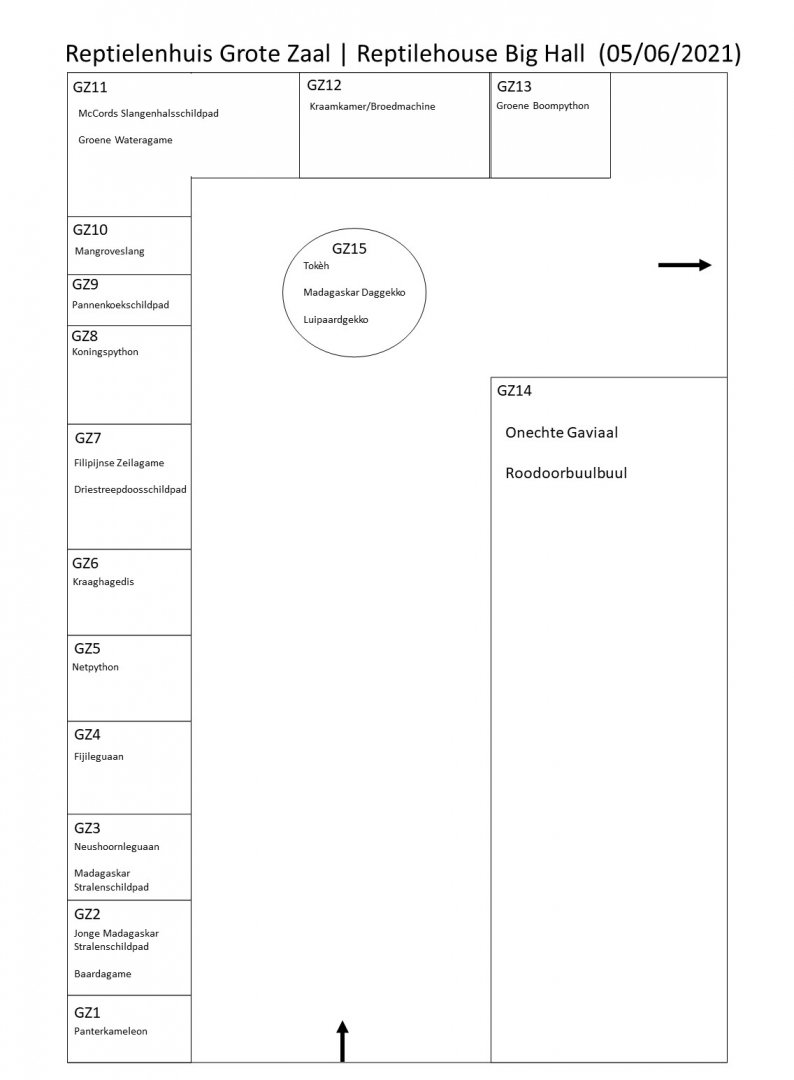
A lot had changed in the reptile house, most reptiles had changed terrariums. I made the following schematic overview of the enclosures in the reptile house to visualize the current layout.
Overview of the content of each terrarium in the "warmer" part of the reptile house.
GZ1: Panther chameleon (
Furcifer pardali).
GZ2: Central bearded dragons (
Pogona vitticeps) and juvenile Radiated tortoises (
Astrochelys radiata).
GZ3: Hispaniolan rhinoceros iguanas (
Cyclura cornuta cornuta) and adult Radiated tortoises (
Astrochelys radiata). The radiated tortoises used to live in the former manatee enclosure in the gorilla house.
GZ4: Fiji banded iguanas (
Brachylophus fasciatus). This used to be 2 separate terrariums, the most left terrarium housed a Gold-ringed cat snake/Mangrove snake (
Boiga dendrophila) and the other a Green tree python
(Morelia viridis).
GZ5: Reticulated python (
Malayopython reticulatus).
GZ6: Frill-necked lizards (
Chlamydosaurus kingii)
GZ7: Philippine sailfin lizard (
Hydrosaurus pustulatus) and Chinese three-striped box turtles
(
Cuora trifasciata). The Malaysian painted river turtles (
Batagur borneoensis) used to live in this terrarium together with the sailfin lizard. The Chinese three-striped box turtles, were behind the scenes for years but are now finally back on display!
GZ8: Royal pythons (
Python regius). Before this terrarium housed Common agamas (
Agama agama) and Pancake tortoises (
Malacochersus tornieri). Not sure where the agamas went but the pancake toroises now live in the next terrarium.
GZ9: Pancake tortoises (
Malacochersus tornieri). This terrarium used to house the royal pythons.
GZ10: Gold-ringed cat snake/Mangrove snake (
Boiga dendrophila), previously the Fiji banded iguanas lived in this terrarium.
GZ11: McCord's snake-necked turtle (
Chelodina mccordi) and one Chinese water dragon (
Physignathus cocincinus).
GZ12: Reptile nursery.
GZ13: Green tree python
(Morelia viridis), previously Fiji banded iguanas lived in this terrarium.
GZ14: False gharial (
Tomistoma schlegelii) and free flying Red-whiskered bulbuls (
Pycnonotus jocosus).
GZ15: Round enclosure with multiple separate terrariums with juvenile Tokay geckos (
Gekko gecko), one Common leopard gecko (
Eublepharis macularius) and one Greater Madagascar day gecko (
Phelsuma grandis).
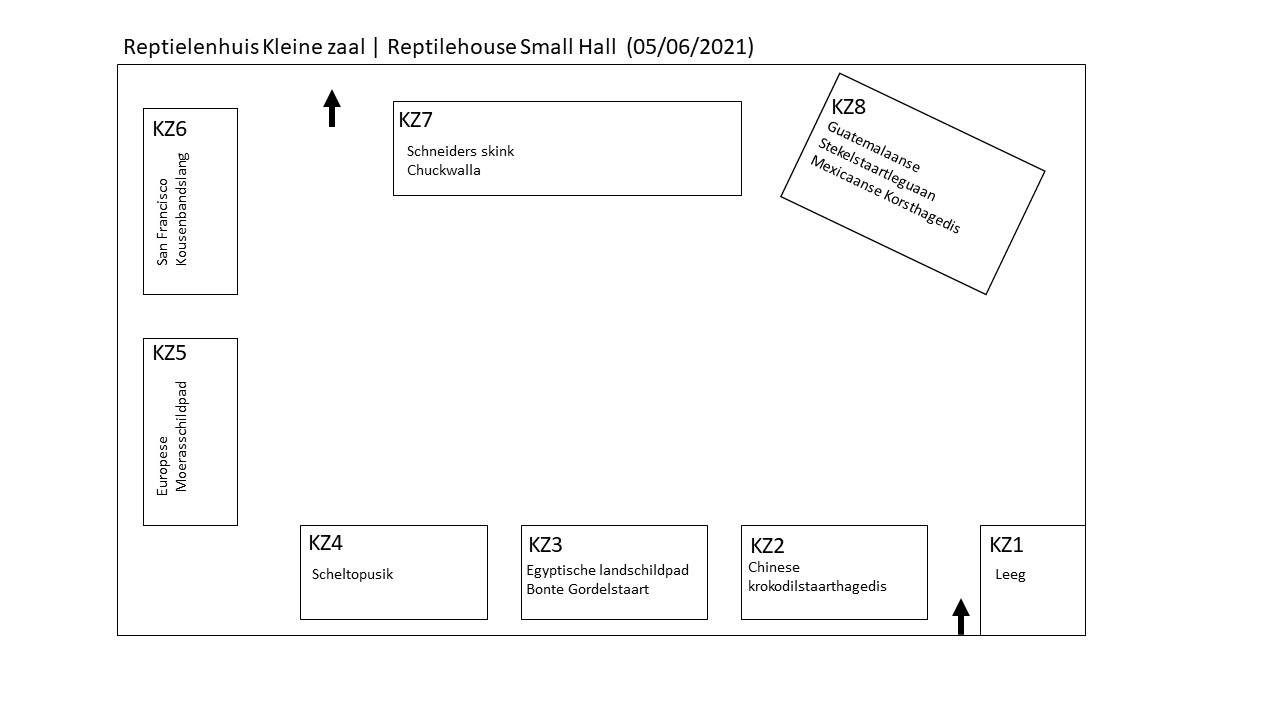
Overview of the content of each terrarium in the "colder" part of the reptile house.
KZ1: Empty, front window removed and a few plants placed inside of the terrarium as decoration.
KZ2: Crocodile lizards (
Shinisaurus crocodilurus).
KZ3: Egyptian tortoises (
Testudo kleinmanni) and Zoutpansberg girdled lizard (
Smaug depressus).
KZ4: European legless lizards (
Pseudopus apodus).
KZ5: European pond turtle (
Emys orbicularis).
KZ6: San Francisco gartersnakes (
Thamnophis sirtalis tetrataenia), previously Fiji banded iguanas lived in this terrarium.
KZ7: Algerian orange-tailed skink (
Eumeces algeriensis) and Common chuckwallas (
Sauromalus ater).
KZ8: Guatemalan spiny-tailed iguana (
Ctenosaura palearis) and Rio Fuerte beaded lizards (
Heloderma horridum exasperatum).
- Other news:
- The male two-toed sloth is back in the small mammal house, he is recovering from an operation. The Cotton-top tamarins (
Saguinus oedipus) now no-longer have access to the sloth enclosure.
- The Pontianak Prevost's squirrel (
Callosciurus prevostii borneoensis) only had access to the armadillo and middle enclosures. So not to its "original" enclosure.
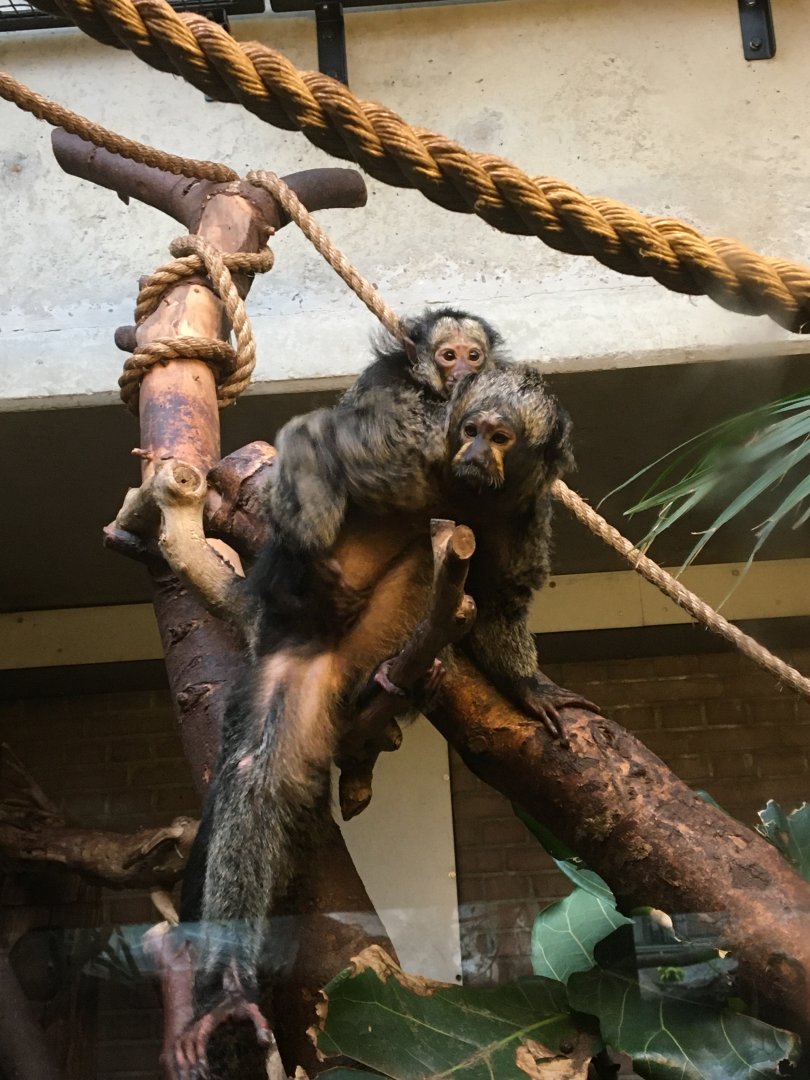
- I was finally able to see the young white-faced saki!
Female white-faced saki with her young.
- The former manatee tank is getting prepared to house the Pacus (
Colossoma macropomum). All the plants around the tank were removed, making that side of the gorilla house look quite bare. Hopefully some new plants will be placed there once the preparations are completed.
View of the former manatee tank.
- There were almost no butterflies in the butterfly greenhouse, this is because Artis didn't receive much butterfly cocoons due to covid.
- Some older news three weeks ago I saw at least 4 juvenile and 3 adult Black-crowned night herons (
Nycticorax nycticorax nycticorax) in the Japanse paradijs tuin (near the penguins). There is also a make shift aviary hidden behind some trees.
- According to the zoo magazine the following bird species arrived from GaiaZoo and will temporarily stay in Artis: Common redshanks (
Tringa totanus), an Eurasian Oystercatcher (
Haematopus ostralegus), Lesser kestrels (
Falco naumanni), European rollers (
Coracias garrulus),
Marbled teals (
Marmaronetta angustirostris), Pied avocets (
Recurvirostra avosetta) and Scaly-sided mergansers (
Mergus squamatus).