I have decided to post my future exhibit and zoo ideas and designs in this personal thread.
From now I will be posting all such content in this thread. I had been considering making this thread for some time, but recently I realized I now had to actually do it if I wanted to be able to continue fantasy zoo activities. I am not going to promise any kind of schedule for submissions to this thread as not to put pressure on myself. I will also be giving myself a lot of choice and rein in terms of which ideas I will develop and how I develop them.
I am going to start this thread off with the completion of a project I started early this year in one of the assignment threads, namely my Realms of the Amazon project, originally started for the thread "Make an exhibit with that theme". After that I will be starting development on another bird project with the working title "Wild Congo", as I was assigned Congo in that same thread for after the completion of my Amazon project. As the original thread and its original starter have not been active for months I decided not to further bump the thread and move these projects to my personal thread, where I believe they will serve quite well as openers.
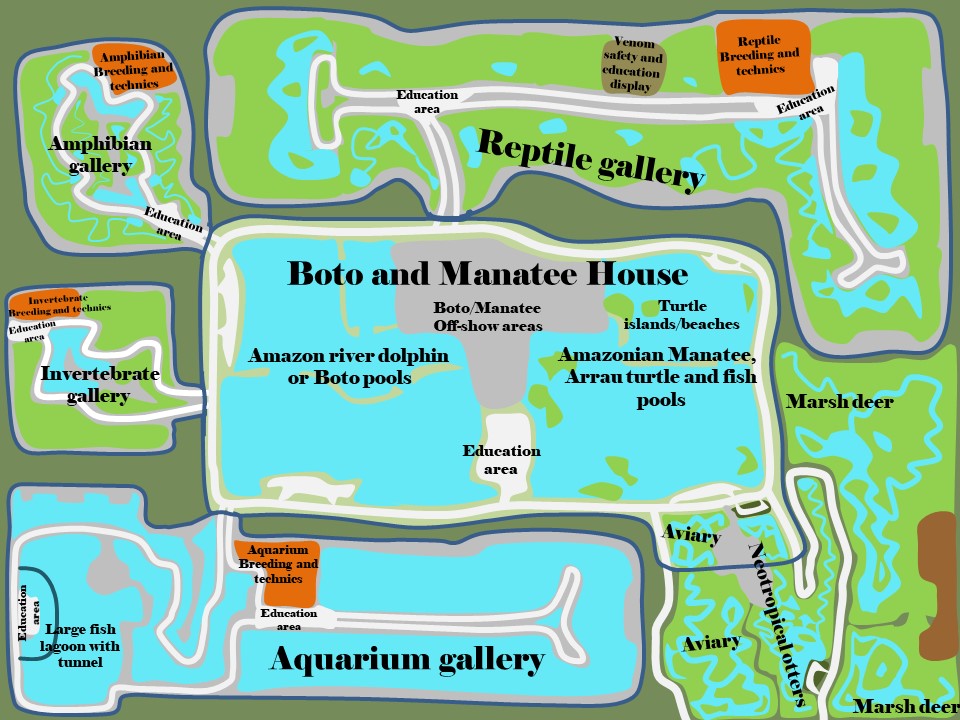
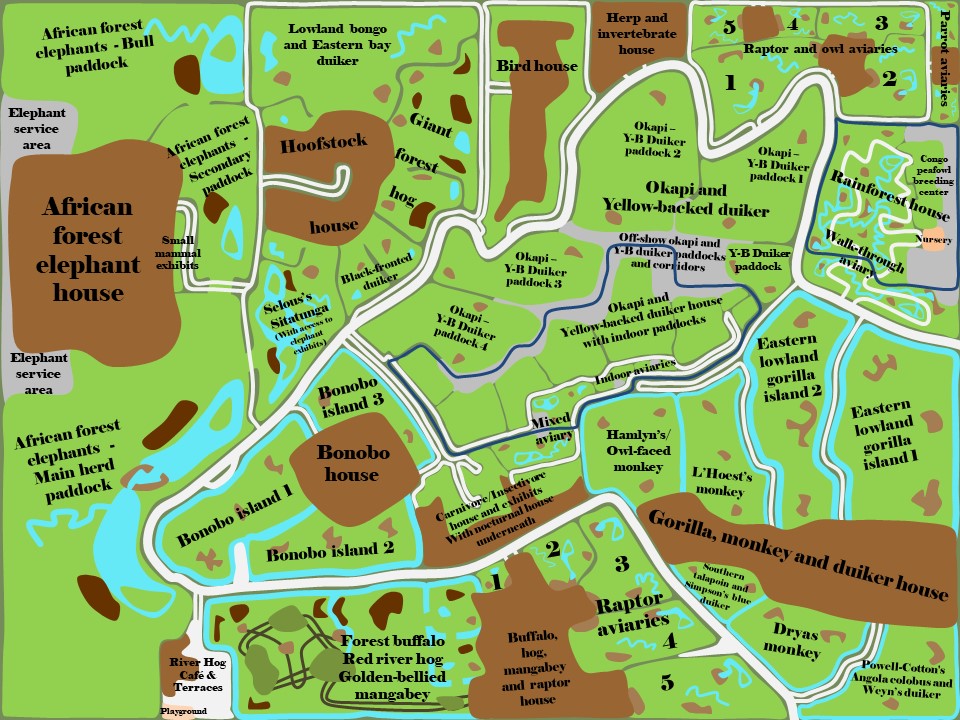
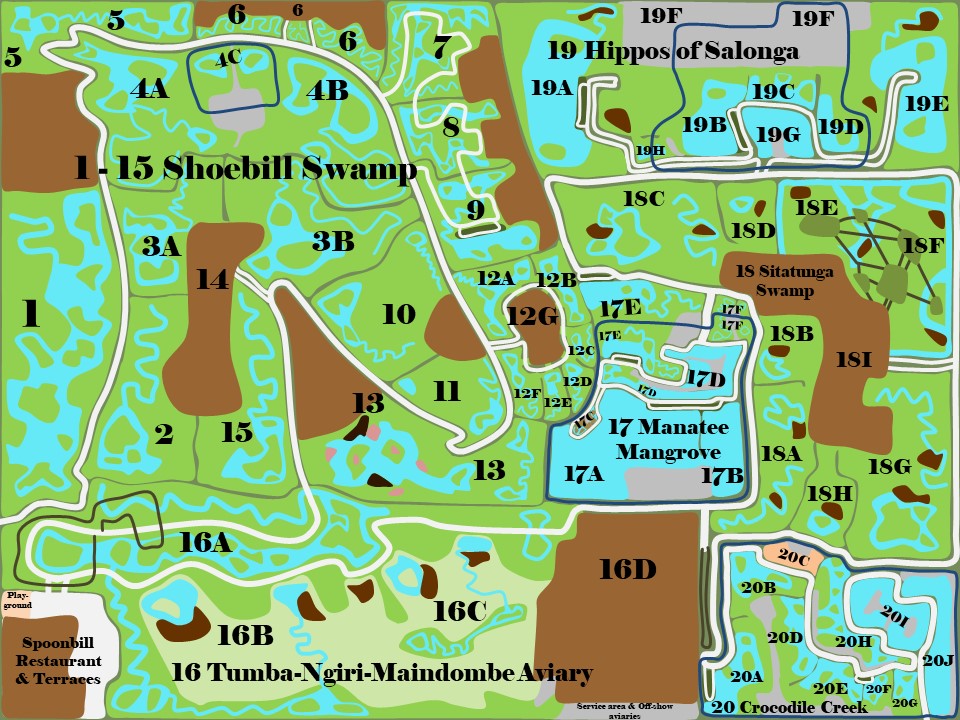
The two first parts of the Realms of the Amazon project can be found at the links below. They were the Realm of the Harpy Eagle and the Jaguar, focusing on Amazonian carnivores, and the Realm of the Capybara and the Saki, focusing on the ground-dwelling and arboreal mammals of Amazonia as well as on wetland bird species.
Make an Exhibit with that theme
Make an Exhibit with that theme
I will now move on to the discussion and description of the third part of Realms of the Amazon, "The Realms of the Hoatzin and the Macaw", which focuses on the avifauna of the Amazon Basin and the Amazon biome.
Realms of the Amazon - The Realm of the Hoatzin and the Macaw
Design
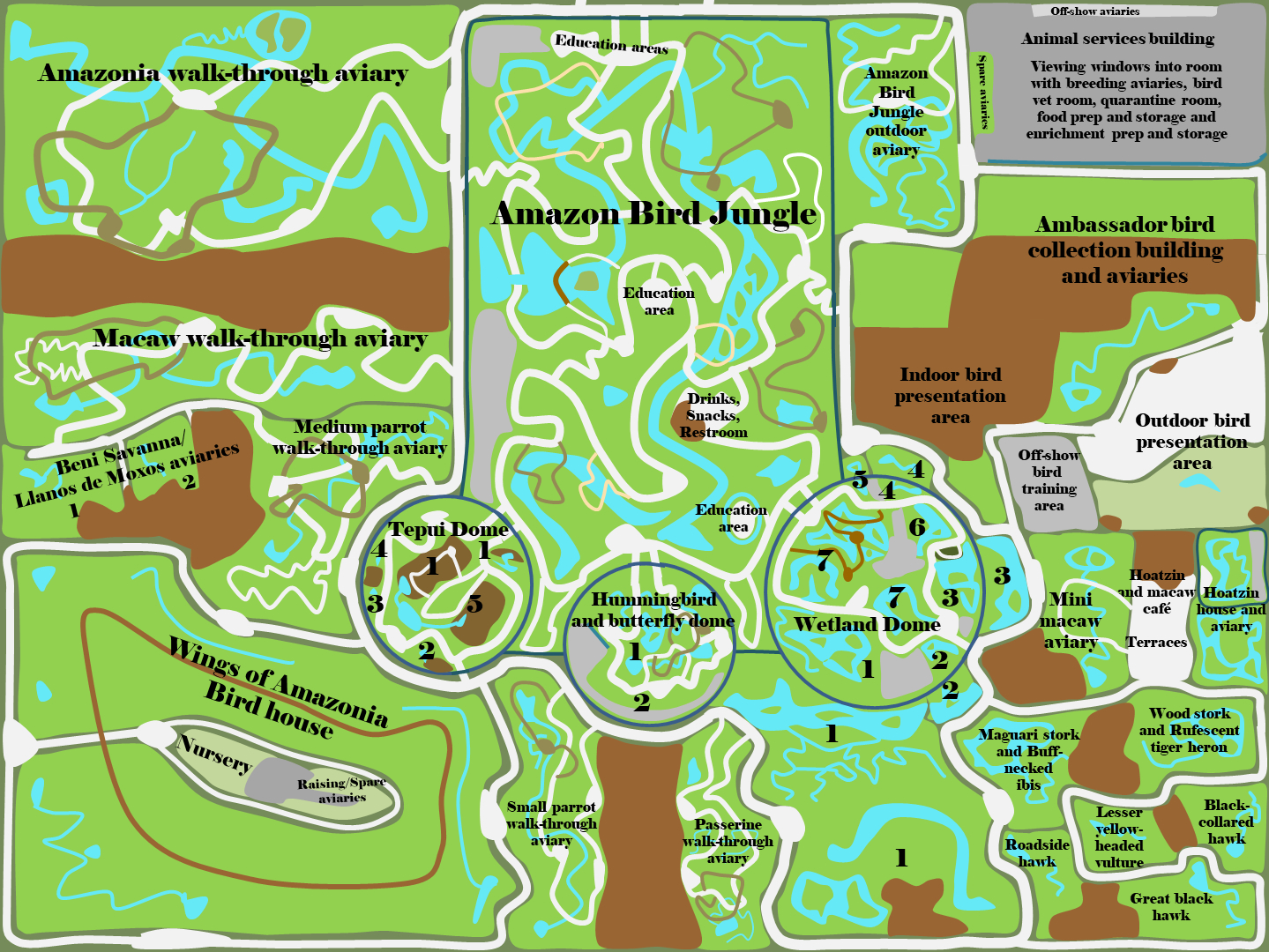
In the discussion below dotted lists represent the different species in mixed exhibits and striped lists represent different species kept in the different exhibits of an area, building or complex.
As can been from the design, this realm will feature a central large trail surrounding the Amazon Bird Jungle complex, with smaller looping trails to and from this area to give visitors access to different exhibits or exhibit complexes. Some of the exhibits will be able to be seen from both the central trail and the loop trails.
Amazon Bird Jungle complex
Amazon Bird Jungle walk-through tropical house and Amazon Bird Jungle outdoor walk-through aviary
The Amazon Bird Jungle main building will be a very large and tall tropical house, something like for example Burgers' Bush at Burgers' Zoo in the Netherlands, with a walk-through rainforest habitat housing mostly medium and smaller bird species. As this house will attempt to show as well as possible in a human care setting the healthy habitats of Amazonia, lots of native flora will be included, including species that are of interest or economic importance to or have interesting uses to humans. These species will be included in the education on the importance for humanity of preserving the Amazon's ecosystems and ecosystem services.
The very large indoor exhibit will have with a lush rainforest vegetation, a series of pools, creeks and islands, a sizable number of ground level, adventurous and canopy trails, different kinds of nesting facilities catering to the different species provided in numerous locations and a number of feeding platforms of different sizes and types and in different locations (i.e. on poles, hanging in trees, at ground level, large and small), placed both within direct view of visitors and in more distanced locations. The outdoor aviary will be able to be used by the birds during the warmer months and will feature a lush vegetation of herbaceous plants, shrubs and trees, and will also have creeks, pools, islands and feeding areas.
The building will feature four education areas to educate visitors about the ecosystems and the avifauna of the Amazon and on the preservation of Amazonia. But education will also be present elsewhere throughout this facility. This house will also feature an area with a food and drink stand, terraces and restroom for guests. This area will be netted off from the birds for their safety, but viewing into the bird areas will still be possible.
Species kept in the Amazon Bird Jungle:
Tepui Dome
This dome will feature species from the tepuis (isolated table-top mountains or mesas) of the Guiana Shield, situated in a region including parts of Brazil, Guiana and Venezuela. The climate and vegetation of this dome will be somewhat different from that in the Amazon Bird Jungle house, to represent the unique ecosystems of the tepuis. The dome will also feature several mock rock structures, partially clad with vegetation and with scattered small waterfalls, mimicking the tepuis and the waterfalls and streams that sometimes flow from them. The dome will feature a large walk-through exhibit, three smaller aviaries and a series of terrariums built into one of the tepui rock structures. Visitors will be able to climb onto the top of one of the mock tepuis.
1) Mixed walk-through exhibit with tepui bird species
3) Fiery-shouldered parakeet or Fiery-shouldered conure (Pyrrhura egregia) and Tepui tinamou (Crypturellus ptaritepui)
4) Tepui parrotlet (Nannopsittaca panychlora) and Tepui tinamou (Crypturellus ptaritepui)
5) Tepui Amphibian and reptile terrariums
Hummingbird and Butterfly Dome
The lush vegetation in this dome will be similar to the Amazon Bird Jungle, but the temperature and humidity will be a little bit higher. The vegetation in this dome will be dotted with numerous nectar and fruit feeders for the hummingbirds and butterflies housed here. The dome will feature a large walk-through exhibit as well as a series of separate hummingbird aviaries. Ground level and canopy trails for visitors will be present in this dome.
1) Mixed walk-through exhibit with hummingbirds, honeycreepers, quails and butterflies
- Gould's jewelfront (Heliodoxa aurescens)
- Black-throated mango (Anthracothorax nigricollis)
- Black-bellied thorntail (Discosura langsdorffi)
- Rufous-breasted sabrewing (Campylopterus hyperythrus)
- Ruby-topaz hummingbird (Chrysolampis mosquitus)
- White-chinned sapphire (Chlorestes cyanus)
Wetland Dome
The Wetland Dome will be the only of three domes connected to outdoor exhibits. This dome, focusing on habitats such as riversides, waterfront, marshes, flooded forests (Igapo and Varzéa) and river islands, will feature the indoor exhibits for 5 outdoor exhibits and two indoor exhibits, one of which will be a walk-through wetland exhibit with a boardwalk. The lush vegetation in the two indoor exhibits in the dome will be dominated by wetland plant species from Amazonia, with the jacana exhibit including the Amazonian giant water lily (Victoria amazonica).
The outdoor exhibits will feature grassy, sandy and mulch-floored land areas, wetland vegetation, shrubs and trees surrounding pools, creeks and islands, and the indoor exhibits for the species with outdoor access will have mulch, sand or hard floors and will feature live vegetation trees as well as dead trees and branches for perching. Nesting platforms and feeding areas will be provided both indoors and outdoors.
1) Mixed aviary
3) Neotropic cormorant or Olivaceous cormorant (Phalacrocorax brasilianus)
4) Wattled curassow (Crax globulosa) and Amazonian umbrellabird (Cephalopterus ornatus)
5) Amazon kingfisher (Chloroceryle amazona)
6) Wattled jacana (Jacana jacana) and American pygmy kingfisher (Chloroceryle aenea)
7) Walk-through indoor wetland, flooded forest and river island exhibit with boardwalk
Amazonia walk-through aviary
This will be a very large, tall walk-through aviary with a ground level trail and a canopy trail. The aviary will sit next to a large tall bird house will walls partially covered with climbing vegetation and partially consisting of exposed brick and mock rock. The aviary will feature a series of pools and creeks with a few islands, grassy, sandy and mulch-floored land areas, a lush vegetation of herbaceous plants, shrubs and trees, nesting facilities and feeding platforms.
Species list:
Large macaw walk-through aviary
This will be a large, tall aviary with tough and fast-growing live plants, grassy, sandy and mulch floors, a creek and pools. Due to the housing of parrots the aviary will have to be made entirely of metal and the vegetation will not be able to be as extensive and as lush as in some of the other aviaries.
The structure of the animals' living space will feature dead trees and branches and natural fiber ropes and nets for perching, climbing and chewing, hollow logs for nesting, feeding platforms, an enrichment wall based on a clay lick and enrichment platforms providing a variety of enrichment, such as materials to destroy and foraging-type enrichment, to keep these very smart birds occupied and enriched.
The large macaw aviary will feature a ground-level trail and a canopy trail, and the bird house for the macaw will be similar in structure to and in a complex with the bird house for the Amazon walk-through aviary. The indoor housing for the macaws will have mulch floors and will feature extensive climbing structures and a lot of enrichment materials (a "macaw jungle gym" so to speak).
Beni Savanna/Llanos de Moxos aviaries
These two aviaries will focus on the avifauna of the Beni Savanna, also known as the Llanos de Moxos, a tropical savanna ecosystem in northern Bolivia, situated in the upper Amazon Basin and surrounded by upper Amazonian rainforests.
The vegetation in the aviaries will be oriented towards recreating the Beni Savanna vegetation, which consists of mosaics of savannas and wetlands, with islands of forest and gallery forests along rivers, through areas with tall and short grasses and herbaceous plants surrounding groves of shrubs and trees and pools and creeks with adjacent vegetation. The building with the indoor housing will be wood-finished on the smaller bird aviary side, and brick-finished on the macaw side. The indoor aviaries will be similar to those for the aviaries discussed above, but at a smaller scale. The building will feature an indoor viewing area.
1) Blue-throated macaw aviary
Medium Parrot walk-through aviary
This aviary will be fairly similar to the large macaw aviary, but with the animal facilities, structural components and enrichment materials adapted to be suitable for medium-sized parrot species.
Wings of Amazonia bird house
This will be a traditional style bird house, but with modern indoor and outdoor exhibits.The building, which will have section of brick wall and sections of mock rock walls partially covered by climbing plants and plants placed in planters, will have the very rough shape of a bird wing. Located centrally in building will be a large nursery and a series of raising/spare aviaries. This area will also include an off-show space where keepers can prepare food and take care of birds off-show when needed.
The indoor visitor area will be darker than the indoor aviaries, which will have large skylights to provide natural light. The indoor and outdoor aviaries will be based on tropical forest habitats and will feature live plants. The accommodations and furnished of the aviaries, including type and amount of vegetation and the feeding, nesting and enrichment facilities will differ between the different aviaries in the complex, as they will be determined based on the needs and characteristics of the different species kept.
Small parrot walk-through aviary
Similar to the other two walk-through parrot aviaries, but with facilities adapted to be appropriate for small parrot species.
This aviary will have lush vegetation both indoors and outdoors and will feature shallow creeks and pools, small nesting facilities and small feeding platforms on poles and hanging from branches. This aviary will house sometimes sizable flocks of different, mostly small passerine species.
This loop will feature six large aviaries, which will look somewhat like those in the "Raptor village" area at Pairi Daiza in Belgium. Indoor housing will provided in three wood-finished buildings, each servicing two aviaries. The aviaries will feature grass, sand or mulch floors, live shrubs and trees, dead trees and rocks for perching, pools and creeks and nesting platforms.
Maguari stork (Ciconia maguari) and Buff-necked ibis or White-throated ibis (Theristicus caudatus)
Wood stork (Mycteria americana) and Rufescent tiger heron (Tigrisoma lineatum)
Black-collared hawk (Busarellus nigricollis)
Lesser yellow-headed vulture (Cathartes burrovianus)
Great black hawk (Buteogallus urubitinga)
Roadside hawk (Rupornis magnirostris)
Hoatzin and macaw area
The exhibits in this area will be located on either side of the Hoatzin and macaw café and terraces.
Mini macaw aviary
This will be a mixed walk-through aviary, similar to the previously discussed parrot aviaries, for so-called "mini macaws" (medium-sized true macaws from the tribe Arini).
Hoatzin house and aviary
Hoatzin (Opisthocomus hoazin) will be housed in a greenhouse and an aviary with grass and mulch floors, live shrubs and trees and pools and creeks surrounding vegetated islands.
Ambassador bird collection and bird presentation area
This area will feature the Ambassador bird collection building, containing a small indoor presentation area and the ambassador bird indoor aviaries and surrounded by the outdoor aviaries for the ambassador birds, an off-show outdoor bird training area with an open-topped training ground and a training aviary and finally the large outdoor bird presentation area with grandstands for visitors, which will be partially covered by a shade structure for visitor comfort. The presentations will feature some spectacular free flight elements, but will be very clearly oriented towards education on the adaptations of bird species and on the conservation of their habitats.
The ambassador bird collection will feature the following species that will be trained to participate presentations:
Animal services building
This will be a building for all kinds of services needed for the care and husbandry of tropical birds.
The building will feature viewing windows into a room with breeding aviaries, a bird vet room, a quarantine room and rooms food prep and storage and enrichment prep and storage, with appropriate education on the purpose of these rooms provided.
This complex will also feature a few on-show spare aviaries as well as off-show indoor and outdoor spare and breeding aviaries. The building will also feature additional off-show rooms with similar usage as those with viewing windows and further off-show animal services areas such as storage areas, staff rooms and offices for animal-related administration.
Next up in thread will be the final part of Realms of the Amazon, the Realms of the Boto and the Caiman, which will feature amphibians, reptiles, invertebrates and aquatic species of Amazonia. I have already come up with a concept idea for that realm, but as I still have to draw out the design and select the species it will be at least a few weeks before I will be posting it.
From now I will be posting all such content in this thread. I had been considering making this thread for some time, but recently I realized I now had to actually do it if I wanted to be able to continue fantasy zoo activities. I am not going to promise any kind of schedule for submissions to this thread as not to put pressure on myself. I will also be giving myself a lot of choice and rein in terms of which ideas I will develop and how I develop them.
I am going to start this thread off with the completion of a project I started early this year in one of the assignment threads, namely my Realms of the Amazon project, originally started for the thread "Make an exhibit with that theme". After that I will be starting development on another bird project with the working title "Wild Congo", as I was assigned Congo in that same thread for after the completion of my Amazon project. As the original thread and its original starter have not been active for months I decided not to further bump the thread and move these projects to my personal thread, where I believe they will serve quite well as openers.
The two first parts of the Realms of the Amazon project can be found at the links below. They were the Realm of the Harpy Eagle and the Jaguar, focusing on Amazonian carnivores, and the Realm of the Capybara and the Saki, focusing on the ground-dwelling and arboreal mammals of Amazonia as well as on wetland bird species.
Make an Exhibit with that theme
Make an Exhibit with that theme
I will now move on to the discussion and description of the third part of Realms of the Amazon, "The Realms of the Hoatzin and the Macaw", which focuses on the avifauna of the Amazon Basin and the Amazon biome.
Realms of the Amazon - The Realm of the Hoatzin and the Macaw
Design
Realms of the Amazon - The Realms of the Hoatzin and the Macaw
- KevinB
- 2
Third part of my Amazon project. Originally started for the now inactive thread "Make an exhibit...
In the discussion below dotted lists represent the different species in mixed exhibits and striped lists represent different species kept in the different exhibits of an area, building or complex.
As can been from the design, this realm will feature a central large trail surrounding the Amazon Bird Jungle complex, with smaller looping trails to and from this area to give visitors access to different exhibits or exhibit complexes. Some of the exhibits will be able to be seen from both the central trail and the loop trails.
Amazon Bird Jungle complex
Amazon Bird Jungle walk-through tropical house and Amazon Bird Jungle outdoor walk-through aviary
The Amazon Bird Jungle main building will be a very large and tall tropical house, something like for example Burgers' Bush at Burgers' Zoo in the Netherlands, with a walk-through rainforest habitat housing mostly medium and smaller bird species. As this house will attempt to show as well as possible in a human care setting the healthy habitats of Amazonia, lots of native flora will be included, including species that are of interest or economic importance to or have interesting uses to humans. These species will be included in the education on the importance for humanity of preserving the Amazon's ecosystems and ecosystem services.
The very large indoor exhibit will have with a lush rainforest vegetation, a series of pools, creeks and islands, a sizable number of ground level, adventurous and canopy trails, different kinds of nesting facilities catering to the different species provided in numerous locations and a number of feeding platforms of different sizes and types and in different locations (i.e. on poles, hanging in trees, at ground level, large and small), placed both within direct view of visitors and in more distanced locations. The outdoor aviary will be able to be used by the birds during the warmer months and will feature a lush vegetation of herbaceous plants, shrubs and trees, and will also have creeks, pools, islands and feeding areas.
The building will feature four education areas to educate visitors about the ecosystems and the avifauna of the Amazon and on the preservation of Amazonia. But education will also be present elsewhere throughout this facility. This house will also feature an area with a food and drink stand, terraces and restroom for guests. This area will be netted off from the birds for their safety, but viewing into the bird areas will still be possible.
Species kept in the Amazon Bird Jungle:
- Black-winged trumpeter or Dark-winged trumpeter (Psophia obscura or Psophia viridis obscura)
- Azure gallinule (Porphyrio flavirostris)
- Sunbittern (Eurypyga helias)
- Screaming piha (Lipaugus vociferans)
- Black-faced cotinga (Conioptilon mcilhennyi)
- Rufous-winged ground cuckoo (Neomorphus rufipennis)
- Bearded bellbird, Campanero or Anvil-bird (Procnias averano)
- Black-bellied whistling duck (Dendrocygna autumnalis)
- Russet-crowned crake (Rufirallus viridis)
- Pompadour cotinga (Xipholena punicea)
- Tui parakeet (Brotogeris sanctithomae)
- Orange-cheeked parrot or Barraband’s parrot (Pyrilia barrabandi)
- Rondônia bushbird (Clytoctantes atrogularis)
- Purple-breasted cotinga (Cotinga cotinga)
- Brown-chested barbet or Cinnamon-breasted barbet (Capito brunneipectus)
- Blue ground dove (Claravis pretiosa)
- Rufous-breasted Wood-Quail (Odontophorus speciosus)
- Red-rumped cacique (Cacicus haemorrhous)
- Golden-collared honeycreeper (Iridophanes pulcherrimus)
- Crestless curassow (Mitu tomentosum)
- Cinnamon attila (Attila cinnamomeus)
- Orange-backed troupial or Orange-backed oriole (Icterus croconotus)
- Barred antshrike (Thamnophilus doliatus)
- Rufous-bellied euphonia (Euphonia rufiventris)
- Ferruginous-backed antbird (Myrmoderus ferrugineus)
- Rio Branco antbird (Cercomacra carbonaria)
- Scaled antpitta (Grallaria guatimalensis)
- Pavonine quetzal (Pharomachrus pavoninus)
- Bananaquit (Coereba flaveola)
- Red-capped cardinal (Paroaria gularis)
- Blue-gray tanager (Thraupis episcopus)
- Green honeycreeper (Chlorophanes spiza)
- Wire-tailed manakin (Pipra filicauda)
- Snow-capped manakin (Lepidothrix nattereri)
Tepui Dome
This dome will feature species from the tepuis (isolated table-top mountains or mesas) of the Guiana Shield, situated in a region including parts of Brazil, Guiana and Venezuela. The climate and vegetation of this dome will be somewhat different from that in the Amazon Bird Jungle house, to represent the unique ecosystems of the tepuis. The dome will also feature several mock rock structures, partially clad with vegetation and with scattered small waterfalls, mimicking the tepuis and the waterfalls and streams that sometimes flow from them. The dome will feature a large walk-through exhibit, three smaller aviaries and a series of terrariums built into one of the tepui rock structures. Visitors will be able to climb onto the top of one of the mock tepuis.
1) Mixed walk-through exhibit with tepui bird species
- Red-banded fruiteater (Pipreola whitelyi)
- Guianan cock-of-the-rock (Rupicola rupicola)
- Rose-collared piha (Lipaugus streptophorus)
- Tepui tinamou (Crypturellus ptaritepui)
- Tepui brushfinch (Atlapetes personatus)
- Greater flowerpiercer (Diglossa major)
- Tepui antpitta or Brown-breasted antpitta (Myrmothera simplex)
- Tepui whitestart or Tepui redstart (Myioborus castaneocapilla)
- Tepui vireo (Vireo sclateri)
- Tepui foliage-gleaner or White-throated foliage-gleaner (Syndactyla roraimae)
3) Fiery-shouldered parakeet or Fiery-shouldered conure (Pyrrhura egregia) and Tepui tinamou (Crypturellus ptaritepui)
4) Tepui parrotlet (Nannopsittaca panychlora) and Tepui tinamou (Crypturellus ptaritepui)
5) Tepui Amphibian and reptile terrariums
- Pantepuisaurus rodriguesi
- Roraima black frog or Roraima bush toad (Oreophrynella quelchii)
- Tepuis tree frog (Stefania ginesi)
- Monte Duida tree frog (Tepuihyla aecii)
- Hoogmoed's tree frog (Boana roraima)
- Anomaloglossus roraima
- Roraima black frog or Roraima bush toad (Oreophrynella quelchii)
- Tepuis tree frog (Stefania ginesi)
- Monte Duida tree frog (Tepuihyla aecii)
- Hoogmoed's tree frog (Boana roraima)
- Anomaloglossus roraima
Hummingbird and Butterfly Dome
The lush vegetation in this dome will be similar to the Amazon Bird Jungle, but the temperature and humidity will be a little bit higher. The vegetation in this dome will be dotted with numerous nectar and fruit feeders for the hummingbirds and butterflies housed here. The dome will feature a large walk-through exhibit as well as a series of separate hummingbird aviaries. Ground level and canopy trails for visitors will be present in this dome.
1) Mixed walk-through exhibit with hummingbirds, honeycreepers, quails and butterflies
- Crimson topaz (Topaza pella)
- Tapajós hermit (Phaethornis aethopygus)
- White-necked jacobin (Florisuga mellivora)
- Fork-tailed woodnymph (Thalurania furcata)
- Red-legged honeycreeper (Cyanerpes cyaneus)
- Starred wood quail (Odontophorus stellatus)
- Thoas swalloswtail (Papilio thoas)
- Morpho telemachus
- Red rim or Crimson-banded black(Biblis hyperia)
- Illinissa glasswing (Hyposcada illinissa)
- Brown peacock, Scarlet peacock or Red peacock (Anartia amathea)
- Papilio zagreus
- Parides aenaes
- Periander metalmark or Variable beautymark (Rhetus periander)
- Godart's Agrias (Prepona claudina)
- Forest giant owl (Caligo eurilochus)
- Scarce bamboo page or Dido longwing (Philaethria dido)
- Tiger longwing, Hecale longwing, Golden longwing or Golden heliconian (Heliconius hecale)
- Red postman, Small postman, Red passion flower butterfly or Crimson-patched longwing (Heliconius erato)
- Doris longwing (Heliconius doris)
- Wallace's longwing (Heliconius wallacei)
- Sara longwing (Heliconius sara)
- Hermathena longwing (Heliconius hermathena)
- Helenor blue morpho or Common blue morpho (Morpho helenor)
- Gould's jewelfront (Heliodoxa aurescens)
- Black-throated mango (Anthracothorax nigricollis)
- Black-bellied thorntail (Discosura langsdorffi)
- Rufous-breasted sabrewing (Campylopterus hyperythrus)
- Ruby-topaz hummingbird (Chrysolampis mosquitus)
- White-chinned sapphire (Chlorestes cyanus)
Wetland Dome
The Wetland Dome will be the only of three domes connected to outdoor exhibits. This dome, focusing on habitats such as riversides, waterfront, marshes, flooded forests (Igapo and Varzéa) and river islands, will feature the indoor exhibits for 5 outdoor exhibits and two indoor exhibits, one of which will be a walk-through wetland exhibit with a boardwalk. The lush vegetation in the two indoor exhibits in the dome will be dominated by wetland plant species from Amazonia, with the jacana exhibit including the Amazonian giant water lily (Victoria amazonica).
The outdoor exhibits will feature grassy, sandy and mulch-floored land areas, wetland vegetation, shrubs and trees surrounding pools, creeks and islands, and the indoor exhibits for the species with outdoor access will have mulch, sand or hard floors and will feature live vegetation trees as well as dead trees and branches for perching. Nesting platforms and feeding areas will be provided both indoors and outdoors.
1) Mixed aviary
- Limpkin (Aramus guarauna)
- Sungrebe (Heliornis fulica)
- Western cattle egret (Bubulcus ibis)
- Capped heron (Pilherodius pileatus)
- Snowy Egret (Egretta thula)
- American darter or Anhinga (Anhinga anhinga)
3) Neotropic cormorant or Olivaceous cormorant (Phalacrocorax brasilianus)
4) Wattled curassow (Crax globulosa) and Amazonian umbrellabird (Cephalopterus ornatus)
5) Amazon kingfisher (Chloroceryle amazona)
6) Wattled jacana (Jacana jacana) and American pygmy kingfisher (Chloroceryle aenea)
7) Walk-through indoor wetland, flooded forest and river island exhibit with boardwalk
- Castelnau's antshrike (Thamnophilus cryptoleucus)
- Parker's spinetail or White-breasted spinetail (Cranioleuca vulpecula)
- Lesser wagtail-tyrant (Stigmatura napensis)
- Pearly-breasted conebill (Conirostrum margaritae)
- Várzea piculet (Picumnus varzeae)
- Plum-throated cotinga (Cotinga maynana)
- Lesser hornero (Furnarius minor)
- Várzea Schiffornis, Várzea mourner or Greater Schiffornis (Schiffornis major)
- Hoary-throated spinetail (Synallaxis kollari)
- Várzea thrush (Turdus sanchezorum)
Amazonia walk-through aviary
This will be a very large, tall walk-through aviary with a ground level trail and a canopy trail. The aviary will sit next to a large tall bird house will walls partially covered with climbing vegetation and partially consisting of exposed brick and mock rock. The aviary will feature a series of pools and creeks with a few islands, grassy, sandy and mulch-floored land areas, a lush vegetation of herbaceous plants, shrubs and trees, nesting facilities and feeding platforms.
Species list:
- Ochre-winged Trumpeter ( Psophia ochroptera or Psophia crepitans ochroptera)
- American purple gallinule (Porphyrio martinicus)
- Great kiskadee (Pitangus sulphuratus)
- Boat-billed flycatcher (Megarynchus pitangua)
- White bellbird (Procnias albus)
- Vulturine parrot (Pyrilia vulturina)
- Santarém parakeet (Pyrrhura amazonum)
- Masked fruiteater (Pipreola pulchra)
- Capuchinbird or Calfbird (Perissocephalus tricolor)
- Purple-throated fruitcrow (Querula purpurata)
- Scarlet-banded barbet (Capito wallacei)
- Squirrel cuckoo (Piaya cayana)
- Golden-tufted mountain grackle or Golden-tufted grackle (Macroagelaius imthurni)
- Scaled pigeon (Patagioenas speciosa)
- White-crested guan (Penelope pileata)
- Sapphire quail-dove (Geotrygon saphirina)
Large macaw walk-through aviary
This will be a large, tall aviary with tough and fast-growing live plants, grassy, sandy and mulch floors, a creek and pools. Due to the housing of parrots the aviary will have to be made entirely of metal and the vegetation will not be able to be as extensive and as lush as in some of the other aviaries.
The structure of the animals' living space will feature dead trees and branches and natural fiber ropes and nets for perching, climbing and chewing, hollow logs for nesting, feeding platforms, an enrichment wall based on a clay lick and enrichment platforms providing a variety of enrichment, such as materials to destroy and foraging-type enrichment, to keep these very smart birds occupied and enriched.
The large macaw aviary will feature a ground-level trail and a canopy trail, and the bird house for the macaw will be similar in structure to and in a complex with the bird house for the Amazon walk-through aviary. The indoor housing for the macaws will have mulch floors and will feature extensive climbing structures and a lot of enrichment materials (a "macaw jungle gym" so to speak).
- Hyacinth macaw or Hyacinthine macaw (Anodorhynchus hyacinthinus)
- Scarlet macaw (Ara macao)
- Blue-and-gold macaw or Blue-and-yellow macaw (Ara ararauna)
- Razor-billed curassow (Mitu tuberosum)
Beni Savanna/Llanos de Moxos aviaries
These two aviaries will focus on the avifauna of the Beni Savanna, also known as the Llanos de Moxos, a tropical savanna ecosystem in northern Bolivia, situated in the upper Amazon Basin and surrounded by upper Amazonian rainforests.
The vegetation in the aviaries will be oriented towards recreating the Beni Savanna vegetation, which consists of mosaics of savannas and wetlands, with islands of forest and gallery forests along rivers, through areas with tall and short grasses and herbaceous plants surrounding groves of shrubs and trees and pools and creeks with adjacent vegetation. The building with the indoor housing will be wood-finished on the smaller bird aviary side, and brick-finished on the macaw side. The indoor aviaries will be similar to those for the aviaries discussed above, but at a smaller scale. The building will feature an indoor viewing area.
1) Blue-throated macaw aviary
- Blue-throated macaw (Ara glaucogularis)
- Speckled chachalaca (Ortalis guttata)
- Rusty-collared seedeater (Sporophila collaris ochrascen)
- Streamer-tailed tyrant (Gubernetes yetapa)
- Hauxwell's thrush (Turdus hauxwelli)
- White-eyed attila or Dull-capped attila (Attila bolivianus)
- Undulated tinamou (Crypturellus undulatus)
Medium Parrot walk-through aviary
This aviary will be fairly similar to the large macaw aviary, but with the animal facilities, structural components and enrichment materials adapted to be suitable for medium-sized parrot species.
- Sun conure (Aratinga solstitialis)
- Hawk-headed parrot or Red-fan parrot (Deroptyus accipitrinus)
- Golden conure, Golden parakeet or Queen of Bavaria conure (Guaruba guarouba)
- Orange-winged amazon, Orange-winged parrot and Loro guaro (Amazona amazonica)
- Southern festive amazon (Amazona festiva)
- Dusky parrot or Dusky pionus (Pionus fuscus)
- Blue-throated piping guan (Pipile cumanensis)
- American comb duck (Sarkidiornis sylvicola)
Wings of Amazonia bird house
This will be a traditional style bird house, but with modern indoor and outdoor exhibits.The building, which will have section of brick wall and sections of mock rock walls partially covered by climbing plants and plants placed in planters, will have the very rough shape of a bird wing. Located centrally in building will be a large nursery and a series of raising/spare aviaries. This area will also include an off-show space where keepers can prepare food and take care of birds off-show when needed.
The indoor visitor area will be darker than the indoor aviaries, which will have large skylights to provide natural light. The indoor and outdoor aviaries will be based on tropical forest habitats and will feature live plants. The accommodations and furnished of the aviaries, including type and amount of vegetation and the feeding, nesting and enrichment facilities will differ between the different aviaries in the complex, as they will be determined based on the needs and characteristics of the different species kept.
- Cuvier’s toucan (Ramphastos cuvieri) and Nocturnal curassow (Nothocrax urumutum)
- Ariel toucan (Ramphastos ariel) and Red-throated piping guan (Pipile cujubi)
- Belém curassow (Crax pinima)
- Gould's toucanet (Selenidera gouldii)
- Red-billed toucanet or Golden-collared toucanet (Selenidera reinwardtii)
- Tawny-tufted toucanet (Selenidera nattereri)
- Many-banded araçari (Pteroglossus pluricinctus)
- Eastern red-necked araçari or Brazilian red-necked araçari (Pteroglossus bitorquatus)
- Peach-fronted parakeet or Peach-fronted conure (Eupsittula aurea) and Little chachalaca (Ortalis motmot)
- Manu parrotlet or Amazonian parrotlet (Nannopsittaca dachilleae) and Starred wood quail (Odontophorus stellatus)
- Dusky-headed parakeet, Weddell's conure or Dusky-headed conure (Aratinga weddellii) and Marbled wood-quail (Odontophorus gujanensis)
- Amazonian motmot (Momotus momota)
- Amazonian royal flycatcher (Onychorhynchus coronatus) and Rufous-sided crake (Laterallus melanophaius)
- White-crowned manakin (Pseudopipra pipra)
- Lanceolated monklet (Micromonacha lanceolata)
- Chestnut-headed nunlet (Nonnula amaurocephala)
- Great jacamar (Jacamerops aureus)
- Chestnut-capped puffbird (Bucco macrodactylus)
- Gilded barbet (Capito auratus)
- Cream-colored woodpecker (Celeus flavus)
- Crimson-crested woodpecker (Campephilus melanoleucos)
- Orinoco piculet (Picumnus pumilus)
- Amazonian Oropendola (Psarocolius yuracares)
- Casqued cacique or casqued oropendola (Cacicus oseryi)
- Ariel toucan (Ramphastos ariel) and Red-throated piping guan (Pipile cujubi)
- Belém curassow (Crax pinima)
- Gould's toucanet (Selenidera gouldii)
- Red-billed toucanet or Golden-collared toucanet (Selenidera reinwardtii)
- Tawny-tufted toucanet (Selenidera nattereri)
- Many-banded araçari (Pteroglossus pluricinctus)
- Eastern red-necked araçari or Brazilian red-necked araçari (Pteroglossus bitorquatus)
- Peach-fronted parakeet or Peach-fronted conure (Eupsittula aurea) and Little chachalaca (Ortalis motmot)
- Manu parrotlet or Amazonian parrotlet (Nannopsittaca dachilleae) and Starred wood quail (Odontophorus stellatus)
- Dusky-headed parakeet, Weddell's conure or Dusky-headed conure (Aratinga weddellii) and Marbled wood-quail (Odontophorus gujanensis)
- Amazonian motmot (Momotus momota)
- Amazonian royal flycatcher (Onychorhynchus coronatus) and Rufous-sided crake (Laterallus melanophaius)
- White-crowned manakin (Pseudopipra pipra)
- Lanceolated monklet (Micromonacha lanceolata)
- Chestnut-headed nunlet (Nonnula amaurocephala)
- Great jacamar (Jacamerops aureus)
- Chestnut-capped puffbird (Bucco macrodactylus)
- Gilded barbet (Capito auratus)
- Cream-colored woodpecker (Celeus flavus)
- Crimson-crested woodpecker (Campephilus melanoleucos)
- Orinoco piculet (Picumnus pumilus)
- Amazonian Oropendola (Psarocolius yuracares)
- Casqued cacique or casqued oropendola (Cacicus oseryi)
Small parrot walk-through aviary
Similar to the other two walk-through parrot aviaries, but with facilities adapted to be appropriate for small parrot species.
- Crimson-bellied conure or Crimson-bellied parakeet (Pyrrhura perlata)
- Rose-fronted conure or Rose-fronted parakeet (Pyrrhura roseifrons)
- Black-headed caique or Black-headed parrot (Pionites melanocephalus)
- Brown-throated Parakeet (Eupsittula pertinax)
- Sapphire-rumped parrotlet (Touit purpuratus)
- White-winged parakeet or Canary-winged parakeet (Brotogeris versicolurus)
- Grey tinamou (Tinamus tao)
- Stripe-faced wood quail (Odontophorus balliviani)
This aviary will have lush vegetation both indoors and outdoors and will feature shallow creeks and pools, small nesting facilities and small feeding platforms on poles and hanging from branches. This aviary will house sometimes sizable flocks of different, mostly small passerine species.
- Striolated manakin or Western striped manakin (Machaeropterus striolatus)
- Red-crowned ant tanager (Habia rubica)
- Tawny-crowned greenlet (Tunchiornis ochraceiceps)
- Olive-backed foliage-gleaner (Automolus infuscatus)
- Long-winged antwren (Myrmotherula longipennis)
- Point-tailed palmcreeper (Berlepschia rikeri)
- Wedge-billed Woodcreeper (Glyphorynchus spirurus)
- Paradise tanager (Tangara chilensis)
- Opal-crowned tanager (Tangara callophrys)
- Bay-headed tanager (Tangara gyrola)
- Chestnut-crested antbird (Rhegmatorhina cristata)
- Peruvian recurvebill (Syndactyla ucayalae)
- Variegated tinamou (Crypturellus variegatus)
This loop will feature six large aviaries, which will look somewhat like those in the "Raptor village" area at Pairi Daiza in Belgium. Indoor housing will provided in three wood-finished buildings, each servicing two aviaries. The aviaries will feature grass, sand or mulch floors, live shrubs and trees, dead trees and rocks for perching, pools and creeks and nesting platforms.
Maguari stork (Ciconia maguari) and Buff-necked ibis or White-throated ibis (Theristicus caudatus)
Wood stork (Mycteria americana) and Rufescent tiger heron (Tigrisoma lineatum)
Black-collared hawk (Busarellus nigricollis)
Lesser yellow-headed vulture (Cathartes burrovianus)
Great black hawk (Buteogallus urubitinga)
Roadside hawk (Rupornis magnirostris)
Hoatzin and macaw area
The exhibits in this area will be located on either side of the Hoatzin and macaw café and terraces.
Mini macaw aviary
This will be a mixed walk-through aviary, similar to the previously discussed parrot aviaries, for so-called "mini macaws" (medium-sized true macaws from the tribe Arini).
- Red-bellied macaw (Orthopsittaca manilatus)
- Chestnut-fronted macaw or Severe macaw (Ara severus)
- Blue-headed macaw or Coulon's macaw (Primolius couloni)
- Horned curassow or Southern helmeted curassow (Pauxi unicornis)
Hoatzin house and aviary
Hoatzin (Opisthocomus hoazin) will be housed in a greenhouse and an aviary with grass and mulch floors, live shrubs and trees and pools and creeks surrounding vegetated islands.
Ambassador bird collection and bird presentation area
This area will feature the Ambassador bird collection building, containing a small indoor presentation area and the ambassador bird indoor aviaries and surrounded by the outdoor aviaries for the ambassador birds, an off-show outdoor bird training area with an open-topped training ground and a training aviary and finally the large outdoor bird presentation area with grandstands for visitors, which will be partially covered by a shade structure for visitor comfort. The presentations will feature some spectacular free flight elements, but will be very clearly oriented towards education on the adaptations of bird species and on the conservation of their habitats.
The ambassador bird collection will feature the following species that will be trained to participate presentations:
- Roadside hawk (Rupornis magnirostris)
- Laughing falcon (Herpetotheres cachinnans)
- Red-legged seriema (Cariama cristata) and Guira cuckoo (Guira guira)
- Green-winged macaw (Ara chloropterus)
- Hawk-headed parrot or Red-fan parrot (Deroptyus accipitrinus) and Golden conure, Golden parakeet or Queen of Bavaria conure (Guaruba guarouba)
- Sun conure or Sun parakeet (Aratinga solstitialis) and Crimson-bellied conure or Crimson-bellied parakeet (Pyrrhura perlata)
- Toco toucan (Ramphastos toco)
- Guianan toucanet (Selenidera piperivora)
- White bellbird (Procnias albus) and Amazonian umbrellabird (Cephalopterus ornatus)
- Horned screamer (Anhima cornuta), Black-bellied whistling duck (Dendrocygna autumnalis) and Roseate spoonbill (Platalea ajaja)
- Laughing falcon (Herpetotheres cachinnans)
- Red-legged seriema (Cariama cristata) and Guira cuckoo (Guira guira)
- Green-winged macaw (Ara chloropterus)
- Hawk-headed parrot or Red-fan parrot (Deroptyus accipitrinus) and Golden conure, Golden parakeet or Queen of Bavaria conure (Guaruba guarouba)
- Sun conure or Sun parakeet (Aratinga solstitialis) and Crimson-bellied conure or Crimson-bellied parakeet (Pyrrhura perlata)
- Toco toucan (Ramphastos toco)
- Guianan toucanet (Selenidera piperivora)
- White bellbird (Procnias albus) and Amazonian umbrellabird (Cephalopterus ornatus)
- Horned screamer (Anhima cornuta), Black-bellied whistling duck (Dendrocygna autumnalis) and Roseate spoonbill (Platalea ajaja)
Animal services building
This will be a building for all kinds of services needed for the care and husbandry of tropical birds.
The building will feature viewing windows into a room with breeding aviaries, a bird vet room, a quarantine room and rooms food prep and storage and enrichment prep and storage, with appropriate education on the purpose of these rooms provided.
This complex will also feature a few on-show spare aviaries as well as off-show indoor and outdoor spare and breeding aviaries. The building will also feature additional off-show rooms with similar usage as those with viewing windows and further off-show animal services areas such as storage areas, staff rooms and offices for animal-related administration.
Next up in thread will be the final part of Realms of the Amazon, the Realms of the Boto and the Caiman, which will feature amphibians, reptiles, invertebrates and aquatic species of Amazonia. I have already come up with a concept idea for that realm, but as I still have to draw out the design and select the species it will be at least a few weeks before I will be posting it.


 I am glad that you were able to think things through a little bit more!!!