A Guidebook Library: TLD's year-long randomised walkthrough of zoo guides

Day 10: Zoo Leipzig (2013) - Tiger (English-language)

full


Page count: 116 (including several pages of advertisements at the rear)
Photographs: c.170
Illustrations/diagrams: N/A
Layout: Walkthrough account of collection, followed by general information about history of zoo, conservational involvement, commercial functions/activities and zoo restaurants.
Map: Double-sided map provided at rear of guidebook, showing entirety of zoo and the Gondwanaland exhibit complex.

From one of the oldest guidebooks in my collection, to one of the newest guidebooks in my collection - in point of fact, this is the first guidebook to be covered in this thread which I purchased at the collection in question whilst it was the current guidebook, having visited Zoo Leipzig for the first time in April 2014, only around 9 months or so after this was published. It is also the first time we have discussed a guidebook for a German collection printed in English-language; it should be noted that I did also purchase the original German-language edition at the same time.

The first thing that must be said about the guidebook itself is that - like all of the guidebooks issued by Zoo Leipzig in recent years - it comprises a spiral ring-bound format, something which I have never been particularly fond of when it comes to guidebooks given the increased difficulty in storing and shelving them alongside more traditionally-bound items, and the fact that in my experience they are more prone to being damaged. However, the quality and production-value of the guidebook itself is rather high in my opinion, comprising - as is the case for many of the items I have discussed thus far - an exhibit-by-exhibit walkthrough account of the collection, followed by a brief history of the zoo and then discussion of more general aspects such as the various restaurants and cafes, the availability of the zoo for commercial and business functions and so forth, all presented in a clear format with copious photographic illustrations throughout.

full


Although - as I mentioned - I purchased this guidebook shortly after it was originally published, it should be noted that at the time of my visit to Zoo Leipzig it was already somewhat out-of-date, with a number of species and exhibits already no longer present - most notably, and infuriatingly, the Baikal Seal discussed in the above screenshot! However, this strikes me as an appropriate time to note that, in my opinion, the commonplace argument espoused both by some zoo enthusiasts and (more frustratingly) the management of zoological collections themselves that zoo guidebooks, being inherently prone to becoming out-of-date soon after publication if not beforehand, are an irrelevant thing of the past which can be abandoned to no loss, and are easily substituted by a mobile phone app or similar ephemeral media, is entirely wrong.

Quite apart from the fact that media of this sort is seldom accessible in retrospect, and only patchily-accessible at the time of release in many cases due to firmware and software issues, there is also the fact that they are just plain tacky, generally being low-effort content which provides the bare minimum of information and is entirely disposable. By comparison, when done well a guidebook represents a solid record of a zoological collection at the time it was published, and something which has lasting value and presence in the world - although knowing that some highlight or other mentioned in a guidebook is no longer present *can* sting a little, the fact that guidebooks become outdated and are ultimately replaced by later editions is not a detriment, but rather one of the key reasons those of us who collect them prize them so. To put it another way, a guidebook could be good or it could be bad, but it still *lasts*, whilst no matter how good an app is (and as noted they so seldom are) one will be hard-pushed to access it again more than a few months after one has visited the collection.

Rant over.

full


As both the previous image from the opening of the "zoo walkthrough" segment, and the above image from somewhat further into the guidebook show, the content of this section is attractive, laid out in a clear and appealing fashion, and does a pretty good job of striking a balance between being informative and keeping the attention of the casual reader. The exhibits and enclosures within the guidebook are discussed in an order presented as a suggested route throughout the collection, to the point of observing when and where an opportunity for food and drink is available in the middle of the overall text. As I will note again anon, this suggested route is also illustrated in the map at the end of the guidebook; overall, this is a very good idea when it comes to catering to the casual zoo visitor, and one which I think more collections should probably follow both in their guidebook and map provision.... even if, like many zoo enthusiasts, I am a little contrary and often defy the suggested route! It should also be noted here that although a total of seven pages are devoted to the Gondwanaland tropical house which forms one of the key points of the zoo, these are merely a highly-abridged form of a seperate guidebook which Zoo Leipzig publishes for Gondwanaland. I may well discuss one or more of the Gondwanaland guidebooks at greater length at a later point in this thread, but for now it is sufficient to state that this again demonstrates both the value of zoo guidebooks in general, and the quality of the guidebooks published even in the modern day in some German collections!

At the conclusion of the walkthrough segment, this guidebook moves onto a brief account of the history of Zoo Leipzig; something of this sort has, of course, been present in many of the guidebooks discussed, sometimes in much greater detail than is the case here. However, the format of this particular example is nonetheless worthy of note, with a handful of paragraphs introducing the historical segment being followed by a timeline of key dates and events, albeit one which is very much focused on the present day - although the timeline presented spans from 1878 to 2011, with a total of 26 key events listed, literally half of these occurred from 1991 onwards.

full


As such, this is very much a historical segment aimed at the everyday zoo visitor, rather than the enthusiast, with a definite eye to highlighting the construction of the exhibits and enclosures they would see on their day at the zoo - but this is no bad thing, per my above statements about the value of a zoo guidebook as a record of the here-and-now and an opportunity to provide a lasting memento of a given visit to a zoological collection. Similarly, the segments beyond this point go into some detail about commercial aspects of the zoo, such as the various animal sponsorships and encounters which could be booked, the availability of the zoo for private functions and events, the various restaurants and cafes throughout the collection, and so forth - although this is also the segment where discussion takes place regarding the conservation and captive breeding programmes that Zoo Leipzig is involved in, along with wider discussion of the value of zoological collections in such regards, and (similarly to the previously-discussed guidebook from Exmoor Zoo) discussion of the day-to-day routine of the zoo-keeping staff.

After this point, the guidebook concludes with an index listing all of the species cited in the text, along with page references, followed by the provision of a detailed and highly-attractive fold-out map to the zoo within the back cover of the guidebook itself; as noted, this includes a recommended route throughout the zoo, and is accompanied both by a numerical key listing the various animal exhibits and enclosures, and a more general key showing the various symbols for aspects such as restaurants, first-aid points, toilets and baby-changing facilities, and (I was particularly pleased and impressed by this aspect, as it is something many zoo maps omit) details of which exhibits have step-free wheelchair access.

full


On the reverse of this map - but still folded inwards and hidden from view when the guidebook is closed, due to the fact it is somewhat smaller and does not cross into the very back-cover itself - a second map of equal quality is present, depicting the contents of the Gondwanaland house and again presenting the recommended route throughout the building. The provision of these two maps, along with the aforementioned quality of the walkthrough account within the guidebook, certainly elevates this item to a position of some esteem in my eyes, despite my aforementioned dislike for ring-bound guidebooks tempering my appreciation somewhat.

full


As usual, any questions about the contents, particular species mentioned and so forth are more than welcome - and naturally, if one wishes for a more in-depth discussion of Zoo Leipzig at the time this was published, my (very) lengthy account of my 2014 visit can be found at the following link:

The German Adventures Of A Tea-Loving Dave - April 2014
 
Last edited:
Day 11: Zoo Jihlava (2017) - Krok za krokem Jihlavskou Zoo

full


Page count: 94
Photographs: c.150
Illustrations/diagrams: c.110
Layout: Walkthrough account of collection, followed by general information about zoo.
Map: Fold-out double map within front cover; one showing labelled diagram of collection and one showing a realistic aerial portrait of the zoo.


The first Czech guidebook of the thread - purchased not long after it was initially published in summer 2017, when I visited Zoo Jihlava for the first time in the company of @HOMIN96 - and I have to admit to being rather pleased that this particular item has been randomly selected; despite the fact that this is a ring-bound guide, and as I noted last time I am not particularly fond of that particular format, it is also one of *the* best-quality guidebooks released in the past decade without a shadow of a doubt in my mind, as I intend to demonstrate through the medium of this post.

The guidebook (whose title translates to "Step by step through Jihlava Zoo" as far as I can tell) opens with a pair of fold-out maps built into the front cover; one, which is a more classical zoo map and is comprehensively labelled with numbers and symbols representing various aspects of the collection - as demonstrated in the key located immediately opposite, on the first page of the guidebook proper - will be addressed more fully at the end of this post, as for one reason or another I have taken to formatting these posts thus. However, the second fold-out map deserves to be presented at the beginning of this post, given how perfectly it introduces the collection; as can be seen below, it comprises a lush painting showing Zoo Jihlava as it would be seen in its entirety from the air, nestled deep within the wooded gorge of the River Jihlávka. Although entirely unlabelled, all the key structures and enclosures are clearly visible and recognisable once one knows what to look for, and even without such knowledge it provides an appealing and attractive introduction to the zoo.

full


Beyond here, after a brief introduction to the zoo, the guidebook enters into the main body of the overall discourse - as has been the case in many of the items discussed thus far, an exhibit-by-exhibit discussion of the collection, highlighting key species and discussing them at great length. However, I believe that none of the guidebooks which I have highlighted in this thread up to this point have managed to strike such an imaginative balance between illustrating the text with lush, colourful photography and copious informational drawings and diagrams - not even the guidebooks from Zoo Berlin and Tierpark Berlin which mean so much to me! Every segment is illustrated with numerous photographs accompanying the text, naturally, showing the various structures and exhibits along with the species displayed within, but one of the fantastic aspects of this particular guidebook is the fact that the text and photographic material is copiously supplemented by drawings showing various behavioural, anatomical and identification features of the species discussed, accompanied by faux-handwritten notes. The overall effect - most certainly a deliberate design choice, and something which works extremely well - is to give the feeling that the guide has been used as a notebook by a naturalist working in-situ, jotting down various sketches and field notes. It should be noted that, whilst I have a faltering and very patchy understanding of German text, I have more or less zero understanding of Czech - but the joy of these drawings and notes is that it is nonetheless incredibly clear precisely what is being conveyed.

I could very easily highlight *any* of the sixty or so pages that follow, and do so at great length, but I believe that it will suffice to pick out a small handful; what follows, then, is a reasonable amount of unbridled gushing over how much I like the contents of this item.

full


This first double-page selection comes from relatively early in the guidebook, during the segment discussing the complex of African exhibits; as can be seen, the species being highlighted here are the giraffes - both Rothschild's and Reticulated - and Marabou storks which share the main savannah enclosure, along with Lowland Nyala and Burchell's Zebra discussed elsewhere in the text. Along with key statistics pertaining to height, weight, classification and so forth which accompany photographs, and the main body of the text giving a brief description of the species in question, attractive sketches and notes give information on more focused subjects such as the feeding habits of giraffes and the way in which their long tongues are designed to handle the sharp, spiny foliage of acacia; the key differences in overall pattern and colouration between Reticulated and Rothschild's giraffes; and the communal nesting habits of the Marabou.

full


This second double-page selection which I have elected to highlight occurs somewhat deeper into the walkthrough account of the collection, in the segment discussing the various exhibits and enclosures displaying Australian fauna; here the species being discussed are the Southern Cassowary and the Eastern Quoll held at the collection at the time this guidebook was originally published - the latter species having subsequently died off - along with discussion of the leaf-insects native to the continent. Again, a wide variety of information is conveyed via various means, with the sketches and notes in this case discussing the parental behaviour of male cassowaries; the diet of cassowaries and the important role they play in the germination and distribution of plant seeds; physical features of the cassowary such as their hyper-robust toe-claw and their filamentous pelage; the fact that like all marsupials, the Eastern Quoll produces particularly underdeveloped altricial young which mature in a pouch; and discussion of the fact that both the black and brown morphs of the quoll can be born within a single litter.

full


The final double-page selection from the walkthrough account of Zoo Jihlava which I will discuss in this post comprises, as one can probably guess, a portion of the larger account relating to the cat species held at the zoo, both within the Cat House itself and the surrounding area - in this case discussing both Sri Lankan and Persian Leopard alongside Serval and Margay. The faux field-notes and sketches on the first of these pages are particularly interesting, I feel, including as they do sketches of the various prey species of the Sri Lanka Leopard throughout its range, along with direct comparison of the pelage and size of the two leopard subspecies being discussed - this latter being an excellent example of how key information about a species can be conveyed in an interesting and immediately-engaging fashion. The sketches and notes relating to the two small cat species discussed in the opposite page are also very good, both showing behavioural aspects of the species in question which perhaps are unlikely to be seen with ease or regularity in a captive setting; to wit, the leaping, pounding behaviour of the serval when hunting, and the highly-arboreal habits of the margay and its ability to rotate its ankle-joints at a 180-degree angle, permitting it to climb vertically up and down trees with little-to-no difficulty.

Just beyond the account of cat species held at Zoo Jihlava, the exhibit-by-exhibit account within the guidebook concludes, leading into a series of short segments discussing more general aspects of the zoo, from the various woodland paths and routes throughout the collection, the presence of various beehives and "insect hotels" throughout the site, and the playgrounds, cafes and other such available amenities, to the history of the zoo itself and the conservation programmes which it is involved in. Finally, after a concluding statement, a short index provides page references for the various key species cited in the main body of the text, beyond which several blank lined pages are presented for any note-taking or writing which the zoo visitor may elect to make here.

Before I conclude this post, I will once again return to the subject of the map provided in the opening pages of the guidebook; although lacking in some of the charm that can be found in the maps produced by collections such as Prague or Plzen - to cite the best examples in close geographic proximity - this is a very well-presented map, which indicates all necessary aspects and features in a clear, concise and attractive fashion - the accompanying key is very comprehensive, and the symbols for the various species held within are appealing whilst not being overly-distracting or obtrusive to the eye.... and of course, the presence of the previously-discussed aerial portrait of the zoo in immediate proximity to the map enhances it immeasurably.

full


So, I rather think I have made a reasonably conclusive argument for the excellence of this guidebook - although the deep, methodical detail which guidebooks such as those formerly produced by the Berlin collections is something I very much love as a historian, a lover of old books and documents, and as someone with a deep fondness for the collections themselves, I *do* recognise that where the everyday zoo visitor is concerned, sometimes a less in-depth and more "crowd-pleasing" approach is the better option. However, this guidebook proves - at least, to my satisfaction - that a zoological collection electing to produce the latter sort of item does NOT have to mean sacrificing the beauty, artistic approach and attention to detail which is another of the great joys of the more heavyweight guidebooks. In my opinion, this guidebook presents the best of both worlds in many ways, and perhaps is the standard which modern zoo guides should aspire to.

After all, if someone with little-to-no ability to even *understand* the language this guidebook is written in can nonetheless find so much of value and note within, the experience of those for whom the guidebook is actually intended must be all the greater!
 
Last edited:
Day 12: Dierenpark Wassenaar (1962) - Baby Chimpanzee in basket

full


Page count: 120
Photographs: c.55
Illustrations/diagrams: N/A
Layout: Walkthrough account of collection, interspersed with numerous advertisments
Map: Loose folded map included within (missing from my copy)


Another collection which is no longer with us today, albeit one which is spoken of with rather more nostalgia and fondness than Riber Castle, and one which in its day held a variety of rare and unusual taxa which have seldom - if ever - been since since. I am, of course, talking about Dierenpark Wassenaar in the Netherlands - this guidebook represents one of three such items I possess from the collection, and is probably the one in the most pristine condition now. Unfortunately, at some point over the years the accompanying map which was included loosely within the guidebook went astray before it ever entered my possession, but otherwise it is in an incredibly good state considering it is now 60 years old. From my memory, I obtained this one at an IZES meeting held at Hamerton Zoo some years ago - as such, the odds are good I bought it from a fellow Zoochatter, although I cannot recall offhand who it was!

As with many of the items I have discussed thus far, the general format of this guidebook represents a walkthrough account of the collection, highlighting a variety of the species held at the time and occasionally depicting them with large (black-and-white) photographs; this item pre-dates many of the biggest oddities held at the collection, and several others are only briefly mentioned in the text, but nonetheless species such as White-necked Picathartes, Shoebill, Resplendent Quetzal and Dwarf Cassowary can be seen here.

full


My ability to fully appreciate this particular item is somewhat lower than has been the case for several of the older, more in-depth items I have discussed thus far, although it is very much apparent to me that it *is* a detailed and methodical account of the collection, for three interconnected reasons; firstly, given the length of the guidebook there are remarkably few photographs within, and no other form of illustration barring numerous advertisements scattered throughout the text... in greater numbers than photographs, as a matter of fact. Secondly, unlike most of the oldest items I have highlighted thus far, there is zero use of scientific names when mentioning the various animal species held in the collection in the text. These two factors make it somewhat difficult to get everything out of this guidebook which I otherwise *would* be able to, when combined with the third factor; my ability to read Dutch is negligible at best, and non-existent at worst! Therefore, when faced with solid blocks of text with the occasional species name highlighted in bold, I have to admit to struggling a little! Fortunately, Dutch *is* close enough to both English and German that, at the very least, I can generally understand what species are being referred to in the text once a little thought is applied.

full


As such, whereas I am able to glean a great deal from the Zoo Jihlava guidebook of which I spoke yesterday (despite understanding Czech even less than I do Dutch) thanks to the presence of copious illustrations, photographs and use of taxonomic terminology, and similarly can get a lot of pleasure out of reading the high-density material published at Zoo Berlin and Tierpark Berlin thanks to my (very shaky) grasp of German, familiarity with the collections in question, and the high level of illustration and taxonomic labelling found within their guidebooks, in this particular case my main source of enjoyment is much more esoteric and cerebral; that is to say, the knowledge that I own an important historical document relating to a zoological collection which has been lost, and can help to preserve this information for the future, and hold the hope that one day I may be able to understand the contents a shade better than I do now.

full


Of course, I do not doubt that had the accompanying map managed to remain with the guidebook, my enjoyment of this item *would* have been somewhat higher - but there is no point crying over spilled milk, and these things happen; as I have previously mentioned, many of my Cold War guidebooks from Tierpark Berlin are missing their accompanying maps for precisely the same reason. Overall, though, this *is* a rather good guide, even if I can only ascertain the quality of the item in the broadest sense; the level of detail being put into discussing the various species and exhibits at the collection certainly seems to be pretty high, the guidebook itself has been produced in an attractive and well-formatted style, and it seems to cover a variety of topics beyond the animal collection, such as the restaurants and playgrounds on-site and the history of the zoo. Were there a shade more space given to photographs and illustrations, and a shade less space given to rather out-of-place and sometimes obtrusive-looking advertisements (an advert for a hair salon being located opposite a photograph of shoebills, for instance) it would be even better.... but then I suppose that when advertisements are that front-and-centre, this is often an indication that they are necessary to keep the collection afloat; perhaps without the copious adverts, the zoo world might have lost Wassenaar a lot sooner?

Either way, I feel this is a guidebook where I have only just scratched the surface - so, even moreso than usual, I very much welcome any questions, remarks or other such jumping-off points for discussion which people can provide! I am more than happy to write-up the species mentioned in any particular sections of the guidebook which people request, for instance :)
 
Last edited:
I am, of course, talking about Dierenpark Wassenaar in the Netherlands - this guidebook represents one of three such items I possess from the collection....
Do either of the two other Wassenaar guides you own cover the period when the collection included an otter civet?
 
Before I conclude this post, I will once again return to the subject of the map provided in the opening pages of the guidebook; although lacking in some of the charm that can be found in the maps produced by collections such as Prague or Plzen - to cite the best examples in close geographic proximity - this is a very well-presented map, which indicates all necessary aspects and features in a clear, concise and attractive fashion - the accompanying key is very comprehensive, and the symbols for the various species held within are appealing whilst not being overly-distracting or obtrusive to the eye.... and of course, the presence of the previously-discussed aerial portrait of the zoo in immediate proximity to the map enhances it immeasurably.

full

I'm a huge fan of this map! Nice amount of colour, but not too flashy.... Simple, yet provides enough detail. I wish more zoo maps were like this.
 
Do either of the two other Wassenaar guides you own cover the period when the collection included an otter civet?

Regrettably not - all three date to the early to mid 1960s!

At one point I did purchase a copy of an early 1970s edition covering the timespan in question, but ultimately it was one of only three guidebooks I have ever had go astray in the post :( the other two being a 1906 Zoo Berlin and a 1990s Antwerp.

One day, perhaps.
 
So far the most intresting item for me personal. I have several guide-books from this zoo but these are from the 1970s and 1980s when I was so lucky to visit this legendary collection several times. In the Netherlands the collection was very well-known because the wife of the owner came regulary with an animal to a childeren-TV program which was very populair at that time.
I remember the many rare birds ( my main intrest at that time ) but also a lot of other animals I saw for the first time at this zoo !
Next to the Picathares ( Wassenaar had at one time both species ), the cock-of the-rocks, the Quetzalts ( I remember seeing 3 adult males in 1 aviary ! ), Pesquet's parrot, Lady Grey lechwe and so on, the 2 bird-halls, the Bird of prey aviaries, and actualy the complete zoo were simple great ! A real pitty the zoo doesn't exist anymore ( dispite the advertisements in this guide-book ).
@TeaLovingDave if you can give a list of the dutch animal names mentioned in this guide-book I can try to translate them :).
 
Does the Zoo Guide provide a map of the park as well?
If so would it be different to the map posted by VogelCommando?

Plan Dierenpark Wassenaar - ZooChat

There aren't many images of this zoos older maps on google from what I found.

As I noted in the initial post the guidebook *is* supposed to contain a folded map loosely inserted within, but at some point before it entered my possession, the map within went missing. A similar thing happened with one of my other Wassenaar guidebooks, but I *do* have a map within the oldest of the three guidebooks - hopefully I'll have an opportunity to post about that particular edition at some point! The map in question is entirely different from the one linked above, as you'd imagine given the fact they are more than twenty years removed from one another.
 
So far the most intresting item for me personal. I have several guide-books from this zoo but these are from the 1970s and 1980s when I was so lucky to visit this legendary collection several times. In the Netherlands the collection was very well-known because the wife of the owner came regulary with an animal to a childeren-TV program which was very populair at that time.
I remember the many rare birds ( my main intrest at that time ) but also a lot of other animals I saw for the first time at this zoo !.

I rather suspected and hoped this one would catch your eye!

All of the above means that this strikes me as a perfect opportunity for you to post as much as possible about your memories and experiences of the collection over the timespan in question :) especially given the fact that (barring further items entering my collection) I won't be posting about the later years of Wassenaar in this thread, lacking any guidebooks from that period.

@TeaLovingDave if you can give a list of the dutch animal names mentioned in this guide-book I can try to translate them :).

Well, there are a LOT of species named :p but given you have mentioned your particular interest in birds, here are all of the bird species cited as being on-display within the Louise-Hal - although there appears to be mention made in several places that this list is nowhere near complete, and there's definitely a little repetition! I suspect I can make a very good guess at a lot of the species in question, or recognise them outright, but there are also more than a few where I wouldn't have anywhere as much success!

I'll put line-breaks where a new segment of the account begins, and put everything into a spoiler tag, both to make things a bit easier on the eye:

Toko toekan
Ariel toekan
Vitellinus toekan
Groensnavel toekan
Citroen toekan
Swainsons toekan
Roodsnavel arassarie
Azara arassarie
Bailoni arassarie
Viekken arassarie
Halsband arassarie
Goudoor arassarie
Grasgroene arassarie
Dubbele halsband arassarie
Roodstult arassarie
---
Ekstergaaien
Borstelkop
---
Kleine schubbenlorie
Rode lorie
Lorie van de Blauwe Bergen
Forstens lorie
---
Hardwick's bladvogel
Goudvoorhoofdbladvogel
Zwartkeel tropiaal
Fluweel tangara
Jungle babbler
Tandsnavel baardvogel
---
Apostelvogel
Grijze boomeksters
Stellersgaaien
Blauwkop coucal
Bonte gaai
Roodschouder spreeuwen
Zwarte koekouk
Halsbandgaailijster
Neumans glansmerel
Blauwvleugel ekster
Sikkelsnavel
---
Roodteugel kakatoe
Grijze roodstaartpapegaai
Goudparkiet
Cuba amazone
Maracana
Inca kakatoe
Waaier papegaai
Kea
Grote geelkuifkakatoe
Naaktoogkakatoe
Panama amazone
Surinaamse amazone
Dwergara
Wijnborst amazone
---
Victoria kroonduiven
Imperial duif
Wonga wonga duif
Witborst duif
Groene vruchtenduif
Witkop Cuba duif
Blauwkop Cuba duif
Treurduif
Guinee duif
Roodmasker duif
Dolksteeduif
Bronsvieugelduiven
Kopernekduiven
Australische Kuifduiven
Nicobarduiven
Galapagos duif
Rode grondduif
Witte vruchtenduif
Wilde tortelduiven
Lachtortels
Diamantduifjes
Peruduifjes
Musduifjes
Grijze gronduif
Paelhalsduif
Tamboerijnduif
Pygmeeduif
Staalviekduif
Zwartmaskerduif
---
Jachtekster
---
Gruttos
Kemphanen
Australische kieviten
Afrikaanse kieviten
Argentijnse kieviten
Hollandse kieviten
Frankolin
Senegaltrapganzen
Zonnerallen
---
Geelsnavel hokkos
Urumutu of Bruine hokko
Roodsnavel toksvogel
Gekuifde toksvogel
Hartlaubs toksvogel
---
Jacutinga penelopen
Helmgierparelhoenders
---
Bahama eenden
Braziliaanse blauwvleugeltalingen
kleinste zaagbekjes
nonnetjes
Rode ibis
Geelsnavel kitta
Zwartsnavel tokvogel
Penelopen
Zwartkopgaaien
Boomeksters
Strepengaaien
Chucarpatrijzen
Krokodilwachters
Bosijsvogels
---
Oranjekop tropialen
Geelkopspreeuwen
Roodsnavelbulbuls
Chinese bulbuls
Shama lijsters
Soldatenspreeuwen
Kleine glansspreeuwen
Zijden glanzende koespreeuwen
Oever maina
Herder maina
---
Zwartmasker gaal
Bontkeelgaailijster
Witganggaailijster
Witkuifgaai
Blauwnekgaai
Witnekgaai
Witoorkatvogel
Princess of Wales parkiet
Browns rosella
---
Zilverbekje
Loodbekje
Spitsstaartamadine
Staalvink
Boliviaanse Kuifkardinaal
Tijgervink
Mexicanse nonpareil
Aymara parakieten
Dwergtimalie
Papegaaisnavelmees
Groene Katvogel
Witte merel
---
Oever maina
Ekster maina
Roodsnavelbulbul
Maskergaai
Jerdon spreeuw
Andamanen spreeuw
Mandarijnspreeuw
Zwavelgeie tyran
---
Grote Beo
---
Witrug trompetvogel
---
Bruinoor katvogel
---
Robijn kolibrie
---
Goud tangara
Masker tangara
Driekleur tangara
Veelkleuren tangara
Zwartblauwe tangara
Isabel tangara
Purpur kroonvinken
Blauwe honigzuigers
Vliegenvangers
Audobon's warblers
Brillenvogeltjes
Witnek Picathartes
---
Klokvogel
Regent prieel vogel
Grijsrug trompet vogel
Montezuma cassique
Chinese baardvogel
Reuzen baartvogel
Witte specht
Rode Rotshaan
---
Grote Paradijsvogels
---
Roulroul
Pygmee gansjes
Bronsnekduiven
Grijze toerakos
Quetzals
Zandhoen
Masker toerako
Steenpatrijs
Lappenkievit
Roodkuif toerako
Witkuif toerako
Witnek toerako
Violetkuif toerako
Grijze bananeneter
---
Witte vruchtenduif
Groene vruchtenduif
---
Toekanbaardvogel
Tandsnevelbaardvogel
Roodkop baardvogel
Goudoor
Grasgroene arassarie
Dubbele halsband arassarie
Treur tangara
Sayaca tangara
Roodstuit arassarie
Driekleur glansspreeuwen
Rose spreeuwen
Oranje tropiaal
Witkeel bulbul
Roodstuit bulbul
Transvaalse ooruilen
---
Regent prieelvogel
Satijnblauwe prieelvogel
---
Irene bulbul
Bergtangara
Rode tangara
Vlinderkwartel
Groene vliegenvanger
Witoor bulbul
Kaapse bulbul
Blauwwangbaardvogel
Roodoorbulbul
Argentijnse dwergral
Japanse nachtegalen
Zilveroor nachtealen
Dayal lijsters
Bengaalse pittas
Roodkeel kalliope
Dwergrallen
Bruinoor bulbul
Zomertangara
Donker rode tangara
Vuurrug tangara


Even bearing in mind repetition of some species, and the aforementioned implied omission of others, that still comes to well over 200 taxa in the one exhibit :o
 
Thanks Dave, thats realy a load of bird-species. Because its already late I will start with translate the list tomorrow but I already saw that there are several species with names not in use anymore so it will take a lot of searching and even then I'm affraid not all species can put down to species level for example the Sikkelsnavel is one of the species of Sicklebill bird of paradise but without mentioning Black or Brown we won't get the exact species. Same for ( for example ) Berg tangara = Mountain tanager, there are a lot of species in this group. Evenso I will try to do my best to find out as much as possible !
 
Day 13: Wildpark Schwarze Berge (2012) - Ihr Wegweiser als Bildband

full


Page count: 120
Photographs: c. 165
Illustrations/diagrams: c.30
Layout: Overview of primary species and exhibits in collection, followed by discussion of playground, restaurant, wild plants and animals within grounds, conservation work in local area, and bookable experiences/events.
Map: Loose folded map distributed for free when purchasing entry ticket

Possibly one of the more unusual guidebooks I am liable to highlight in this thread, for the simple reason that it is a fairly obscure collection as far as Anglophone zoo enthusiasts are concerned and as such not many members of this forum are likely to have visited - despite the fact that it is, relatively speaking, spitting distance from more well-frequented collections such as Tierpark Hagenbeck, Weltvogelpark Walsrode and Erlebnis-Zoo Hannover, being just beyond the southern outskirts of Hamburg. In point of fact, the perimeter fence of the collection quite literally follows the southern border between Hamburg and Niedersachsen for quite some distance!

That said, I *have* visited - in the summer of 2016 - and purchased this guidebook at the time, along with a number of other copies I distributed to various UK zoo enthusiasts in the subsequent months. I have actually been meaning to type up my notes, representing an enclosure-by-enclosure account of the collection, for many years; which of course means that I am reasonably well-equipped to answer any questions about the collection which those reading this post may put forth! For now, a basic summary will suffice before I talk a little about the guidebook itself; Wildpark Schwarze Berge is a pleasant, if largely unexceptional collection which largely comprises an array of native European species in the usual German "wildpark" style, interspersed with a small handful of more exotic species such as Asian Short-clawed Otter, Dybowski Deer, Egyptian Fruit Bat and Northern Raccoon, all located in a mixture of thick woodland and open fields.

full


The guidebook in question is one of the chunkiest and sturdiest I have come across, one has to admit - although it is no longer than many other zoo guides in my collection, and like these is paperback in format, the paper used in the printing of this item is fairly thick and glossy, and the binding very tight and stiff..... which all adds together to mean it was extremely difficult for me to get any decent scans of the contents! Ultimately I satisfied myself with scanning two sample double-pages showing a pair of the more interesting exhibits; the first of these, as seen above, shows the segment discussing the "Fledermaushaus" - that is to say, the Bat House. Although the only captive species within is the distinctly non-native Egyptian Fruit Bat as previously noted, this exhibit contained a remarkably detailed and interesting array of information on the various native bats of Germany, making particular note of those species occurring within the grounds of the zoo. As can be seen, the text is fairly concise and large-print, and is illustrated both by photographic images showing the exhibit and a stock photograph of a bat, along with a cartoon image of the zoo mascot, "Lenny Luchs". This mascot appears copiously throughout the guidebook, more or less on every other double-page for large swathes of the text, and along with the format and style of the text makes it very clear that this guidebook is first-and-foremost aimed at a younger audience than some of the items we have discussed thus far.

This is not to say, of course, that the text of the guidebook is lacking in sufficient detail and information to make it of interest and use to the older zoo enthusiast - it is actually pretty good in this regard, more or less devoting a page or two to each major species or exhibit present at the collection and giving a wide variety of information relating to the habitat and range, diet, physical attributes and life cycle of the taxa concerned, merely in more informal and relaxed language than would be the case in a Berlin, Walsrode or an older London! There are also several pages devoted to subjects such as the natural fauna and flora of the site,with particular focus on wild plants and flowers, the everyday duties of the zoo vets and keepers, and the local conservation programmes which the Wildpark is involved with.

full


The guidebook concludes with several pages promoting the various animal experiences and encounters, special activities for children and birthday party bookings which were available at Wildpark Schwarze Berge at the time of publication - this section being particularly thick with drawings of "Lenny Luchs" demonstrating various activities! As such, this section definitely does make it clear that the overall audience for this item is squarely focused on the younger generation - although it must be noted that it says a vast amount for the current state of most UK zoo guidebooks that even those which *do* feel aimed towards adults rather than children and young teenagers tend to be less detailed and more "dumbed down" than a German guidebook which is seemingly aimed at the latter audience!

full


The guidebook unfortunately does not include a map, per se, but this is certainly due to the fact that a complete map to the collection was available for free on arrival at the collection - and, as can be seen above, a rather excellent one at that! Given the fact that they were available for free, I took the opportunity to collect more than a few of these for the purposes of trade with other zoo enthusiasts - I believe it is only in the last 12 months or so that I sent my final spare copy to @snowleopard !

So, any thoughts, questions or feedback? I'd definitely be interested to hear how many other Zoochatters have even visited this collection, to be honest, let alone own a guidebook from here - I believe this 2012 edition was the last one released by Wildpark Schwarze Berge to date, and given the collection is probably mostly visited by local families I can't imagine many guidebooks from the collection hit the secondary market all that often! I'm also happy to take photographs of any segments which people are interested in seeing, although given the aforementioned difficulty opening the book wide enough to get a decent scan they might have to be more traditional photos using a hand-held camera or phone camera!
 
Thanks Dave, thats realy a load of bird-species. Because its already late I will start with translate the list tomorrow but I already saw that there are several species with names not in use anymore so it will take a lot of searching and even then I'm affraid not all species can put down to species level for example the Sikkelsnavel is one of the species of Sicklebill bird of paradise but without mentioning Black or Brown we won't get the exact species. Same for ( for example ) Berg tangara = Mountain tanager, there are a lot of species in this group. Evenso I will try to do my best to find out as much as possible !

Put the list into the thread Former zoo Wasenaar so I can translate them into English without "spoiling" your thread over several days / weeks with parts of the translations of the list. It also gives me the possibility to provide some extra info about some of the animals on the list :).
 
As I noted in the initial post the guidebook *is* supposed to contain a folded map loosely inserted within, but at some point before it entered my possession, the map within went missing. A similar thing happened with one of my other Wassenaar guidebooks, but I *do* have a map within the oldest of the three guidebooks - hopefully I'll have an opportunity to post about that particular edition at some point! The map in question is entirely different from the one linked above, as you'd imagine given the fact they are more than twenty years removed from one another.

I must've read over that, quite unfortunate the map got lost.
Would be lovely to see that other guidebook of this lost Dutch collection
 
Day 14: WWT Slimbridge (1984) - Swans in flight

full

full


Page count: 16
Photographs: 18
Illustrations/diagrams: Single fold-out central spread in colour
Layout: Summary of collection and discussion of education activities and on-site wildfowl conservation programmes.
Map: Included as part of body of guidebook


Having already highlighted a guidebook from the WWT several days ago, another one issued around a decade later has come up for discussion via random selection; this time an item from the first and largest of the captive collections managed by the Trust, Slimbridge. As I have mentioned previously, I have something of a soft spot for the guidebooks released by the Trust, and as such have accumulated a fairly decent assortment of them.

The generation of guidebooks issued by the WWT during the early 1980s were far more minimalistic than those released in the prior decade, and more or less entirely divested themselves of the significant digressions into wider discussion of the taxonomy, behaviour and and conservation of wildfowl; rather, they focused themselves more or less entirely on providing a walkthrough account of the collections in question. This of course means that the WWT guidebooks released during this timespan were a lot shorter than those issued previously; but equally, it means that the editions available at any given Trust collection differed from one another a lot more than had previously been the case. However, a number of similarities in format still remained; the foreword by Sir Peter Scott was retained verbatim from the 1970s generation of guidebooks, as were the maps showing the location of the various centres open to the public around the UK at the rear of the guidebook. Moreover, despite the near-complete removal of the general information on wildfowl species from this generation of Trust guidebooks, the excellent fold-out central colour diagram showing a wide range of waterfowl is retained here, the only colour image within the guidebook as it happens. Finally, the walkthrough account of Slimbridge is opened by a copiously-labelled map of the collection; noticeably rather more well-developed and intricate than the map previously discussed from Washington, but still very much in the same overall format and style.

full


Beyond here, much of the main body of the guidebook comprises an exhibit by exhibit account of Slimbridge, highlighting both the captive exhibits and the large swathes of wetland reserves and viewing hides present across the site, and drawing attention to oddities such as the breeding group of Andean Flamingo, the Tropical House which at the time held numerous species of hummingbird, sunbirds and tanagers, and even an exhibit devoted to displaying species and genera-level hybrid waterfowl. The quality of these sections is pretty high, giving a good overview of Slimbridge in a clear and concise fashion and describing the optimum route through the collection, the only real drawback being the fact that the colour images used throughout the 1970s generation of guidebooks have now been entirely replaced by black-and-white photographs, barring the aforementioned central spread.

full


However, one of the more interesting segments of this guidebook, which is particularly informative when one compares it to the material found in previous generations of Trust guidebooks, is the collection of digressions from the main walkthrough "narrative" located in the pages surrounding the central colour spread. Here, accounts of the educational and conservational activities of the WWT can be found, paying particular note to the work being undertaken to protect a pair of waterfowl species found within the British Isles; as such, these segments provide an interesting look at how the activities of the Trust had grown and developed over the intervening decade. The first of these is a segment discussing the Trust's work in the conservation of Barnacle Geese - both at the Caerlaverock site in southwest Scotland, where a significant portion of the world population of the species winters, and in the Arctic Circle breeding grounds of the geese - and the adoption schemes which the WWT had started in order to raise both funds and awareness for this work. This segment also contains promotional material relating to Trust membership.

full


The second of these notable segments comprises discussion of a very similar scheme, but one focused on Slimbridge itself and relating to the wintering population of Bewick's Swan which occurred there at the time and - unfortunately in rather lower densities in recent years - still does to this day, raising awareness of the species and the work undertaken by the Trust through the adoption of individual swans, which were tracked year-to-year on their migrations to and from their breeding grounds in Siberia, with "Swan Supporters" kept updated on "their" swans over the years. Discussion also occurs here of the schemes in place for the adoption of more commonplace wildfowl which had been ringed and released at Slimbridge. Overall, these segments tend to suggest a much more "localised" focus on the conservation and protection of wildfowl had developed at the Trust over the decade following the release of the previous WWT guidebook I discussed in this thread; where previously a great deal of attention was paid to conservational triumphs such as the captive breeding programme for Nēnē, the species is barely mentioned whatsoever in this edition of the guidebook, and no mention is made of the breeding programme which had taken place for the species at Slimbridge!

full


Overall, then, a very interesting item and (as noted) one much more applicable to the collection in question than the previous WWT item which I highlighted; I find it particularly interesting to read about the rich variety of oddities present within the Tropical House at the time, given the state of abject neglect and distinctly diminished collection which I encountered within on first visiting Slimbridge in 2013, a few years before the Tropical House was ultimately demolished.

So, thoughts?
 
Partially due to the advice of @CGSwans - who believes that engagement levels in this thread are lower than they would otherwise be due to the fact people may feels posts come-and-go so fast that there isn't much point in posting questions or feedback (despite the fact I openly state that this is welcome, and need not be limited to the current post), and that if I keep up the current pace unabated I risk burn-out - and partially due to the fact I am feeling somewhat under the weather at present (went to see Spiderman in the cinema last night, and although I definitely enjoyed it, going out in public has used up my entire mental and physical reservoir of "spoons") I shall be taking this weekend off from formal guidebook posts :)

As such, I'd like to open the floor for any feedback, questions or comments on the guidebooks I have highlighted thus far. Moreover, I would very much appreciate any constructive criticism or feedback on the thread itself - are there things that you would all like me to focus on more, or indeed less, and is there anything you would like to see or hear regarding previously-covered guidebooks that I may have glossed over or omitted to mention?

55649696_10158396550737571_5168097094593937408_n.jpg

In the meantime, and to provide general illustration to this post, here is a photograph showing the full set of Tierpark Berlin guidebooks which represents one of the cornerstones of my collection - in time I fully expect to highlight and discuss several of these guidebooks, but for now this image will suffice, and in the process show just how attractive the guidebooks released by the collection really were :) see if any of you can guess which one was the hardest for me to track down, and represented the final addition to the set!
 

Attachments

  • 55649696_10158396550737571_5168097094593937408_n.jpg
    55649696_10158396550737571_5168097094593937408_n.jpg
    148 KB · Views: 73
I have a few questions which I've been stockpiling, but I'm sure I had a few more queries about the earlier ones so I'll have to come back to them later.

but nonetheless species such as White-necked Picathartes, Shoebill, Resplendent Quetzal and Dwarf Cassowary can be seen here.

Any indication of how long the picathartes and quetzal lasted? Just out of interest, wondering if they would ever make their way back into European zoos...

the Tropical House which at the time held numerous species of hummingbird, sunbirds and tanagers, and even an exhibit devoted to displaying species and genera-level hybrid waterfowl.

Would be interested to find out how exactly Slimbridge got their hands on these species - were hummingbirds widespread in Europe at this time?

and in the process show just how attractive the guidebooks released by the collection really were :) see if any of you can guess which one was the hardest for me to track down, and represented the final addition to the set!

I'll say either the gibbon or snow leopard one. :)
 
I can’t remember the species, and was disappointed at the variety (one or two species), but I think they were the first hummingbirds I had ever seen.
 
Any indication of how long the picathartes and quetzal lasted? Just out of interest, wondering if they would ever make their way back into European zoos...

Given the fact that neither species of Picathartes is particularly endangered (they are classified as Vulnerable but numbers are stable), they are both massive focuses of ecotourism within their native range, and the ban on the import of wild-caught birds which came into force about 10-15 years ago I would say the chances of these making their way into European zoos is precisely zero; a pity, as (unlike the quetzal) they seem to fare pretty well in captivity.

White-necked Picathartes were present at Wassenaar from the late 1950s to the early 1970s, with a brief interval in the middle, but elsewhere in Europe collections such as Frankfurt and Antwerp kept them for several decades and even bred them; Grey-necked Picathartes fared even better, with Frankfurt in particular breeding the species several times and keeping them for a total of 41 years; the last surviving individual (born at the collection in 1984) died as recently as 2009.

were hummingbirds widespread in Europe at this time?

They really were, in both public and private collections - again, numbers have massively dropped since the ban on wild-caught birds, both because of the ban, public collections losing interest in keeping humminbirds, and the fact that most of the species maintained in captivity within Europe were being bred by a small number of dedicated private keepers who have now all passed away AFAIK.

To give you an idea of just how commonplace hummingbirds used to be, the following post from my 2015 "Species We Have Lost In The Last Quarter Century" thread demonstrates that between 1990 and 2015 a total of 40 hummingbird species were lost from European public collections, some of which were held in many collections; we have lost several further species since that post was originally made:

Hummingbird taxa lost over the past 25 years:

Long-tailed Sylph (Aglaiocercus kingii) - last held at Oasi di Sant'Alessio in 2011, with no photographs of the taxon on Zoochat.

Blue-chested Hummingbird (Amazilia amabilis) - last held at Tierpark Berlin in the early 1990's, with no photographs of the taxon on Zoochat.

Berylline Hummingbird (Amazilia beryllina) - last held at Wuppertal in 2011, with no photographs of the taxon on Zoochat.

White-bellied Emerald (Amazilia candida) - last held at Wuppertal in 1997, with the only photographs of the taxon on Zoochat being of a wild individual in Mexico.

Indigo-capped Hummingbird (Amazilia cyanifrons) - last held at Wuppertal in 1999, with no photographs of the taxon on Zoochat.

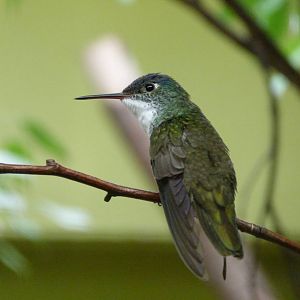
Azure-crowned Hummingbird (Amazilia cyanocephala) - last held at Zoo Augsburg in 2014, with a small number of photographs of the individual in question on Zoochat. For instance:


Glittering-throated Emerald (Amazilia fimbriata) - held in a number of European collections during the timespan in question; last held at Dierenpark Emmen in 2006, with no photographs of the taxon on Zoochat.

Andean Emerald (Amazilia franciae) - last held at Antwerp in 1991, with no photographs of the taxon on Zoochat.

Sapphire-spangled Emerald (Amazilia lactea) - last held at Augsburg in 1991, with no photographs of the taxon on Zoochat.

Plain-bellied Emerald (Amazilia leucogaster) - last held at Tiergarten Schönbrunn in 1995, with no photographs of the taxon on Zoochat.

Rufous-tailed Hummingbird (Amazilia tzacatl) - last held at Antwerp in 1994, with the only photographs of the taxon on Zoochat being of wild individuals in Mexico.

Violet-crowned Hummingbird (Amazilia violiceps) - last held at Augsburg in 2011, with the only photographs of the taxon on Zoochat being of wild individuals in Mexico.

Black-throated Mango (Anthracothorax nigricollis) - last held at Osnabrück in 1995, with the only photograph of the taxon on Zoochat being of a wild individual in Mexico.

Ruby-throated Hummingbird (Archilochus colubris) - last held at Stratford Butterfly Farm in the early 2000's, with the only photographs of the taxon on Zoochat being of individuals in the USA.

Velvet-purple Coronet (Boissonneaua jardini) - last held at Augsburg in 1995, with the only photograph on Zoochat being of a taxidermy exhibit.

Anna's Hummingbird (Calypte anna) - last held at Wuppertal in the mid-1990's, with the only photographs on Zoochat being of individuals in the USA.

Costa's Hummingbird (Calypte costae) - held in a handful of UK collections within the last decade, with the last holding at Tropical Wings in the early 2010's; however the only photographs on Zoochat of this taxon represent individuals in the USA.

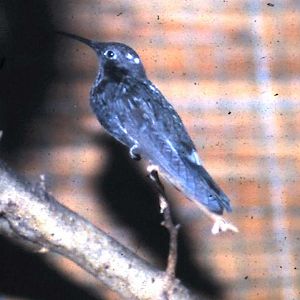
Sombre Hummingbird (Campylopterus cirrochloris) - last held at Walsrode in 1994, with a single photograph of this individual uploaded to the Zoochat gallery:


Glittering-bellied Emerald (Chlorostilbon lucidus) - last held at Wuppertal in 1990, with no photographs of the taxon on Zoochat.

Blue-chinned Sapphire (Chlorostilbon notatus) - last held at Walsrode in the early 2000's, with no photographs of the taxon on Zoochat.

Brown Violetear (Colibri delphinae) - last held at Paignton in 1993, with the only photographs of this taxon on Zoochat being from Central American collections.

Green Violetear (Colibri thalassinus) - last held at Parc des Oiseaux à Villars les Dombes in 1998, with no photographs of this taxon on Zoochat.

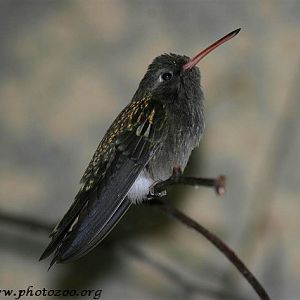
Dusky Hummingbird (Cynanthus sordidus) - last held at Wuppertal in 2008, with a single photograph of the individual in question found on the Zoochat gallery:


Violet-bellied Hummingbird (Damophila julie) - last held at Walsrode in the early 2000's, with no photographs of the taxon on Zoochat.

Wire-crested Thorntail (Discosura popelairii) - last held at Wuppertal in 1992, with no photographs of the taxon on Zoochat.

Swallow-tailed Hummingbird (Eupetomena macroura) - last held at Antwerp in 1997, with no photographs of the taxon on Zoochat.

White-necked Jacobin (Florisuga mellivora) - last held at Augsburg in 2002, with the only photograph of this taxon on Zoochat being an individual in the USA.

Rufous-breasted Hermit (Glaucis hirsutus) - last held at Wuppertal in 2012, with a single image of the individual in question having been posted to the Zoochat gallery:

full


Long-billed Starthroat (Heliomaster longirostris) - last held at Wuppertal in 1991, with no photographs of this taxon on Zoochat.

Black-tailed Trainbearer (Lesbia victoriae) - last held at Augsburg in 1999, with no photographs of this taxon on Zoochat.

Vervain Hummingbird (Mellisuga minima) - last held at Wuppertal in the early 1990's, with no photographs of this taxon on Zoochat.

Fanny`s Woodstar (Myrtis fanny) - last held at Oasi di Sant'Alessio in 2012, with no photographs of the taxon on Zoochat.

Black-breasted Hillstar (Oreotrochilus melanogaster) - last held at Augsburg in 2004, with no photographs of the taxon on Zoochat.

Giant Hummingbird (Patagona gigas) - last held at Pairi Daiza in 1997, with the only photographs of this taxon on Zoochat being of an individual in the USA.

Long-billed Hermit (Phaethornis longirostris) - last held at Wuppertal in the late 1990's, with the only photographs on Zoochat of the taxon being of a wild individual in Costa Rica.

Bronze-tailed Comet (Polyonymus caroli) - last held at Parc des Oiseaux à Villars les Dombes in 2002, with no photographs of this taxon on Zoochat.

Oasis Hummingbird (Rhodopis vesper) - several collections held this taxon in the last 10-15 years, the last of which was Wuppertal in 2008. No photographs of this taxon are present on Zoochat.

Peruvian Sheartail (Thaumastura cora) - last held at Oasi di Sant'Alessio in 2012, with no photographs of this taxon present on Zoochat.

Green-and-black Streamertail (Trochilus polytmus) - last held at Wuppertal in 2004, with no photographs of this taxon present on Zoochat.

Black-billed Streamertail (Trochilus scitulus) - last held at Oasi di Sant'Alessio in 2011, with no photographs of this taxon present on Zoochat.


-----

It is quite striking to me that of the 40 species of hummingbird which have been lost in European collections over the last 25 years, only four are represented on the Zoochat gallery - especially when one considers that a number of these were present in regularly-visited collections, and present within the last 5-10 years in some cases.

Here, I suspect, there is scope for quite a few old photographs to be uploaded!

I'll say either the gibbon or snow leopard one. :)

Nope :) and in fact, the snow leopard one was one of my very first Tierpark guides, being given to me at the 2013 Zoohistorica by @Zoo guide books !
 
I can’t remember the species, and was disappointed at the variety (one or two species), but I think they were the first hummingbirds I had ever seen.

The fact that the prospect of "only" one or two species of hummingbird was disappointing speaks volumes about how ubiquitous they once were in aviculture methinks :P

Zootierliste is notoriously even more patchily-complete when it comes to historical holdings of a given collection, but for what it is worth it indicates the following were held at Slimbridge:

Green Violetear (Colibri thalassinus)
Red-billed Streamertail (Trochilus polytmus)
Sparkling Violetear (Colibri coruscans)
 
Back
Top