Hey everyone!
As many of you may know, this is my first time ever doing something like this. In fact, I've never actually posted any real content in this subforum nor the old Fantasy Zoo subforum. I just like to pop in every once in a while and read others' threads and give feedback so I'm very excited to make a thread for myself. That being said, I will take all the feedback and help I can get, it will be very much appreciated! Before I get started with everything, I'd like to thank @Great Argus for all his help, he actually reviewed the first few habitats, that I'm about to post, for me and has been very helpful! Not to mention, the thread he created with resources for Speculative Zoo Designing, I'd also like to thank many of you who posted in that thread for all the wonderful resources! Now that that's out of the way, why don't we get started!
Right now I'm thinking I'll post new habitats either weekly or every other week and I'll try my very best to get those updates posted regularly.
So... I'll start with a quick introduction of my zoo:
Introduction: Discovery Hills Zoo is a 110 acre zoo that opened in 1993 and is located in San Marcos, California. The zoo was granted AZA accreditation in 2011 and specializes in keeping and breeding rare mammals but also houses a large variety of birds, reptiles, and other herps. The zoo will be open daily from 10 AM to 5 PM with the exception of a few holidays.
My first few habitats aren't too impressive especially when accounting the number of species that were included but I wanted to start off small so I could get in the hang of things. I'll definitely try to start making more species rich exhibits as we start moving along. Habitat sizes is also another thing I was big skeptical about so if there are any habitats in here that you think would be too small or anything, please let me know! Another quick thing, I tried my best to create unique names for my exhibits but I'm not that creative so they're not that unique lol, sorry about that. I also apologize for the quality of my maps, especially the first one, I think I found a better way to make them so hopefully my next set of maps will look better!
Anyways, without further ado... here's the opening set of habitats. This will be followed by one more sections for now and then, like I said earlier, I'll start posting updates every week or every other week.
- ARA!
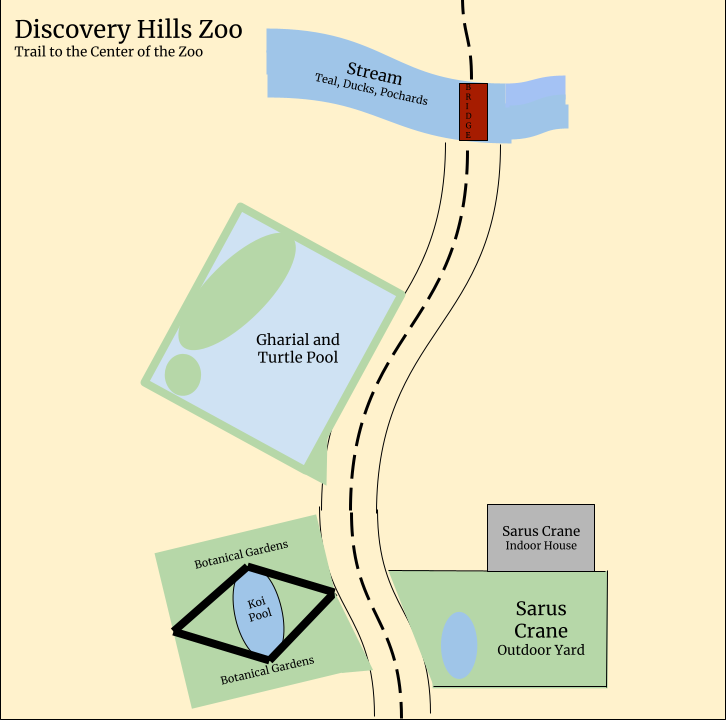
As soon as guests walk into the gates of the zoo, they are guided into a winding path into the heart of the zoo with a few habitats along the way. To the left of the walking path, a grassy 25 sq meter enclosure with a small pond is home to a pair of flight-restricted 1.1 sarus cranes (Grus antigone). On the other side of the path is a small 30 sq meter walk-through botanical garden with a crystal clear pond in the middle with a large group of koi carp (Cyprinus rubrofuscus). Further down the path, on the right side there is a large 40 sq meter enclosure with a large pond home to a group of 2.5 gharials (Gavialis gangeticus), 1.1 Fly river turtles (Carettochelys insculpta), and 1.2 Asian leaf turtles (Cyclemys dentata). Finally as the path comes to an end, a bridge passes over a small stream and brings visitors into the heart of the zoo. A number of ducks and other waterfowl species such as 5.6 marbled teal (Marmaronetta angustirostris), 1.3 baikal teal (Anas formosa), 5.5 laysan duck (Anas laysanensis), 6.3 Baer’s pochard (Aythya baeri), and 1.1 falcated duck (Anas falcata) inhabitat the stream.
As guests enter the heart of the zoo, they are greeted by a large 300 sq meter habitat, surrounded by a moat, inhabited by a breeding pair of 1.1 siamang (Symphalangus syndactylus). The center of the island is filled with trees which allows for natural behaviors such as brachiation but there are none closer to the ends of the habitat to prevent escapes. The roughly 40 sq meter siamang indoor house is behind the island, and off-view. Just to the left of the habitat, a trail surrounded by long stalks of bamboo welcomes guests into the first major renovation and expansion project completed by the zoo in 1999, “Into the Mangroves: Asian Adventure.”
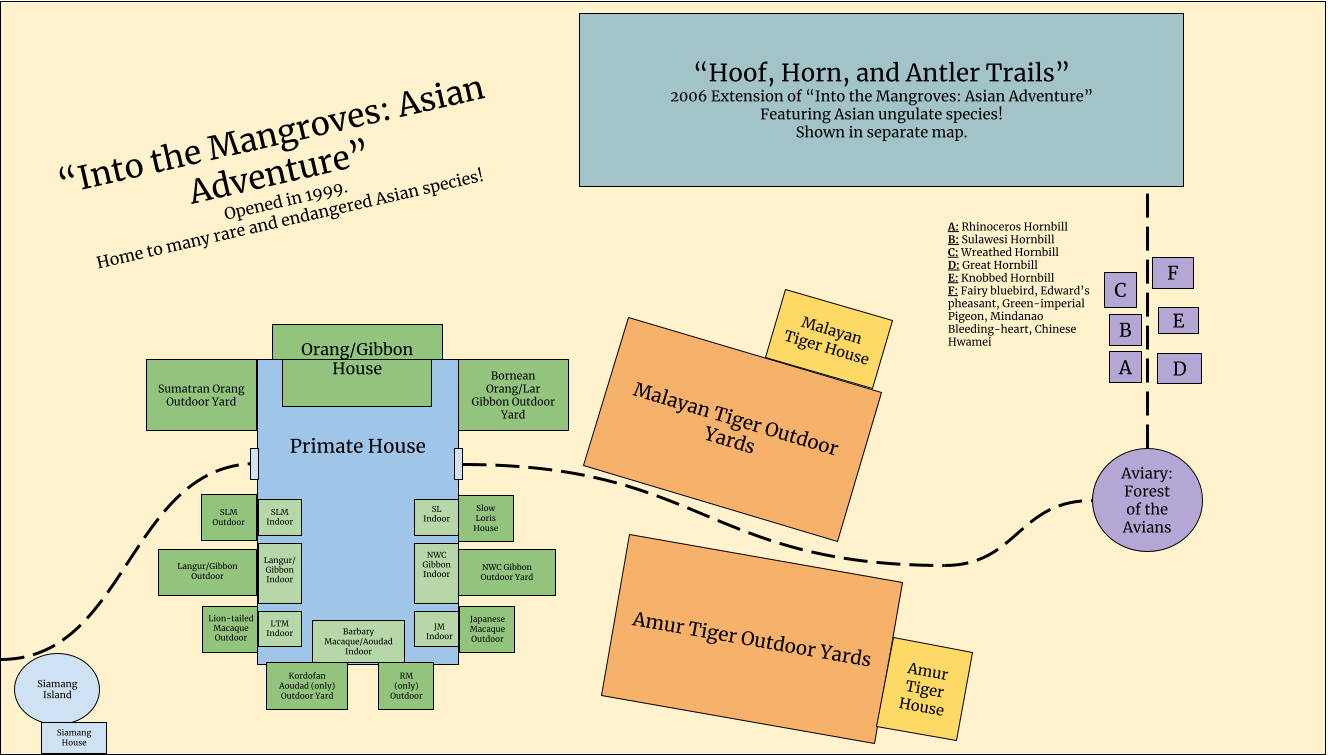
The path leading into this habitat is surrounded by long and tall stalks of bamboo and after a bit of walking, the entrance to the Primate House comes into view. Prior to entering the house, guests get their first glimpse at the first habitat housing a troop of 1.3 Sumatran orangutans (Pongo abelii). The zoo’s troop consists of an adult breeding male, Burung, two adult females (Alicia and her daughter Cinta), and Burung & Cinta’s 4 year old daughter Hadiah. Once inside the house, guests can view one of the day rooms of the indoor orangutan habitat which is roughly 500 sq meters and is divided into two day rooms, various shift rooms, and a quarantine area. If guests continue walking forward they will exit the Primate House and will see a large grassy yard that’s home to a small group of 2.2 Bornean orangutans (Pongo pygmaeus) and 1.1 Lar gibbons (Hylobates lar), who share the indoor housing quarters with the Sumatran orangutans but are kept in separate stalls/rooms. The Bornean orangutan troop is made up of a breeding pair (1.0 Berani and 0.1 Suriya) and their two offspring (10-year old female Sabah, and 2-year old male Rocky). The gibbons are a young pair named Johnny and Suki, they have not produced offspring so far but that is the goal. Both the Sumatran and Bornean orangutan/gibbon yards are 800 sq meters each and have large climbing structures. The outdoor orang habitats are separated from the public by tall glass panels right next to the walking path as well as large empty moats between the habitats and the panels.
Once passing by the orangutan/gibbon indoor viewing area, guests will turn to the right (rather than continuing forward), to view the remaining primates in the building. Guests will walk around in a large circle to view all the habitats in the Primate House, which are all along the edges of the House. All the guest-viewable habitats in the House are indoor habitats with glass barriers, but all the primates have behind-the-scenes outdoor access. The center of the Primate House is filled with signage on the dangers these primates face in the wild such as palm oil plantations, deforestation, poaching, etc and how guests can get involved in helping these animals out.
The first habitat on the right is 30 sq meters and 5 meters tall, and is home to a breeding group of 3.7 Silvered Leaf Monkey (Trachypithecus cristatus). The next habitat immediately to the left of the SL monkeys is a 40 sq meter, 5.5 meter tall room home to 4.10 François' langur (Trachypithecus francoisi) and 1.2 Javan gibbon (Hylobates moloch). The last habitat on the right hand side of the Primate House is home to an elderly pair of 1.1 Lion-tailed macaques (Macaca silenus) named Krish and Leela, this habitat is the exact same size as the SL monkey habitat.
The habitat on the back side of the Primate House is around 300 sq meters and about 7.5 meters tall. It is home to a non-breeding troop of 3.4 Barbary macaques (Macaca mulatta) and an elderly herd of 0.5 Kordofan Aoudad (Ammotragus lervia). The habitat is filled with fake rockwork for the aoudad and lots of artificial climbing structures for the macaques. The aoudad are on phase-out in accordance with the AZA’s decision and the habitat will be renovated for a new species once the girls pass away. This habitat was previously home to a breeding group of markhor and Sulawesi crested macaques but the macaques were phased out and the markhor were moved to another region of the zoo. The barbary macaques and aoudad both have their own bts outdoor yards so that they can get away from the other species when needed.
There are 3 habitats on the left side of the Primate House as well and they are all the exact same sizes as the 3 on the right side. The first habitat as you turn the corner from the macaque/aoudad habitat is home to a large breeding troop of 3.9 Japanese macaques (Macaca fuscata). The middle habitat is home to a family of 2.2 Northern White-cheeked gibbons (Nomascus leucogenys). The gibbon family consists of adult male Gus, adult female Ratu, and their two offspring, 3-year old Kara and newborn Leo. The last habitat closest to the exit is home to a breeding pair of 1.1 pygmy slow loris (Nycticebus pygmaeus), named Mekong and Mei. The glass barrier has reflective window film and the habitat has dim lights to darken it and mimic their nocturnal lifestyles as much as possible.
Guests will have made an entire loop around the primate house at this point and would be back near the exit and the indoor orang viewing area.
Once guests exit the Primate House and walk down the path and pass the Bornean orangutan/gibbon yard, they will be surrounded by the sights and sounds of tigers. On the right side of the path is a 1-acre habitat inhabited by 1.1 Malayan tiger (Panthera tigris jacksoni) while the left side is a 1.5-acre habitat home to a family of 2.4 Amur tigers (Panthera tigris altaica). Both habitats are meshed and are very well planted. The Malayan tiger indoor room is roughly 100 sq meters and is divided into two large rooms and a third small one while the Amur tiger indoor quarters are 115 sq meters and are divided into two large stalls and two small ones that can be combined to make another large stall if needed. The male Malayan tiger is named Roshan and was born at DHZ while the female, named Kasih, arrived at the zoo just a few months ago to breed with Roshan. The Amur tiger family consists of a breeding pair named Nikolai and Altaica and their 6-month old (1.4) cubs named Putin, Georgia, Katie, and Sasha.
Past the tiger habitats, guests are guided into a beautiful 25 meter tall, 230 sq meter walkthrough, two-story aviary called “Forest of the Avians” home to the following bird species:
The other side of the path also has 3 meshed aviaires with a few species of hornbill and other birds. The first habitat on the right is home to a family of 1.3 Great hornbill (Buceros bicornis), an adult male (Mohan), an adult female (Sundara), and their two female chicks (Kasi and Kasthuri). This aviary is about 20 sq meters and 11 meters tall, and is filled with many real trees and vegetation which allows the birds to nest naturally. The next aviary is home to a pair of 1.1 Knobbed hornbill (Rhyticeros cassidix) named Tang and Koko, it is the same size as the Rhinoceros hornbill aviary (6 meters tall, 18 sq meters). The final aviary is about 16 sq meters and 5 meters tall and is home to a large variety of birds including 1.1 Asian Fairy-bluebird (Irena puella), 1.3 Edward’s Pheasant (Lophura edwardsi), 2.2 Green-imperial Pigeon (Ducula aenea), 2.4 Mindanao Bleeding-heart Dove (Gallicolumba crinigera), and 3.2 Chinese Hwamei (Garrulax canorus). The aviary was previously home to a pair of Oriental pied Hornbill (Anthracoceros albirostris) until they passed away and a number of other bird species from “Forest of the Avians” were moved in here to replace them.
The final row of habitats in this section of the zoo are an extension of “Into the Mangroves: Asian Adventure” that opened in 2006 and the area is referred to as “Hoof, Horn, and Antler Trails”, I'll get this posted in a little bit.
As many of you may know, this is my first time ever doing something like this. In fact, I've never actually posted any real content in this subforum nor the old Fantasy Zoo subforum. I just like to pop in every once in a while and read others' threads and give feedback so I'm very excited to make a thread for myself. That being said, I will take all the feedback and help I can get, it will be very much appreciated! Before I get started with everything, I'd like to thank @Great Argus for all his help, he actually reviewed the first few habitats, that I'm about to post, for me and has been very helpful! Not to mention, the thread he created with resources for Speculative Zoo Designing, I'd also like to thank many of you who posted in that thread for all the wonderful resources! Now that that's out of the way, why don't we get started!
Right now I'm thinking I'll post new habitats either weekly or every other week and I'll try my very best to get those updates posted regularly.
So... I'll start with a quick introduction of my zoo:
Introduction: Discovery Hills Zoo is a 110 acre zoo that opened in 1993 and is located in San Marcos, California. The zoo was granted AZA accreditation in 2011 and specializes in keeping and breeding rare mammals but also houses a large variety of birds, reptiles, and other herps. The zoo will be open daily from 10 AM to 5 PM with the exception of a few holidays.
My first few habitats aren't too impressive especially when accounting the number of species that were included but I wanted to start off small so I could get in the hang of things. I'll definitely try to start making more species rich exhibits as we start moving along. Habitat sizes is also another thing I was big skeptical about so if there are any habitats in here that you think would be too small or anything, please let me know! Another quick thing, I tried my best to create unique names for my exhibits but I'm not that creative so they're not that unique lol, sorry about that. I also apologize for the quality of my maps, especially the first one, I think I found a better way to make them so hopefully my next set of maps will look better!
Anyways, without further ado... here's the opening set of habitats. This will be followed by one more sections for now and then, like I said earlier, I'll start posting updates every week or every other week.
- ARA!
As soon as guests walk into the gates of the zoo, they are guided into a winding path into the heart of the zoo with a few habitats along the way. To the left of the walking path, a grassy 25 sq meter enclosure with a small pond is home to a pair of flight-restricted 1.1 sarus cranes (Grus antigone). On the other side of the path is a small 30 sq meter walk-through botanical garden with a crystal clear pond in the middle with a large group of koi carp (Cyprinus rubrofuscus). Further down the path, on the right side there is a large 40 sq meter enclosure with a large pond home to a group of 2.5 gharials (Gavialis gangeticus), 1.1 Fly river turtles (Carettochelys insculpta), and 1.2 Asian leaf turtles (Cyclemys dentata). Finally as the path comes to an end, a bridge passes over a small stream and brings visitors into the heart of the zoo. A number of ducks and other waterfowl species such as 5.6 marbled teal (Marmaronetta angustirostris), 1.3 baikal teal (Anas formosa), 5.5 laysan duck (Anas laysanensis), 6.3 Baer’s pochard (Aythya baeri), and 1.1 falcated duck (Anas falcata) inhabitat the stream.
Discovery Hills Zoo - Opening Habitats Map
See the "AnimalsRAmazing's Speculative Zoo (Discovery Hills Zoo)" thread for more detailed...
As guests enter the heart of the zoo, they are greeted by a large 300 sq meter habitat, surrounded by a moat, inhabited by a breeding pair of 1.1 siamang (Symphalangus syndactylus). The center of the island is filled with trees which allows for natural behaviors such as brachiation but there are none closer to the ends of the habitat to prevent escapes. The roughly 40 sq meter siamang indoor house is behind the island, and off-view. Just to the left of the habitat, a trail surrounded by long stalks of bamboo welcomes guests into the first major renovation and expansion project completed by the zoo in 1999, “Into the Mangroves: Asian Adventure.”
The path leading into this habitat is surrounded by long and tall stalks of bamboo and after a bit of walking, the entrance to the Primate House comes into view. Prior to entering the house, guests get their first glimpse at the first habitat housing a troop of 1.3 Sumatran orangutans (Pongo abelii). The zoo’s troop consists of an adult breeding male, Burung, two adult females (Alicia and her daughter Cinta), and Burung & Cinta’s 4 year old daughter Hadiah. Once inside the house, guests can view one of the day rooms of the indoor orangutan habitat which is roughly 500 sq meters and is divided into two day rooms, various shift rooms, and a quarantine area. If guests continue walking forward they will exit the Primate House and will see a large grassy yard that’s home to a small group of 2.2 Bornean orangutans (Pongo pygmaeus) and 1.1 Lar gibbons (Hylobates lar), who share the indoor housing quarters with the Sumatran orangutans but are kept in separate stalls/rooms. The Bornean orangutan troop is made up of a breeding pair (1.0 Berani and 0.1 Suriya) and their two offspring (10-year old female Sabah, and 2-year old male Rocky). The gibbons are a young pair named Johnny and Suki, they have not produced offspring so far but that is the goal. Both the Sumatran and Bornean orangutan/gibbon yards are 800 sq meters each and have large climbing structures. The outdoor orang habitats are separated from the public by tall glass panels right next to the walking path as well as large empty moats between the habitats and the panels.
Once passing by the orangutan/gibbon indoor viewing area, guests will turn to the right (rather than continuing forward), to view the remaining primates in the building. Guests will walk around in a large circle to view all the habitats in the Primate House, which are all along the edges of the House. All the guest-viewable habitats in the House are indoor habitats with glass barriers, but all the primates have behind-the-scenes outdoor access. The center of the Primate House is filled with signage on the dangers these primates face in the wild such as palm oil plantations, deforestation, poaching, etc and how guests can get involved in helping these animals out.
The first habitat on the right is 30 sq meters and 5 meters tall, and is home to a breeding group of 3.7 Silvered Leaf Monkey (Trachypithecus cristatus). The next habitat immediately to the left of the SL monkeys is a 40 sq meter, 5.5 meter tall room home to 4.10 François' langur (Trachypithecus francoisi) and 1.2 Javan gibbon (Hylobates moloch). The last habitat on the right hand side of the Primate House is home to an elderly pair of 1.1 Lion-tailed macaques (Macaca silenus) named Krish and Leela, this habitat is the exact same size as the SL monkey habitat.
The habitat on the back side of the Primate House is around 300 sq meters and about 7.5 meters tall. It is home to a non-breeding troop of 3.4 Barbary macaques (Macaca mulatta) and an elderly herd of 0.5 Kordofan Aoudad (Ammotragus lervia). The habitat is filled with fake rockwork for the aoudad and lots of artificial climbing structures for the macaques. The aoudad are on phase-out in accordance with the AZA’s decision and the habitat will be renovated for a new species once the girls pass away. This habitat was previously home to a breeding group of markhor and Sulawesi crested macaques but the macaques were phased out and the markhor were moved to another region of the zoo. The barbary macaques and aoudad both have their own bts outdoor yards so that they can get away from the other species when needed.
There are 3 habitats on the left side of the Primate House as well and they are all the exact same sizes as the 3 on the right side. The first habitat as you turn the corner from the macaque/aoudad habitat is home to a large breeding troop of 3.9 Japanese macaques (Macaca fuscata). The middle habitat is home to a family of 2.2 Northern White-cheeked gibbons (Nomascus leucogenys). The gibbon family consists of adult male Gus, adult female Ratu, and their two offspring, 3-year old Kara and newborn Leo. The last habitat closest to the exit is home to a breeding pair of 1.1 pygmy slow loris (Nycticebus pygmaeus), named Mekong and Mei. The glass barrier has reflective window film and the habitat has dim lights to darken it and mimic their nocturnal lifestyles as much as possible.
Guests will have made an entire loop around the primate house at this point and would be back near the exit and the indoor orang viewing area.
Once guests exit the Primate House and walk down the path and pass the Bornean orangutan/gibbon yard, they will be surrounded by the sights and sounds of tigers. On the right side of the path is a 1-acre habitat inhabited by 1.1 Malayan tiger (Panthera tigris jacksoni) while the left side is a 1.5-acre habitat home to a family of 2.4 Amur tigers (Panthera tigris altaica). Both habitats are meshed and are very well planted. The Malayan tiger indoor room is roughly 100 sq meters and is divided into two large rooms and a third small one while the Amur tiger indoor quarters are 115 sq meters and are divided into two large stalls and two small ones that can be combined to make another large stall if needed. The male Malayan tiger is named Roshan and was born at DHZ while the female, named Kasih, arrived at the zoo just a few months ago to breed with Roshan. The Amur tiger family consists of a breeding pair named Nikolai and Altaica and their 6-month old (1.4) cubs named Putin, Georgia, Katie, and Sasha.
Past the tiger habitats, guests are guided into a beautiful 25 meter tall, 230 sq meter walkthrough, two-story aviary called “Forest of the Avians” home to the following bird species:
- 2.5 Golden-crested Myna (Ampeliceps coronatus)
- 3.4 Metallic Pigeon (Columba vitiensis)
- 6.6 Nicobar Pigeon (Caloenas nicobarica)
- 3.1 Sumba Eclectus Parrot (Eclectus roratus cornelia)
- 4.6 Bali Myna (Leucopsar rothschildi)
- 1.1 Pink-necked Green Pigeon (Treron vernans)
- 1.0 Palm Cockatoo (Probosciger aterrimus)
- 4.3 White-naped Pheasant-pigeon (Otidiphaps nobilis aruensis)
- 5.8 Papuan Mountain-pigeon (Gymnophaps albertisii albertisii)
- 1.2 Pink-headed Fruit-dove (Ptilinopus porphyreus)
- 2.3 Victoria Crowned-Pigeon (Goura Victoria)
- 1.1 Eurasian Collared Dove (Streptopelia decaocto)
- 1.3 Golden Pheasant (Chrysolophus pictus)
- 0.3 Satyr Tragopan (Tragopan satyra)
- 0.2 Temminck’s Tragopan (Tragopan temminckii)
- 2.2 Himalayan Monal (Lophophorus impejanus)
- 4.3 Wompoo Fruit Dove (Ptilinopus magnificus)
- 1.2 Great Argus (Argusianus argus)
- 1.3 Grosbeak starlings (Scissirostrum dubium)
The other side of the path also has 3 meshed aviaires with a few species of hornbill and other birds. The first habitat on the right is home to a family of 1.3 Great hornbill (Buceros bicornis), an adult male (Mohan), an adult female (Sundara), and their two female chicks (Kasi and Kasthuri). This aviary is about 20 sq meters and 11 meters tall, and is filled with many real trees and vegetation which allows the birds to nest naturally. The next aviary is home to a pair of 1.1 Knobbed hornbill (Rhyticeros cassidix) named Tang and Koko, it is the same size as the Rhinoceros hornbill aviary (6 meters tall, 18 sq meters). The final aviary is about 16 sq meters and 5 meters tall and is home to a large variety of birds including 1.1 Asian Fairy-bluebird (Irena puella), 1.3 Edward’s Pheasant (Lophura edwardsi), 2.2 Green-imperial Pigeon (Ducula aenea), 2.4 Mindanao Bleeding-heart Dove (Gallicolumba crinigera), and 3.2 Chinese Hwamei (Garrulax canorus). The aviary was previously home to a pair of Oriental pied Hornbill (Anthracoceros albirostris) until they passed away and a number of other bird species from “Forest of the Avians” were moved in here to replace them.
Discovery Hills Zoo - "Into the Mangroves: Asian Adventure"
See the "AnimalsRAmazing's Speculative Zoo (Discovery Hills Zoo)" thread for more detailed...
The final row of habitats in this section of the zoo are an extension of “Into the Mangroves: Asian Adventure” that opened in 2006 and the area is referred to as “Hoof, Horn, and Antler Trails”, I'll get this posted in a little bit.
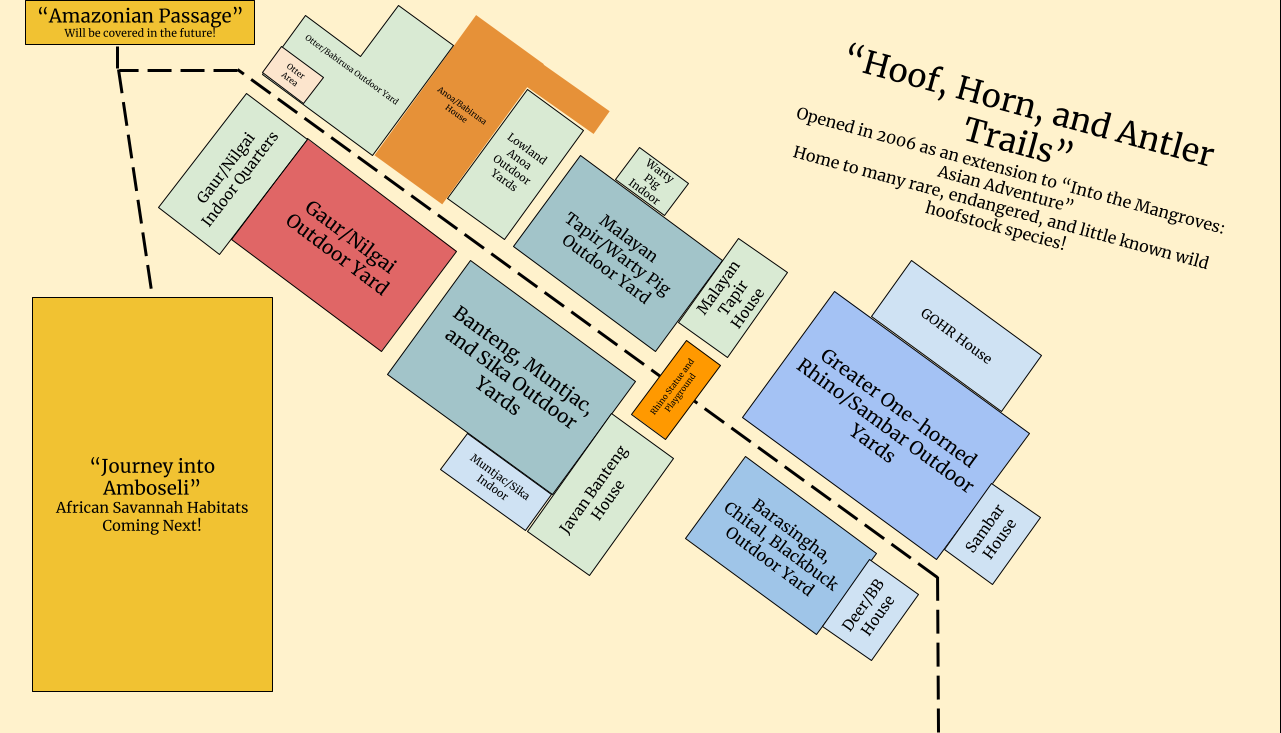


 ), is one of the zoo’s larger habitat complexes.