Thought on Basic Animal Design - prove me wrong!

ulrichburke

New Member
Dear Anyone.

Not saying I don't believe in Darwin or Evolution, it's just I 'ad this thought and wanted one of you experts to tell me where I'm wrong....

There's a cutoff point in general evolution, design-wise. Call it X. Above X, everything's designed square(ish!) in middle section, sphere on top, stick at each corner (4 legs, arms and legs....)

Below X, Everything's long, wiggly and loadsa legs or no legs!

This includes fish - they're ABOVE X, oval sphere at top, rectangular middle section (so sorta square) and 'stick' at each corner (2 fins/flippers, 2 tail corners.) If you stood a fish on its tail, you could imagine it wiggling each side of the tail in turn to propel it like feet. I know that wouldn't work in reality but if you put a guy in a fish suit, that's how he'd get along.

What I've never seen is anything bridging the divide. THAT'S the 'missing link' that fascinates me. All the 'missing links' that get talked about are between species that are in the same area - either above or below the X point. I've never seen anything said about bridging the gap BETWEEN below-and-above X.

Have I missed something!?!

Yours puzzledly

Chris.
 
Dear Anyone.


Something for you to think about as far as Evolution goes, I've asked this question in forums but never got a good answer.

There's a definite cutoff point in design. Anything ABOVE a Certain Evolutionary Point, square (sorta!) in middle, sphere on top, stick at each corner (arms/legs, 4 legs.....) Everything BELOW that point, long, wiggly, lots of legs. Even fish. Rectangular in middle, stick on each corner (flippers/tail fins) vaguely oval 'sphere' on top of rectangle.

See if you can think of anything that doesn't follow that format.

I'm not saying I don't believe in Darwin or anything - but I'd LOVE to know of any creature from any geological age that bridges the divide between those two basic groups. If you can't, why do you think there is that divide? What that tells me is that there Suddenly Appeared creatures of both types - and there was never a crossover between them.

Now I'm NOT trying to say 'that shows Evolution doesn't work' or 'that shows God's hand' or anything like that. I'm not saying the above to come down on either side. It's just something I've always noticed and never seen any comments on anywhere, is all, was wondering what people thought....

Yours puzzledly

Chris.
 
Google can be a great friend in these situations.

You could read something like;

Snakes Evolved Out of Their Legs—but They Still Have the Gene

you say in your other duplicate thread you’ve asked this question before but didn’t get an answer you liked.

Perhaps it’s worth reviewing your propensity towards liking an answer that isn’t creationist.

You can believe in creationism if you want or that the world is flat or indeed whatever you like. There’s room for many opinions in this world.

Unfortunately when you look at evidence vs preference however there just isn’t room for them all to be fact.
 
There's a cutoff point in general evolution, design-wise. Call it X. Above X, everything's designed square(ish!) in middle section, sphere on top, stick at each corner (4 legs, arms and legs....)

Below X, Everything's long, wiggly and loadsa legs or no legs!
While scientists don’t have an exact word for that divide. However, from your description, ‘above X’ creatures are mostly those with a backbone, which are called vertebrates, and creatures ‘below X’ mostly don’t have a backbone and are called invertebrates.

'stick' at each corner (2 fins/flippers, 2 tail corners.) If you stood a fish on its tail, you could imagine it wiggling each side of the tail in turn to propel it like feet.
There are indeed fish that can walk along the seabed or on riverbanks and beaches, such as mudskippers, lungfishes and handfishes, but they walk in a very different way. They do indeed have four ‘sticks’ (limbs or fins would be a better term), but they are not the ones you are describing. Instead, the ‘front sticks’ are positioned along the sides of the body, known as pectoral fins, and as certain fish evolved onto land, these got converted slowly, generation by generation, into front limbs, and eventually in birds and bats, wings. The second pair are below the body, and are known as pelvic fins. These became the back legs of land animals. The other fins, including the tail fin, were useless on land and so disappeared. Fish that cannot walk or crawl have the same fins, but in positions better suited for swimming.
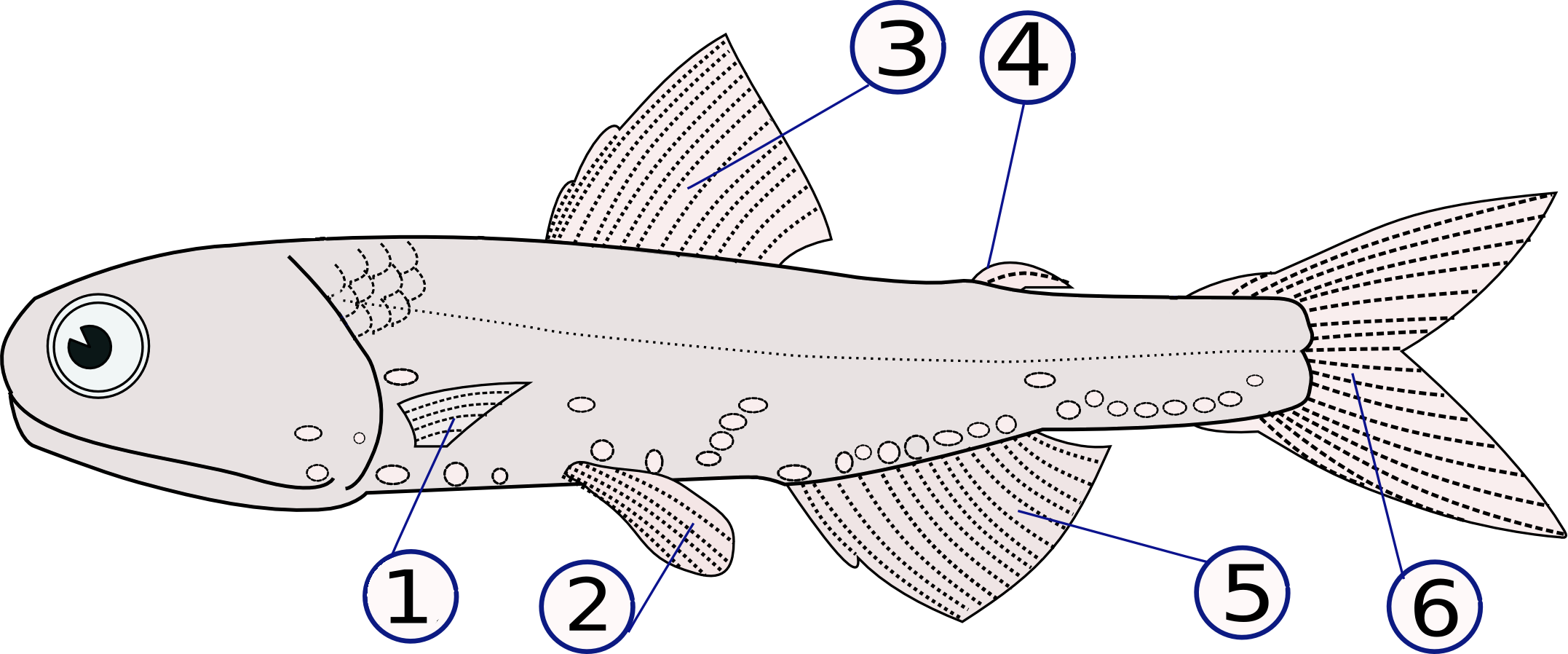
Here is a picture showing the names of the different fins:
Lampanyctodes_hectoris_%28fins%29.png
1- pectoral, 2- pelvic, 3 and 4- dorsal, 5- anal, 6- caudal or tail fin
File:Lampanyctodes hectoris (fins).png - Wikimedia Commons

As to the missing link between vertebrates and invertebrates, that is indeed an interesting question. Of those vertebrates alive today, the most primitive, known as hagfish and lampreys, do look very wormlike. They are unique among modern vertebrates for not having jaws. It seems likely that somewhere between these jawless vertebrates and all other jawed vertebrates, including ourselves, there was some transition where they became more body and developed fins. We have fossils of fish which fall into this divide, and those fish are informally known as ostracoderms and placoderms.

I hope this answers your questions!
 
Last edited:
Also, do note that various ‘below X’ creatures such as snakes, caecilians and certain extinct groups do indeed have backbones, and are considered vertebrates. They originally evolved from creatures with 4 limbs, but have ‘reverted’ to a worm-like body plan.
 
Have I missed something!?!

In my opinion, yes, yoy missed... absolutely everything. Evolution is not lineal, is like a tree with million branches, so it's impossible to have an "X-point", instead, there are millions of X-points, and above them infinite designs that of course do not stick to the design that you imagined - an octopus, a butterfly and a tapeworm are very evolved creatures, they are just not related to tetrapods,and hence they have different body designs. And don't forget plants and fungus that also can be very evolved and belonging to recently appeared groups, they're eukaryotes too, just they followed different paths in evolutions than animals did. Even notice that the most related groups with vertebrates, namely the sea urchins and starfishes, have a completely different body plan, with radial instead bilateral symmetry. And no, there is not a "missing link" because there is nothing missing, there are plenty of links of most of the "below" and "above" of the millions of X-points, and for the transition of vertebrates and tetrapods they're not only fossils but also all gradients of living ones too, from echinoderms to tunicates then to non-vertebrate chordates such as acorn worms, then came amphioxus and from this to agnathes is just a simple step, all of these being, as I said, not steps in a lineal evolution but branches of it. None "common ancestor" of any antique group are alive today because the time causes genes to change constantly, but with the branched alone there is enough material for see the whole gradation of evolution of most organisms. The most perfect organism group, at least in terms of evolutive success, are the insects, and these certainly do not have the body plan you mentioned, as the "rear sticks" are absent and instead they have "middle sticks".
 
There's a definite cutoff point in design. Anything ABOVE a Certain Evolutionary Point, square (sorta!) in middle, sphere on top, stick at each corner (arms/legs, 4 legs.....) Everything BELOW that point, long, wiggly, lots of legs. Even fish. Rectangular in middle, stick on each corner (flippers/tail fins) vaguely oval 'sphere' on top of rectangle.

This cutoff point you speak of does not exist. There is no "above" and "below". Almost every animal is fundamentally a tube with appendages. Look at it that way, and our evolutionary history is simply a case of ever more elaborate additions to a basic tube body plan.

Take a primate, which I think comes closest to your description of the "above" group. And a sea squirt larvae, which is obviously in the "below group" (long and wiggly). What is, fundamentally, the difference in body plan between a primate and a mouse? And between a mouse and a lizard? Or between a lizard and a newt, between a newt and a bony fish, between a bony fish and a lamprey, between a lamprey and a lancelet, and between a lancelet and a sea squirt larvae? The last in the list is quite obviously a tube with some extras - and through these representatives* you can see a clear and gradual change of the basic tube body plan to a modern primate. In reality, even this list is extremely crude and does not show how extremely gradual this change was, but one can easily image the evolutionary change between each pair, if the change between sea squirt and primate is too much. There is no missing link because the whole thing is so gradual that you cannot point to one!

* Nota bene: they are representatives that show a particular state of the body plan, not actual evolutionary ancestors!
 
There's a cutoff point in general evolution, design-wise. Call it X. Above X, everything's designed square(ish!) in middle section, sphere on top, stick at each corner (4 legs, arms and legs....)

Below X, Everything's long, wiggly and loadsa legs or no legs!
Natural evolution as described by very young children's drawings
Often little ones can provide great insights because they do not see the world as adults do.
This is not such a case
 
Last edited:
There's a cutoff point in general evolution, design-wise. Call it X. Above X, everything's designed square(ish!) in middle section, sphere on top, stick at each corner (4 legs, arms and legs....)
This includes fish - they're ABOVE X, oval sphere at top, rectangular middle section (so sorta square) and 'stick' at each corner (2 fins/flippers, 2 tail corners.) If you stood a fish on its tail, you could imagine it wiggling each side of the tail in turn to propel it like feet. I know that wouldn't work in reality but if you put a guy in a fish suit, that's how he'd get along.
As @Junklekitteb already said the separation you are describing is vertebrates vs. invertebrates. What you first described was the superclass Tetrapoda and lumped fish in with them to create the vertebrates. Why do these tetrapods have this body shape? It is mainly influenced by the newfound vertebrae in fishes. The fish was the first species of vertebrates and so our body shape is directly influenced by theirs. Fish evolved the square body four limb shape to account for life in the sea and their backbones. We don't see these same features in invertebrates because their bodies have no need to support a backbone, so they can freely evolve with exoskeletons instead. We have kept the original general fish shape because it works. It works well enough for basic functions with the backbone so we keep it and add on to it for more specialized functions. Some animals have more rounder bodies, slimmer faces, or different limbs but they all generally fit the same type of shape to support the backbone in different environments.
What I've never seen is anything bridging the divide. THAT'S the 'missing link' that fascinates me. All the 'missing links' that get talked about are between species that are in the same area - either above or below the X point. I've never seen anything said about bridging the gap BETWEEN below-and-above X.

Have I missed something!?!
You have entirely missed the idea of evolution as many creationists often do. You do not need a link between vertebrates and invertebrates at all.
First, let me explain the idea of a link between species. You are looking for a grey area between the two but scientists don't always find that. There definitely is a link between the two
Another problem is you don't exactly understand what you are looking for. You want a link that shows the description you gave between "above" and "below x". The problem is you don't completely understand their evolutionary history. As you said fish don't exactly share the description you gave and that is because fish are the link and that description isn't fully evolved until much later. Evolution is very gradual, you don't go from a lamprey to a corgi in just one genetic mutation (assuming you understand the genetic mutation aspect of evolution). It takes millions of gradual genetic mutations to reach a certain point in evolution so most defining traits of tetrapods most likely won't be found in an evolutionary link because those characteristics came later.
Now we actually can figure out vertebrates and invertebrates are connected through their genetics. I mentioned the importance of understanding genetics in evolution earlier, so if you don't fully understand that please go google it. We know all animals are genetically connected because new species are created by minor mutations in animals' genetic codes. By observing how much variation there is genetically between different species we can discover how closely they are related. Through this genetic sequencing, we know vertebrates are related to invertebrates through fish and ostracoderms/ placoderms as mentioned earlier.
 
Back
Top