Taronga Zoo Recent history of Taronga and developments etc

SMH 29 September 1994.

Tarongas orang-utans may be sent overseas, claims animal welfare group

By Steve Offner

‘’’’
An animal welfare group specialising in the protection of captive primates has written to Taronga Zoo asking for an assurance that its orangutans will not be shipped overseas. The group is concerned that the orang-utans, which were given a new publicly funded enclosure this year, will be moved to make way for new breeding stock. The letter, sent by the International Primate Protection League to the director of the zoo, Mr John Kelly, asked for confirmation that none of the six animals which the NSW public donated money towards would be transferred.

...
‘’’’

An image of Archie the hybrid Orangutan is featured with a caption reading: ‘’’’ Home or away: is Taronga planning to shift Archie, its 18-year-old orang-utan? ‘’’’ (Archie was technically 19 years old when the article was written and published).

It’s not hard to imagine that this PR uproar prevented Taronga from exporting their orangutans to Indian zoos (i.e. it was indeed Taronga’s intention to export). Taronga held the most hybrids of any zoo in the region - yet they exported the fewest hybrids (one) to India.

It’s also supported by not only the zoo cancelling the import of the fourth Bornean orangutan; but not breeding from the young trio they imported.

Although the hybrids remaining at Taronga was in their best interests, it’s a great shame Taronga were never able to establish a purebred Bornean colony. Aside from being a support to Auckland Zoo, it may have ensured the future of orangutans at Taronga.
 
It’s not hard to imagine that this PR uproar prevented Taronga from exporting their orangutans to Indian zoos (i.e. it was indeed Taronga’s intention to export). Taronga held the most hybrids of any zoo in the region - yet they exported the fewest hybrids (one) to India.

It’s also supported by not only the zoo cancelling the import of the fourth Bornean orangutan; but not breeding from the young trio they imported.

Although the hybrids remaining at Taronga was in their best interests, it’s a great shame Taronga were never able to establish a purebred Bornean colony. Aside from being a support to Auckland Zoo, it may have ensured the future of orangutans at Taronga.
One would believe that it would not be that hard for a major zoo to do
 
One would believe that it would not be that hard for a major zoo to do

In addition to the female orangutan they sent to Hyderabad Zoo, they also exported several chimpanzees there in 1992 - so it was definitely something they had no issue with doing.

In an ideal world, Taronga would have invested in the infrastructure to house a purebred Bornean colony alongside their many hybrids; but in reality, this wouldn’t have been cost effective and they had to choose one over the other - with the decision ultimately being made for them.

On the plus side, it likely paved the way for Taronga importing gorillas in 1996 and instead, focusing on gorillas and chimpanzees.
 
Last edited:
A 1984 map of Taronga Zoo

https://www.facebook.com/photo/?fbi...ztGM6Y-6GX5SQbBhSSqY1s3_5TWzi4HJYuoTVaPLD8ZE0

(tip: if you click save image you can see whole map if don't have fb account)

PS @Hix Thanks so much for all the info about how Taronga was 30-45 years ago; your recollections (not to mention great photos) have been as vivid in description like actually painting the imagery in mind.

Thanks for sharing @steveroberts.

Those Indian elephant and Common hippopotamus exhibits look tiny compared to what’s an acceptable exhibit size by today’s standards. I’d initially wondered if they were Pygmy hippo (the animals on the map aren’t in proportion as evidenced by a chimpanzee the height of an elephant), but I see from records that Taronga Zoo transferred Common hippopotamus to Dubbo in 1992, so still had them in 1984.
 
Thanks for sharing @steveroberts.

Those Indian elephant and Common hippopotamus exhibits look tiny compared to what’s an acceptable exhibit size by today’s standards. I’d initially wondered if they were Pygmy hippo (the animals on the map aren’t in proportion as evidenced by a chimpanzee the height of an elephant), but I see from records that Taronga Zoo transferred Common hippopotamus to Dubbo in 1992, so still had them in 1984.

I think from other previous maps thats about where the Common Hippo pool was. From photos, the pool was quite tiny, and the land space was even smaller. The whole enclosure was concrete too, surrounded by large, steel fences. It's likely Pygmy Hippos shared the compound later on.

I found this photo here whilst doing research showing Lindy (and her two week old daughter Louise):

up-boss-baby-louise-lindy-with-her-2-week-old-daughter-louisetaronga-picture-id1080023274
 
I think from other previous maps thats about where the Common Hippo pool was. From photos, the pool was quite tiny, and the land space was even smaller. The whole enclosure was concrete too, surrounded by large, steel fences. It's likely Pygmy Hippos shared the compound later on.

I found this photo here whilst doing research showing Lindy (and her two week old daughter Louise):

up-boss-baby-louise-lindy-with-her-2-week-old-daughter-louisetaronga-picture-id1080023274

Pygmy hippopotamus have been held at Taronga Zoo since the 1950’s when Happy and Sneezy arrived from the Smithsonian National Zoo, so they had both Common and Pygmy hippopotamus at this time. Sneezy produced 10 calves - two of which survived to adulthood.

That photo was taken in 1980 and shows Lindy with her fourth successful calf since 1967, Louise. She was sired by Billy, who arrived in 1954.
 
Pygmy hippopotamus have been held at Taronga Zoo since the 1950’s when Happy and Sneezy arrived from the Smithsonian National Zoo, so they had both Common and Pygmy hippopotamus at this time. Sneezy produced 10 calves - two of which survived to adulthood.

That photo was taken in 1980 and shows Lindy with her fourth successful calf since 1967, Louise. She was sired by Billy, who arrived in 1954.

They would've been kept in the same complex then. The pygmy's were moved into an enclosure near the Giraffes shortly before they were moved into their current enclosures in the Rainforest Trail.

How long did Louise live? I'm assuming she died within the first few years of her birth. Lindy and Billy were also the last ever Common Hippos at Taronga; they were sent to Dubbo in 1992. They both died soon after the move.
 
I think from other previous maps thats about where the Common Hippo pool was. From photos, the pool was quite tiny, and the land space was even smaller. The whole enclosure was concrete too, surrounded by large, steel fences. It's likely Pygmy Hippos shared the compound later on.

I found this photo here whilst doing research showing Lindy (and her two week old daughter Louise):

up-boss-baby-louise-lindy-with-her-2-week-old-daughter-louisetaronga-picture-id1080023274
The hippo pools were indeed tiny, I saw them in 1977 and was surprised to see how small they were they also had round pipe fencing around them. it would of been heaven to them when they were shipped out to the western plains zoo later on! I also saw what I believe was Australia’s last Gnu there
 
Last edited:
They would've been kept in the same complex then. The pygmy's were moved into an enclosure near the Giraffes shortly before they were moved into their current enclosures in the Rainforest Trail.

How long did Louise live? I'm assuming she died within the first few years of her birth. Lindy and Billy were also the last ever Common Hippos at Taronga; they were sent to Dubbo in 1992. They both died soon after the move.

It would make sense to have the Common and Pygmy hippopotamus pools next to each other given they could have shared a water source and zoos of this era often arranged their exhibits by taxonomy.

I’d assume Louise died in infancy. I can find no further mention of her or reference to any hippos that list her as their dam. She didn’t appear to be transferred to Dubbo at any stage, like many of Taronga’s hippos.
 
@Zoofan15 @Zorro @Jambo Great old photo btw Jambo (baby Hippos always give my mind cuteness overload as am sure they do all of us). Yeah the 1992 transfer you mentioned ZooFan of the River Hippos to Western Plain makes sense in the space then being used for the construction of the early '94 completed Orangutan exhibit(s). The exhibits the Pygmy Hippos lived in near the Giraffes that Jambo mentions are the ones I was recalling to you ZooFan about how the one Katrina lived in was still very small and when it was converted into a Fenenc Fox exhibit sometime around 2012 it made sense considering the limited space. The one which Cleo lived in for many years was larger and seemed to be an ok home for her, and later Tiquie the Brazilian Tapir from 2006 until 2015? when after her move to DDZ it was temporarily a Meerkat exhibit. When Dora (and later poor ill-fated Kua) the Indian Rhino(s) were in the exhibit adjacent it was interesting to see them in close proximity to the Pygmy Hippos (and on one late 2006 visit Kua the Rhino, Katrina or Cleo the Hippo and Tiquie the Tapir all within less than 50 metres of one another). On first visit to Taronga in August '94 there were three Pygmy Hippos on display, Cleo and Katrina in the two mentioned 'African waterhole' exhibits and the male (sorry cant remember name right now, is it Tim?) in the exhibit down the bottom west part of the zoo next door to the recently abandoned old Orangutan cages and on the spot where Free Flight Bird show is now (well either on the spot of or right next to).

PS Also of course two of the Pygmy Hippos inherited Berani and Denise the Malayan Tapirs old exhibit around 2006 (though Berani and Denise moved into new rainforest trail exhibits around June/July 2005 their former exhibit was first home to Collared Peccaries until sometime in 2006 when two of the Pygmy Hippos took it over; it was Abbey {cheers Abbs'} who I learnt about the Peccaries from as wasn't able to visit Taronga in 2005 or early 2006).
 
Last edited:
On first visit to Taronga in August '94 there were three Pygmy Hippos on display, Cleo and Katrina in the two mentioned 'African waterhole' exhibits and the male (sorry cant remember name right now, is it Tim?) in the exhibit down the bottom west part of the zoo next door to the recently abandoned old Orangutan cages and on the spot where Free Flight Bird show is now (well either on the spot of or right next to).

That was Timmy:

1.0 Timmy
Born at Honolulu Zoo 29/04/1980
Arrived at Taronga Zoo 15/04/1981
Sent to Melbourne Zoo 05/07/1995
Returned to Taronga Zoo 18/09/2007
Died at Taronga Zoo 10/05/2011

I’m going to upload the records of Taronga Zoo’s Pygmy hippopotamus shortly, which will add some context to this conversation.
 
Pygmy Hippopotamus at Taronga Zoo - Complete Records

Early History

Taronga Zoo's first Pygmy hippopotamus were 1.1 from the United States:

1.0 Happy
Born at the Smithsonian National Zoo 01/01/1949
Arrived at Taronga Zoo 19/11/1954
Died at Taronga Zoo 17/06/1975

0.1 Sneezy
Born at Smithsonian National Zoo 20/12/1949
Arrived at Taronga Zoo 11/02/1952
Died at Taronga Zoo 01/01/1978

Sneezy gave birth to ten calves at Taronga Zoo:

0.1 Unnamed
Born at Taronga Zoo 19/05/1957
Died at Taronga Zoo 26/07/1957
Sire: Happy; Dam: Sneezy

0.0.1 Unnamed
Born at Taronga Zoo 18/11/1958
Died at Taronga Zoo 18/11/1958
Sire: Happy; Dam: Sneezy

0.0.1 Unnamed
Born at Taronga Zoo 03/02/1960
Died at Taronga Zoo 03/02/1960
Sire: Happy; Dam: Sneezy

0.0.1 Unnamed
Born at Taronga Zoo 31/10/1961
Died at Taronga Zoo 05/11/1961
Sire: Happy; Dam: Sneezy

0.1 Unnamed
Born at Taronga Zoo 31/05/1967
Died at Taronga Zoo 28/06/1967
Sire: Happy; Dam: Sneezy

0.1 Cleo
Born at Taronga Zoo 13/06/1968
Died at Taronga Zoo 07/10/2005
Sire: Happy; Dam: Sneezy

0.1 Unnamed
Born at Taronga Zoo 18/02/1970
Died at Taronga Zoo 23/04/1970
Sire: Happy; Dam: Sneezy

0.1 Unnamed
Born at Taronga Zoo 26/11/1970
Died at Taronga Zoo 28/11/1970
Sire: Happy; Dam: Sneezy

1.0 Anthony
Born at Taronga Zoo 23/07/1972
Died at Taronga Zoo 13/11/1979
Sire: Happy; Dam: Sneezy

0.1 Unnamed
Born at Taronga Zoo 28/09/1973
Died at Taronga Zoo 01/10/1973
Sire: Happy; Dam: Sneezy

Cleo gave birth to two calves at Taronga Zoo:

0.1 Katrina
Born at Taronga Zoo 21/08/1973
Died at Taronga Zoo 02/02/2012
Sire: Happy; Dam: Cleo

0.1 Cookie
Born at Taronga Zoo 09/11/1978
Died at Taronga Zoo 28/09/1990
Sire: Anthony; Dam: Cleo

A new male named Timmy was imported from Honolulu Zoo:

1.0 Timmy
Born at Honolulu Zoo 29/04/1980
Arrived at Taronga Zoo 15/04/1981
Sent to Melbourne Zoo 05/07/1995
Returned to Taronga Zoo 18/09/2007
Died at Taronga Zoo 10/05/2011

Timmy sired one calf prior to his export to Melbourne Zoo:

0.1 Ady
Born at Taronga Zoo 31/10/1985
Sent to Arnhem Zoo 16/06/1988
Sire: Timmy; Dam: Cookie

Recent History

Timmy returmed from Melbourne Zoo in 2007; and a female was imported from Adelaide Zoo:

0.1 Petre
Born at Adelaide Zoo 04/08/1984
Arrived at Taronga Zoo 11/09/2007
Sent to Melbourne Zoo 12/12/2012

Petre gave birth to three calves at Taronga Zoo:

0.1 Monifa
Born at Taronga Zoo 15/10/2008
Sent to Melbourne Zoo 30/07/2009
Sire: Timmy; Dam: Petre

1.0 Unnamed
Born at Taronga Zoo 23/08/2009
Died at Taronga Zoo 28/08/2009
Sire: Timmy; Dam: Petre

0.1 Kambiri (F)
Born at Taronga Zoo 26/06/2010
Sire: Timmy; Dam: Petre

After Petre's export, a new male was imported from Cairns Wildlife Safari:

1.0 Fergus
Born at Cairns Wildlife Safari 06/08/2009
Arrived at Taronga Zoo 2012-2015

Kambiri has produced two calves to date at Taronga Zoo:

0.1 Kamina
Born at Taronga Zoo 21/02/2017
Sent to Darling Downs Zoo 01/11/2018
Sire: Fegus; Dam: Kambiri

0.1 Amara
Born at Taronga Zoo 22/11/2021
Died at Taronga Zoo 29/12/2021
Sire: Fergus; Dam: Kambiri
 
@Zoofan15 Oh awesome cheers (sorry though to hear about poor little Amara)

You’re welcome. :)

Amara was a great loss to the region. She was the first calf in nearly seven years and considering the region only has two other females, a third female would have been valuable - especially considering we have two unpaired males in the region (albeit related to the females).
 
The hippo pools were indeed tiny, I saw them in 1977 and was surprised to see how small they were they also had round pipe fencing around them. it would of been heaven to them when they were shipped out to the western plains zoo later on! I also saw what I believe was Australia’s last Gnu there

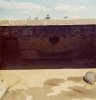
This is one of my photos from 1977 in the Taronga Gallery:
full


The pool was a little larger than the adults and was usually a dirty green colour due to their habit of ... well, you know.

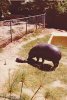
And I hate to disappoint you but as far as I know the Pygmy Hippos never occupied these enclosures. In 1975 I photographed a Pygmy Hippo in in one of the hoofstock enclosures that occupied the area that eventually became the Chimpanzee Park. There were at least three, all in separate enclosures - completely concrete with concrete pools.

upload_2022-4-13_22-1-11.jpeg


By December 1978 they had moved to the enclosures beside the Chimps and Orangs (where the Bird Show now is, as Steve Roberts has already mentioned) which is when I snapped this picture:

upload_2022-4-13_22-6-4.jpeg

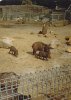
When the Common Hippos moved to WPZ the enclosures were occupied by a family of wild boars, not peccaries - the pecarries were in a sandy enclosure nearby with some Common Rheas. This photo from 1980:
upload_2022-4-13_22-13-29.jpeg

:P

Hix
 

Attachments

  • upload_2022-4-13_22-1-11.jpeg
    upload_2022-4-13_22-1-11.jpeg
    122.5 KB · Views: 40
  • upload_2022-4-13_22-6-4.jpeg
    upload_2022-4-13_22-6-4.jpeg
    114.5 KB · Views: 40
  • upload_2022-4-13_22-13-29.jpeg
    upload_2022-4-13_22-13-29.jpeg
    115.9 KB · Views: 40
This is one of my photos from 1977 in the Taronga Gallery:
full


The pool was a little larger than the adults and was usually a dirty green colour due to their habit of ... well, you know.

And I hate to disappoint you but as far as I know the Pygmy Hippos never occupied these enclosures. In 1975 I photographed a Pygmy Hippo in in one of the hoofstock enclosures that occupied the area that eventually became the Chimpanzee Park. There were at least three, all in separate enclosures - completely concrete with concrete pools.

View attachment 539237


By December 1978 they had moved to the enclosures beside the Chimps and Orangs (where the Bird Show now is, as Steve Roberts has already mentioned) which is when I snapped this picture:

View attachment 539238

When the Common Hippos moved to WPZ the enclosures were occupied by a family of wild boars, not peccaries - the pecarries were in a sandy enclosure nearby with some Common Rheas. This photo from 1980:
View attachment 539239

:p

Hix
Thank you mr Hix that pic brings it back. I dont recall even seeing the pygmy hippo at the time. I do recall seeing the Eland and blackbuck and even the one and only Gnu living in concrete paddock’s which surprised me somewhat
 
Thank you mr Hix that pic brings it back. I dont recall even seeing the pygmy hippo at the time. I do recall seeing the Eland and blackbuck and even the one and only Gnu living in concrete paddock’s which surprised me somewhat
I understand Sir Edward Hallstrom was very keen on concrete, with a view to avoiding parasite buildup in a more natural substrate
 
Back
Top