As you might see, this past month was indeed a very busy time indeed; and since the holidays are not too far away, I just thought it would be nice to conclude another major exhibit tour before the craziness of the holidays begin. With that being addressed, I suppose that now is the right time to pick up from where we left off, and to resume with the progress that we have made on this tour so far. But for now, let us continue:
HIMALAYAN CROSSROADS: - (23 exhibits)
Rising up off of our feet and thus leaving behind the monastery-themed holding building from where we have last met at. We will now make our ascend towards another flight of stairs that will take us to the third and final part of the complex, (at least, chronologically). Once we reach the other end of the stairs, you are instantly greeted with two, nearly identical enclosures that aren’t exactly the biggest of their kind; but are still one of the most natural. Both of the 400 sq ft enclosures, each contain a single
1.1.0 Pallas’s Cat, with both individuals being given access to each habitat every other day. Not too far away from the cat’s main viewing area, is another infographic kiosk that tells us that we are now some 3,962 m (or 13,000 ft) above sea level; and explains about how the relatively few organisms that are found in this altitude have certain adaptations that help them persist in these challenging conditions. Moving away from this kiosk and after turning a short turn towards our right, up ahead is an equally sized, meshed-in aviary of 250 sq ft, which is usually home to a rather successful breeding pair of
1.1.5 Himalayan Monals and their current offspring. But since the monal chicks first hatched about a week ago, each bird is currently off-exhibit until the chicks have started to become more naturalized to their new environment. Now splitting off from this main path for a bit, while not being too far away from the monal aviary, are two adjacent enclosures that each contain one of the zoo’s major highlights. Aka, the trio of
2.1.0 Snow Leopards that currently call the zoo their home. While two of the leopards are given access to the public enclosures every day; it is “
Taj”, the third leopard, who instead lives in a specialized off-show exhibit that well satisfies his needs, as he is an older individual who is effectively retired from being on display. Now occasionally, mainly before the zoo opens, “
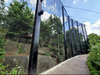
Taj” does get to have access to one of the public enclosures for a change of scenery; but other than that, he tends to remain in his more familiar home behind the scenes. Speaking of enclosures, each enclosure has two dedicated viewing areas with a certain type of barrier which separates the guests from the cats. The first viewing area’s barrier is exactly like the outdoor fossa viewing area from a previous tour, in which, the barrier of question is made of piano-wire; with a intricately-craved wooden fence in front, that serves as a guest barrier to keep the occasional unruly guest from get too close. Both habitats are also well-furnished with rocks, boulders, and logs of various sizes, are approximately 8,511 and 7,225 sq ft in size; and have a double-enforced mesh roof to prevent the cats from breaking out. With the general appearance of each enclosure being something very similar to the first image below:

As for the second leopard enclosure, the main barrier used for this space would be the conventional plexiglass window with another wooden-fence that keeps the guests from getting too close to the cats. Rounding out the corner from the second leopard exhibit and walking back to the monal aviary, for which we walk pass by; up ahead is a sheltered viewing platform that takes overlooks a steep, descending cliff-face. While this 7,600 sq ft aviary may seem like it would contain a separate species. This is in fact, the upper level viewing area for the 20 ft tall enclosure that we have already seen before, (in the lower viewing area). However, unlike the previous viewing platform, we head on inside past the double set of wooden doors that serve as an airlock. Of course, as you can already see below, the aviary does feature a rather small committee of
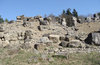
4.0.0 Himalayan Griffon Vultures which is subjected to change, as while we do plan on making a transaction with the region’s vulture breeding program to swap out two of our males in exchange for a pair of females; but as of right now, the general plans necessary for the transaction to be underway have yet to be finalized. While the following second image below demonstrates on the exact scale, rather than the general appearance of the vulture aviary. I just thought it would make some sense as to how tall the aviary actually is when compared to some of the other aviaries scattered throughout the zoo:

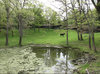
Exiting out of the vulture viewing platform and making our way left of the aviary, we will now begin to make our descent back down towards the attraction’s exit. But before we do so, there is yet another exhibit not too far away from the defending flight of stairs and accompanying ramp. Being located adjacent to the second leopard exhibit and to where we stand at the moment, is a 10,920 sq ft, rocky enclosure with a small, boulder-stacked hill in the center, (as seen in the third image below), that serves as the mountain’s “highest point”. Inhabiting this said space are a herd of
1.4.0 Bharal or Blue Sheep, that once had a successful breeding program in the past, but as of late, the zoo’s herd have been slowly dying off; with the zoo planning on phasing out this species, in favor of something new in the near future:

Now as we begin to make our decent down the flight of stairs, along the way, in the middle section of the mountain; is yet another exhibit for an ungulate. Being smaller than the sheep exhibit at around 5,500 sq ft. The zoo’s lone
0.1.0 Chinese Goral, known by all as
“Bo”, has been living by herself for quite sometime; but in this case, it seems to be ok, as gorals do tend to be solitary in the wild aside from a female raising her offspring. Even still, with “
Bo” being a younger individual, we do have plans to pair her up with a young male; even if the last male goral she was introduced to did not end up getting along. Leaving “
Bo” to be in her reclusive hiding place, but not yet making down the next flight of stairs, you eventually enter a small, covered replica of a traditional Tibetan shrine with infographic signage on each wall that highlights the cultural impact of a certain snowman, and how it has remained as an iconic symbol of the Himalayas, (even if the snowman is nothing more than a humble legend). Exiting out of the shrine, and making our way the next (and final), flight of stairs. We have now returned to the forested foothills of the Himalayas, with a rather simple aviary being within our sight not too far away. Greeting us at the bottom of the stairs, this rather simplistic, 950 sq ft, walk-in aviary that may not exactly be a walkthrough; yet you still get to easily view the birds from an open-topped frame that looks out into the center of the aviary. Three species of bird currently inhabit the aviary, with
3.2.0 Plum-Headed Parakeets, 4.0.0 Himalayan Bulbuls, and a secretive pair of
1.1.0 Hill Partridges that steal the show come feeding time. Last but not least, as we leave the aviary and walk past it to our right, up ahead is a wooden boardwalk that mainly serves as a main viewing area. Overlooking the attraction’s biggest habitat at around 13,700 sq ft, the following exhibit would look very similar to the image seen below; although in this case, the inhabitants within would be different, as the exhibit does contain the zoo’s charismatic herd of
1.5.2 Mishmi Takins, which have recently gained some attention due to the births of the two calves that were born this past year:

As we leave the takins behind, and walk out of the boardwalk; we will now conclude our journey through these crossroads by leaving the attraction the same way that we did before. For up ahead, in plain sight, lies the inviting entrance area that greeted us before. As we stand in the midst of the four towering pillars that we stood in awe before, we will now leave the complex with hopefully, a better understanding of the people, places, plants, and animals that inter-connectedly dwell within the towering peaks of the Himalayan mountains.
(
8 mammal taxa)
(
10 bird taxa)
(
1 amphibian taxa)
(All photo credits, in order, go to
@twilighter,
@Moebelle, leclub, and
@geomorph respectively)