Animal Stereotypes That You Hate

Don't forget brachiation! Your "standard monkey" often gets around by swinging from branch to branch, while real monkeys move over the branch more often than under it. A lot about how your stereotypical monkey moves seems like it comes from gibbons.

Speaking of gibbons, I've actually been using the "monkeys love bananas" thing to my advantage lately. I volunteer at my local zoo interpreting at the gibbon enclosure, and I've been using kids' assumptions that the gibbons eat bananas to talk about the importance of fruit in gibbons' diets. (Gibbons are mainly frugivores, with about 2/3 of their diet in the wild being fruit.) (And, yes, the vast majority of guests call the gibbons "the monkeys"...it's usually too rude to straight-up correct people, and it's so pervasive it'd be a losing battle anyway. I've stopped even being fazed by it at this point and just appreciate when somebody comes along that knows they're apes.)
Personally, I wouldn’t bother correcting these people either. I really don’t mind; it’s phylogenetically correct after all.
Interestingly, I once heard of someone who didn’t recognize humans as apes (i.e. recognize apes as a monophyletic group equivalent to “hominoids”) because then they would also have to recognize apes as monkeys (i.e. recognize monkeys as a monophyletic group equivalent to “simians” or “anthropoids”), which they didn’t want to do, ultimately because they were annoyed by people calling apes monkeys at a zoo.
 
Last edited:
Don't forget brachiation! Your "standard monkey" often gets around by swinging from branch to branch, while real monkeys move over the branch more often than under it. A lot about how your stereotypical monkey moves seems like it comes from gibbons.

Speaking of gibbons, I've actually been using the "monkeys love bananas" thing to my advantage lately. I volunteer at my local zoo interpreting at the gibbon enclosure, and I've been using kids' assumptions that the gibbons eat bananas to talk about the importance of fruit in gibbons' diets. (Gibbons are mainly frugivores, with about 2/3 of their diet in the wild being fruit.) (And, yes, the vast majority of guests call the gibbons "the monkeys"...it's usually too rude to straight-up correct people, and it's so pervasive it'd be a losing battle anyway. I've stopped even being fazed by it at this point and just appreciate when somebody comes along that knows they're apes.)
Spider monkeys also brachiate, and I assumed they were the “default monkey” until I remembered the whole “no thumbs” deal. I still think the Tufted Capuchin is the closest species to this “amalgamonkey”: mostly brown, prehensile tail, commonly seen in pop-culture but never specified, all it’s missing is the brachiation.
When ever someone sees a Alpaca and Llama they automatically get on the defense and be like "watch out they spit." First off alpacas and llamas only spit when they are annoyed or mad about something. Simply watching them is usually not enough to make them want to spit at you.
And even if they were annoyed, it’s not like they have sniper-like range and accuracy.
 
Yes but encountering a shark is way more safer than encountering a cassowary.

I’ve went on snorkelling trips in the Maldives and have encountered blacktip reef sharks multiple times.

That’s the point, nobody should be scared of a shark since they’re so diverse in terms of size, temperament etc. Cassowaries aren’t really diverse and they all possess the same capabilities

List of fatal shark attacks in Australia - Wikipedia

Australia had 11 fatal shark attacks in 2020+2021 ... which is why many people are afraid of them. The rate of attacks seems to be increasing in recent years too - it has been suggested that an increase in the number of seals in Australian waters has attracted more sharks to the area.

Of course, not all sharks are aggressive and the percentage of people entering the water versus the number of attacks is very low - but the fact is, there are lots of fatal shark attacks in Australia each year and it scares people.

My understanding of the typical mechanism of shark attack is that you are far more likely to be attacked while on the surface swimming or surfing, than under it while snorkelling. From below, you are easily mistaken for a seal or other shark food.

There are also only four species responsible for the vast majority of attacks - the bull shark, tiger shark, oceanic whitetip shark and the great white shark.
 
Magpies kill more people (or more specifically, cause more deaths) than cassowaries. Again though - like cows, humans are much more likely to come into contact with magpies than they are with cassowaries.

I also dislike the magpie stereotype (which is largely true though - they genuinely are feared here in Australia - for very good reason), having grown up in regional areas where we actually had a great relationship with the local magpies and they would regularly come caroling at our back door and never swoop us. They are beautiful birds with amazing songs - but they can also be terrifying and actually dangerous.
*Your magpies. Australian magpie isnt even a corvid. Most magpies are not that dangerous ;)
 
List of fatal shark attacks in Australia - Wikipedia

Australia had 11 fatal shark attacks in 2020+2021 ... which is why many people are afraid of them. The rate of attacks seems to be increasing in recent years too - it has been suggested that an increase in the number of seals in Australian waters has attracted more sharks to the area.

Of course, not all sharks are aggressive and the percentage of people entering the water versus the number of attacks is very low - but the fact is, there are lots of fatal shark attacks in Australia each year and it scares people.

My understanding of the typical mechanism of shark attack is that you are far more likely to be attacked while on the surface swimming or surfing, than under it while snorkelling. From below, you are easily mistaken for a seal or other shark food.

There are also only four species responsible for the vast majority of attacks - the bull shark, tiger shark, oceanic whitetip shark and the great white shark.
The last part was what I was implying, sharks are a diverse family, education is important on teaching people about sharks, since 4 species are known to have attacked humans, whereas the rest can still injure you (e.g. swaying fins hitting you)

But the film Jaws, which is very cheesy, has made people panicking whenever they see a SMALL shark.

They’re definitely majestic creatures when observed in the proper way
 
I remember rather recently when I went to the Berlin Aquarium - I was somewhat annoyed about the people gathering around the large shark tanks, though this is a given in any aquarium with large shark tanks. But what surprised me even more was when I went to see the small cat-shark in its own tank - people were gathering around to see this small cat-shark as well !
 
People do often confuse the words “poison” and “venom”. In common usage, they are used as general words for any toxin, but in zoology, they are terms that refer to different methods of delivery.
Venom takes effect when injected into a wound, whereas poison may be either ingested, inhaled, or absorbed through the skin. Thus, it is said that “if it bites you and the toxin takes effect, it’s venomous, and if you bite it and the toxin takes effect, it’s poisonous”. However, there is no chemical distinction; a particular chemical substance may be delivered as a poison in one species but a venom in another.
 
Here’s a few more cartoon animal tropes that get under my skin.
  • Skunk spray is a gas that they fart out. Not only is it wrong, it’s as low-brow as humor gets. Bonus points if the cure for the smell is tomato juice.
  • Crocodiles are always hungry.
  • Elephants shake the ground when they walk.
  • Anteaters destroy anthills, when they actually eat the same amount of ants/termites every time they eat (feel free to correct me if I’m wrong).
  • Animals having the attributes of the opposite sex. Male kangaroos with pouches, female ostriches with black feathers, etc. I think the worst offender in this category is Melanie the Moose from 64 Zoo Lane, who is a female moose with antlers.
 
Bonus points if the cure for the smell is tomato juice.
The Wild Kratts skunk episode made sure to point out that this is wrong. Likewise, there is an episode of Molly of Denali where two of the main characters are sprayed by a mink and try to get rid of the smell with tomato juice, to no avail. In the end of both shows, the characters successfully remove the odor with dish detergent, baking soda, and hydrogen peroxide.

Animals having the attributes of the opposite sex. Male kangaroos with pouches, female ostriches with black feathers, etc. I think the worst offender in this category is Melanie the Moose from 64 Zoo Lane, who is a female moose with antlers.
I might add the following:
All other female deer (except Reindeer) with antlers.
Male Reindeer with antlers in the winter.
Peahens with male plumage.
Female Narwhals with tusks.
 
Animals having the attributes of the opposite sex. Male kangaroos with pouches, female ostriches with black feathers, etc. I think the worst offender in this category is Melanie the Moose from 64 Zoo Lane, who is a female moose with antlers.
Not so much in cartoons, but I've seen both male and female lions being shown as having manes. I recall two specific instances of this. One was in a mobile game I used to play a long time ago called Zoo Story in which you'd start with a male lion and you'd have the option to acquire a female for breeding. The "female" in question was the exact same model as the male. I haven't played in years so I have no idea if this is still the case or not. I also recall my younger cousin's Noah's Arc set including two lions, both with manes, when of course the point of the story is that Noah gathered a male and female of every species. I guess its not completely inaccurate because there have been occurrences of maned lionesses but it still comes off as lazy and I might even go as far to say that the fact both these occurrences were in things aimed at children make it irresponsible since it promotes misinformation. Maybe that last part is an overreaction, but it is at the very least lazy.
 
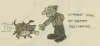
upload_2022-8-16_11-42-3.png
Somewhat on-topic, might someone be able to know what breed of dog this is meant to be?
[found in Blue Peter book]
 

Attachments

  • upload_2022-8-16_11-42-3.png
    upload_2022-8-16_11-42-3.png
    157.7 KB · Views: 59
I have a something to add about cassowaries:
Southern Cassowary and Emu: is one more dangerous than the other? Emus seem to get treated as more gentle or less dangerous than cassowaries, but is that accurate?
According to a Scientific American article by Darren Naish, there is an unsubstantiated and most likely incorrect claim that emus, unlike cassowaries, cannot kick backwards.
 
Last edited:
More like semi-domesticated.
That of course doesn’t say anything about wild emus, but that is a good point; the fact that emus, unlike cassowaries, are commonly raised and farmed might have something to do with the more positive image people have of them.
Although, there was an Emu War.
I have a hunch that ostriches (and to a lesser extent, emus) have killed/attacked more people in modern times than cassowaries have due to them being widely farmed.
And while the story of the Emu War is an interesting one, the Emus never actually killed anyone. The people were just really bad at killing the emus, and that's why they lost.
 
I have a hunch that ostriches (and to a lesser extent, emus) have killed/attacked more people in modern times than cassowaries have due to them being widely farmed.
That may very well be the case: after all, the most dangerous mammals are captive/domesticated ones like dogs, cattle, and horses.
I meant that their status as farm-raised animals might make their image more positive than cassowaries, which are less well-known, and in popular culture today are known mostly for their dangerousness.
And while the story of the Emu War is an interesting one, the Emus never actually killed anyone. The people were just really bad at killing the emus, and that's why they lost.
I know: no humans were directly harmed in the Emu War. I meant that wild Emus’ historic status as agricultural pests, which spurred eradication programs like this, might’ve made their image less positive than what Dillotest0 might’ve been suggesting.
 
2. Snakes are disgusting evil dangerous animals-- honestly I will never understand how a animal that only goes to the bathroom like once a week is considered disgusting by many, and not to mention snakes are actually more likely to hide from people rather then go and attack, plus not all snakes are venomous, and even with the ones that are, they do have anti-venom treatments.
A long, comprehensive video on snake stereotypes came out yesterday!
 
Last edited:
Back
Top