Imports for Open Range Zoos speculation

Zoofan15

Well-Known Member
10+ year member
New Species for the Region

The Bovid IRA will provide an opportunity to import new species, however anything that is not already on the live import list will be a longer process and unlikely to happen imo when there’s easier alternatives.

Species on the live import list are as follows - with species already held in Australian zoos in bold:

Nilgai, Boselaphus tragocamelus
Waterbuck, Kobus ellipsiprymnus
Red Lechwe, Kobus leche
Dama Gazelle, Nanger dama ruficollis
Grant's Gazelle, Nanger granti
Scimitar-horned Oryx, Oryx dammah
Gemsbok, Oryx gazella
Addax, Addax nasomaculatus
Sable Antelope, Hippotragus niger
Eland, Taurotragus oryx
Nyala, Tragelaphus angasii
Bongo, Tragelaphus eurycerus

Sitatunga, Tragelaphus spekii
Greater Kudu, Tragelaphus strepsiceros

Lots of exciting possibilities here, with several species suitable for mixed species exhibits.

The Sable antelope would be my personal preference; followed by the Sitatunga. It represents a different biome (wetlands) than the many Savannah species we have; along with the rainforest dwelling bongo (which would also benefit from imports).
 
Last edited by a moderator:
These are least concern last I checked?

I was thinking of the Giant sable antelope, but yes that is a subspecies of the sable antelope, which is of least concern as a whole. The Southern sable antelope is the most viable option for import, though I note many ranchers have crossed this with the Zambian subspecies, meaning there’s no guarantee we’ll be able to secure purebreds. That’s no big deal if the region is willing to manage them on the species level.
 
New Species for the Region

The Bovid IRA will provide an opportunity to import new species, however anything that is not already on the live import list will be a longer process and unlikely to happen imo when there’s easier alternatives.

Species on the live import list are as follows - with species already held in Australian zoos in bold:

Nilgai, Boselaphus tragocamelus
Waterbuck, Kobus ellipsiprymnus
Red Lechwe, Kobus leche
Dama Gazelle, Nanger dama ruficollis
Grant's Gazelle, Nanger granti
Scimitar-horned Oryx, Oryx dammah
Gemsbok, Oryx gazella
Addax, Addax nasomaculatus
Sable Antelope, Hippotragus niger
Eland, Taurotragus oryx
Nyala, Tragelaphus angasii
Bongo, Tragelaphus eurycerus

Sitatunga, Tragelaphus spekii
Greater Kudu, Tragelaphus strepsiceros

Lots of exciting possibilities here, with several species suitable for mixed species exhibits.

The Sable antelope would be my personal preference; followed by the Sitatunga. It represents a different biome (wetlands) than the many Savannah species we have; along with the rainforest dwelling bongo (which would also benefit from imports).
Sable antelope and Impala were the chosen species for the region not that long ago and yes would be well suited to our open range zoos and climate. Overall most antelope species have been mis-handled within our region for years, highly inbred, poor co-operation and just plain bad management so we are where we are today. The Bongo species is a case in point.
Now we have some zoos appointing woke boards with little to no animal knowledge, its not a winner in the making and these zoo/s will suffer for it. The best outlook in my humble opinion is with Zoos SA, progressive with a big future plan I am excited for them. Perhaps its just a coincidence that they are run by a zoological society.
 
Sable antelope and Impala were the chosen species for the region not that long ago and yes would be well suited to our open range zoos and climate. Overall most antelope species have been mis-handled within our region for years, highly inbred, poor co-operation and just plain bad management so we are where we are today. The Bongo species is a case in point.
Now we have some zoos appointing woke boards with little to no animal knowledge, its not a winner in the making and these zoo/s will suffer for it. The best outlook in my humble opinion is with Zoos SA, progressive with a big future plan I am excited for them. Perhaps its just a coincidence that they are run by a zoological society.

The obvious solution to me is to import a decent sized founder base. To many of our regional ungulate populations descend from a small founder base e.g. Springbok (1.2) or the original Grant’s zebra population.

Sustainable population management is now a well known concept and there’s no excuses for not importing the necessary founder base for long term management - especially for species which can be easily sourced in large numbers. Nyala are an example of this being done well.

It’s a great shame Indian antelope and Barbary sheep aren’t currently on the live import list. Both populations are highly inbred and could benefit from fresh imports.
 
The obvious solution to me is to import a decent sized founder base. To many of our regional ungulate populations descend from a small founder base e.g. Springbok (1.2) or the original Grant’s zebra population.

Sustainable population management is now a well known concept and there’s no excuses for not importing the necessary founder base for long term management - especially for species which can be easily sourced in large numbers. Nyala are an example of this being done well.

It’s a great shame Indian antelope and Barbary sheep aren’t currently on the live import list. Both populations are highly inbred and could benefit from fresh imports.
Correct. The Nyala import was perhaps in my view the best way to date that any importation has been done to my knowledge. As you pointed out importing less than a handful of said antelope species is hardly worth the effort, you would be surprised going back over the years of how many species this has happened to. One does not have to be 12 inches across the forehead to see the importation of a tiny group is not going to work out well something one would assume our zoo managers over the years would of known?
 
Correct. The Nyala import was perhaps in my view the best way to date that any importation has been done to my knowledge. As you pointed out importing less than a handful of said antelope species is hardly worth the effort, you would be surprised going back over the years of how many species this has happened to. One does not have to be 12 inches across the forehead to see the importation of a tiny group is not going to work out well something one would assume our zoo managers over the years would of known?

I assume the difference is down to zoos back then thinking about what their collection needed for the short term future versus now where the zoos (ideally) think collectively about what the region needs for the long term future.

Small founder sizes weren’t seen as a problem as zoos weren’t against inbreeding, even when species like Common hippopotamus and giraffes were available for import throughout the 20th century.

While I like seeing different species are different zoos, I can’t argue against the logic that a species will only be sustainably managed in large numbers, which there’s increased potential to do so with multiple zoos on board.
 
New Species for the Region

The Bovid IRA will provide an opportunity to import new species, however anything that is not already on the live import list will be a longer process and unlikely to happen imo when there’s easier alternatives.

Species on the live import list are as follows - with species already held in Australian zoos in bold:

Nilgai, Boselaphus tragocamelus
Waterbuck, Kobus ellipsiprymnus
Red Lechwe, Kobus leche
Dama Gazelle, Nanger dama ruficollis
Grant's Gazelle, Nanger granti
Scimitar-horned Oryx, Oryx dammah
Gemsbok, Oryx gazella
Addax, Addax nasomaculatus
Sable Antelope, Hippotragus niger
Eland, Taurotragus oryx
Nyala, Tragelaphus angasii
Bongo, Tragelaphus eurycerus

Sitatunga, Tragelaphus spekii
Greater Kudu, Tragelaphus strepsiceros

Lots of exciting possibilities here, with several species suitable for mixed species exhibits.

The Sable antelope would be my personal preference; followed by the Sitatunga. It represents a different biome (wetlands) than the many Savannah species we have; along with the rainforest dwelling bongo (which would also benefit from imports).

Great list!

I know Monarto has had their eyes on Sable antelope, Kudu, and Impala (not on the list) for a while now. Obviously, Sable antelope and Greater Kudu are both very striking with their unique patterns and horns so will definitely engage visitors. Personally, I would prefer a species that can form larger herds like Gemsbok (which would fit the Etosha theme) as I would rather see 5-10 or so species in large herds than a 10+ species in small groups, for me that's just more of an immersive experience. I also hope Monarto will/has already determined a carrying capacity for the entire area of Wild Africa to prevent the land from turning into a massive dustbowl during the summer. Grant's gazelle would also be an excellent substitute for Impala.

I would also love to see Nilgai return to Monarto, they would be great in any subcontinent-themed area and have historically paired well with blackbuck. On that, does anyone know why they died/were phased out?

Otherwise, when deciding on species to introduce to Wild Africa I think Monarto's biggest concern will be their compatibility with both Zebra and White Rhino (zebra especially). Space isn't an issue in the current waterhole exhibit yet Monarto still experience problems with Zebra harassing Eland and Giraffe calves so have to separate them periodically. My theory is that Monarto also eventually wants to introduce elephants to Wild Africa (why else name areas Amboseli or Chobe?) so they may be considered compatibility-wise as well. Elephants seem to do alright in extremely large mixed enclosures (Which Wild Africa will be) like Boras or Carbaceno when the smaller species have ample room to escape. Monarto even planned to hold both white rhinos and elephants in a shared exhibit back in 2008, something I see as fraught with danger.
 
Last edited:
Great list!

I know Monarto has had their eyes on Sable antelope, Kudu, and Impala (not on the list) for a while now. Obviously, Sable antelope and Greater Kudu are both very striking with their unique patterns and horns so will definitely engage visitors. Personally, I would prefer a species that can form larger herds like Gemsbok (which would fit the Etosha theme) as I would rather see 5-10 or so species in large herds than a 10+ species in small groups, for me that's just more of an immersive experience. I also hope Monarto will/has already determined a carrying capacity for the entire area of Wild Africa to prevent the land from turning into a massive dustbowl during the summer. Grant's gazelle would also be an excellent substitute for Impala.

I would also love to see Nilgai return to Monarto they would be great in any subcontinent-themed area and have historically paired well with blackbuck. On that, does anyone know why they died/were phased out?

Otherwise, when deciding on species to introduce to Wild Africa I think Monarto's biggest concern will be their compatibility with both Zebra and White Rhino (zebra especially). Space isn't an issue in the current waterhole exhibit yet Monarto still experience problems with Zebra harassing Eland and Giraffe calves so have to separate them periodically. My theory is that Monarto also eventually wants to introduce elephants to Wild Africa (why else name areas Amboseli or Chobe?) so they may be considered compatibility-wise as well. Elephants seem to do alright in extremely large mixed enclosures (Which Wild Africa will be) like Boras or Carbaceno when the smaller species have ample room to escape. Monarto even planned to hold both white rhinos and elephants in a shared exhibit back in 2008, something I see as fraught with danger.

I’m unsure as to the reason for the Nilgai phase out. I’d assume the combination of their geographic clash with the African Savannah - combined with their size (they’re the largest antelope) and aggression of the males during breeding season. While also geographically incompatible, the saving grace of the Indian antelope was their small size and their docile temperament, with even males living harmoniously with a range of species.

On that note, Nilgai may still exist in private collections according to the Australian mammals guide. If so, this would suggest the zoos have no interest in acquiring this species.

I too would advise against keeping elephants and rhinoceros together. While mixed species exhibits are exciting and reminiscent of the African Savannah, in practice several of these species are better off held separately. Generally speaking, females of most ungulates are more placid than males; so one option could be to run herds of females and juveniles, with males held in small, off display exhibits. Some zoos already do variations of this.
 
African Elephants in Mixed Species Exhibits

On the subject of African elephants in mixed species exhibits, I’ve researched a few combinations from around the world:

Boras Djurpark - African elephant, African Cape buffalo, Grant zebra, Sable antelope, Blesbok, Common eland, Giraffe, Ostrich and Helmeted guineafowl

ZooTampa at Lowry Park - African elephant, Impala, Thompson gazelle, Guinea fowl

Ouwehands Zoo - African elephant, Red river hogs

Peaugres Zoo - African elephant, Warthog

The latter two are mentioned purely for interest given we can’t import species from the Suidae family; and some zoos like Boras Djurpark don’t keep their adult bull with those species, but either way gives an indication of what could potentially be housed with African elephants.
 
African Elephants in Mixed Species Exhibits

On the subject of African elephants in mixed species exhibits, I’ve researched a few combinations from around the world:

Boras Djurpark - African elephant, African Cape buffalo, Grant zebra, Sable antelope, Blesbok, Common eland, Giraffe, Ostrich and Helmeted guineafowl

ZooTampa at Lowry Park - African elephant, Impala, Thompson gazelle, Guinea fowl

Ouwehands Zoo - African elephant, Red river hogs

Peaugres Zoo - African elephant, Warthog

The latter two are mentioned purely for interest given we can’t import species from the Suidae family; and some zoos like Boras Djurpark don’t keep their adult bull with those species, but either way gives an indication of what could potentially be housed with African elephants.

Other than Blackbuck are there any extensive mixed exhibits with Asian elephants? You'd expect them to suit a mixed exhibit better than Africans with their more docile nature.
 
Other than Blackbuck are there any extensive mixed exhibits with Asian elephants? You'd expect them to suit a mixed exhibit better than Africans with their more docile nature.

Indian antelope do indeed seem to be the main species they’re mixed with (across several zoos), but other combinations I came across were:

Dierenrijk Zoo - Asian elephant, Chital, Crab-eating macaque

Whipsnade - Asian elephant, Muntjac deer (free roaming)

Historically speaking, Amersfoort in the Netherlands had a large colony of Black-tailed prairie dogs in the Asian elephant enclosure (1970’s/1980’s). This was discontinued because the burrowing of the prairie dogs became too dangerous for the elephants.
 
African Elephants in Mixed Species Exhibits

On the subject of African elephants in mixed species exhibits, I’ve researched a few combinations from around the world:

Boras Djurpark - African elephant, African Cape buffalo, Grant zebra, Sable antelope, Blesbok, Common eland, Giraffe, Ostrich and Helmeted guineafowl

ZooTampa at Lowry Park - African elephant, Impala, Thompson gazelle, Guinea fowl

Ouwehands Zoo - African elephant, Red river hogs

Peaugres Zoo - African elephant, Warthog

The latter two are mentioned purely for interest given we can’t import species from the Suidae family; and some zoos like Boras Djurpark don’t keep their adult bull with those species, but either way gives an indication of what could potentially be housed with African elephants.

An additional note on African elephants in mixed species exhibits, I came across a zoo that exhibits them with Hamadryas baboon (Beekse Bergen). One could imagine this combination working well given the baboons would be able to swiftly retreat to strategically placed rocky outcrops (an option not readily available to most ungulates).

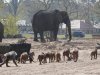
If Monarto were to import African elephants, it would be exciting to see them displayed with Hamadryas baboon (which they’re planning to acquire).

upload_2022-8-28_21-9-48.jpeg
Photo by @MagpieGoose
 

Attachments

  • upload_2022-8-28_21-9-48.jpeg
    upload_2022-8-28_21-9-48.jpeg
    209.4 KB · Views: 24
Scimitar-horned oryx? I always thought springbok would make sense. Also easy to obtain in South Africa and the region (Orana Park) already has them. Mix just as well as impala.

@tetrapod they do have Scimitar Horned Oryx, but as per my last visit, just not on the lower savannah. Nyala, Eland and Waterbuck are the only antelope species displayed on the lower savannah. It's a far cry from the amount of antelope species used to have.

African Elephants in Mixed Species Exhibits

On the subject of African elephants in mixed species exhibits, I’ve researched a few combinations from around the world:

Boras Djurpark - African elephant, African Cape buffalo, Grant zebra, Sable antelope, Blesbok, Common eland, Giraffe, Ostrich and Helmeted guineafowl

ZooTampa at Lowry Park - African elephant, Impala, Thompson gazelle, Guinea fowl

Ouwehands Zoo - African elephant, Red river hogs

Peaugres Zoo - African elephant, Warthog

The latter two are mentioned purely for interest given we can’t import species from the Suidae family; and some zoos like Boras Djurpark don’t keep their adult bull with those species, but either way gives an indication of what could potentially be housed with African elephants.

It does seem African Elephants do get along well with smaller species; although Dallas Zoo keeps their Africans with Giraffe, Zebra, Impala and Ostrich as well; so I assume any mix could be attempted. A large savannah featuring all those key African species (Giraffe, Zebra, Elephant) and large groups of antelope would be phenomenal.
 
@tetrapod they do have Scimitar Horned Oryx, but as per my last visit, just not on the lower savannah. Nyala, Eland and Waterbuck are the only antelope species displayed on the lower savannah. It's a far cry from the amount of antelope species used to have.


It does seem African Elephants do get along well with smaller species; although Dallas Zoo keeps their Africans with Giraffe, Zebra, Impala and Ostrich as well; so I assume any mix could be attempted. A large savannah featuring all those key African species (Giraffe, Zebra, Elephant) and large groups of antelope would be phenomenal.
The larger the space the easier the mix
 
Werribee's lower savannah is 80 acres, so I think that's why it's looking rather empty with only Giraffe, Zebra, Rhino, Ostrich and three antelope species!

Dallas manages to keep those aforementioned species together though, and they only have less than ten acres of total space.
I remember when the San Deigo wild animal park opened with several one hundred acre exhibits it took them a while to sort out which species were more suitable than other’s with some like the Grevys zebras being taken out completely and put into their own exhibit. But as mentioned the larger the exhibit area lets them spread out and avoid each other if they wish.
 
I remember when the San Deigo wild animal park opened with several one hundred acre exhibits it took them a while to sort out which species were more suitable than other’s with some like the Grevys zebras being taken out completely and put into their own exhibit. But as mentioned the larger the exhibit area lets them spread out and avoid each other if they wish.

Zebra stallions appear one of the most problematic across several zoos. At Orana Wildlife Park, a stallion attacked a Southern white rhinoceros and was killed by it and at Hamilton Zoo, a stallion was removed after it chased a juvenile giraffe into a fence, fatally injuring it. There's even been incidents of them fatally injuring or killing mares of their own species and inducing abortions in pregnant mares (a natural response to the introduction of a pregnant mate to an unfamiliar stallion).

Within mixed species exhibits, the obvious solution is to run the stallion seperate from the mares and foals, who'd coexist with the other species without issue.
 
Last edited:
Zebra stallions appear one of the most problematic across several zoos. At Orana Wildlife Park, a stallion attacked a Southern white rhinoceros and was killed by it and at Hamilton Zoo, a stallion was removed after it chased a juvenile giraffe into a fence, fatally injuring it. There's even been incidents of them fatally injuring or killing mares of their own species and inducing abortions in pregnant mares (a natural response to the introduction of a pregnant mate to an unfamiliar stallion).

Within mixed species exhibits, the obvious solution is to run the stallion seperate from the mares and foals, who'd coexist with the other species without issue.

Melbourne have had issues in the past with their stallions being increasingly aggressive towards their Giraffes. Despite their towering size, Giraffes are surprisingly rather cowardly!

Imo White Rhinos are an easy going species. Indians can be a little more intolerant of other species, and Black Rhinos are very territorial, and so are very rarely kept in mixed species exhibits.
 
Back
Top