Australasian Asian Elephant Population 2022

Status
Not open for further replies.
Yeah I agree. I doubt they'd have Kanlaya in there without Porntip. Anjalee, who's new, may be rather timid around the two bulls (albeit one being a juvenile). She of course, has only lived around Burma for many years so this is all a different experience for her.

It seems to be some sort of feeding session too, so it's also likely these four were just the first to get there; or the hungriest. :D

It'd also be good for Kanlaya; via socialisation with another juvenile of her age. And with Pathi Harn in with the girls anyway, there'd be no other option for Sabai besides keeping him by himself. He's obviously not negatively affecting the herd in anyway, and is actually benefiting from the socialisation with the cows and witnessing Pathi Harn mate.

I imagine Anjalee and Sabai have hit it off. Young bulls love to spar and as a young female, Anjalee is energetic and ready to engage in play behaviour. Burma couldn’t keep up. Gung was the same age as Sabai is now when he arrived from Thailand and his favourites were the young cows, Thong Dee and Tang Mo, even if Tang Mo was a little full on for him.

Thong Dee has always taken food very seriously and of course the two males are front and centre. Pathi Harn will be a very large bull one day; and a son between him and Anjalee could well be even larger - as well as having the genes for some impressive tusks.
 
That shot looks very much like the original African elephant exhibit area

The elephant complex consists of five exhibits (three on display, two off display) which were shared between the African elephants and the Asian elephants.

The last African elephant died in 2017, two years after the first 2.2 from the current Taronga herd were transferred across (though Dubbo already had elderly Asian elephant at this time).
 
In regards to exhibits; this was the setup of on display enclosures in 2015 when the 2.2 Asian Elephants arrived from Taronga:

Enclosure 1 - Cuddles
Enclosure 2 - Burma and Gigi
Enclosure 3 - Thong Dee and Porntip + Luk Chai and Pathi Harn

The final two pairs would rotate on and off display.

Now, the setup looks like this:

Enclosure 1 - Thong Dee, Porntip, Anjalee, Sabai, Kanlaya
Enclosure 2 - *same as above
Enclosure 3 - Pathi Harn

And then Gung spends most of his time in the larger off display paddock.
 
In regards to exhibits; this was the setup of on display enclosures in 2015 when the 2.2 Asian Elephants arrived from Taronga:

Enclosure 1 - Cuddles
Enclosure 2 - Burma and Gigi
Enclosure 3 - Thong Dee and Porntip + Luk Chai and Pathi Harn

The final two pairs would rotate on and off display.

Now, the setup looks like this:

Enclosure 1 - Thong Dee, Porntip, Anjalee, Sabai, Kanlaya
Enclosure 2 - *same as above
Enclosure 3 - Pathi Harn

And then Gung spends most of his time in the larger off display paddock.

Sabai still spends time with the matriarchal herd but spends a significant amount of time with Pathi Harn as he transitions out of the herd. It’s probably more accurate to say he spends more time apart from them than with them.

Gung is usually held off display because of his aggression during his musth cycles, which have been irregular in the past. The risk of him throwing rocks etc. at visitors means the zoo are understandably keen to put visitor safety first.

Luk Chai and Pathi Harn were often put together on exhibit as the energetic young bulls made for an exciting display with their frequent sparring matches. By the end of Luk Chai’s time there, they had three interactions a week to limit injuries sustained.
 
https://fb.watch/fl9inGP74t/

Does anyone know where they may be moving to?

It hasn’t been announced yet.

It’s been widely speculated on here that Putra Mas will be transferred to Werribee Open Range Zoo. The region would be mad not to retain this genetically valuable founder and Werribee will have the facilities to accomodate him.

Permai is more up in the air. She’s a post reproductive cow of 33 years and though she’s a much loved member of the Perth family, she would do little to enhance the breeding herds at Dubbo and Werribee. It’d be nice if Werribee accepted her and Burma (who’s in a similar position at Auckland); but if not, an export to the USA is probable.
 
Perth want to move Putra Mas into a breeding situation. Werribee will have the facilities and space for him, and considering he only has one surviving offspring, it would be essential to keep him in the region to breed. Werribee seems the most feasible option as continuing to breed from Luk Chai (who is younger and better represented) wouldn't work long term.

Perth also want Permai to be sent to a facility (with if they can - a large elephant herd). Werribee essentially fits this best, alongside the fact she'll be at one of the premier elephant complexes around the world, spanning across 50 acres.

I think it's incredibly likely Werribee will receive the most (possibly as early as 2024 once their facilities are completed).
 
Permai is more up in the air. She’s a post reproductive cow of 33 years and though she’s a much loved member of the Perth family, she would do little to enhance the breeding herds at Dubbo and Werribee. It’d be nice if Werribee accepted her and Burma (who’s in a similar position at Auckland); but if not, an export to the USA is probable.

It doesn’t make sense to export Permai into USA when USA desperately needs breeding females to sustain the population. It would cost several hundred thousands of dollars at the minimum and for what? Another older cow that may or may not integrate with other elephants.
 
It doesn’t make sense to export Permai into USA when USA desperately needs breeding females to sustain the population. It would cost several hundred thousands of dollars at the minimum and for what? Another older cow that may or may not integrate with other elephants.

You’re not wrong, but it highlights the dilemma she and Burma are in here. They’re post reproductive cows, who in a best case scenario will assimilate into a breeding herd and contribute nothing to it’s succession; in a worst case scenario, disrupt the social dynamics. It’s a risk with little to no reward.

The future of Australasia’s elephant population lies in Werribee and Dubbo, who will each have large multigenerational herds. Ideally, they (more likely Werribee) will accept Burma and Permai on humanitarian grounds - but there’s neither a guarantee they will (nor an obligation on them to do so).

North America will share the same outlook. The difference here is that there’s multiple facilities dedicated to caring for senior cows, some of which could potentially extend that offer to Burma and Permai if options within Australasian prove non viable.
 
I think it's incredibly likely Werribee will receive the most (possibly as early as 2024 once their facilities are completed).

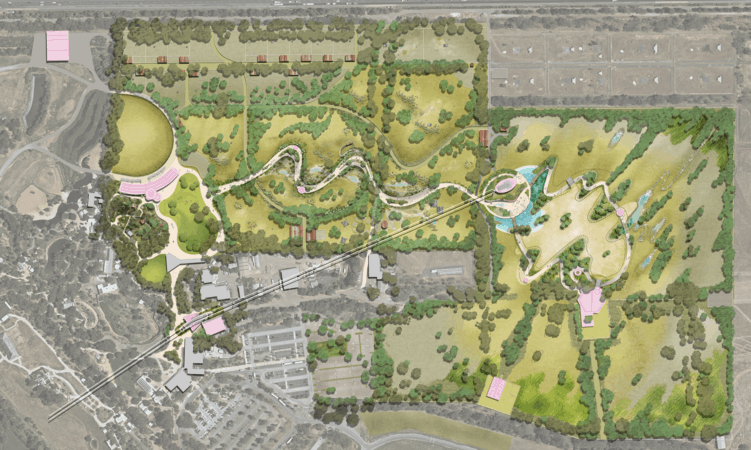
Do currently have any concrete plans/schematics for Werribee's exhibit?

upload_2022-9-5_16-41-30.png

This image suggests that there aren't just 3 yards (Matriarchal herd, Bulls, and transition yard) but rather close to 9 if I counted correctly. Is the layout displayed on this map just a placeholder until a final design was decided on? I assume they have now landed on a final design as construction has begun.

If it is correct then it has a very interesting layout. This design may be more conducive to Werribee accepting Permai and Burma as it has a plentitude of paddocks if anything does go awry and they need to be housed separately. Werribee might be anxious to introduce them while there are still very young calves in the main herd. So they may have to dwell in the other yards as a pair separately for a few years. Preferably they will be fully introduced as the more adult elephants surrounding the infant calves the better, as it increases their EEHV antibodies.

Also, would a smaller third bull barn be necessary? I was just thinking if Putra Mas and Luk Chai were kept together issues could arise when one or both enter Musth and have to sleep just a few meters apart every night.

It doesn’t make sense to export Permai into USA when USA desperately needs breeding females to sustain the population. It would cost several hundred thousands of dollars at the minimum and for what? Another older cow that may or may not integrate with other elephants.

I am aware Auckland is willing to donate Burma so it will be at no cost to any US zoo to take her. Acquiring Burma could also be beneficial to zoos like Honolulu which are currently under the AZA's recommended number of elephants at just 2 older cows.

But as you mention I'm unaware if Perth is willing to donate Permai and Putra Mas or whether they plan on splitting the bill with the receiving zoo. Putra Mas is a founder and has been proven to be a behavioral breeder so he is of great value to zoos in Europe especially. Perth may literally auction off Putra Mas and use the money gained from him to cover the costs of donating Permai somewhere else (who is post-reproductive and of much less value). Therefore Perth doesn't experience any financial losses during the whole process. Saying all that, I have a suspicion that Perth wants them to go as a combined deal using Putra Mas' valuable founder status as the bargaining chip for the relatively invaluable (but social and easygoing) Permai.

Perth also definitely knows Putra Mas is valuable to both ZoosVic and Taronga. So sending him internationally could sour their relationship in the future when it comes to other species. I.e. Taronga might not be so willing to send Hari (Indian Rhino) to Perth if Perth screws over the elephant breeding program.
 

Attachments

  • upload_2022-9-5_16-41-30.png
    upload_2022-9-5_16-41-30.png
    153.8 KB · Views: 12
  • upload_2022-9-5_16-41-30.png
    upload_2022-9-5_16-41-30.png
    153.8 KB · Views: 2
It doesn’t make sense to export Permai into USA when USA desperately needs breeding females to sustain the population. It would cost several hundred thousands of dollars at the minimum and for what? Another older cow that may or may not integrate with other elephants.

You’re not wrong, but it highlights the dilemma she and Burma are in here. They’re post reproductive cows, who in a best case scenario will assimilate into a breeding herd and contribute nothing to it’s succession; in a worst case scenario, disrupt the social dynamics. It’s a risk with little to no reward.

The future of Australasia’s elephant population lies in Werribee and Dubbo, who will each have large multigenerational herds. Ideally, they (more likely Werribee) will accept Burma and Permai on humanitarian grounds - but there’s neither a guarantee they will (nor an obligation on them to do so).

North America will share the same outlook. The difference here is that there’s multiple facilities dedicated to caring for senior cows, some of which could potentially extend that offer to Burma and Permai if options within Australasian prove non viable.

I think Werribee presents the best option for both Putra Mas and Permai. The costs of shipping them together to Werribee, would be much less than sending both individuals to different locations, or even sending just one overseas. I see no issues surrounding Permai integrating with Melbourne's herd. Permai's a rather submissive female, and Melbourne's cows are very laid back.

Another option (Within the region), would be Sydney Zoo. Burma and Permai could be sent here, but this would come at the expense of sending their two current males elsewhere within the region; Werribee/Dubbo (which would be unfavourable at the present time due to space).
 
This image suggests that there aren't just 3 yards (Matriarchal herd, Bulls, and transition yard) but rather close to 9 if I counted correctly. Is the layout displayed on this map just a placeholder until a final design was decided on? I assume they have now landed on a final design as construction has begun.

If it is correct then it has a very interesting layout. This design may be more conducive to Werribee accepting Permai and Burma as it has a plentitude of paddocks if anything does go awry and they need to be housed separately. Werribee might be anxious to introduce them while there are still very young calves in the main herd. So they may have to dwell in the other yards as a pair separately for a few years. Preferably they will be fully introduced as the more adult elephants surrounding the infant calves the better, as it increases their EEHV antibodies.

Also, would a smaller third bull barn be necessary? I was just thinking if Putra Mas and Luk Chai were kept together issues could arise when one or both enter Musth and have to sleep just a few meters apart every night.

I believe the plan is for the enclosures to be intertwined, and those paths to be visitor paths. So the elephants can have access to each enclosure if they wish, but I imagine in some cases there'll be gates to keep them in groups if they need. Nine enclosures is a lot; and I doubt they'll need to use all of them at once, but it will be necessary to seperate the younger bulls, and also rotate the elephants across each enclosure (leaving some to sort of grow out without the presence of elephants).

Luk Chai and Putra Mas should be able to sleep well together in the same barn; although I doubt the barn will be as open as the cows. The bull barn will be designed similar to this one at Dublin I imagine; with walls separating each pen:

images
 
The future of Australasia’s elephant population lies in Werribee and Dubbo, who will each have large multigenerational herds. Ideally, they (more likely Werribee) will accept Burma and Permai on humanitarian grounds - but there’s neither a guarantee they will (nor an obligation on them to do so).

I was thinking and there is actually one small benefit new unrelated older cows provide to a breeding herd if integrated successfully. That is they shed EEHV thus allowing infant calves to build up their EEHV antibodies.

Historically zoos have been wary to accept older cows for the EEHV risk they present. That as we know has turned out to be a myth, stress is likely what causes an EEHV flare-up in the cows and that's what in turn kills adolescent calves. So I say the more unrelated cows surrounding young calves the better (aka Pinnawala). The initial stress induced by a new older cow may cause an initial flare-up but once she is integrated she will shed EEHV and build up an infant calf's tolerance even more.

So Burma and Permai if introduced to the calves while they are young may help prevent EEHV at Werribee not cause it.
 
I was thinking and there is actually one small benefit new unrelated older cows provide to a breeding herd if integrated successfully. That is they shed EEHV thus allowing infant calves to build up their EEHV antibodies.

Historically zoos have been wary to accept older cows for the EEHV risk they present. That as we know has turned out to be a myth, stress is likely what causes an EEHV flare-up in the cows and that's what in turn kills adolescent calves. So I say the more unrelated cows surrounding young calves the better (aka Pinnawala). The initial stress induced by a new older cow may cause an initial flare-up but once she is integrated she will shed EEHV and build up an infant calf's tolerance even more.

So Burma and Permai if introduced to the calves while they are young may help prevent EEHV at Werribee not cause it.

That’s an excellent point. The Werribee complex is scheduled to open early 2024, which means Burma and Permai could be introduced to the herd from Melbourne when the calves are just over 12 months old. EEHV cases peak 2-3 years of age, so having incoming cows settle into the herd (maximum stress levels) before that would be preferable.

Long term, Werribee could reap the benefits of a larger herd - with Burma and Permai representing guaranteed additions to expanding the matriarchal herd - which otherwise depends on the births of females calves (which will be a slow and incremental process over the next few decades).
 
Last edited:
I was thinking and there is actually one small benefit new unrelated older cows provide to a breeding herd if integrated successfully. That is they shed EEHV thus allowing infant calves to build up their EEHV antibodies.

Historically zoos have been wary to accept older cows for the EEHV risk they present. That as we know has turned out to be a myth, stress is likely what causes an EEHV flare-up in the cows and that's what in turn kills adolescent calves. So I say the more unrelated cows surrounding young calves the better (aka Pinnawala). The initial stress induced by a new older cow may cause an initial flare-up but once she is integrated she will shed EEHV and build up an infant calf's tolerance even more.

So Burma and Permai if introduced to the calves while they are young may help prevent EEHV at Werribee not cause it.

That's very true, although they could also present a completely new strain the calves haven't been introduced to yet. So there's both added benefits and risks here. As we've seen though, the bigger the herd, the less likely the calves are to succumb to the virus. This is simply due to the fact they're exposed to multiple strains during their 'safe' period - the first eighteen months of their lives.
 
Do currently have any concrete plans/schematics for Werribee's exhibit?

View attachment 573394

This image suggests that there aren't just 3 yards (Matriarchal herd, Bulls, and transition yard) but rather close to 9 if I counted correctly. Is the layout displayed on this map just a placeholder until a final design was decided on? I assume they have now landed on a final design as construction has begun.

If it is correct then it has a very interesting layout. This design may be more conducive to Werribee accepting Permai and Burma as it has a plentitude of paddocks if anything does go awry and they need to be housed separately. Werribee might be anxious to introduce them while there are still very young calves in the main herd. So they may have to dwell in the other yards as a pair separately for a few years. Preferably they will be fully introduced as the more adult elephants surrounding the infant calves the better, as it increases their EEHV antibodies.

Also, would a smaller third bull barn be necessary? I was just thinking if Putra Mas and Luk Chai were kept together issues could arise when one or both enter Musth and have to sleep just a few meters apart every night.


I am aware Auckland is willing to donate Burma so it will be at no cost to any US zoo to take her. Acquiring Burma could also be beneficial to zoos like Honolulu which are currently under the AZA's recommended number of elephants at just 2 older cows.

But as you mention I'm unaware if Perth is willing to donate Permai and Putra Mas or whether they plan on splitting the bill with the receiving zoo. Putra Mas is a founder and has been proven to be a behavioral breeder so he is of great value to zoos in Europe especially. Perth may literally auction off Putra Mas and use the money gained from him to cover the costs of donating Permai somewhere else (who is post-reproductive and of much less value). Therefore Perth doesn't experience any financial losses during the whole process. Saying all that, I have a suspicion that Perth wants them to go as a combined deal using Putra Mas' valuable founder status as the bargaining chip for the relatively invaluable (but social and easygoing) Permai.

Perth also definitely knows Putra Mas is valuable to both ZoosVic and Taronga. So sending him internationally could sour their relationship in the future when it comes to other species. I.e. Taronga might not be so willing to send Hari (Indian Rhino) to Perth if Perth screws over the elephant breeding program.

Thanks for uploading this diagram. It was really interesting to see the elephant paddock divided like that as previous maps I’ve seen showed a large paddock for the bull and cow respectively - something which left me wondering how they planned to manage multiple adult bulls on site.

This is truly future proofing with multiple options for managing the transition of bull calves out the matriachal herd, which we’ve seen achieved through a fission-fushion style at Dubbo rather than a clean break.

Ideally the cows will live as a cohesive herd, but there’s contingencies if ever issues arose. Case in point, Whipsnade currently need to seperate their mother and newborn from a six year old female in the herd, who’s proving more boisterous than what’s acceptable around a newborn.
 
Here's a more recent photo of the complex:

Screen-Shot-2020-11-04-at-3.25.24-pm.png


They seem to show around five enclosures which sounds about right. One for the matriarchal herd, another three for the bulls and then a further one sitting empty to allow regrowth. The bull barn seems to have an adjacent paddock outside of it too (which is probably for night outdoor access). The cow barn is also accessible via the walking trail, which is good news.
 
Here's a more recent photo of the complex:

Screen-Shot-2020-11-04-at-3.25.24-pm.png


They seem to show around five enclosures which sounds about right. One for the matriarchal herd, another three for the bulls and then a further one sitting empty to allow regrowth. The bull barn seems to have an adjacent paddock outside of it too (which is probably for night outdoor access). The cow barn is also accessible via the walking trail, which is good news.

This shows a minimum of six exhibits - with several smaller yards.

It goes without saying that the more elephants that kept together in cohesive herds, the more room they’ll all have as the paddocks will be interconnected with the primary reason for closing off some of them initially being to allow recovery time time.

By 2025, Werribee could well house three bulls aged 12 years and over - Putra Mas (1989), Luk Chai (2009) and Man Jai (2013); and from there they will need to be sure they can accomodate any bull calves bred at Werribee given placements for these surplus bulls long term aren’t guaranteed.
 
Status
Not open for further replies.
Back
Top