Extirpated animals in geographic exhibits.

elefante

Well-Known Member
15+ year member
Do very many zoos exhibit locally extinct animals in a geographic themed area? For example, the Minnesota Zoo exhibits mountain lions in their Minnesota Trail exhibit dedicated to local wildlife. I haven't seen other examples of this and it seems that it could be an interesting and educational exhibit idea.
 
Zoos in Europe do it quite often with large carnivores, herbivores and birds, which were wiped out in Western Europe and either are released or recolonize. For example bearded vulture, wolf, lynx, brown bear, european bison etc.

Zoo Zurich has a Madagascar exhibit Masoala with Aldabra tortoises as a standup for extinct Madagascar giant tortoises.

But otherwise, it is almost unknown. Even if e.g. european bison could be mixed with West Caucasian ibex (up to early 20. century in Caucasus); or barbary macaques could be mixed with African rhinos, buffalo or elephants (historically in North Africa), or Mesopotamian fallow deer, red deer, ostrich and arabian oryx could be mixed with Asian elephants (historically in modern Israel and Palestine). Asian lions could fit in European exhibits, given how they appear in artistic artifacts and mythology of ancient Greece (where they lived up to the 10. century).
 
Yes, this is pretty common with large predators in native species exhibits especially. Mountain lion at Audobon, jaguar and red wolf at Fort Worth, grizzly bear at OKC, and condors at Oregon are other examples off the top of my head.

Technically this would also apply to any species that's extinct in the wild, so any African exhibit with scimatar-horned oryx, Asian exhibit with Pere David's deer would qualify.

By the way, although there isn't a breeding population, there are typically 1-2 male mountain lions in Minnesota at any given time.
 
Mountain Lions and Wolves at many zoos dedicated to local fauna along the eastern seaboard of the USA. Red Wolves in a several places as well. Bison and Wapiti too…although with the restoration of Wapiti to the southern Appalachians…maybe this representation is becoming more accurate.
 
The Masoala Hall in Zurich Zoo has an exhibit within it for Aldabran giant tortoises, which are the closest living relatives of the extinct Madagascan giant tortoises. I don't know to what extent the exhibit talks about the extinct species, but it is certainly mentioned on the exhibit's ZooLex page.

In the UK, one of the foremost displays of extirpated wildlife is probably Bear Wood at Wild Place, which houses four of Britain's extinct carnivores (brown bear, grey wolf, Eurasian lynx and wolverine) in enclosures set within native woodland.
 
European Brown Bear, Eurasian Wolf, Eurasian Lynx, Black Stork, Eurasian Elk and European Pond Turtle at Wildwood in Kent.
 
I'm a big fan of having extirpated animals in geographic exhibits, can make for an excellent educational point to be made about local species extinctions and its effects on other native fauna.
 
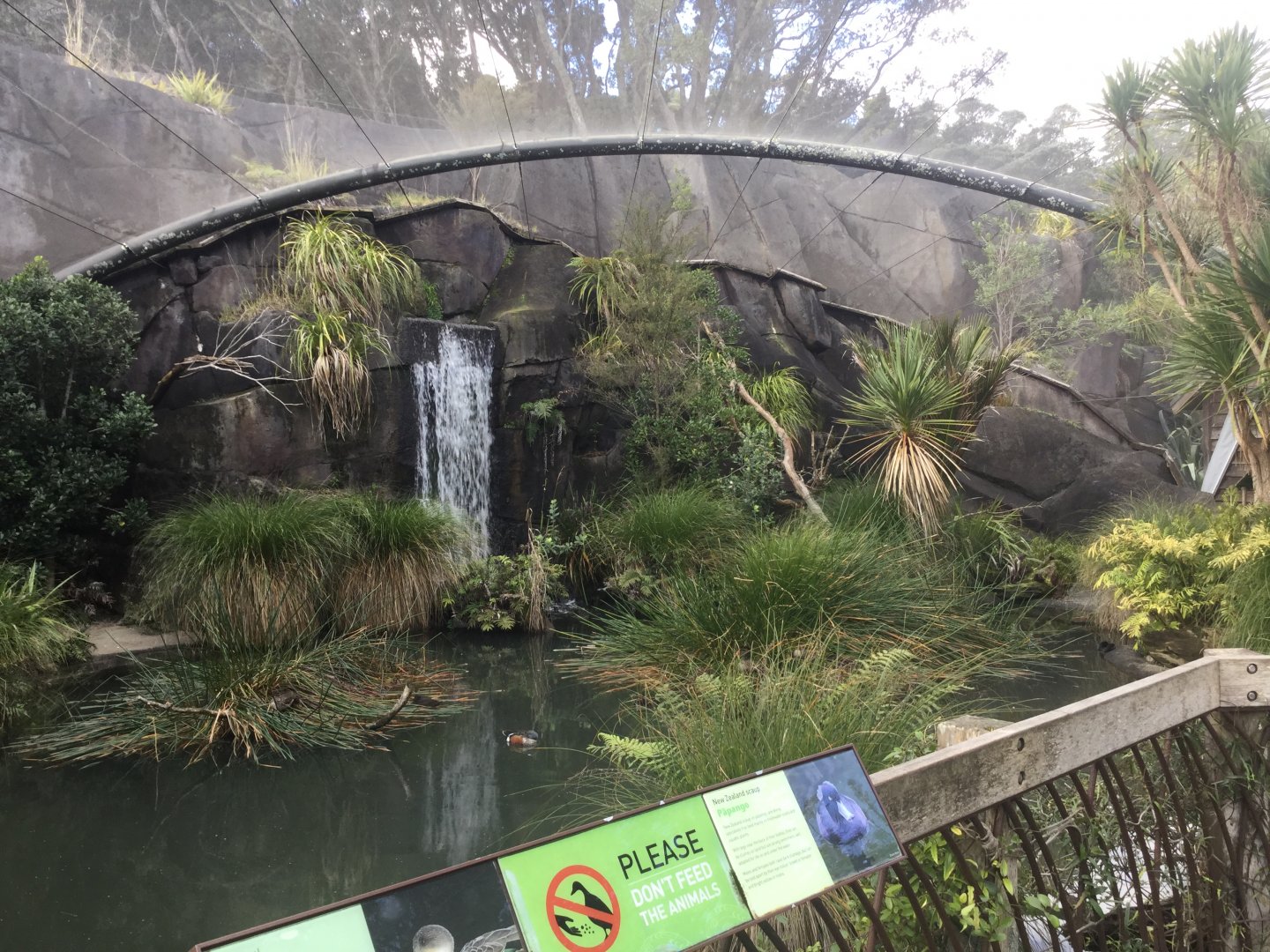
Many New Zealand native species were once found throughout the mainland and have suffered from predation of introduced species. Many species such as Tuatara and Kiwi are reared and bred on offshore islands; and in recent times, large predator proof reserves have been set up via enclosed fencing (extending kilometres).

All of New Zealand’s zoos have native sections. This is two of the exhibits in Auckland Zoo’s native precinct:

 
I'm surprised no one's mentioned this, but San Diego have a whole complex dedicated to this; Elephant Odyssey, featuring descendants of historical Californian species.
Well yes but actually no. Rather than descendants, the animals representing extinct ones are relatives of varying relation. For example, the lions represent an extinct species in the same genus, the camels, elephants, tapirs, and capybaras represent extinct members of their respective taxonomic families, and the species the secretary bird represents (the “Dagget’s eagle”, actually a hawk) was in a different family but had a similar lifestyle. And jaguars themselves are of course, a native though extirpated California species.
 
Well yes but actually no. Rather than descendants, the animals representing extinct ones are relatives of varying relation. For example, the lions represent an extinct species in the same genus, the camels, elephants, tapirs, and capybaras represent extinct members of their respective taxonomic families, and the species the secretary bird represents (the “Dagget’s eagle”, actually a hawk) was in a different family but had a similar lifestyle. And jaguars themselves are of course, a native though extirpated California species.
It is an odd exhibit choice in my opinion.
 
Mountain Lions and Wolves at many zoos dedicated to local fauna along the eastern seaboard of the USA. Red Wolves in a several places as well. Bison and Wapiti too…although with the restoration of Wapiti to the southern Appalachians…maybe this representation is becoming more accurate.

Interesting. I hadn't heard about elk getting reintroduced to the Appalachians. Time for me to get lost in some wiki pages haha.
 
Close to 10,000 In Kentucky, with natural expansion into West Virginia, Virginia, and Tennessee.

Additional introductions in Tennessee and North Carolina, with at least one animal making it as far as South Carolina.

I believe Kentucky is now translocating animals within the state and that Virginia has introduced animals sourced from Kentucky.
 
Close to 10,000 In Kentucky, with natural expansion into West Virginia, Virginia, and Tennessee.

Additional introductions in Tennessee and North Carolina, with at least one animal making it as far as South Carolina.

I believe Kentucky is now translocating animals within the state and that Virginia has introduced animals sourced from Kentucky.
The Land Between the Lakes herd has been a source for a lot of reintroductions.
 
I love this idea! I think it would be especially effective with native exhibits. It would be a way to put into perspective what animals are technically supposed to be in whatever place the zoo is but aren't due to human influence. It could be a great way to show the negative impacts of human development on animals.
 
Back
Top