Australian Reptile Park Australian Reptile Park News

I'm intrigued that they were imported all the way from the UK rather than from the managed population in New Zealand. However, Chester Zoo have had good breeding success with their tuataras so acquiring young individuals that will live for decades is a wise decision.

Probably because NZ stock is considered "taonga" or treasured. And their movements are tightly watched by Iwi (Māori tribes). It would probably be easier to bring them in from the UK then potentially get approval to move them off shore these days.
 
Probably because NZ stock is considered "taonga" or treasured. And their movements are tightly watched by Iwi (Māori tribes). It would probably be easier to bring them in from the UK then potentially get approval to move them off shore these days.

That is a real shame if that's the case. I respect Māori culture but if that is what is preventing a species listed as vulnerable from being kept and bred at international facilities then that is pretty soft. If Tuataras are sacred then their best interest's as a species should be at the forefront. I.e. ensuring that there is a large insurance population abroad so if anything horrible happens to wild populations in NZ they can be returned.
 
That is a real shame if that's the case. I respect Māori culture but if that is what is preventing a species listed as vulnerable from being kept and bred at international facilities then that is pretty soft. If Tuataras are sacred then their best interest's as a species should be at the forefront. I.e. ensuring that there is a large insurance population abroad so if anything horrible happens to wild populations in NZ they can be returned.
That's just my view as a zoo lover & new fan of reptiles. I could be totally off, but I'd say I'm not.

I live in NZ and we recently had we had some unexpected babies. I know the local Iwi had to be consulted on what do do with them even though they were born in captivity (they stayed in the facility they were born at)
 
That's just my view as a zoo lover & new fan of reptiles. I could be totally off, but I'd say I'm not.

I live in NZ and we recently had we had some unexpected babies. I know the local Iwi had to be consulted on what do do with them even though they were born in captivity (they stayed in the facility they were born at)

I agree, I respect that they mean a lot to Māori people but that also provides an opportunity for more Tuatara to be sent overseas and foreigners to be educated on Tuatara's significance within Māori culture and Māori culture as a whole by extension.

For example, I was unaware until now they were considered "taonga" and that has consequently made me research into why that is and now I'm learning about other Māori legends.
 
I agree, I respect that they mean a lot to Māori people but that also provides an opportunity for more Tuatara to be sent overseas and foreigners to be educated on Tuatara's significance within Māori culture and Māori culture as a whole by extension.

For example, I was unaware until now they were considered "taonga" and that has consequently made me research into why that is and now I'm learning about other Māori legends.
I mean, I'm so unqualified to talk about this, but all native animals are important, not just Tuatara. As the thread has discussed, there's other a great abundance of other NZ animals on display either.
 
A few comments regarding this discussion:

The Tuatara has special significance to Māori culture due to their view that Tuatara are guardians of knowledge. While the emphasis is on them reminding in their natural range, local Iwi (tribes) are happy to allow certain facilities to act as kaitiaki (guardians) for them when they’re satisfied this will be in their best interests.

Participation from New Zealand facilities include breeding for release or rearing of juveniles for release. Due to biosecurity restrictions, it would be impractical for facilities outside New Zealand to participate in such a way. Their populations would therefore have no direct benefit to the New Zealand population, which it’s their priority to protect.

The concept of insurance populations is to be considered, but weighed against the fact that many Tuatara overseas have died prematurely, there’s the perception that their husbandry methods are less refined than the tried and tested New Zealand facilities, which have decades of experience and success with this species.

The compromise could be for overseas zoos to commit to supporting New Zealand conservation efforts for this species by passing on donations made by the public to New Zealand’s conservation efforts, or even renting the Tuatara they receive. This way they would at least be (indirectly) contributing to conservation efforts.
 
A few comments regarding this discussion:

The Tuatara has special significance to Māori culture due to their view that Tuatara are guardians of knowledge. While the emphasis is on them reminding in their natural range, local Iwi (tribes) are happy to allow certain facilities to act as kaitiaki (guardians) for them when they’re satisfied this will be in their best interests.

Participation from New Zealand facilities include breeding for release or rearing of juveniles for release. Due to biosecurity restrictions, it would be impractical for facilities outside New Zealand to participate in such a way. Their populations would therefore have no direct benefit to the New Zealand population, which it’s their priority to protect.

The concept of insurance populations is to be considered, but weighed against the fact that many Tuatara overseas have died prematurely, there’s the perception that their husbandry methods are less refined than the tried and tested New Zealand facilities, which have decades of experience and success with this species.

The compromise could be for overseas zoos to commit to supporting New Zealand conservation efforts for this species by passing on donations made by the public to New Zealand’s conservation efforts, or even renting the Tuatara they receive. This way they would at least be (indirectly) contributing to conservation efforts.
Would it be possible to send abroad animals from over-represented lineages and/or elderly animals without interest for breeding ?
 
Would it be possible to send abroad animals from over-represented lineages and/or elderly animals without interest for breeding ?

Since Maori culture regard Tuatara as guardians of knowledge, elderly Tuatara would be regarded as kaumātua (highly respected elders) and therefore be among the most treasured of all.

Given the sheer number of Tuatara (between 60,000-100,000), I don’t believe there’s much emphasis on represented lines. While it sounds like New Zealand has Tuatara to spare, my interpretation is that they’re perceived as a taonga they’re reluctant to part with unless they can see a tangible benefit for the species in doing - something beyond providing other countries with a novel species to look at.

I’d maintain a system that feeds back public donations to a New Zealand conservation programme as a potential compromise.
 
A few comments regarding this discussion:

The Tuatara has special significance to Māori culture due to their view that Tuatara are guardians of knowledge. While the emphasis is on them reminding in their natural range, local Iwi (tribes) are happy to allow certain facilities to act as kaitiaki (guardians) for them when they’re satisfied this will be in their best interests.

Participation from New Zealand facilities include breeding for release or rearing of juveniles for release. Due to biosecurity restrictions, it would be impractical for facilities outside New Zealand to participate in such a way. Their populations would therefore have no direct benefit to the New Zealand population, which it’s their priority to protect.

The concept of insurance populations is to be considered, but weighed against the fact that many Tuatara overseas have died prematurely, there’s the perception that their husbandry methods are less refined than the tried and tested New Zealand facilities, which have decades of experience and success with this species.

The compromise could be for overseas zoos to commit to supporting New Zealand conservation efforts for this species by passing on donations made by the public to New Zealand’s conservation efforts, or even renting the Tuatara they receive. This way they would at least be (indirectly) contributing to conservation efforts.
Thanks, that's a great response.
 
With Australian Reptile Park's involvement in this conservation project, I thought this story was relevant to share here.

Historic world first return of endangered Manning River turtles back to the wild!

Aussie Ark, has today returned 10 endangered Manning River turtles back to the wild in a world first. The program has been supported by the Australian Governments wildlife rescue and rehabilitation initiative, following the bushfire disaster of 2019/20, as well as partners the Australian Reptile Park, Re:wild and WIRES.

The release is the first of its kind for the program established back in 2018 and is hugely significant as these particular turtles were rescued from the nest during the bushfire disaster of 2020, whilst still in the egg.

“This has been a long time coming. We have cared for these juveniles for over 2 years now, and have watched and waited patiently as our river systems recovered from fire, drought and then floods” Said Tim Faulkner, Aussie Ark Managing Director.

He continued “This is what the program is all about, rescuing an endangered species and getting them back to the wild. Getting to see them swim off into the river is not a site I will soon forget”

https://www.aussieark.org.au/manning-river-turtle-release/
 
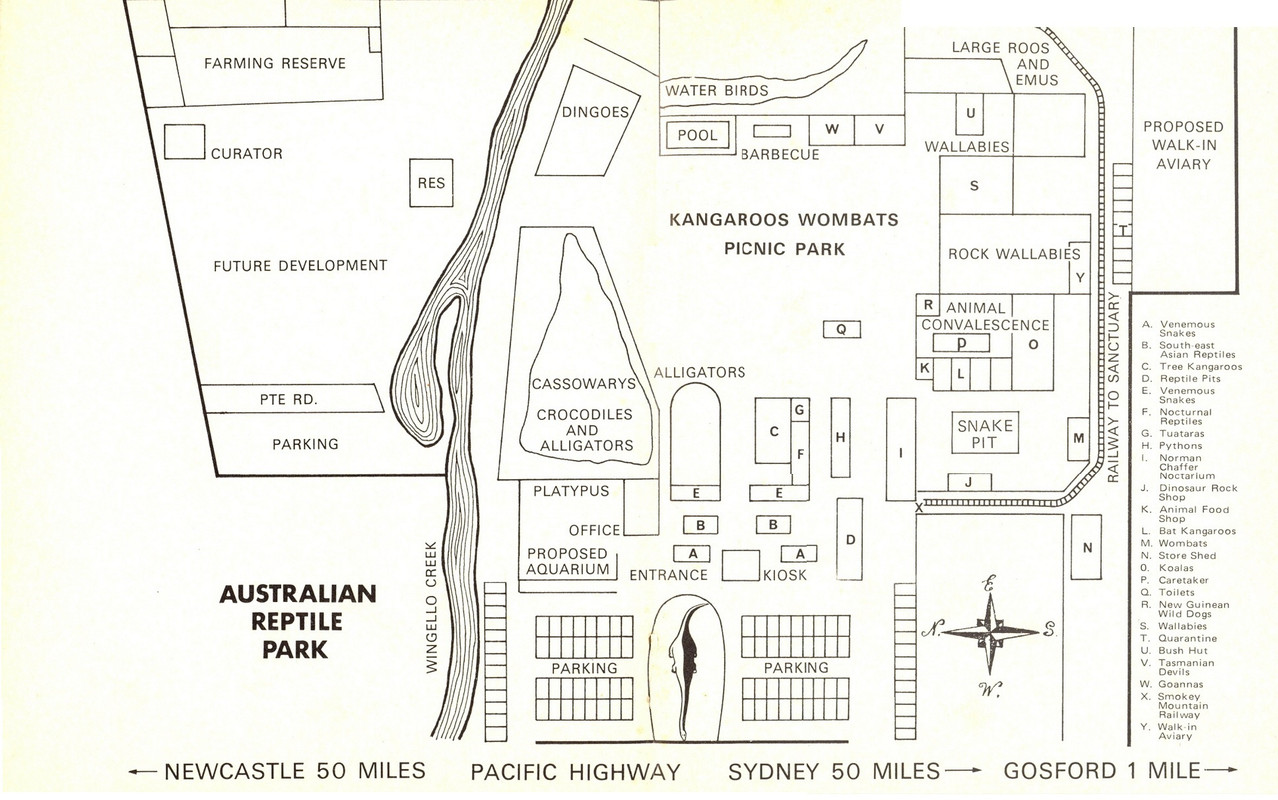
Australian Reptile Park Map from 1972 (at the old site)
Australian-Reptile-Park-1972.jpg

(source: Australian Reptile Park, Wyoming map, 1972)
 
Australian Reptile Park Map from 1972 (at the old site)
Australian-Reptile-Park-1972.jpg

(source: Australian Reptile Park, Wyoming map, 1972)

Ahhh! The memories that this map evokes!!

As soon as I got my driver's licence [1963] I used to drive my old Austin A30 up to the Central Coast each weekend to volunteer alternately at the former Kangy Angy Zoo and at Eric Worrell's Reptile Park. The Dinosaur had not even been built back in my early days there.

Kangy Angy Zoo deserves a chapter in the book but my Australian Reptile Park experiences could fill a book on their own.

On this map, the box marked CURATOR is Eric's house and the box marked RES is the home of his parents. Lovely people - in those simpler days they kept an eye on me as if I was their own grandson and fed me at their own table.

Eric was the greatest mentor that I could have had. Knowledgeable, wise and well prepared to pass on his knowledge [without any ego attached] to an eager young kid from the sticks. Generous to a fault - we need more Eric Worrells.

Mind you, these were the days as he started his slow decline into what would ultimately be his losing battle with his personal demons. The stories that could be told - and won't be told out of respect for this great man.!

Thank you @steveroberts for sharing this gem.
 
@Steve Robinson

Thank you so much for sharing those memories Steve, makes me so happy that you commented and really glad now that I copied the link on here to the legend who kept a 1972 map of the original park and shared it online.

Having just read Snake Bitten last year has doubled my fascination with Eric Worrell (and his park too naturally). There are some really great nostalgic comments have seen on facebook often under old photos of the park and of Eric in photos with various critters (I particularly <3 one of him holding a group of baby Alligators and one of them is nipping his nose but he's simply pulling a witty expression for the camera like having its teeth clamped on his nose doesn't bother him at all, his niece actually commented too saying how dearly she misses her beloved uncle).

That's so awesome that you knew Eric and that he was a mentor to you, and his parents being like surrogates to you too (Percy and Rita Worrell were his parents right? if I remember from the book correct, funny recollection of a teenage Eric having a snake under his bed and when his mum went in to collect clothes under the bed realised there was a python under there lol). Do you remember Athol the Crow? Would love to have visited the park in that era if only had been alive, and to of met Eric (he did seem like was really humble, saw an interview with him from late '70s/early '80s). My science teacher in year 7 mentioned his memories of seeing a Sugar Glider in the Nocturnal House at the original park when he was growing up.

Wow Kangy Angy Zoo, that's one have never heard about, am intrigued.

Well your zoo is in the top 3 most exciting in the whole country imo, (can't wait to come up) and that's how I feel Eric's Reptile Park was like in the '60s, '70s and '80s.

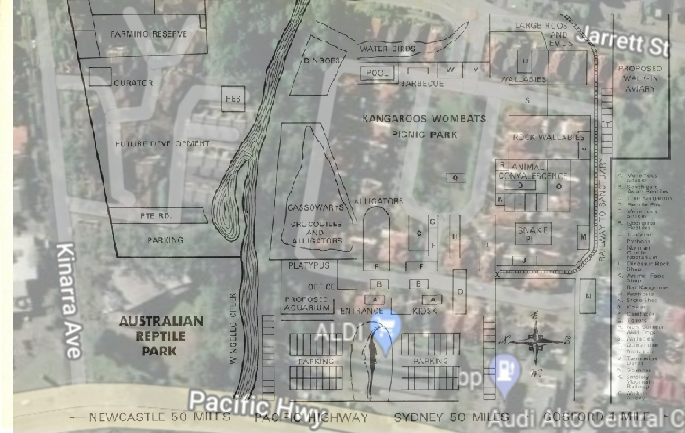
Went on google maps to see the site of the original park and see that the entrance area is an Aldi now and lots of houses have been built on the site of the park with a street named Worrell (sic)Crct and a statue of a 'Gator or Croc' near the creek which maybe has a plaque commemorating the history but not sure.

Ps: Another story from Snake Bitten that found pure gold (because the drama wasn't fatal at least and Robyn ended up ok) but Robyn got bitten and Eric took her to the hospital and the doctor seemed a bit patronising and wasn't listening to Eric's advice at first, then the dr reached for a book about Snakes and their bite treatment, and of course who was it written by (Eric said flustered of course because of time essence for Robyn's sake ''I wrote the bloody thing''...needless to say the doctor starting listening to Eric's suggestions after that lol).
 
@Steve Robinson

Thank you so much for sharing those memories Steve, makes me so happy that you commented and really glad now that I copied the link on here to the legend who kept a 1972 map of the original park and shared it online.

Having just read Snake Bitten last year has doubled my fascination with Eric Worrell (and his park too naturally). There are some really great nostalgic comments have seen on facebook often under old photos of the park and of Eric in photos with various critters (I particularly <3 one of him holding a group of baby Alligators and one of them is nipping his nose but he's simply pulling a witty expression for the camera like having its teeth clamped on his nose doesn't bother him at all, his niece actually commented too saying how dearly she misses her beloved uncle).

That's so awesome that you knew Eric and that he was a mentor to you, and his parents being like surrogates to you too (Percy and Rita Worrell were his parents right? if I remember from the book correct, funny recollection of a teenage Eric having a snake under his bed and when his mum went in to collect clothes under the bed realised there was a python under there lol). Do you remember Athol the Crow? Would love to have visited the park in that era if only had been alive, and to of met Eric (he did seem like was really humble, saw an interview with him from late '70s/early '80s). My science teacher in year 7 mentioned his memories of seeing a Sugar Glider in the Nocturnal House at the original park when he was growing up.

Wow Kangy Angy Zoo, that's one have never heard about, am intrigued.

Well your zoo is in the top 3 most exciting in the whole country imo, (can't wait to come up) and that's how I feel Eric's Reptile Park was like in the '60s, '70s and '80s.

Went on google maps to see the site of the original park and see that the entrance area is an Aldi now and lots of houses have been built on the site of the park with a street named Worrell (sic)Crct and a statue of a 'Gator or Croc' near the creek which maybe has a plaque commemorating the history but not sure.

Ps: Another story from Snake Bitten that found pure gold (because the drama wasn't fatal at least and Robyn ended up ok) but Robyn got bitten and Eric took her to the hospital and the doctor seemed a bit patronising and wasn't listening to Eric's advice at first, then the dr reached for a book about Snakes and their bite treatment, and of course who was it written by (Eric said flustered of course because of time essence for Robyn's sake ''I wrote the bloody thing''...needless to say the doctor starting listening to Eric's suggestions after that lol).


Yep - the man was a man among men back in the day. Mind you, I'm not overlooking any of his idiosyncrasies or what are now perceived to be his faults - we all have a few of those. But, back in those pre-woke days, it was OK to be an Aussie - warts and all.

Athol the bloody Crow!!! Yes - as a matter of fact I even remember the bloke that he was named after.

Just thank your lucky stars that you weren't alive back in those days - there's no fun being old now!
 
@Steve Robinson

Yeah I understand. Think he must of been such fascinating and witty company and someone who would still be vivid in the memories of all those who knew and were close to him in his life. This bloke on fcbook I remember his quote vividly ''the man built a reptile zoo from scratch, helped put Gosford/Woy-Woy 'on the map' and built a gigantic Brontosaurus statue..Eric was a do-er and a marketing genius'' (naturally I thumbs-upped his comment), one of his old herpetologist friends mentioned in the book put up a great photo of him and Eric that really seemed to show how much he missed his old friend dearly to this day.

Oh that's right I forgot reading that Athol was named after a man. He had good innings for a Crow didn't he Athol. Someone else reminisced about how he would fly down from a tree and sneakily try undo some people shoelaces.

Reptiles being the titular flagship animals of Eric's park of-course it would probably be more fitting if I mentioned a reptile species here but it's a mammal instead: I thought was so cool also to see that Eric had Papuan/New Guinean Singing Dogs living at his park back then. Have always wanted to see and meet some of them, but think its only a few zoos and private owners in America who have any currently (but that's just based on what have managed to find out so far).
Apparently the non-reptile species were greatly reduced in the mid '80s when management ended up being shared in dual partnership with Ed Manners the proprietor/owner of Askania Park (think it was Ed Manners idea to cut costs and his belief given the name as a Reptile Park that the mammals and birds should be phased out to a certain degree. & Eric's desired Aquarium building was sidelined unfortunately for cost factors).

Really cool about your friendship with him and his folks and mentorship imparting he gave you (and humbly too). He seemed quite witty too from the interview I saw of him and comments in the book.

I do understand your age related comment but I think its cool life wisdom to have experienced more time, just think it's unfair on older people getting the extra aches and pains, not a very fair compensation for having lived life longer. Am not quite 34 yet but my left ankle hasn't stopped being stiff since spraining in September and my sister teased me at Christmas for reminding her of an old man a lot of the time hahaha.
 
Last edited:
Visited the park yesterday and they’ve now got a sign displayed in the Lost World of Reptiles that the Tuatara has arrived and will be on display soon. There’s also a revamp of the exterior of the Komodo dragons exhibit which looks fantastic.
 
Visited the park yesterday and they’ve now got a sign displayed in the Lost World of Reptiles that the Tuatara has arrived and will be on display soon. There’s also a revamp of the exterior of the Komodo dragons exhibit which looks fantastic.

Great news. It’s good Australia now has this species on display again (even if they did have to import them from the UK).

Hopefully they can import a male down the line. Following their success as the first zoo in the region to breed Komodo dragon, they may one day be the first zoo in Australia to breed Tuatara.
 
Back
Top