Following some of the critiques and suggestions, I considered some of the sections of this hypothetical plan, and decided to make a few adjustments, all to the two regions criticized above, Deserts and Conservation Crossroads.
Deserts
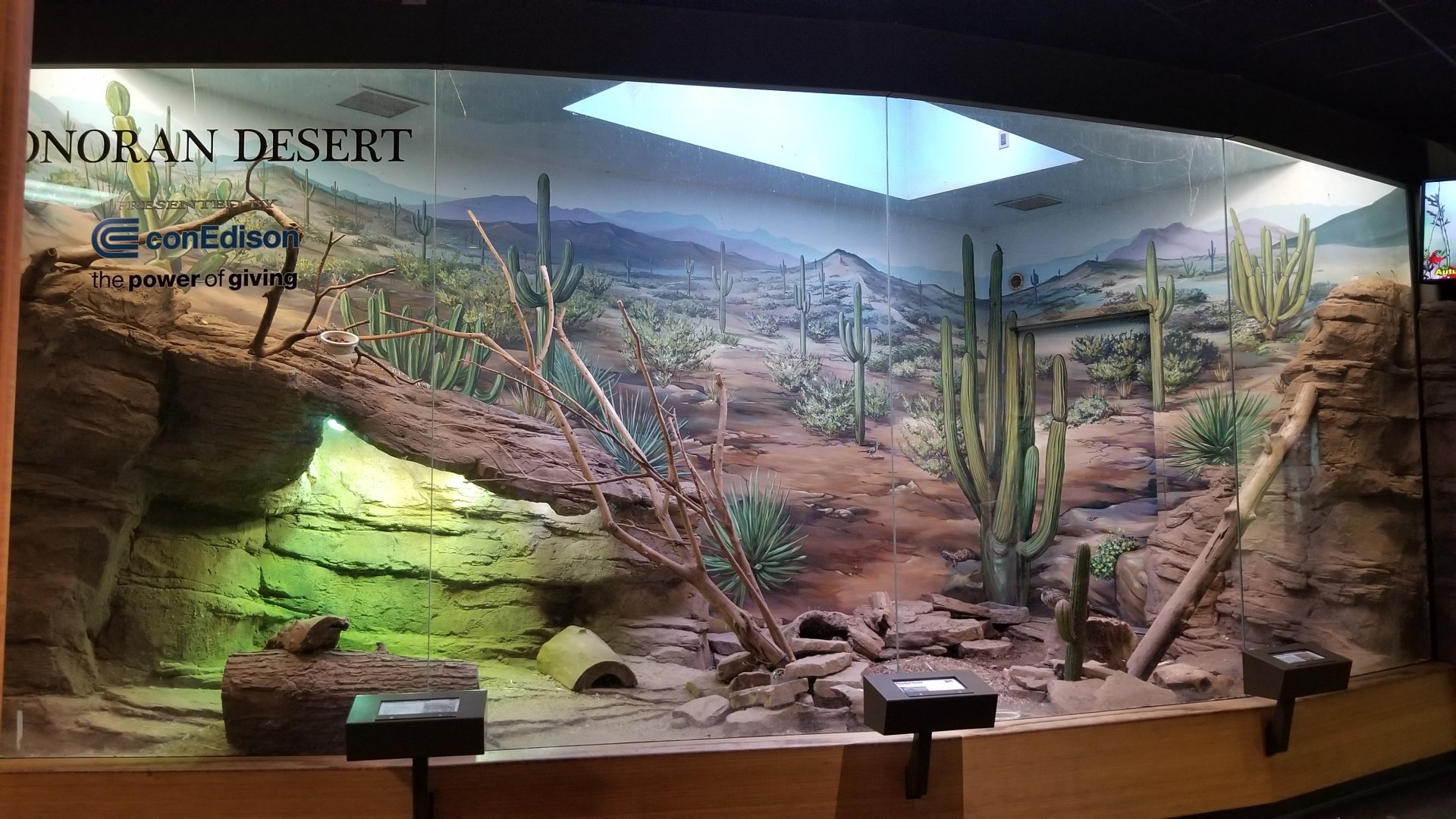
@ZooElephantsMan suggested keeping the current education center intact, and the more I thought about it, the more my ideas for a Deserts exhibit seemed to meld into the existing building, with only minimal modifications to my plan. Chacoan Peccaries would have to be removed from the building for this to work, and Swift Foxes would be moved into an outdoor exhibit, but other than that my plan for a Deserts could work in the current Education Center with only minimal adjustments. Here is an adjusted plan for Deserts:
Before entering the Deserts Building, visitors will be greeted by a large netted-over habitat for Swift Fox, built on the side of the building, in currently unutilized land. This large habitat will connect through a window into a back holding for the swift foxes, designed to look like the foxes are entering a den. Once inside, visitors can pass by the existing restrooms and be welcomed by the large Desert Atrium. Flanking either side of the visitor path are glass-fronted- with the left side holding Gila Monsters and Chuckwallas, with the right side being a large aquarium for Desert Pupfish. The highlight of this atrium, however, is the large aviary that encompasses most of this space. Designed off of Zoo America's Southwest exhibit, this aviary holds Burrowing Owls, Greater Roadrunners, and Desert Tortoises. Exiting this atrium, a number of interpretive graphics flank the back walls as visitors can walk through the back hallway past a number of smaller terrariums. These terrariums are split into two sides: Rattlesnakes and Invertebrates. The rattlesnakes side features three, spacious terrariums- designed with glass walls that make them appear as though they are connected. These three terrariums house Mexican Lance-Headed Rattlesnake, Banded Rock Rattlesnake, and Western Diamondback Rattlesnake. The Invertebrates side contains a number of smaller terrariums, housing Blue Death-Feigning Beetles, Mexican Red-Knee Tarantulas, Arizona Blonde Tarantula, Giant Desert Hairy Scorpions, Vinegaroons, and Tailless Whip Scorpions.
Conservation Crossroads
I realized that when designing this masterplan, I forgot about the area of land that's available between the wolf and eagle exhibits (the 2016 masterplan allocates it for bighorn sheep). This area of land would be an ideal location to add an additional mammal species to this section, and, as observed by @ZooElephantsMan, it would be ideal to add some species from different continents. As such, this area of land would be split into two, 3,000-square foot exhibits, each housing an endangered ungulate species from areas underrepresented in zoos, the Horn of Africa and the Gran Chaco, a dry region in South America. These two species are the Speke's Gazelle and Chacoan Peccary, respectively. Both of these exhibits will feature signage looking at not only the species on display, but also these unique, often ignored regions of the world. The Horn of Africa in particular will be highlighted, as it is one of CEPF's biodiversity hotspots.
Inside, I'm not going to change much of this exhibit, there will still be the same six different exhibit galleries, however I realize that a species list and better descriptions may be desired. The first two galleries were the only ones I gave full species lists of before, and while I'm not knowledgeable enough on corals to make a species list for the Coral Propagation Lab (which will also include some tropical reef fish species), I will make species lists and more in depth descriptions for the other three sections, Amphibians, Songbirds, and Freshwater Turtles.
Amphibians:
The gallery on amphibians will look at the important role amphibians play in the ecosystem, as well as the amphibian extinction crisis that's decimating amphibian populations across the globe. Interactive displays will allow visitors to click on places on a map to see some of the amphibian species found in different regions, will allow visitors to learn how to identify various local amphibian species by their calls, and will provide information on the Frog Watch U.S.A. program and how zoo visitors can get involved as a citizen scientist. Along the sides of this gallery are a number of terrariums for various amphibian species, as well as windows for visitors to see amphibian conservation in action, with isolation rooms for breeding. While the species in these rooms would depend on which ones zoo conservation staff most wants to get involved in, any endangered amphibian species managed by the AZA would be good choices. For the exhibit wall, however, there will be two separate sections each displaying different types of amphibians. While not every individual species is endangered, I selected species based on what is common or recommended to AZA institutions, and even those species that are not endangered are good exhibit animals that can still help be ambassadors for amphibians as a whole, which include many endangered species. Species can also be substituted in and out of my proposed list as necessary.
The "Native Amphibians" side will feature the following species found in North America:
The "Amphibians Around the World" side will feature the following species found in other regions:
Songbirds:
The songbirds section of this building is set up as two consecutive aviaries, separated by a small "research station". The first aviary is for native North American Songbirds, for which I am not providing a species list since this exhibit will likely be dependent on rescues. Inside the research station, visitors can use the Raven Exhibit software from Cornell Ornithology Lab to look at different bird calls of native species, along with learning about how researchers use bird calls for conservation. There will also be various field guides available for visitors to peruse/see different bird species, and a bird blind overlooking the North American Songbirds aviary so visitors (and especially children) can look out into the aviary through the bird blind, with a pair of binoculars that is mounted to the bird blind. This room will also include information on migratory patterns in songbirds and the various challenges facing songbirds, especially two main reasons for the songbird extinction crisis: Outdoor Cats and Non-Bird Safe Windows. Both of these areas are focuses of this research station as they are areas visitors may be able to help protect native songbirds.
Heading closer to the Asian Songbird aviary, there is also interpretive displays on the "This is Not A Pet" campaign, and how songbirds are often the victims of wildlife trafficking. These displays will advocate for responsible pet ownership, and acquiring any pets from an ethical source. The purpose of this signage is not to say no exotic animals can be pets, but rather to make sure that one isn't getting a pet taken from the wild and instead from an ethical breeder. Along with the aforementioned Bali Mynah, a number of rare Asian songbird species will be found in this second aviary. These species include Chinese Hwamei, Blue-Crowned Laughing Thrush, Red-Billed Leiothrix, Scarlet-Faced Liocichla, White-Rumped Shama, Asian Fairy Bluebird, White-Eared Bulbul, and Golden White-Eye, or a similar combination of species based on availability and the needs of the Passerine TAG.
Freshwater Turtles:
Freshwater turtles is the final of our four galleries on different taxa of conservation concern. The big centerpiece of this gallery is a larger-than-life-sized box turtle shell located in the center, so that kids (and adults) can climb through the turtle shell. One unique thing about this shell however, would be the anatomical accuracy of it- as it will highlight the turtle's spine built into the carapace. While one side of this room will have large windows overlooking a lab for the zoo's head-start program for local turtles (so visitors can see conservation in action), the other sides are split into three different sections, highlighting the freshwater turtles (and a single critically endangered non-turtle species) of the Neotropics, Asia, and New England.
The Neotropics section will be comprised of a singular exhibit, albeit it is the largest in this gallery. This mixed-species exhibit, complete with underwater and above-water viewing, houses three turtle species- the Mata Mata Turtle, Arrau River Turtle, and Yellow-Spotted Amazon River Turtle.
The Mainland Asia section features the gallery's single non-turtle species, the critically endangered Chinese Crocodile Lizard, who share a large habitat, complete with a waterfall and many climbing branches, with multiple species of Asian box turtles- specifically the Indochinese Box Turtle, McCord's Box Turtle, and Chinese Three-Striped Box Turtle. Smaller tanks feature Black-Breasted Leaf Turtles, Rote Island Snake-Necked Turtles, and Malayan Painted Terrapins.
The New England section focuses on the rare turtle species that can be found right here in New England. Compared to the other sections, the New England portion of this gallery has the most individual tanks, however most are smaller than the Asian or Neotropical tanks and contain singular species rather than mixed species. These tanks, each with sizeable land and water portions, contain Blanding's Turtles, Spotted Turtles, Eastern Box Turtles, North American Wood Turtles, Diamondback Terrapins, and Common Musk Turtles.
Deserts
@ZooElephantsMan suggested keeping the current education center intact, and the more I thought about it, the more my ideas for a Deserts exhibit seemed to meld into the existing building, with only minimal modifications to my plan. Chacoan Peccaries would have to be removed from the building for this to work, and Swift Foxes would be moved into an outdoor exhibit, but other than that my plan for a Deserts could work in the current Education Center with only minimal adjustments. Here is an adjusted plan for Deserts:
Before entering the Deserts Building, visitors will be greeted by a large netted-over habitat for Swift Fox, built on the side of the building, in currently unutilized land. This large habitat will connect through a window into a back holding for the swift foxes, designed to look like the foxes are entering a den. Once inside, visitors can pass by the existing restrooms and be welcomed by the large Desert Atrium. Flanking either side of the visitor path are glass-fronted- with the left side holding Gila Monsters and Chuckwallas, with the right side being a large aquarium for Desert Pupfish. The highlight of this atrium, however, is the large aviary that encompasses most of this space. Designed off of Zoo America's Southwest exhibit, this aviary holds Burrowing Owls, Greater Roadrunners, and Desert Tortoises. Exiting this atrium, a number of interpretive graphics flank the back walls as visitors can walk through the back hallway past a number of smaller terrariums. These terrariums are split into two sides: Rattlesnakes and Invertebrates. The rattlesnakes side features three, spacious terrariums- designed with glass walls that make them appear as though they are connected. These three terrariums house Mexican Lance-Headed Rattlesnake, Banded Rock Rattlesnake, and Western Diamondback Rattlesnake. The Invertebrates side contains a number of smaller terrariums, housing Blue Death-Feigning Beetles, Mexican Red-Knee Tarantulas, Arizona Blonde Tarantula, Giant Desert Hairy Scorpions, Vinegaroons, and Tailless Whip Scorpions.
Conservation Crossroads
I realized that when designing this masterplan, I forgot about the area of land that's available between the wolf and eagle exhibits (the 2016 masterplan allocates it for bighorn sheep). This area of land would be an ideal location to add an additional mammal species to this section, and, as observed by @ZooElephantsMan, it would be ideal to add some species from different continents. As such, this area of land would be split into two, 3,000-square foot exhibits, each housing an endangered ungulate species from areas underrepresented in zoos, the Horn of Africa and the Gran Chaco, a dry region in South America. These two species are the Speke's Gazelle and Chacoan Peccary, respectively. Both of these exhibits will feature signage looking at not only the species on display, but also these unique, often ignored regions of the world. The Horn of Africa in particular will be highlighted, as it is one of CEPF's biodiversity hotspots.
Inside, I'm not going to change much of this exhibit, there will still be the same six different exhibit galleries, however I realize that a species list and better descriptions may be desired. The first two galleries were the only ones I gave full species lists of before, and while I'm not knowledgeable enough on corals to make a species list for the Coral Propagation Lab (which will also include some tropical reef fish species), I will make species lists and more in depth descriptions for the other three sections, Amphibians, Songbirds, and Freshwater Turtles.
Amphibians:
The gallery on amphibians will look at the important role amphibians play in the ecosystem, as well as the amphibian extinction crisis that's decimating amphibian populations across the globe. Interactive displays will allow visitors to click on places on a map to see some of the amphibian species found in different regions, will allow visitors to learn how to identify various local amphibian species by their calls, and will provide information on the Frog Watch U.S.A. program and how zoo visitors can get involved as a citizen scientist. Along the sides of this gallery are a number of terrariums for various amphibian species, as well as windows for visitors to see amphibian conservation in action, with isolation rooms for breeding. While the species in these rooms would depend on which ones zoo conservation staff most wants to get involved in, any endangered amphibian species managed by the AZA would be good choices. For the exhibit wall, however, there will be two separate sections each displaying different types of amphibians. While not every individual species is endangered, I selected species based on what is common or recommended to AZA institutions, and even those species that are not endangered are good exhibit animals that can still help be ambassadors for amphibians as a whole, which include many endangered species. Species can also be substituted in and out of my proposed list as necessary.
The "Native Amphibians" side will feature the following species found in North America:
- Dusky Gopher Frog
- Eastern Hellbender
- Grey Tree Frog
- American Bullfrog
- Northern Leopard Frog
- Spotted Salamander
- Eastern Newt
- Tiger Salamander
- Wood Frog
- Pickerel Frog
- Fowler's Toad
- Eastern Hellbender
- Grey Tree Frog
- American Bullfrog
- Northern Leopard Frog
- Spotted Salamander
- Eastern Newt
- Tiger Salamander
- Wood Frog
- Pickerel Frog
- Fowler's Toad
The "Amphibians Around the World" side will feature the following species found in other regions:
- Panamanian Golden Frog
- Puerto Rican Crested Toad
- Emperor Newt
- Kaiser's Spotted Newt
- Aquatic Caecilian
- Axolotl
- Red-Eyed Tree Frog
- Mountain Chicken
- Surinam Toad
- Lemur Leaf Frog
- Lake Titicaca Frog
- Crowned Tree Frog
- Terrible Poison Dart Frog
- Anthony's Poison Dart Frog
- Puerto Rican Crested Toad
- Emperor Newt
- Kaiser's Spotted Newt
- Aquatic Caecilian
- Axolotl
- Red-Eyed Tree Frog
- Mountain Chicken
- Surinam Toad
- Lemur Leaf Frog
- Lake Titicaca Frog
- Crowned Tree Frog
- Terrible Poison Dart Frog
- Anthony's Poison Dart Frog
Songbirds:
The songbirds section of this building is set up as two consecutive aviaries, separated by a small "research station". The first aviary is for native North American Songbirds, for which I am not providing a species list since this exhibit will likely be dependent on rescues. Inside the research station, visitors can use the Raven Exhibit software from Cornell Ornithology Lab to look at different bird calls of native species, along with learning about how researchers use bird calls for conservation. There will also be various field guides available for visitors to peruse/see different bird species, and a bird blind overlooking the North American Songbirds aviary so visitors (and especially children) can look out into the aviary through the bird blind, with a pair of binoculars that is mounted to the bird blind. This room will also include information on migratory patterns in songbirds and the various challenges facing songbirds, especially two main reasons for the songbird extinction crisis: Outdoor Cats and Non-Bird Safe Windows. Both of these areas are focuses of this research station as they are areas visitors may be able to help protect native songbirds.
Heading closer to the Asian Songbird aviary, there is also interpretive displays on the "This is Not A Pet" campaign, and how songbirds are often the victims of wildlife trafficking. These displays will advocate for responsible pet ownership, and acquiring any pets from an ethical source. The purpose of this signage is not to say no exotic animals can be pets, but rather to make sure that one isn't getting a pet taken from the wild and instead from an ethical breeder. Along with the aforementioned Bali Mynah, a number of rare Asian songbird species will be found in this second aviary. These species include Chinese Hwamei, Blue-Crowned Laughing Thrush, Red-Billed Leiothrix, Scarlet-Faced Liocichla, White-Rumped Shama, Asian Fairy Bluebird, White-Eared Bulbul, and Golden White-Eye, or a similar combination of species based on availability and the needs of the Passerine TAG.
Freshwater Turtles:
Freshwater turtles is the final of our four galleries on different taxa of conservation concern. The big centerpiece of this gallery is a larger-than-life-sized box turtle shell located in the center, so that kids (and adults) can climb through the turtle shell. One unique thing about this shell however, would be the anatomical accuracy of it- as it will highlight the turtle's spine built into the carapace. While one side of this room will have large windows overlooking a lab for the zoo's head-start program for local turtles (so visitors can see conservation in action), the other sides are split into three different sections, highlighting the freshwater turtles (and a single critically endangered non-turtle species) of the Neotropics, Asia, and New England.
The Neotropics section will be comprised of a singular exhibit, albeit it is the largest in this gallery. This mixed-species exhibit, complete with underwater and above-water viewing, houses three turtle species- the Mata Mata Turtle, Arrau River Turtle, and Yellow-Spotted Amazon River Turtle.
The Mainland Asia section features the gallery's single non-turtle species, the critically endangered Chinese Crocodile Lizard, who share a large habitat, complete with a waterfall and many climbing branches, with multiple species of Asian box turtles- specifically the Indochinese Box Turtle, McCord's Box Turtle, and Chinese Three-Striped Box Turtle. Smaller tanks feature Black-Breasted Leaf Turtles, Rote Island Snake-Necked Turtles, and Malayan Painted Terrapins.
The New England section focuses on the rare turtle species that can be found right here in New England. Compared to the other sections, the New England portion of this gallery has the most individual tanks, however most are smaller than the Asian or Neotropical tanks and contain singular species rather than mixed species. These tanks, each with sizeable land and water portions, contain Blanding's Turtles, Spotted Turtles, Eastern Box Turtles, North American Wood Turtles, Diamondback Terrapins, and Common Musk Turtles.