the future of roger williams park zoo

Following some of the critiques and suggestions, I considered some of the sections of this hypothetical plan, and decided to make a few adjustments, all to the two regions criticized above, Deserts and Conservation Crossroads.

Deserts
@ZooElephantsMan suggested keeping the current education center intact, and the more I thought about it, the more my ideas for a Deserts exhibit seemed to meld into the existing building, with only minimal modifications to my plan. Chacoan Peccaries would have to be removed from the building for this to work, and Swift Foxes would be moved into an outdoor exhibit, but other than that my plan for a Deserts could work in the current Education Center with only minimal adjustments. Here is an adjusted plan for Deserts:

Before entering the Deserts Building, visitors will be greeted by a large netted-over habitat for Swift Fox, built on the side of the building, in currently unutilized land. This large habitat will connect through a window into a back holding for the swift foxes, designed to look like the foxes are entering a den. Once inside, visitors can pass by the existing restrooms and be welcomed by the large Desert Atrium. Flanking either side of the visitor path are glass-fronted- with the left side holding Gila Monsters and Chuckwallas, with the right side being a large aquarium for Desert Pupfish. The highlight of this atrium, however, is the large aviary that encompasses most of this space. Designed off of Zoo America's Southwest exhibit, this aviary holds Burrowing Owls, Greater Roadrunners, and Desert Tortoises. Exiting this atrium, a number of interpretive graphics flank the back walls as visitors can walk through the back hallway past a number of smaller terrariums. These terrariums are split into two sides: Rattlesnakes and Invertebrates. The rattlesnakes side features three, spacious terrariums- designed with glass walls that make them appear as though they are connected. These three terrariums house Mexican Lance-Headed Rattlesnake, Banded Rock Rattlesnake, and Western Diamondback Rattlesnake. The Invertebrates side contains a number of smaller terrariums, housing Blue Death-Feigning Beetles, Mexican Red-Knee Tarantulas, Arizona Blonde Tarantula, Giant Desert Hairy Scorpions, Vinegaroons, and Tailless Whip Scorpions.

Conservation Crossroads

I realized that when designing this masterplan, I forgot about the area of land that's available between the wolf and eagle exhibits (the 2016 masterplan allocates it for bighorn sheep). This area of land would be an ideal location to add an additional mammal species to this section, and, as observed by @ZooElephantsMan, it would be ideal to add some species from different continents. As such, this area of land would be split into two, 3,000-square foot exhibits, each housing an endangered ungulate species from areas underrepresented in zoos, the Horn of Africa and the Gran Chaco, a dry region in South America. These two species are the Speke's Gazelle and Chacoan Peccary, respectively. Both of these exhibits will feature signage looking at not only the species on display, but also these unique, often ignored regions of the world. The Horn of Africa in particular will be highlighted, as it is one of CEPF's biodiversity hotspots.

Inside, I'm not going to change much of this exhibit, there will still be the same six different exhibit galleries, however I realize that a species list and better descriptions may be desired. The first two galleries were the only ones I gave full species lists of before, and while I'm not knowledgeable enough on corals to make a species list for the Coral Propagation Lab (which will also include some tropical reef fish species), I will make species lists and more in depth descriptions for the other three sections, Amphibians, Songbirds, and Freshwater Turtles.

Amphibians:
The gallery on amphibians will look at the important role amphibians play in the ecosystem, as well as the amphibian extinction crisis that's decimating amphibian populations across the globe. Interactive displays will allow visitors to click on places on a map to see some of the amphibian species found in different regions, will allow visitors to learn how to identify various local amphibian species by their calls, and will provide information on the Frog Watch U.S.A. program and how zoo visitors can get involved as a citizen scientist. Along the sides of this gallery are a number of terrariums for various amphibian species, as well as windows for visitors to see amphibian conservation in action, with isolation rooms for breeding. While the species in these rooms would depend on which ones zoo conservation staff most wants to get involved in, any endangered amphibian species managed by the AZA would be good choices. For the exhibit wall, however, there will be two separate sections each displaying different types of amphibians. While not every individual species is endangered, I selected species based on what is common or recommended to AZA institutions, and even those species that are not endangered are good exhibit animals that can still help be ambassadors for amphibians as a whole, which include many endangered species. Species can also be substituted in and out of my proposed list as necessary.

The "Native Amphibians" side will feature the following species found in North America:
- Dusky Gopher Frog
- Eastern Hellbender
- Grey Tree Frog
- American Bullfrog
- Northern Leopard Frog
- Spotted Salamander
- Eastern Newt
- Tiger Salamander
- Wood Frog
- Pickerel Frog
- Fowler's Toad

The "Amphibians Around the World" side will feature the following species found in other regions:
- Panamanian Golden Frog
- Puerto Rican Crested Toad
- Emperor Newt
- Kaiser's Spotted Newt
- Aquatic Caecilian
- Axolotl
- Red-Eyed Tree Frog
- Mountain Chicken
- Surinam Toad
- Lemur Leaf Frog
- Lake Titicaca Frog
- Crowned Tree Frog
- Terrible Poison Dart Frog
- Anthony's Poison Dart Frog


Songbirds:
The songbirds section of this building is set up as two consecutive aviaries, separated by a small "research station". The first aviary is for native North American Songbirds, for which I am not providing a species list since this exhibit will likely be dependent on rescues. Inside the research station, visitors can use the Raven Exhibit software from Cornell Ornithology Lab to look at different bird calls of native species, along with learning about how researchers use bird calls for conservation. There will also be various field guides available for visitors to peruse/see different bird species, and a bird blind overlooking the North American Songbirds aviary so visitors (and especially children) can look out into the aviary through the bird blind, with a pair of binoculars that is mounted to the bird blind. This room will also include information on migratory patterns in songbirds and the various challenges facing songbirds, especially two main reasons for the songbird extinction crisis: Outdoor Cats and Non-Bird Safe Windows. Both of these areas are focuses of this research station as they are areas visitors may be able to help protect native songbirds.

Heading closer to the Asian Songbird aviary, there is also interpretive displays on the "This is Not A Pet" campaign, and how songbirds are often the victims of wildlife trafficking. These displays will advocate for responsible pet ownership, and acquiring any pets from an ethical source. The purpose of this signage is not to say no exotic animals can be pets, but rather to make sure that one isn't getting a pet taken from the wild and instead from an ethical breeder. Along with the aforementioned Bali Mynah, a number of rare Asian songbird species will be found in this second aviary. These species include Chinese Hwamei, Blue-Crowned Laughing Thrush, Red-Billed Leiothrix, Scarlet-Faced Liocichla, White-Rumped Shama, Asian Fairy Bluebird, White-Eared Bulbul, and Golden White-Eye, or a similar combination of species based on availability and the needs of the Passerine TAG.

Freshwater Turtles:
Freshwater turtles is the final of our four galleries on different taxa of conservation concern. The big centerpiece of this gallery is a larger-than-life-sized box turtle shell located in the center, so that kids (and adults) can climb through the turtle shell. One unique thing about this shell however, would be the anatomical accuracy of it- as it will highlight the turtle's spine built into the carapace. While one side of this room will have large windows overlooking a lab for the zoo's head-start program for local turtles (so visitors can see conservation in action), the other sides are split into three different sections, highlighting the freshwater turtles (and a single critically endangered non-turtle species) of the Neotropics, Asia, and New England.

The Neotropics section will be comprised of a singular exhibit, albeit it is the largest in this gallery. This mixed-species exhibit, complete with underwater and above-water viewing, houses three turtle species- the Mata Mata Turtle, Arrau River Turtle, and Yellow-Spotted Amazon River Turtle.

The Mainland Asia section features the gallery's single non-turtle species, the critically endangered Chinese Crocodile Lizard, who share a large habitat, complete with a waterfall and many climbing branches, with multiple species of Asian box turtles- specifically the Indochinese Box Turtle, McCord's Box Turtle, and Chinese Three-Striped Box Turtle. Smaller tanks feature Black-Breasted Leaf Turtles, Rote Island Snake-Necked Turtles, and Malayan Painted Terrapins.

The New England section focuses on the rare turtle species that can be found right here in New England. Compared to the other sections, the New England portion of this gallery has the most individual tanks, however most are smaller than the Asian or Neotropical tanks and contain singular species rather than mixed species. These tanks, each with sizeable land and water portions, contain Blanding's Turtles, Spotted Turtles, Eastern Box Turtles, North American Wood Turtles, Diamondback Terrapins, and Common Musk Turtles.
 
I can understand what you are saying here, and it's valid criticism. One of the ways this exhibit will stand out from other exhibits is the inclusion of Science museum-esque displays, with interactive exhibits for visitors to learn about best practices and how to save wildlife. It's sort of a hybrid between a zoo exhibit and a museum exhibit.

I'll admit I didn't explain this section in as much detail as I could've, but conservation will be integral to this exhibit, while other sections have other underlying messages about ecosystems, exploration, geography, etc. Of course conservation can be ingrained elsewhere in the zoo as well, but I find it surprising that zoos haven't used conservation as theming for an exhibit yet, as it's a core focus of reputable zoos.

To add on, while I can see what you mean by saying it's generic, I will say that there is a need for zoos to build generic complexes as a catch-all for species that don't easily fit into the traditional zones that zoos have. While a few of the popular species in this zone are well-represented, many species of Turtles, Amphibians, etc. often aren't given the attention they deserve from zoos since they don't easily fit into the traditional themes that zoos have. There's also plenty of flexibility in this area for other species to be incorporated, essentially being a place for any species of conservation concern the zoo wishes to work with that don't easily fit elsewhere in the zoo, just like Adaptations currently houses some species due to the fact they don't easily fit elsewhere (i.e. River Otters, King Vultures, Radiated Tortoise).

Conservation Crossroads

I realized that when designing this masterplan, I forgot about the area of land that's available between the wolf and eagle exhibits (the 2016 masterplan allocates it for bighorn sheep). This area of land would be an ideal location to add an additional mammal species to this section, and, as observed by @ZooElephantsMan, it would be ideal to add some species from different continents. As such, this area of land would be split into two, 3,000-square foot exhibits, each housing an endangered ungulate species from areas underrepresented in zoos, the Horn of Africa and the Gran Chaco, a dry region in South America. These two species are the Speke's Gazelle and Chacoan Peccary, respectively. Both of these exhibits will feature signage looking at not only the species on display, but also these unique, often ignored regions of the world. The Horn of Africa in particular will be highlighted, as it is one of CEPF's biodiversity hotspots.

Inside, I'm not going to change much of this exhibit, there will still be the same six different exhibit galleries, however I realize that a species list and better descriptions may be desired. The first two galleries were the only ones I gave full species lists of before, and while I'm not knowledgeable enough on corals to make a species list for the Coral Propagation Lab (which will also include some tropical reef fish species), I will make species lists and more in depth descriptions for the other three sections, Amphibians, Songbirds, and Freshwater Turtles.

Amphibians:

The gallery on amphibians will look at the important role amphibians play in the ecosystem, as well as the amphibian extinction crisis that's decimating amphibian populations across the globe. Interactive displays will allow visitors to click on places on a map to see some of the amphibian species found in different regions, will allow visitors to learn how to identify various local amphibian species by their calls, and will provide information on the Frog Watch U.S.A. program and how zoo visitors can get involved as a citizen scientist. Along the sides of this gallery are a number of terrariums for various amphibian species, as well as windows for visitors to see amphibian conservation in action, with isolation rooms for breeding. While the species in these rooms would depend on which ones zoo conservation staff most wants to get involved in, any endangered amphibian species managed by the AZA would be good choices. For the exhibit wall, however, there will be two separate sections each displaying different types of amphibians. While not every individual species is endangered, I selected species based on what is common or recommended to AZA institutions, and even those species that are not endangered are good exhibit animals that can still help be ambassadors for amphibians as a whole, which include many endangered species. Species can also be substituted in and out of my proposed list as necessary.

The "Native Amphibians" side will feature the following species found in North America:

- Dusky Gopher Frog

- Eastern Hellbender

- Grey Tree Frog

- American Bullfrog

- Northern Leopard Frog

- Spotted Salamander

- Eastern Newt

- Tiger Salamander

- Wood Frog

- Pickerel Frog

- Fowler's Toad

The "Amphibians Around the World" side will feature the following species found in other regions:

- Panamanian Golden Frog

- Puerto Rican Crested Toad

- Emperor Newt

- Kaiser's Spotted Newt

- Aquatic Caecilian

- Axolotl

- Red-Eyed Tree Frog

- Mountain Chicken

- Surinam Toad

- Lemur Leaf Frog

- Lake Titicaca Frog

- Crowned Tree Frog

- Terrible Poison Dart Frog

- Anthony's Poison Dart Frog

Songbirds:

The songbirds section of this building is set up as two consecutive aviaries, separated by a small "research station". The first aviary is for native North American Songbirds, for which I am not providing a species list since this exhibit will likely be dependent on rescues. Inside the research station, visitors can use the Raven Exhibit software from Cornell Ornithology Lab to look at different bird calls of native species, along with learning about how researchers use bird calls for conservation. There will also be various field guides available for visitors to peruse/see different bird species, and a bird blind overlooking the North American Songbirds aviary so visitors (and especially children) can look out into the aviary through the bird blind, with a pair of binoculars that is mounted to the bird blind. This room will also include information on migratory patterns in songbirds and the various challenges facing songbirds, especially two main reasons for the songbird extinction crisis: Outdoor Cats and Non-Bird Safe Windows. Both of these areas are focuses of this research station as they are areas visitors may be able to help protect native songbirds.

Heading closer to the Asian Songbird aviary, there is also interpretive displays on the "This is Not A Pet" campaign, and how songbirds are often the victims of wildlife trafficking. These displays will advocate for responsible pet ownership, and acquiring any pets from an ethical source. The purpose of this signage is not to say no exotic animals can be pets, but rather to make sure that one isn't getting a pet taken from the wild and instead from an ethical breeder. Along with the aforementioned Bali Mynah, a number of rare Asian songbird species will be found in this second aviary. These species include Chinese Hwamei, Blue-Crowned Laughing Thrush, Red-Billed Leiothrix, Scarlet-Faced Liocichla, White-Rumped Shama, Asian Fairy Bluebird, White-Eared Bulbul, and Golden White-Eye, or a similar combination of species based on availability and the needs of the Passerine TAG.

Freshwater Turtles:

Freshwater turtles is the final of our four galleries on different taxa of conservation concern. The big centerpiece of this gallery is a larger-than-life-sized box turtle shell located in the center, so that kids (and adults) can climb through the turtle shell. One unique thing about this shell however, would be the anatomical accuracy of it- as it will highlight the turtle's spine built into the carapace. While one side of this room will have large windows overlooking a lab for the zoo's head-start program for local turtles (so visitors can see conservation in action), the other sides are split into three different sections, highlighting the freshwater turtles (and a single critically endangered non-turtle species) of the Neotropics, Asia, and New England.

The Neotropics section will be comprised of a singular exhibit, albeit it is the largest in this gallery. This mixed-species exhibit, complete with underwater and above-water viewing, houses three turtle species- the Mata Mata Turtle, Arrau River Turtle, and Yellow-Spotted Amazon River Turtle.

The Mainland Asia section features the gallery's single non-turtle species, the critically endangered Chinese Crocodile Lizard, who share a large habitat, complete with a waterfall and many climbing branches, with multiple species of Asian box turtles- specifically the Indochinese Box Turtle, McCord's Box Turtle, and Chinese Three-Striped Box Turtle. Smaller tanks feature Black-Breasted Leaf Turtles, Rote Island Snake-Necked Turtles, and Malayan Painted Terrapins.

The New England section focuses on the rare turtle species that can be found right here in New England. Compared to the other sections, the New England portion of this gallery has the most individual tanks, however most are smaller than the Asian or Neotropical tanks and contain singular species rather than mixed species. These tanks, each with sizeable land and water portions, contain Blanding's Turtles, Spotted Turtles, Eastern Box Turtles, North American Wood Turtles, Diamondback Terrapins, and Common Musk Turtles.

That is an interesting way to frame it. After learning about ecosystems, exploration, and geography in the zoo's other complexes, the last section of the zoo would synthesize these messages by saying how we can take that knowledge and apply it in support conservation (both in our own lives, and through larger initiatives). Plus, the final gallery on freshwater turtles would tie into the wetlands trail perfectly, and this preserved wild area would be a chance to see conservation in action.

I also think a lot of your elaborations on the species lists are alleviating some of my other concerns about this zone. Obviously orangutans are the all-star species featured in this complex, and so it is important for these great apes not to outshine everything else. The remaining galleries should feel substantial enough to stand on their own, without being overshadowed by the orangutan area.

So? The tiger exhibit hasn't been built yet, so it's not like I'm relocating the species for no reason. Greater One Horned Rhinos are a better thematic fit for Marco Polo, while Tigers are a better thematic fit for Islands. Instead of upgrading/expanding the camel yard for tigers, my plan will upgrade/expand the camel yard for rhinos and build a tiger exhibit on what is now the farmyard. The current plan sets a good foundation for the zoo's future, but it does have a few obvious flaws and a few ideas that I'm personally not a big fan of. Tigers in the camel yard is one of those ideas I'm not a fan of.

For me, another downside of including Tigers in the Marco Polo Trail is that the complex already has enough large predatory species in the form of Asiatic Black Bears and Snow Leopards. Adding Greater One Horned Rhinos would be a better option than tigers, because the addition of the megaherbivores would help more fully represent the diversity of animals and ecological niches found in that part of Asia.

Following some of the critiques and suggestions, I considered some of the sections of this hypothetical plan, and decided to make a few adjustments, all to the two regions criticized above, Deserts and Conservation Crossroads.

Deserts

@ZooElephantsMan suggested keeping the current education center intact, and the more I thought about it, the more my ideas for a Deserts exhibit seemed to meld into the existing building, with only minimal modifications to my plan. Chacoan Peccaries would have to be removed from the building for this to work, and Swift Foxes would be moved into an outdoor exhibit, but other than that my plan for a Deserts could work in the current Education Center with only minimal adjustments. Here is an adjusted plan for Deserts:

Before entering the Deserts Building, visitors will be greeted by a large netted-over habitat for Swift Fox, built on the side of the building, in currently unutilized land. This large habitat will connect through a window into a back holding for the swift foxes, designed to look like the foxes are entering a den. Once inside, visitors can pass by the existing restrooms and be welcomed by the large Desert Atrium. Flanking either side of the visitor path are glass-fronted- with the left side holding Gila Monsters and Chuckwallas, with the right side being a large aquarium for Desert Pupfish. The highlight of this atrium, however, is the large aviary that encompasses most of this space. Designed off of Zoo America's Southwest exhibit, this aviary holds Burrowing Owls, Greater Roadrunners, and Desert Tortoises. Exiting this atrium, a number of interpretive graphics flank the back walls as visitors can walk through the back hallway past a number of smaller terrariums. These terrariums are split into two sides: Rattlesnakes and Invertebrates. The rattlesnakes side features three, spacious terrariums- designed with glass walls that make them appear as though they are connected. These three terrariums house Mexican Lance-Headed Rattlesnake, Banded Rock Rattlesnake, and Western Diamondback Rattlesnake. The Invertebrates side contains a number of smaller terrariums, housing Blue Death-Feigning Beetles, Mexican Red-Knee Tarantulas, Arizona Blonde Tarantula, Giant Desert Hairy Scorpions, Vinegaroons, and Tailless Whip Scorpions.

Part of the reason why I suggested reusing the building is because I generally like to reuse and preserve existing zoo buildings instead of replacing them with new ones if it can be done. I think it is a great form of recycling on a grand scale (recycling an entire building instead of turning it all to garbage). I also think it can encourage a lot of creative problem solving in terms of how to integrate new habitats into old spaces. Madagascar, at the Bronx Zoo, is a really excellent example of this. Sometimes, I think about what things would be like at FPZ if the old Elephant House and Lion House weren't torn down in the 70s to make way for the 4-Domes masterplan-- maybe they could have been reused for something else interesting today. Obviously RWPZ's education center is not as beautiful of as some of the really old Beaux Arts zoo architecture, but to me some of the logic still applies in terms of recycling and making creative solutions for old spaces.

I also like the way you’ve run with my concept of reusing the existing building, and adding exterior exhibits on the hillside was something I was going to suggest as well. I was imagining there could be hidden underground chutes, which would connect indoor holding areas with outdoor exhibits built on the hill. The fox den could be heated, and the viewing would work so that even if the animals are hiding in the den and you can’t see them from the exterior points of view, you can still see them from the indoor viewing area.

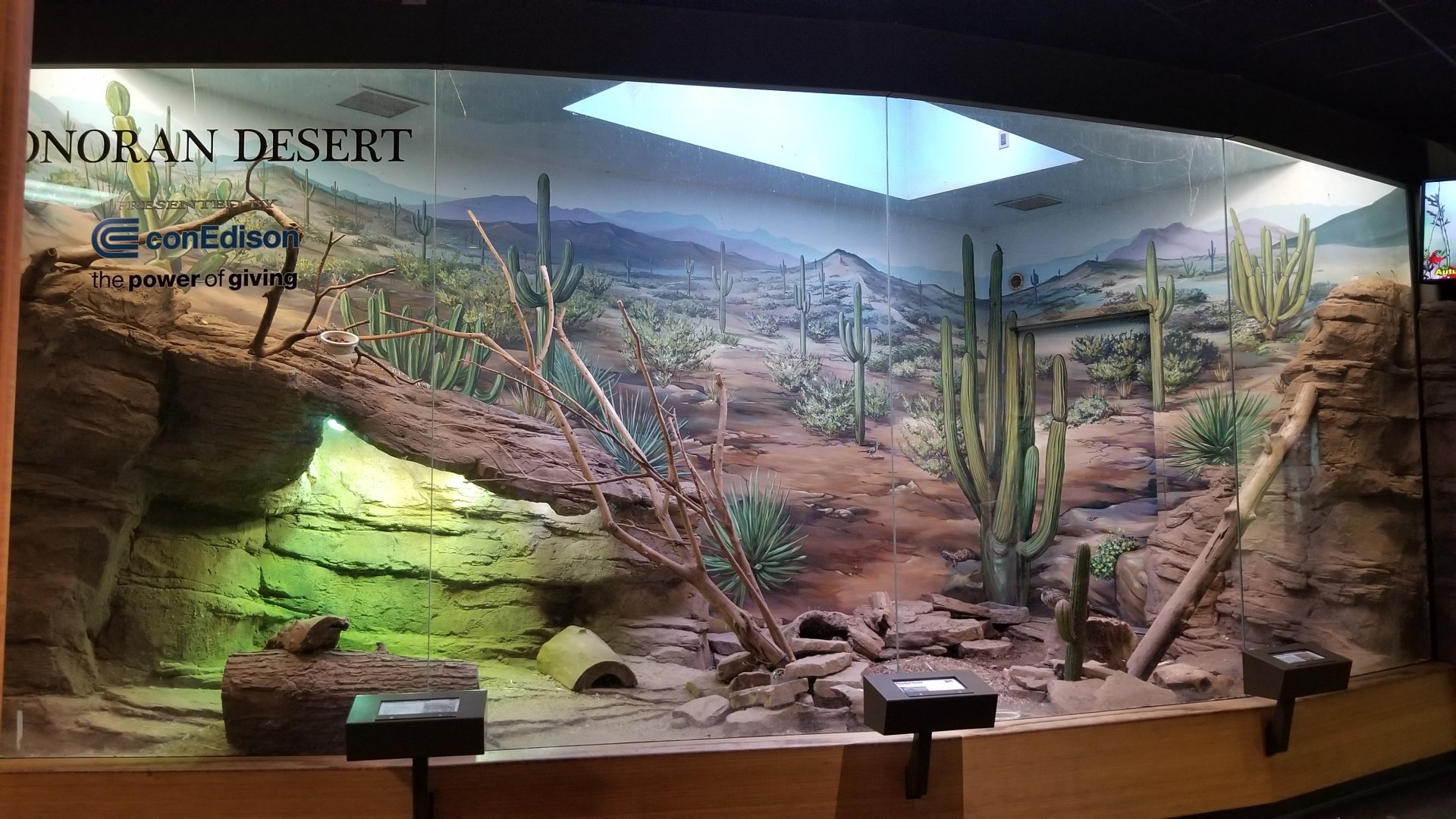
Another indoor desert exhibit I like that could serve as inspiration for another part of the dome is the Sonoran Desert habitat at the Staten Island Zoo. It is a mixed exhibit for roadrunners, beaded lizards, colorado river toads, and nine-banded armadillos, and seeing so many species in this exhibit all interacting was a very memorable experience for me—although I do not know if there would be space for something like that in this building.

 
I also think a lot of your elaborations on the species lists are alleviating some of my other concerns about this zone. Obviously orangutans are the all-star species featured in this complex, and so it is important for these great apes not to outshine everything else. The remaining galleries should feel substantial enough to stand on their own, without being overshadowed by the orangutan area.
Koalas are another extremely popular species that adds some weight to this zone, so it's not solely orangutans that are popular. Two other things help to alleviate some of the orangutan's popularity:
1. Location- Once inside, orangutans are near the middle of the interpretive center. As such, in order to see the indoor orangutan exhibit, visitors would have to walk through some of the other galleries to get there. Enough attractive signage and interactives, along with aesthetically well-designed areas would encourage people to stop and see other stuff instead of skipping right to the orangutans.
2. Interaction- There's a reason that children's museums and science museums are so popular- people can interact with stuff. This building draws on people's desire to touch stuff, play with stuff, etc. through the use of interactive stations in just about every room, with the most notable of course being the ability to climb through an anatomically correct mega-size turtle shell. At least for children, this turtle shell would likely be even more popular than the orangutans, but is also more educational (as they'd learn, and hopefully remember, that turtles have a backbone!)

For me, another downside of including Tigers in the Marco Polo Trail is that the complex already has enough large predatory species in the form of Asiatic Black Bears and Snow Leopards. Adding Greater One Horned Rhinos would be a better option than tigers, because the addition of the megaherbivores would help more fully represent the diversity of animals and ecological niches found in that part of Asia.
I haven't thought of that as a reason against the tigers there, but I do agree that it's another perk of putting tigers elsewhere in the zoo. Both Eld's Deer and Greater One-Horned Rhinos add more overall diversity to that section of the zoo, while Tigers would add more overall diversity to the Islands section of the zoo.

Another indoor desert exhibit I like that could serve as inspiration for another part of the dome is the Sonoran Desert habitat at the Staten Island Zoo. It is a mixed exhibit for roadrunners, beaded lizards, colorado river toads, and nine-banded armadillos, and seeing so many species in this exhibit all interacting was a very memorable experience for me—although I do not know if there would be space for something like that in this building.

While I'm not sure there's enough room for a second big mixed-species exhibit, Nine-Banded Armadillos are a species that the zoo has worked with behind-the-scenes and as an ambassador animal for years. I haven't thought of it as a species for the Deserts exhibit, but it may be a good idea to add armadillos to the main aviary, along with the owls/roadrunner/tortoises. The aviary could have rockwork designed to split it into two- with armadillos on one side, tortoises on the other, and the bird species able to access both halves. The zoo has four behind the scenes, perhaps the zoo could continue using two as ambassadors behind-the-scenes while moving two into this exhibit so visitors can see this unique species.
 
I grew up in New Hampshire but a trip to the zoo as a kid meant bypassing all of the Massachusetts institutions and going to Roger Williams. My parents just saw it as the best zoo around I suppose. Once I was older (early 2000's or so) we started visiting Franklin Park more regularly but I distinctly remember my parents calling Stone Zoo things like "small" and "sad". I didn't even realize places like Southwicks and Buttonwood existed until I was a teenager with internet access. I'm not claiming my parents were zoo experts by any means but they may have been good examples of the average zoo goer in New England. Roger Williams had that unbeatable combo of popular species and great exhibits.

Because of this, I think I've always held RWPZ to a higher standard in my mind. It has been interesting watching it grow and change just in my lifetime and if I am being frank a lot of the newer developments just didn't do it for me like some of the exhibits I remember did. (the original rainforest building was probably my favorite place on earth as a kid, the original tree kangaroo habitat that now houses hornbills I think had this really cool jurassic park vibe with how dense the planting was, and I think my favorite zoo memory overall was going to see the polar bear cub Triton) That's no discredit to the facility, they really do some incredible work and are arguably rather humble about it. It is cool to daydream about what the future could hold though. This thread is such a fun read, thanks!
 
southwicks used to be really bad, mainly the ring tailed lemurs, with a stereotypical big iron barred box, much like the old cartoons. stone zoo i dont know about in the past, but i always loved it.
 
southwicks used to be really bad, mainly the ring tailed lemurs, with a stereotypical big iron barred box, much like the old cartoons. stone zoo i dont know about in the past, but i always loved it.

The first time I went to Southwicks there was signage explaining that the younger monkeys of some species were small enough to fit through the exhibit mesh and not to touch them. Right as I was reading the sign I heard a woman scream and turned to see a young monkey (I think it was a mangaby or a guenon of some sort) sitting in a baby stroller with an admittedly delighted toddler.

More recent visits have impressed me though, the "african" leopard enclosure in particular was lovely and the new tapir yard seemed very comfortable for its residents.
 
yeah, they fixed it a while ago, the lemur enclosures i mean. also, i think the leopard, mowgli, might be a real african leopard, but i may be wrong
 
my sister had an experience the first time we went, a lemur had gotten through and my sister chased it around the cage
 
yeah, they fixed it a while ago, the lemur enclosures i mean. also, i think the leopard, mowgli, might be a real african leopard, but i may be wrong
There are no "real" African leopards in the US, and this has been discussed numerous times before on this forum. Mowgli was a generic leopard, just like the rest of the so-called Africans.
 
This was my whole point.

If theming is to be attempted, I would prefer the design is intricate enough to simulate emersion. The selection and inclusion of species also contributes to the theme. Amur tigers don't fit at all, and domestic camels have no conservation value. The red panda and crane enclosures should be connected and the muntjac could move there, too. Any well-represented male Persian onagers could replace the camels, or else Myanmar Eld's deer. Striped hyenas, dholes, or, by some miracle, new Asiatic black bears might/would be good animals for the bear enclosure. Maybe some of the following in enclosures where there is room, though there obviously won't be space for the bigger ones:

blue-crowned laughingthrush
Pallas's cat
Chinese alligator
northern treeshrew
Indian flying fox
Asian palm civet
Indian rhinoceros
Myanmar Eld's deer
northern white-cheeked gibbon
Asian forest tortoise

The Marco Polo section of the zoo was being discussed in the news thread, and since it (inevitably) turned speculative/fantastical, I figured that it'd be better to move the rest of the conversation to this thread. @wild boar I agree that some of those would be great choices, albeit a few are rather unrealistic. Here's what I'd argue as the ideal line-up for Marco Polo Adventure Trek:
- Greater One-horned Rhino/Eld's Deer mix- expand the camel exhibit over Nourish 401 (similar to what the masterplan shows for tigers). Feature signage on "Marco Polo's Unicorns", with Marco Polo's description of one, compared with a rhino.
- Chinese Alligator- re-imagination of Marco Polo Plaza into an exhibit for Chinese Alligators, titled "Lair of the Dragon", as that's how Marco Polo described the Chinese alligator.
- Pallas' Cat- a new exhibit could be built for these incredible felines, which Marco Polo likely encountered, in the space between the current camel and crane exhibits. I'm always a fan of zoos finding ways to use underutilized space, and there's a good amount of space in between those two exhibits that would be perfect for a pallas' cat habitat.
- Sloth Bear- since Marco Polo circumnavigated India as part of his return trip, sloth bears would be a fitting replacement for the Asiatic Black Bear. Bears are popular and awesome animals, and the exhibit is well-designed for them, so I'd love to see more bears in it after George's passing, with sloth bears being the best choice of species.
- Red-Crowned Crane, Red-Breasted Geese, Red-Billed Blue Magpie, Scaly-Sided Merganser- replace the crane exhibit with a large, netted-over aviary so that the cranes no longer need to be flight-restricted. This also allows other birds to be incorporated into the exhibit, for instance adding waterfowl such as the red-breasted geese and scaly-sided merganser, and adding magpies for sky-level interest. Other birds could also feasibly work in this space as well, and I'm open to suggestions for other cold-tolerant, Asian bird species that could join this space as well. I thought about tragopans or pheasants, but am skeptical of if they could successfully mix with the cranes.
- Red Panda, Reeve's Muntjac- move the muntjac into the red panda exhibit and add an indoor exhibit for the pandas so that they are visible in the summer months.
- Snow Leopard- keep the existing snow leopard exhibit.
- Sichuan Takin- keep the existing takin exhibit.
- Cinereous Vulture- birds-of-prey were another species described by Marco Polo, in particular descriptions of falconers when in the city of Xanadu (the summer capital of the Yuan Dynasty). As such, I feel it would be appropriate to add an exhibit for a Eurasian raptor species, and these vultures would be an impressive choice for a species.
- Francois' Langur/White-Cheeked Gibbon- the current animal ambassador area, along with the snake den and black vulture exhibit, can be demolished to make way for an expansion of this region, specifically the construction of a series of primate habitats for langurs and gibbons.
 
The Marco Polo section of the zoo was being discussed in the news thread, and since it (inevitably) turned speculative/fantastical, I figured that it'd be better to move the rest of the conversation to this thread. @wild boar I agree that some of those would be great choices, albeit a few are rather unrealistic. Here's what I'd argue as the ideal line-up for Marco Polo Adventure Trek:
- Greater One-horned Rhino/Eld's Deer mix- expand the camel exhibit over Nourish 401 (similar to what the masterplan shows for tigers). Feature signage on "Marco Polo's Unicorns", with Marco Polo's description of one, compared with a rhino.
- Chinese Alligator- re-imagination of Marco Polo Plaza into an exhibit for Chinese Alligators, titled "Lair of the Dragon", as that's how Marco Polo described the Chinese alligator.
- Pallas' Cat- a new exhibit could be built for these incredible felines, which Marco Polo likely encountered, in the space between the current camel and crane exhibits. I'm always a fan of zoos finding ways to use underutilized space, and there's a good amount of space in between those two exhibits that would be perfect for a pallas' cat habitat.
- Sloth Bear- since Marco Polo circumnavigated India as part of his return trip, sloth bears would be a fitting replacement for the Asiatic Black Bear. Bears are popular and awesome animals, and the exhibit is well-designed for them, so I'd love to see more bears in it after George's passing, with sloth bears being the best choice of species.
- Red-Crowned Crane, Red-Breasted Geese, Red-Billed Blue Magpie, Scaly-Sided Merganser- replace the crane exhibit with a large, netted-over aviary so that the cranes no longer need to be flight-restricted. This also allows other birds to be incorporated into the exhibit, for instance adding waterfowl such as the red-breasted geese and scaly-sided merganser, and adding magpies for sky-level interest. Other birds could also feasibly work in this space as well, and I'm open to suggestions for other cold-tolerant, Asian bird species that could join this space as well. I thought about tragopans or pheasants, but am skeptical of if they could successfully mix with the cranes.
- Red Panda, Reeve's Muntjac- move the muntjac into the red panda exhibit and add an indoor exhibit for the pandas so that they are visible in the summer months.
- Snow Leopard- keep the existing snow leopard exhibit.
- Sichuan Takin- keep the existing takin exhibit.
- Cinereous Vulture- birds-of-prey were another species described by Marco Polo, in particular descriptions of falconers when in the city of Xanadu (the summer capital of the Yuan Dynasty). As such, I feel it would be appropriate to add an exhibit for a Eurasian raptor species, and these vultures would be an impressive choice for a species.
- Francois' Langur/White-Cheeked Gibbon- the current animal ambassador area, along with the snake den and black vulture exhibit, can be demolished to make way for an expansion of this region, specifically the construction of a series of primate habitats for langurs and gibbons.
I know tigers should *still* be in the plan for what to do with the Marco Polo Trail - maybe they could be placed in a space adjoining your proposed area for the langurs/gibbons? (In a hillside exhibit)
 
I know tigers should *still* be in the plan for what to do with the Marco Polo Trail - maybe they could be placed in a space adjoining your proposed area for the langurs/gibbons? (In a hillside exhibit)
Yeah, that could be a possibility. Personally, I'm not a big cat person, so the prospects of bringing tigers to Roger Williams doesn't excite me too much, but I understand that a lot of others want to see tigers so could see something like that working. When I made my theoretical masterplan earlier in this thread, I opted for malayan tigers in the Islands complex instead of amurs in Marco Polo, and stand by that a better spot for tigers would be in the Islands-themed zone, specifically an expansion of Islands over the current farmyard.
 
Faces of the Rainforest
This exhibit has admittedly grown on me, and a lot of the criticisms from when it first open I no longer agree with. However, there are a few ways I'd like to see this complex improve, starting with utilizing some of the empty space between the Administration Building and Faces for an exhibit for Jaguars. This is a species the zoo's director has done a lot of work with in the past (and is the SSP leader for), so is an ideal choice for a new, popular species for the zoo. Furthermore, this is an ideal choice of a location since it fits in well with the South American theme and creates a small pseudo-themed exhibit for big cats, across the way from the proposed Tiger exhibit.

Inside, nothing really needs to change in this exhibit, although some new additions and returns of old species to the large walk-through aviary would be nice, such as Bearded Emperor Tamarins, Crested Oropendola, Red-Crested Cardinals, and Green-Backed Trogons.

Ideally, a new, larger aviary will be constructed outdoors to replace the current flamingo exhibit and some of the empty space in front of the building. This could be a walk-through aviary, shared between the flamingos and some waterfowl, namely Puna Teals, Chiloe Wigeons, and Coscoroba Swans.

One sore spot in this area is that the old Tropical America Building remains standing but not open to the public. As long as it remains safe and not disruptive to do so, I would love to see this building re-opened under a new name: Faces of the Rainforest: After Dark. It was already fairly dark in that building to begin with, so turning it into a nocturnal display would be a natural choice. Five large exhibits will be incorporated into this building, housing Ocelots, Common Vampire Bats, Prehensile-tailed Porcupines, Spectacled Owls, and a mixed species exhibit for Red-Rumped Agoutis and Nancy Ma's Night Monkeys, although the last one is dependent on them being acquirable, which is questionable at best. Space-dependent, some smaller terrariums can be incorporated into this building as well for herps and inverts from Neotropical environments.
Since it opened, Faces of the Rainforest has always been my favorite exhibit at the zoo. I really like the building, and think that the final result is much better than what was intended. Maned wolves not being included, because they don't inhabit rainforests; no ridiculous attempt at South American-themed architecture; and separate enclosures that allow for species that couldn't be exhibited in a walk-through area to be kept all contribute to this.

Tropical America should have been demolished, and I would have replaced it with a large enclosure, encompassing the land occupied by flamingos, for the following:
1. Baird's tapir
2. capybara
3. roseate spoonbill
4. Central American red brocket deer*
5. a rare spider monkey species*
a. not variegated spider monkeys because they should be consolidated in Europe
b. Peruvian spider monkeys or red-faced spider monkeys would both work equally well
6. South American comb duck
7. Orinoco goose
8. giant anteater (already at the zoo)
9. American flamingo (instead of Chilean flamingos)
10. collared peccary*

A second building that mirrors the design of the current Faces of the Rainforest building is something that I would love to see for the following species together as below:
1. blue dacnis, Brazilian teal, Jamaican fruit bat, red-handed tamarin*, crested oropendola, coppery titi*, pompadour cotinga, lowland paca, paradise tanager, curl-crested aracari, wattled jacana, Peruvian pigeon*
2. gray-handed night monkey*, Geoffroy's tamarin*, red-faced spider monkey* (or Peruvian spider monkeys*, only in winter)
3. emerald tree boa, Amazon milk frog
4. Brazilian rainbow boa, strawberry poison dart frog
5. smooth helmeted iguana, green-and-black poison dart frog
6. yellow-spotted Amazon river turtle, black pacu, kinkajou, ocellate river stingray, other fish?
7. smooth-fronted caiman* (or black caiman*)
8. harpy eagle*
9. jaguar
10. channel-billed toucan* (or white-throated toucan)

Some of those species would benefit from being outside, and there are a few others that I would like to see at the zoo. The Roger Williams Park Zoo and Zoo New England could work together to reestablish bush dogs in North American zoos. Five outdoor enclosures would hold:
1. jaguar
2. harpy eagle*
3. kinkajou
4. bush dog*
5. ocelot

As for species that you mentioned could be reintroduced to the zoo, I disagree with you about every one, except for maybe the trogon. If am pretty sure that one of the reasons for removing the troupials and oropendolas was that they look a lot like yellow-rumped caciques to the average visitor and apparently that hinders educational prospects. Staff have become heavily invested in trying to breed their caciques, and that couldn't've helped. I would prefer to see Geoffrey's tamarins or pied tamarins instead of emperor tamarins, cotton-top tamarins, golden-head lion tamarins, pygmy marmosets, and Goeldi's monkeys, because those species are found in nearby collections. This is just my personal preference, though. I would rather see guira cuckoos, helmeted curassows, white-faced whistling ducks, and ring-necked ducks return, and a new species, the crimson-rumped toucanet*.

There is a very real possibility that jaguars will be in Rhode Island at some point in the future, what with Stacey Johnson, the director, being involved in the SSP. Other animals, especially those with an asterisk, have almost no chance of ever being kept here, but I can still dream.

This Faces of the Rainforest expansion has been recurring in all my renditions of the zoo's future and imaginary plans. There are other things I can realistically want that could be mentioned, too.
 
Maned wolves not being included, because they don't inhabit rainforests
Do you feel this way about Chilean Flamingos as well, as they are not a Rainforest species?

Tropical America should have been demolished, and I would have replaced it with a large enclosure, encompassing the land occupied by flamingos, for the following:
If you're considering when they were building Faces, I can agree with this, however, it wouldn't make sense to demolish Tropical America now because part of it is used to store Faces of the Rainforest's life support systems. They'd be better off keeping the building and repurposing it, either for more Neotropical species or to be able to compare/contrast with a Rainforest from elsewhere in the world (e.g. The Congo or Southeast Asia). I'd be equally happy with either of these, but would just love for the building to see use as an animal building again! It's also historically significant, so I'd hate to see the building outright demolished if it didn't have to be.

Tropical America should have been demolished, and I would have replaced it with a large enclosure, encompassing the land occupied by flamingos, for the following:
1. Baird's tapir
2. capybara
3. roseate spoonbill
4. Central American red brocket deer*
5. a rare spider monkey species*
a. not variegated spider monkeys because they should be consolidated in Europe
b. Peruvian spider monkeys or red-faced spider monkeys would both work equally well
6. South American comb duck
7. Orinoco goose
8. giant anteater (already at the zoo)
9. American flamingo (instead of Chilean flamingos)
10. collared peccary*

A second building that mirrors the design of the current Faces of the Rainforest building is something that I would love to see for the following species together as below:
1. blue dacnis, Brazilian teal, Jamaican fruit bat, red-handed tamarin*, crested oropendola, coppery titi*, pompadour cotinga, lowland paca, paradise tanager, curl-crested aracari, wattled jacana, Peruvian pigeon*
2. gray-handed night monkey*, Geoffroy's tamarin*, red-faced spider monkey* (or Peruvian spider monkeys*, only in winter)
3. emerald tree boa, Amazon milk frog
4. Brazilian rainbow boa, strawberry poison dart frog
5. smooth helmeted iguana, green-and-black poison dart frog
6. yellow-spotted Amazon river turtle, black pacu, kinkajou, ocellate river stingray, other fish?
7. smooth-fronted caiman* (or black caiman*)
8. harpy eagle*
9. jaguar
10. channel-billed toucan* (or white-throated toucan)
Personally, I don't see the value in getting super rare species that there isn't much interest for elsewhere in the country. There are already great programs for Geoffroy's and Robust Black Spider Monkeys, for instance, so if a spider monkey was to happen (and it'd be great if it did- they're awesome species), I'd want the zoo to contribute to an existing SSP. Capybara would be a pretty good choice for a new animals, so I'd agree with them as a potential future inclusion. Roseate Spoonbills and a Podocnemis species are also good choices for potential additions to the building, and would work well in the existing walk-through segment. If that first one you mentioned is an idea for a mixed-species exhibit, it'd end in a disaster. While all of the species are individually super neat, there are a few in there that are notoriously aggressive (collared peccary) or notoriously fractious/flighty (flamingos). Sloths are the only mammal I'd trust mixed with flamingos, and the peccaries I wouldn't trust mixed with anything.
As for species that you mentioned could be reintroduced to the zoo, I disagree with you about every one, except for maybe the trogon. If am pretty sure that one of the reasons for removing the troupials and oropendolas was that they look a lot like yellow-rumped caciques to the average visitor and apparently that hinders educational prospects. Staff have become heavily invested in trying to breed their caciques, and that couldn't've helped.
I don't really see how having multiple similar species "hinders educational prospects"? It's also extremely easy to tell the three species apart as they are all different colors, but I digress. What's your rationale against red-crested cardinals? They're a gorgeous species that I think would make a great inclusion in the area.
I would prefer to see Geoffrey's tamarins or pied tamarins instead of emperor tamarins, cotton-top tamarins, golden-head lion tamarins, pygmy marmosets, and Goeldi's monkeys, because those species are found in nearby collections. This is just my personal preference, though. I would rather see guira cuckoos, helmeted curassows, white-faced whistling ducks, and ring-necked ducks return, and a new species, the crimson-rumped toucanet*.
Geoffroy's tamarins are on their last legs in US zoos, and I don't forsee that changing anytime soon. Pied tamarins also were a terrible choice for the walk-through to begin with, as they have a reputation of being mean animals not just at RWPZ, but at zoos across the country. Most people also don't care enough about the species of callichthrid for it to matter what second species is added, but I agree a second species would be a nice addition. I didn't realize guira cuckoos left the collection, but I agree I'd like to see them return. Helmeted curassows were replaced with the piping guans, and I'd prefer the zoo stick with the latter. I disagree on those two duck species as they are ridiculously common, non-SSP species that take up valuable space from species more deserving of space in zoos. Brazilian teal would be a better choice, or an even better one would be to drop the South American exclusivity and get some Madagascar Teals. I'd also like to see tinamous return, but that's extremely unlikely given the current state of the US population. I wouldn't trust toucanets, or any Piciformes, in a walk-through setting.

It's also worth noting that my suggestions were merely possibilities that I know would be reasonable to source, I more so was advocating for the basic idea that Faces of the Rainforest would be able to accommodate a few additional species, and I'd love to see some new additions arrive. I really don't have strong feelings about any particular species to include, but just that I'd like to see a few more species added to the exhibit.
 
I believe it's pretty well accepted nowadays that the extinct Caspian Tiger population was not distinct from extent Amur Tigers.
I find new reports that change taxonomic understanding to be rather interesting. I have become well aware of the conflicting views on tiger taxonomy in terms of the two subspecies model or nine subspecies model, but this is news to me. Could you direct me toward research papers that explain this?

At the least, the two were extremely similar and Amur Tiger makes for a great stand in for the extirpated populations.
Well somethimes a zoo has no choice but get what is available at the time rather than make 100% accurate exhibits.
This is the sad truth. I would prefer that, when it is avoidable, in this case by not including tigers, it doesn't occur. This example might be a bit more contentious, but the Houston Zoo could have sourced lowland tapirs from a private breeder, and I'm fairly certain there are many, instead of Baird's tapirs, which is an inaccurate portrayal of the Pantanal.

I don't want to derail the news thread further, as was pointed out to me, so this conversation can be continued here.
 
This is the sad truth. I would prefer that, when it is avoidable, in this case by not including tigers, it doesn't occur. This example might be a bit more contentious, but the Houston Zoo could have sourced lowland tapirs from a private breeder, and I'm fairly certain there are many, instead of Baird's tapirs, which is an inaccurate portrayal of the Pantanal.
But would it be ethical to do so? Choosing the more endangered, AZA-managed species is a logical choice over choosing a non-threatened species that, while present in the private trade, has no value to the AZA's population management. Furthermore, many of these "private breeders" have questionable standards of welfare, sourcing of animals, and overall care, so I wouldn't want to see reputable zoos supporting them unless an individual place is thoroughly vetted. It's not helpful to anyone to be pedantic about exhibits to the point of encouraging zoos to abandon their conservation mission to get an 100% accurate species list when the average visitor wouldn't even notice the difference.
 
Furthermore, many of these "private breeders" have questionable standards of welfare, sourcing of animals, and overall care, so I wouldn't want to see reputable zoos supporting them unless an individual place is thoroughly vetted.
There are a couple of "reputable zoos" that participate in lowland tapir breeding. The Brookfield, John Ball, and Alexandria zoos all have this species. I am pretty sure that either the Wildlife World Zoo or the Metro Richmond Zoo (I get them confused) regularly work with the AZA, which certainly counts for something.

It's not helpful to anyone to be pedantic about exhibits to the point of encouraging zoos to abandon their conservation mission to get an 100% accurate species list when the average visitor wouldn't even notice the difference.
Houston does a fair bit of conservation work for lowland tapirs, despite them having Baird's tapirs, so "abandon" might not be a good word here. Even if they didn't contribute to in situ programs, the educational aspects of keeping lowland tapirs are the same (I know this argument can be used both ways). It's not as if the wild lowland tapir population is thriving, either. In my own personal experience, zoos that publicize their uncommonly-kept species will even receive more favor, so some visitors do care.

But would it be ethical to do so? Choosing the more endangered, AZA-managed species is a logical choice over choosing a non-threatened species that, while present in the private trade, has no value to the AZA's population management.
The AZA's population management decisions make sense from a legislative perspective, but shouldn't be followed like ducklings and whoever they see first. It seems odd to me that some ZooChatters love the decisions to import small carnivores or maintain a gaur population, but at the same time are critical of the concept itself. I don't think I should be lectured on what is ethical, because everyone has their own idea of what is right and wrong.
 
There are a couple of "reputable zoos" that participate in lowland tapir breeding. The Brookfield, John Ball, and Alexandria zoos all have this species. I am pretty sure that either the Wildlife World Zoo or the Metro Richmond Zoo (I get them confused) regularly work with the AZA, which certainly counts for something.
All of the AZA holders of Brazilian tapirs should have aging individuals that are not breeding. Once these individuals pass, I would expect the zoos to replace them with TAG-recommended species. I also wouldn't consider Wildlife World or Metro Richmond to be reputable, and both regularly associate with some of the worst of the worst of the private zoo world (especially Wildlife World, which has been involved in wildlife trafficking).

Houston does a fair bit of conservation work for lowland tapirs, despite them having Baird's tapirs, so "abandon" might not be a good word here. Even if they didn't contribute to in situ programs, the educational aspects of keeping lowland tapirs are the same (I know this argument can be used both ways). It's not as if the wild lowland tapir population is thriving, either. In my own personal experience, zoos that publicize their uncommonly-kept species will even receive more favor, so some visitors do care.
Most zoos separate their in-situ and ex-situ conservation goals. Houston may chose to do in-situ conservation work with Lowland tapirs, and many zoos do in-situ work with species not in their collection. However, from an ex-situ perspective, zoos should be contributing to demographically healthy assurance populations, which means opting for Baird's Tapir, the species being managed ex-situ in the United States. Lowland tapirs have a successful assurance population in Europe, and is an example of each continent managing different species to maximize conservation Impact.

The AZA's population management decisions make sense from a legislative perspective, but shouldn't be followed like ducklings and whoever they see first. It seems odd to me that some ZooChatters love the decisions to import small carnivores or maintain a gaur population, but at the same time are critical of the concept itself. I don't think I should be lectured on what is ethical, because everyone has their own idea of what is right and wrong.
I'm not trying to "lecture" you on what is ethical, and I apologize if I came across that way. Instead, I was presenting an ethical argument for why I agree with Houston Zoo's decision to maintain Baird's Tapirs. If you disagree with that argument, that's completely fine, and people are allowed differing ideas on ethics, morality, and what they are comfortable with.

I will say that I have never talked about on here the import of small carnivores, so I don't know why you're bringing up the bit about being "critical of the concept itself". I believe that AZA Zoos should, as much as feasible, participate in SSPs and other TAG recommended program. Sure, there are specific instances where a program can be individually evaluated and a zoo can make an ethically sound decision to keep a non-recommended species (gaur is a good example of this), but cases where I agree with ignoring TAG recommendations are few and far between. However, this is a topic for another thread, so if you want to start a thread about when it's appropriate for AZA Zoos to ignore TAG recommendations, be my guest, however this isn't the place to be having this conversation.
 
Do you feel this way about Chilean Flamingos as well, as they are not a Rainforest species?
Elegant crested tinamous, maned wolves, red-crested cardinals, and Chilean flamingoes are all species that aren't naturally found in or are only in small pockets of tropical rainforests. Not including them is purely just my preference. Trogons aren't my favorite, either, for no particular reason (I know its odd).

If you're considering when they were building Faces, I can agree with this, however, it wouldn't make sense to demolish Tropical America now because part of it is used to store Faces of the Rainforest's life support systems.
I did mean when they were building the new rainforest building. I was not aware that the life support systems are here. I think I remember that vaguely now that you mention it, but wouldn't have otherwise. Now that Faces of the Rainforest is constructed on other land, removing it makes no sense. A lot of the zoo's history pertains to this building, and it would also be inefficient to remove when it could be used as holding for the mixed species enclosure I would like to see built.

They'd be better off keeping the building and repurposing it, either for more Neotropical species or to be able to compare/contrast with a Rainforest from elsewhere in the world (e.g. The Congo or Southeast Asia). I'd be equally happy with either of these, but would just love for the building to see use as an animal building again!
I think using it for tapirs, capybaras, and other animals' holding would be better, but I guess that technically agrees with your thoughts.

While all of the species are individually super neat, there are a few in there that are notoriously aggressive (collared peccary) or notoriously fractious/flighty (flamingos).
I didn't know that peccaries are that aggressive. I figured that warthogs are fine in many enclosures, so peccaries would also be. Of course, I didn't take into account how destructive and antagonistic red river hogs can be, either. Would this enclosure work if the suiformes were removed and no other changes were made?
 
Back
Top