Marwell Wildlife Marwell Zoo as it stands - a depthly review

I just had a look at the Marwell gallery - and there's plenty of old stuff on there that will likely interest you (some of it mine). Go to last page first (Page 131 currently) and work backwards.

The scary thing is that most of these photos aren’t that old! Quite depressing how things can change so quickly.
 
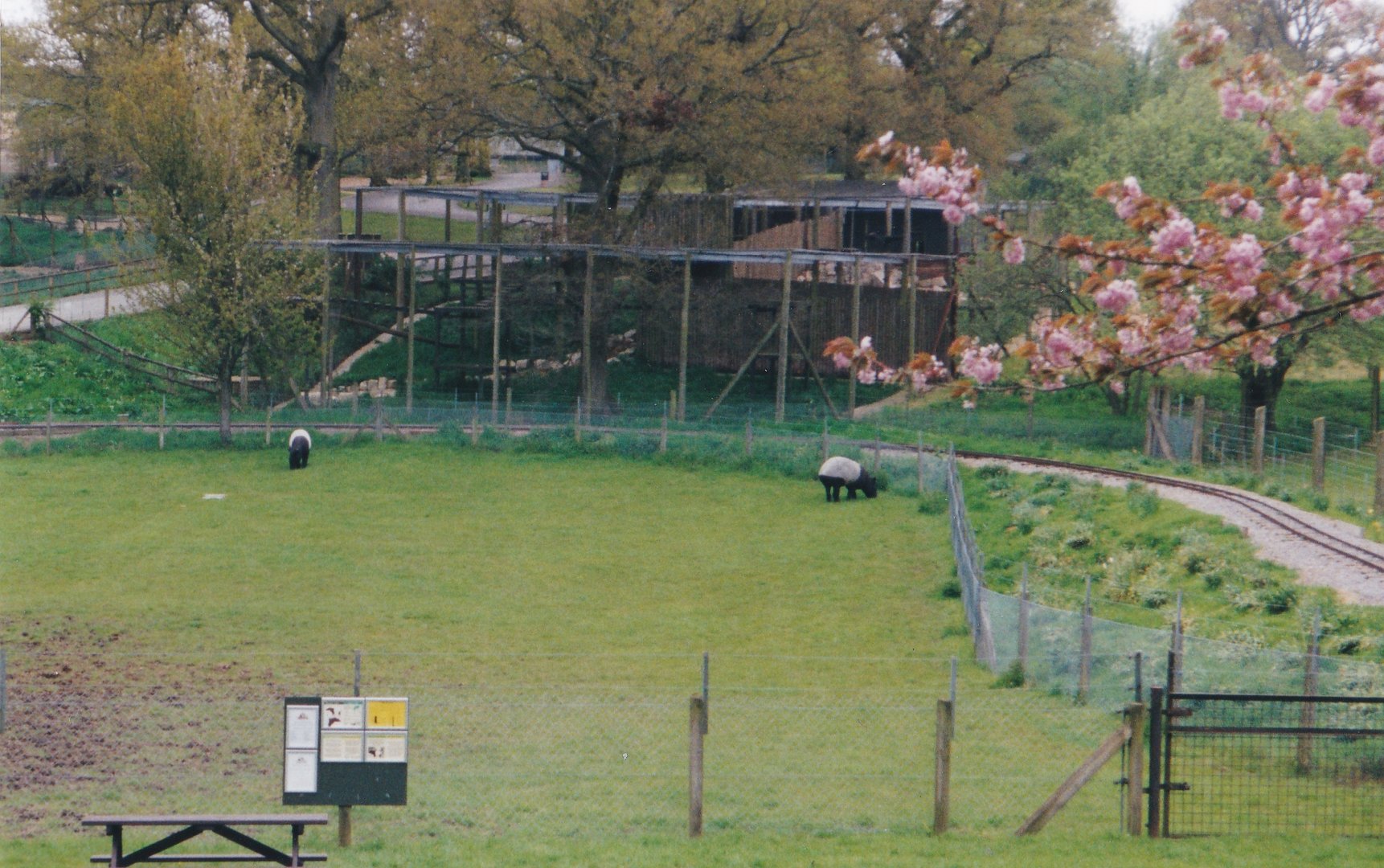
Very nice ! I wonder what the signs are saying ...
Would be nice if Marwell did Malayan Tapir again someday .. though as it is, Marwell don't seem to have had much breeding success with either of their tapir species !
If I remember correctly, the right hand four signs gave information about the tapirs, including a warning not to stand close to the fence if you didn't want to get sprayed, and the left two were names of adopters (of tapir and hippo).
 
Formerly: Common wombat, brushtail possum, western grey kangaroo, common wallaroo
I notice that two of the four marsupials here were only held in Marwell's early days - a common metric point for measuring Marwell's 'animal decline' is typically past the year 2000, or beyond the era of Knowles. Depending on how you look at it, the latter ended in 1998, when Knowles resigned from main director [but remained as honorary director], or in 2006 when he resigned from Marwell altogether. From hereon, I will be emboldening species of similar situation - which left prior 2000.
Northern giant mouse lemur, Alaotran gentle lemur, potto, Senegal galago, Geoffroy's marmoset, Illiger's saddle-backed and Geoffroy's tamarins, Bolivian and common squirrel monkeys, lemurine night monkey, crested black macaque, patas, De Brazza's, Hamlyn's and Diana monkeys, king colobus
The owl-faced monkey was only held for the span of a single year, as was the Bolivian Squirrel Monkey.
Rodents: Formerly: Riborovski's desert and common hamsters, great Balkhan brush-tailed mouse, Gambian giant pouched rat, giant jumping rat, Southern African pouched mouse, Allen's mountain, Levant, reed and Eurasian water voles, steppe lemming, bushy-tailed, Mongolian, Persian, Shaw's and fat-tailed jirds, Flower's and Indian gerbils, Arabian and Turkish spiny mouse, Eurasian harvest mouse, Matthey's, house and mltimammate mice, black rat, Edward's swamp rat, Cape and crested porcupines, Brazilian guinea pig, Patagonian mara, capybara, Central American and red-rumped agoutis, long-tailed chinchilla, degu, red, Palas's, Prevost's and Guavaquil squirrels, Siberian chipmunk, forest African dormouse
Insectivores: Formerly: North African desert hedgehog
I must ask - how many of these rodents + insectivores were on-show, actually ? A number of these rodents didn't live at Marwell for much longer than a year. I recall that the Giant Pouched Rat was given to Marwell as a customs seizure in the early 2000s. Given that nowhere else would've kept Tunisian House Mouse in 1999, I'm inclined to believe that it would've been a customs seizure too. The species I did not underline I am fairly confident that they were onshow at some point, Though I will ask about the chinchilla - I'm not sure if they were ever on show at Marwell as exhibit animals? If anything, I'd imagine they were used as ambassador animals - but, if they were on-show, I'd imagine Encounter Village would've been the most logical location. Though, the African Dormouse was, apparently, kept until 2015 - I wonder where they were held all those years?
Formerly: Reeves' muntjac, fallow, hog, axis, Pere David's and Indian swamp deer, sika, Javan rusa, southern pudu. blackbuck, Arabian mountain, Thomson's and dama gazelles, long-tailed goral, takin, European bison, African buffalo, nilgai, greater kudu, common eland, common waterbuck, Nile lechwe, sable antelope, gemsbok, impala, white-tailed gnu, blue and Maxwell's duikers, wild boar, common warthog, Sulawesi babirusa, collared peccary, guanaco and vicuna
And here I have a few problems .. in that most of these species were held prior to the 2000s. Most of the deer left priot to 2000. Blue duiker was never put on-show at Marwell, only held behind the scenes. Vicuna was held until 2013, though afaik was held BTS for several years.
I will also add to a comment I made previously about reindeer - it could've been that reindeer were only held on-show during the Winter period at Encounter Village - I have yet to see any evidence of them being held at EV at other times of the year.
 
Formerly: Asiatic wild ass, Malayan tapir, black rhinoceros
Two of these species were held prior to the 90's.
Formerly: Lion, leopard, jaguar, sand and black-footed cats,northern lynx, caracal, cheetah, leopard cat,banded and dwarf mongooses, fosa, bush dog, fennec, bat-eared fox, maned wolf, African wild dog,sun bear, striped skunk, South American coati
From what I recall, the black-footed cat survived only a year. The leopard cat iirc never came on-show, held during Marwell's earlier days. As was Sun Bear. Though, I will say in regards to bush dogs - they are due to return to the collection soon enough in April 2023.
I find it is one thing to lament about Marwell's declining collection since the 'glory days' [whenever they were], and another to back up your claims with animals that were not held in the 2000s, and/or others that were held only for brief periods of time, sometimes off-show.
 
I notice that two of the four marsupials here were only held in Marwell's early days - a common metric point for measuring Marwell's 'animal decline' is typically past the year 2000, or beyond the era of Knowles. Depending on how you look at it, the latter ended in 1998, when Knowles resigned from main director [but remained as honorary director], or in 2006 when he resigned from Marwell altogether. From hereon, I will be emboldening species of similar situation - which left prior 2000.

The owl-faced monkey was only held for the span of a single year, as was the Bolivian Squirrel Monkey.

I must ask - how many of these rodents + insectivores were on-show, actually ? A number of these rodents didn't live at Marwell for much longer than a year. I recall that the Giant Pouched Rat was given to Marwell as a customs seizure in the early 2000s. Given that nowhere else would've kept Tunisian House Mouse in 1999, I'm inclined to believe that it would've been a customs seizure too. The species I did not underline I am fairly confident that they were onshow at some point, Though I will ask about the chinchilla - I'm not sure if they were ever on show at Marwell as exhibit animals? If anything, I'd imagine they were used as ambassador animals - but, if they were on-show, I'd imagine Encounter Village would've been the most logical location. Though, the African Dormouse was, apparently, kept until 2015 - I wonder where they were held all those years?

And here I have a few problems .. in that most of these species were held prior to the 2000s. Most of the deer left priot to 2000. Blue duiker was never put on-show at Marwell, only held behind the scenes. Vicuna was held until 2013, though afaik was held BTS for several years.
I will also add to a comment I made previously about reindeer - it could've been that reindeer were only held on-show during the Winter period at Encounter Village - I have yet to see any evidence of them being held at EV at other times of the year.
As regards Encounter Village Reindeer first arrived at Marwell in1991 they were always held in EV all year long and bred there, the last one left in 2004,there were also there Poitou Donkey, Dwarf Zebu, Pot Bellied Pig, Dwarf Goats, and Camels they were used in the summer months to give children rides in an area close bye. Vicuna first arrived in 1986 from London they were always on show, unlike the Blue Duiker which were not but bred I saw them but they were always very nervous.
 
As regards Encounter Village Reindeer first arrived at Marwell in1991 they were always held in EV all year long and bred there, the last one left in 2004,there were also there Poitou Donkey, Dwarf Zebu, Pot Bellied Pig, Dwarf Goats, and Camels they were used in the summer months to give children rides in an area close bye. Vicuna first arrived in 1986 from London they were always on show, unlike the Blue Duiker which were not but bred I saw them but they were always very nervous.
Though I will say in regards to reindeer - the main problem I had with the idea of them being in EV year round was that at times of the year they would shed their coat, and grow sensitive velvet - surely non-condusive with animals being kept in close touching proximity with visitors?
 
I was thinking of doing something recently to analyse the true scale of Marwell’s purported decline -
Namely a report of comparison between Marwell’s mammal collection over a period of 20 or so years.
I have chosen to limit such thing to mammals solely for various reasons -
1] Mammals are the most often-cited evidence of the ‘decline’. Whilst some birds have come and gone, I find mammals as a better metric for Marwell.
2] Marwell has historically specialised mainly in mammals, and continues to do so today. Where their bird and reptile collections have fluctuated a fair bit, mammals have stayed somewhat constant.
3] One is able to get a fairly good idea of where the mammals at Marwell resided. Whereas, in the case of other animals, their exact location, historically, is less archived.
I have limited my range basically to 2000 onwards - as that is amongst the most-cited comparison point for Marwell. We also have clearer records of what lived at Marwell in 2000 and onwards than in prior years.
I hope to start this soon.
 
Though I will say in regards to reindeer - the main problem I had with the idea of them being in EV year round was that at times of the year they would shed their coat, and grow sensitive velvet - surely non-condusive with animals being kept in close touching proximity with visitors?
The barriers did not normally allow visitors to touch the reindeer.
 
I was thinking of doing something recently to analyse the true scale of Marwell’s purported decline -
Namely a report of comparison between Marwell’s mammal collection over a period of 20 or so years.
I have chosen to limit such thing to mammals solely for various reasons -
1] Mammals are the most often-cited evidence of the ‘decline’. Whilst some birds have come and gone, I find mammals as a better metric for Marwell.
2] Marwell has historically specialised mainly in mammals, and continues to do so today. Where their bird and reptile collections have fluctuated a fair bit, mammals have stayed somewhat constant.
3] One is able to get a fairly good idea of where the mammals at Marwell resided. Whereas, in the case of other animals, their exact location, historically, is less archived.
I have limited my range basically to 2000 onwards - as that is amongst the most-cited comparison point for Marwell. We also have clearer records of what lived at Marwell in 2000 and onwards than in prior years.
I hope to start this soon.
Statistics on species and specimens are recorded in the Annual Reports, so there will be no surprises, to those interested, in the changes over the years, but there seems to be little validity . in the exercise unless the records are compared to other similar sized UK collections over the same period.
 
Part 1 - Hoofed Animals

I supposed I would start this off by tackling perhaps the most fundamental group of animals at Marwell of all - hoofed animals. They are what Knowles built Marwell off essentially, and one of the most-commonly brought up points in regards to Marwell’s decline. For the purposes of this section, I will be counting even-hoofed and odd-hoofed animals together - so my numbers will be counting the rhinoceros, hippos, and tapirs.

In 2000, Marwell had about 40 or so species of hoofed animal. I use the words tentatively, as the exact number could depend on who one asks. In 2000, Marwell held both Zebu and Ankole Cattle - and also both Exmoor Pony and Przewalski’s Horse. It also held both Poitou donkeys and Wild Asses. Depending on how you split either group, you either have 40 species in 2000, or 42. These numbers are inclusive of domesticated animals, namely llamas, Bactrian camels, reindeer, zebu, donkeys, Exmoor ponies, pot-bellied pigs, Ankole cattle, goats and sheep. Overall, of the 40 odd hoofed species held at Marwell in 2000, 10 or so of these were domesticated animals. Most of these - namely all but the camels and Ankole, were held in the Encounter Village, and several left in 2006, when the Village closed as a childrens’ farm. Some left earlier - reindeer left in 2004, donkeys in 2002, and pot-bellied pigs around 2003. The Ankole, however, stayed until 2010 - and the camels until 2018.

In 2007, Marwell held a total of, by the end of that year, 32 species of hoofed mammal. In addition to the domestics departing as already stated, the change in number also accounts for the departure of Reeves’ Muntjac [2004], Mountain Gazelle [2002], Lesser Malayan Chevrotain [2004 - was later re-acquired in 2017, but departed again in 2022], and Malayan Tapir [2005] - and acquisition of Takin [2004]. In regards to the Mountain Gazelle, I am not totally sure what led to their departure, as at the time there were still several others in the UK. The muntjac I can understand slightly more - my belief is that as time passed as Marwell held muntjac, legislature was put in place which refused Marwell to get any more. Chevrotain I am not sure either about the circumstances of their departure in 2004, though I am aware that, for one reason or another, Marwell lost their entire group in 2022. I believe with tapirs it was merely a case of bad luck - as they rarely bred at Marwell, and their death was found to be a result of sudden medical problems. Today at Marwell, 25 hoofed species are present - where 15 species in all have left since 2007, 8 others have arrived to the collection - Brazilian Tapir, Visayan Warty Pig, Red River Hog, Beisa Oryx, Lesser Kudu, Blesbok, Kirk’s Dik-Dik, and Banteng. I supposed also that as I was doing hoofed mammals, I would also do a survey of the species of antelope in comparison to 2000 numbers. In 2000, Marwell held 13 species of antelope. In 2007, they held the same number. In 2023, they currently hold 11 species of antelope - a net decline of only 2. So, they net decline of antelope at Marwell, whilst the species have evidently changed over the years, is not significant by much measure, even if one can make a point that total hoofed diversity has fell a fair bit.
 
A couple of thoughts on the above.

Although the number of antelope species may only have dropped by 2, I would suspect the number of individual animals would tell a different story. I don't have any numbers to hand, but you no longer see the large herds at Marwell that you used to. It is now just a handful on animals per species.

The second thing worth noting is that the vast majority of the listed new ungulate species added since 2007 are relatively new additions, i.e. within the last 5-6 years.
 
A couple of thoughts on the above.

Although the number of antelope species may only have dropped by 2, I would suspect the number of individual animals would tell a different story. I don't have any numbers to hand, but you no longer see the large herds at Marwell that you used to. It is now just a handful on animals per species.

The second thing worth noting is that the vast majority of the listed new ungulate species added since 2007 are relatively new additions, i.e. within the last 5-6 years.
As regards Antelope in 2000 there were about one hundred and eighty Antelope at Marwell, today its about forty.
 
Hello there, I have loved reading the posts here, a great read and thought I'd share my views on the current Marwell from my trip April 2023... I have been going since 2015 Bear in mind...

- First Impressions:
Walking up to tickets booth/entrance and noticed many animals on the entrances design that no longer live at marwell e.g. the Anteater, Sulawesi Macaque, Cheetah etc.

After buying tickets, I always choose to go towards Gift Shop. Noticed first off the Black Swans are gone from the pond and replaced with moorhens, but the moorhen chicks frankly made up for it

Walking up the path to the old anteater enclosure, per my last visit, the Red River Hogs had been moved there, but it is still disappointing to not see the Giant Anteater.

Moving on, to the Capybara... Wait what happened to the Capybara? I was shocked to see that they were gone, remembering a time seeing the capys with Rhea and Kangaroos? Idk if I remember that correctly... What did happen to the capybaras ? Sitatunga were still enjoyable to watch but nowhere near as recgonisable and icon as the capybara.

I have little to complain about these next 2; Pygmy Hippo and Tapir house was lovely, Tapirs being my favourite animal, loved to see a pair of South American Tapirs, always have seen a pair and hopefully always will, Pygmy Hippos were outside... Outside landscaping seemed lackluster and would have liked to see more; same with Sitatunga and Tapir mentioned Previously.

Disappointed to see all the owls were gone (what happened? Bird flu?) , and saw old Takin enclosure but myself had never seen the Takin... Snow Leopard enclosure looked stunning as always, snow leopard was basking in the sun right next to the glass! Is there only the individual now? Machinery clearly starting work on other exhibit for the Leo's.

Old Rhino House, don't remember it but I was going whilst it was still in use, seems like dead space that will never be repurposed.

Glad to see old tropical house is going to be refurbished, don't remember it clearly either haha

Siamang Area - brachiation is amazing, loved seeing them and they seemed to enjoy their enclosure, otters too! Sad to see Anoa has gone, but Warty Pigs weren't a let down.. I did also hear there used to be a Rodent house in the now Warty pig house? Interesting

Now we get into the pretty bad stuff...

Very lackluster zebra enclosure, where did the ostrich and kudu go? Saw a baby Zebra though. Macaque Area, disappointed to see it completely empty but presume the escapees had something to do with that.

Wallaby Walkthrough, well yeah thats pretty much it. Hornbills seem to be gone, Potooro gone too and lovebirds replaced with weavers? Lots of dead space that could probably fit an Australian animal! Cold Blooded Corner no complaints at all. Walkthrough was amazing saw both species of wallaby.

Red Panda Mei Mei died a few months ago, Indoor area has fresh hay and food? Saw Potooro - clearly moved from where I said earlier, but they didn't seem to be able to access house so confused on that one. God I miss the coatis! Bird Walkthrough was amazing too!

Dead Space, Dead Space, Dead Space... Old red panda enclosure and aviary's that I believe held secratery Bird? And peacock? May have got that confused with somewhere else.

Banteng clearly have a steady herd but lackluster enclosure as usual it seems with Marwell. Old Meerkat enclosure - more dead space!!! Oryx enclosure seemed huge for a pair, lackluster as usual and I thought it was planned for Blesbok?

Old Bat Eared Fox enclosure, glad to hear that's being renoed for Bush Dog. Old ocelot enclosure also being renoed for Caracara; New species finally!!

Tropical House; Great selection of birds, fish and tortoises, loved seeing the sloth; missing a mouse deer but oh well... There is another empty bit as you go towards exit, could benefit from a revamp into a better research area or an enclosure (Agouti would go nicely?) Iguana and Crocodile monitor looked good.

Saw Cotton Top Tamarin and A bird species I can't remember the name of near Marwell hall, old meerkats and porcupine enclosure empty also? My god... Saw the weavers and ate lunch on the green, saw more jackdaws there than I had animals in the zoo so far

Life among the trees was great, confused to see lemurs weren't there but found they had finally gone back to their old enclosure! Cusimanse and Bokiboky were great choices to break up the Tamarins, Marmosets, Saki and Monkeys. Looked into otter house and saw one sleeping, also spotted Binturong sleeping (Sad to see fossa left; but as with anteater they were gone per my July 2022 visit).

Saw individual lowland Anoa - seemed a lackluster enclosure (seem to be my main issue with Marwell currently!) Okapi enclosures were great though.

Tiger enclosure was amazing, spotted both tigers and saw them fight in the water. Tiger house was not bad either.

Ostrich enclosure lackluster! Aridlands; yellow mongoose heaven now, I don't remember the species before (would love to lear Which were), but it is a great mongoose enclosure for the 3 or so mongeese. Just realised there are now more mongoose species than big cats...

Addax and other antelope I can't remember name of's enclosure was good, locust and cockroach enclosure was a bit ew.

Meerkat enclosure. Eh is all I'm gonna say.

Blesbok and Prezwalskis enclosure is huge! Would fit elephants well or lions if Marwell could do it, less lackluster than others surprisingly, but could do with more Savannah type trees.

Kirk's Dik Dik and oryx enclosure was fine but lackluster as per usual, where did the camels go?

Amur leopard gone... So so sad but was also gone per my July 2022 trip. Saw clouded leopard and it's a valid replacement but do wish they'd repair and reopen the walkway as it gets v crowded around windows on ground.

New Rhino, Oryx and Zebra enclosure is amazing!! Majority of the main grassland is a bit boring but everything else makes up for it...

Marabou stork enclosure was totally gone! As if it was never there! What happened?

Amazed to see lemurs back in Lemur Loop, Ring Tailed, Red Ruffed, Black & White Ruffed & Crowned or Egyptian I couldn't tell. Giraffe house was pretty great too. But disappointed to see only 5-6 giraffes (hopefully now restrictions are lifted they can get more back)

The Bongo, antelope and Zebra house looked lovely but the Congo buffalo are gone? An s what was in the enclosure that not just has animal skulls?

Saw giraffes, Zebra as roan antelope in the, as usual, lackluster plains. I'm curious where their house used to be as , as I mentioned before, their current house used to hold Congo buffalo.

Didn't see kudu in the shared bongo field either but we're signposted.

Disappointed to see warthog enclosure was still gone, I hope they can get them back or put RRH there is anteater returns.

Sad to see cheetahs gone as one was still there at my last visit. Servals there now but huge enclosures for only 2. What did used to be in that area along with cheetah?

Flamingo enclosure looks nice and a great population. Humboldt Penguin enclosures seems to be very empty bird wise and the whole area needs a good clean!

Overall, it's still a great zoo to visit but would benefit from a few renovations to it's larger areas e.g. wallaby area especially and some new species, e.g. a great ape, some more hoofstock and some more big cats plus some larger populations of currently exhibited animals!

What's happening with the wetlands area btw? It seems to have disappeared from being advertised.

Hope you enjoy this read.
 
Answers to some of HelloCrossy's questions.

The capybara and rhea left a couple of years ago. The sitatunga moved to replace them. Marwell has decided not to keep animals in the wooded section along the southern edge of the zoo any more with the exception of the snow leopards. This also explains why the takin and owls left. Are they expanding the snow leopard enclosure into this area?

I think the potoroo are only temporarily in the red panda enclosure whilst they wait for new pandas.

When the blesboks first arrived they were in the paddock next to the tropical house where the beisa oryx are now. They have moved around a bit, first to the giraffe paddock and then to their current location.

Arabian sand cats used to be held where the yellow mongoose are now.

The camels were both elderly passed away in the last few years.

The cheetah area used to be two separate enclosures for cheetahs. The upper enclosure now holds the servals whilst the lower one has been incorporated into the giraffe paddock.

The penguins were badly hit by the avian fly outbreak. They lost more than half their penguins.

The wetlands plans were scrapped as a result of the covid pandemic. I guess they had to use the money elsewhere.
 
Answers to some of HelloCrossy's questions.

The capybara and rhea left a couple of years ago. The sitatunga moved to replace them. Marwell has decided not to keep animals in the wooded section along the southern edge of the zoo any more with the exception of the snow leopards. This also explains why the takin and owls left. Are they expanding the snow leopard enclosure into this area?

I think the potoroo are only temporarily in the red panda enclosure whilst they wait for new pandas.

When the blesboks first arrived they were in the paddock next to the tropical house where the beisa oryx are now. They have moved around a bit, first to the giraffe paddock and then to their current location.

Arabian sand cats used to be held where the yellow mongoose are now.

The camels were both elderly passed away in the last few years.

The cheetah area used to be two separate enclosures for cheetahs. The upper enclosure now holds the servals whilst the lower one has been incorporated into the giraffe paddock.

The penguins were badly hit by the avian fly outbreak. They lost more than half their penguins.

The wetlands plans were scrapped as a result of the covid pandemic. I guess they had to use the money elsewhere.
Yes they are expanding the Snow Leopard enclosure into the area where owls and Takin used to be and work should start soon on that as they can work from behind the area without causing problems to visitors, the road train has now returned, the last three Black White Ruffed Lemurs have now left, Marwell no longer hold this species.
 
Cool thanks. Capybara left in 2022 right? Oh that's great that the road train is back, any idea what scale of the zoo does it cover?

Ahh so the Bontebok were moved aroun, makes sense.
Yep figure the Penguins were due to bird flu. Shame to hear the lemur have gone, must've been lucky to see them!!
 
Cool thanks. Capybara left in 2022 right? Oh that's great that the road train is back, any idea what scale of the zoo does it cover?

Ahh so the Bontebok were moved aroun, makes sense.
Yep figure the Penguins were due to bird flu. Shame to hear the lemur have gone, must've been lucky to see them!!
For what it's worth BaWRLemurs are pretty common - not ring-tailed common but still quite common. They can be found many other places.
 
Back
Top