Perth Zoo New exotic mamal species for Perth Zoo? (Speculation)

Couldn't agree more - however, with the amazing success they've had with the Sumatran species, I wonder why they don't consider entering into a program for the Bornean species to extend their expertise.

I’d very much like to see this happen, but the impression I get is Perth are intentionally downsizing their colony. There’s been three deaths and two exports in the last decade - without any imports or births to counter these.

This has reduced the colony to 2.6 orangutans:

0.1 Puteri (12/06/1970) Atjeh x Puan
0.1 Utama (19/06/1979) Atjeh x Puteri
1.0 Dinar (06/03/1987) Imported 2004
0.1 Sekara (20/07/1990) Hsing Hsing x Puspa
0.1 Pulang (21/12/1993) Atjeh x Puan
0.1 Teliti (20/10/2009) Hsing Hsing x Puteri
1.0 Sungai (30/12/2011) Dinar x Sekara
0.1 Lestari (09/01/2012) Hsing Hsing x Pulang

It wouldn’t surprise me to see Pulang and Lestari transfer out together (probably to Adelaide); and considering Puteri is 53 years old next month, it’s not hard to imagine the colony reduced to 2.3 adults by 2030 - with two reproductive aged females (Sekara and Teliti) that can both breed with Dinar.

Borneans remain the dominant species in Europe and are now a critically endangered species, so what I wouldn’t discount is another holder emerging in the region. Perhaps Orana Wildlife Park (if they can secure the funding); or Taronga, who a few of us have speculated will acquire orangutans again long term.
 
Several points.
If you can see that PZ would reduce the colony down to 2.3 adults, why would they export out one of the breeding females plus her youngster? The whole point of the current exhibit setup is to manage multiple female units separate from the male and each other, but allow opportunities for visual contact over the walls. The one individual that can be guaranteed to be exported in the near future will be the young male, Sungai.
Why would PZ consider bringing in Borneans? For the general public, one orang is the same as the next. Also orangs are expensive animals to house and manage. Would make next to no sense. They would be better off looking at other primates to supplement the collection.
 
Several points.
If you can see that PZ would reduce the colony down to 2.3 adults, why would they export out one of the breeding females plus her youngster?

Because I find it hard to believe Perth Zoo intends to breed four related females to the male they have.

By transferring Pulang (1993) and Lestari (2012) to Adelaide, they can dedicate resources to breeding from Sekara (1990) and Teliti (2009) and housing their offspring to make up the numbers (if the intention is to hold a colony).

The move would supply Adelaide with a mother/daughter dyad (that stands a better chance of remaining cohesive long term in a larger exhibit) to pair with a male from a line unrelated to the male available at Perth.
The whole point of the current exhibit setup is to manage multiple female units separate from the male and each other, but allow opportunities for visual contact over the walls.

With current being the operative word. Perhaps you know something we don’t, but Perth are redeveloping their orangutan exhibit and there’s been indications they wish to downsize their colony - namely five orangutans not being replaced; and no breeding for 11 years.

This also aligns with the region, where every holder has decreased their colony to a pair or a trio. Perth has up until now been happy to dedicate the resources (multiple exhibits) to housing a colony and it’s my preference to see them continue to do so; but the value in doing so with regards to visitor numbers is debatable.

Does the general visitor appreciate seeing multiple exhibits of the same species? Would having a smaller number in an immersive exhibit attract less visitors?
The one individual that can be guaranteed to be exported in the near future will be the young male, Sungai.

My money would actually be on Sungai transferring to Sydney Zoo to replace Santan (1977) when he passes; but again, you may know something we don’t.
 
Because I find it hard to believe Perth Zoo intends to breed four related females to the male they have.

By transferring Pulang (1993) and Lestari (2012) to Adelaide, they can dedicate resources to breeding from Sekara (1990) and Teliti (2009) and housing their offspring to make up the numbers (if the intention is to hold a colony).

The move would supply Adelaide with a mother/daughter dyad (that stands a better chance of remaining cohesive long term in a larger exhibit) to pair with a male from a line unrelated to the male available at Perth.


With current being the operative word. Perhaps you know something we don’t, but Perth are redeveloping their orangutan exhibit and there’s been indications they wish to downsize their colony - namely five orangutans not being replaced; and no breeding for 11 years.

This also aligns with the region, where every holder has decreased their colony to a pair or a trio. Perth has up until now been happy to dedicate the resources (multiple exhibits) to housing a colony and it’s my preference to see them continue to do so; but the value in doing so with regards to visitor numbers is debatable.

Does the general visitor appreciate seeing multiple exhibits of the same species? Would having a smaller number in an immersive exhibit attract less visitors?


My money would actually be on Sungai transferring to Sydney Zoo to replace Santan (1977) when he passes; but again, you may know something we don’t.
Sending a mother/daughter duo to Adelaide would indeed be the best option, whether that’s Pulang/Lestari or Sekara/Teleti. The mother/daughter duo would then be able to remain together long term, and could potentially both breed with Kluet. Of course this will have to be following Puspa’s death.

Another alternative to this would be sending one of the mother/daughter duos to Melbourne to breed with Malu. Melbourne can manage two groups; but it would mean they’re limited breeding wise unless further exhibits are built.

I also believe the best option would be to send Sungai to Sydney where he can be paired with Dewi for breeding purposes following Santan’s death.

That would leave Perth with three older individuals and one of the mother/daughter duos to focus on going forward and would provide them with optimal space to import a new male from overseas and breed from both females.
 
With current being the operative word. Perhaps you know something we don’t, but Perth are redeveloping their orangutan exhibit and there’s been indications they wish to downsize their colony - namely five orangutans not being replaced; and no breeding for 11 years.

This also aligns with the region, where every holder has decreased their colony to a pair or a trio. Perth has up until now been happy to dedicate the resources (multiple exhibits) to housing a colony and it’s my preference to see them continue to do so; but the value in doing so with regards to visitor numbers is debatable.

Does the general visitor appreciate seeing multiple exhibits of the same species? Would having a smaller number in an immersive exhibit attract less visitors?
I have no idea what the current plans are with PZ's orangs or the alterations to the exhibits. PZ has historically held orangs in multiple 'territories' which equates to multiple exhibits. This has been marketed it to the public that they are actually viewing a single family of orangs. Showing the family tree and the history with the species pushes this point, and I've never heard any arguments from the public about too many resources devoted to one species. I would argue that there have been plenty of cuts to species diversity within the collection that would be far more noticable to regular zoo goers.
Not sure what other zoos are doing has much bearing on PZ, as they aren't planning on keeping other great apes. If PZ wasn't so successful with orangs then the region's population and breeding record would be pretty dire.
The lack of breeding is partly due to space constraints and that females have long interbirth intervals. Eleven years isn't a huge problem for a long lived species. If they decide to export an individual to another zoo or rewild one, then you can be sure they will breed again from the most suitable individuals.
 
I have no idea what the current plans are with PZ's orangs or the alterations to the exhibits. PZ has historically held orangs in multiple 'territories' which equates to multiple exhibits. This has been marketed it to the public that they are actually viewing a single family of orangs. Showing the family tree and the history with the species pushes this point, and I've never heard any arguments from the public about too many resources devoted to one species. I would argue that there have been plenty of cuts to species diversity within the collection that would be far more noticable to regular zoo goers.
Not sure what other zoos are doing has much bearing on PZ, as they aren't planning on keeping other great apes. If PZ wasn't so successful with orangs then the region's population and breeding record would be pretty dire.
The lack of breeding is partly due to space constraints and that females have long interbirth intervals. Eleven years isn't a huge problem for a long lived species. If they decide to export an individual to another zoo or rewild one, then you can be sure they will breed again from the most suitable individuals.

Orangutans in the Masterplan

In the concept drawing for the new habitat, it shows two large netted exhibits connected by an overhead pathway. It implies the exhibits will be larger than the existing exhibits, but there will be less of them.

A Future Vision For Perth Zoo

This new habitat starts in the undergrowth with creatures great and small and ascends through the treetop canopy to enter the world of the orangutan. It will combine natural elements and digital technology that connects visitors with the work Perth Zoo undertakes with its orangutan colony and the significant contribution we make to orangutan and rainforest conservation in South-East Asia.

Encouragingly, it does still mention the word colony (a colony is not a pair), so I imagine with dens/off display areas they will manage at least three groupings of orangutans.

Going forward, I would anticipate them to breed from two or three females maximum - which would be the happy medium of social exposure to maternal behaviour; combined with genetic diversity (breeding four related females with one male is unnecessary).

I don’t know the current relationships between the two mother-daughter dyads - Puteri and Teliti; and Pulang and Lestari to comment on whether they could be housed cohesively long term, but would expect with a larger exhibit this may be possible.
 
sources: https://perthzoo.wa.gov.au/perthzoowebsite/media/perthzoo/7111-Master-Plan-2018_V19_web.pdf & A Future Vision For Perth Zoo

pzmstplnmp.jpg

pzmstplnmp1.png

pzmstplmp2.jpg


pzfutureorangprecinct.jpg

pzsavannahexpansion.jpg

pzprimaterun.jpg
 

Thanks for sharing @steveroberts. It’s exciting to see Taronga, Zoos SA and Zoos Victoria aren’t the only ones with big plans for the years to come.

The African Savannah includes the same generic expansion the others are planning; but the concept drawing shows an Eastern bongo and they’ve received previous mention. They’ll be a great addition to Perth and a first for Western Australia.

I’m most excited for the orangutan complex. I hope the renovations cater to multiple groupings so that Perth can continue to hold a colony into the future.
 
@Zoofan15 No worries, stuff you guys already found and shared just thought maybe if it was visually compiled on the thread might be able to discuss or go back to if aspect(s) of were being referenced. On that note there was this too that forgot to add (thought maybe might be worth posting too, also sourced from A Future Vision For Perth Zoo page):
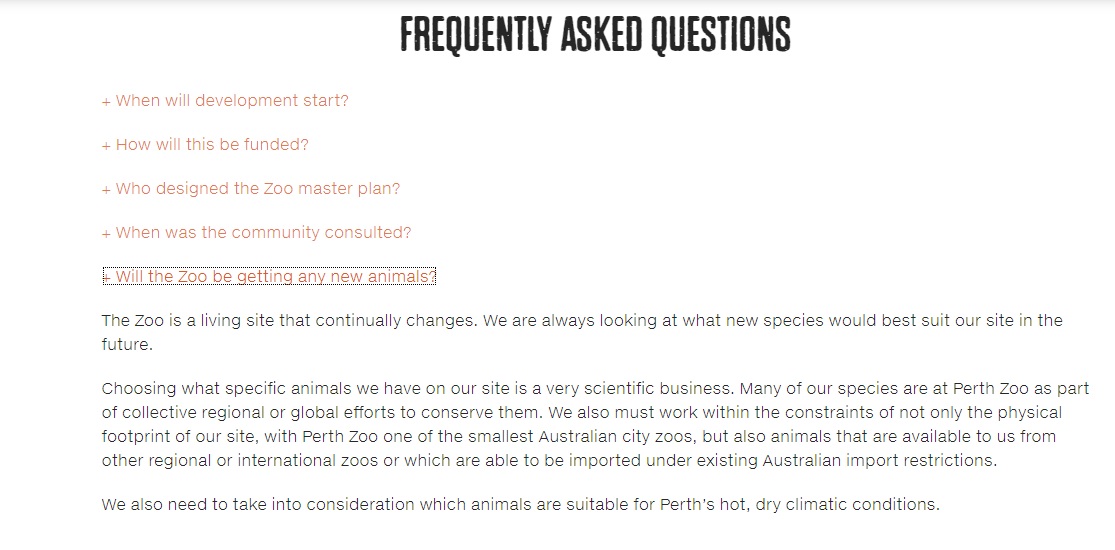
PZfaq.jpg
 
On that note there was this too that forgot to add (thought maybe might be worth posting too, also sourced from A Future Vision For Perth Zoo page):
PZfaq.jpg

It’s a shame they don’t specify which new species are being considered. This page still lists the following FAQ: Frequently Asked Questions

Our curatorial team are also looking at what new species would best suit our site in the future. This could include Bongo, a stunning antelope species and nature’s armoured tanks, the endangered One-horned Rhino. This rhino species love to swim and could make a big splash in a future waterhole exhibit at the Zoo.

It was posted a number of years ago, but bongo at least appear to have remained in the plans. Presumably the elephants will transfer out within the next two years, which will open up their exhibit area for redevelopment.

I don’t know about Werribee’s intentions around receiving Putra Mas (the obvious move) but I imagine they’d want to avoid transit during the Australian summer. One possibility is allowing the Melbourne herd six to nine months to acclimatise to the new complex and transferring Putra Mas in Autumn 2025.
 
Back
Top