You are using an out of date browser. It may not display this or other websites correctly.
You should upgrade or use an alternative browser.
You should upgrade or use an alternative browser.
Trends in European zoo collections in the 21st century
- Thread starter lintworm
- Start date


What does Zoochat expect?
Over the past weeks nearly 40 people have filled in the small survey I was stalking everyone about. I have analysed the results and it has yielded some interesting results. It is clear that Xoochatters can hit the mark at times, but other predictions were widely off. That is maybe not surprising given that all but 1 reply said that they were either somewhat or very unconfident about their responses.
Mammals
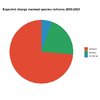
There was quite broad agreement on the trend that zoochatters think mammal diversity is going (Figure 1). 28 people expect a decrease, 2 believe the trend is stable and 8 people think the number of mammal species has increased since 2000. The median expected change is a 13% decrease in the number of mammal species held.

Figure 1: Overview of expected change of the number of mammal species from 2000-2023
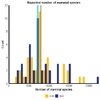
While there were wildly different expectations on trends, there was maybe even more disagreement on how many species have been kept in Europe (Figure 2). The responses varied between 250 and 1500 species kept in 2000 and 170 and 2200 species now. The median response was 800 species kept in 2000, and 723 species kept currently in Europe. (for people with some knowledge of statistics: I use median here as the average instead of mean as the data is far from normally distributed.)

Figure 2: Expected number of mammal species present in 2000 (yellow) and 2023 (blue), with the median for each year represented by the vertical line (yellowbrown for 2000, skyblue for 2023)
There was quite a bit of agreement on which mammals have increased in popularity since 2000 (Figure 3). Marsupials (9x), rodents (8x) and xenarthrans (7x) were the groups that were expected to have increased in popularity the most. Carnivores, in particular small carnivores, and primates, in particular lemurs and callitrichids, were also mentioned often.

Figure 3: Wordcloud representing all answers to which mammal groups have gained most popularity this century. The larger the font size, the more mentions. Groups with the same colour represent the same taxonomic group (e.g. all primates)
When it comes to mammals that have lost popularity since 2000 it were the ungulates (13x), with event-toed ungulates and bovids in particular, and cetaceans (13x) that were generally expected to have done worst (Figure 4). Primates and in particular the old world monkeys were another group that is widely expected to not have done great, whereas primates were by others mentioned as a group that has increased in popularity. Carnivores (6x) are another group zoochatters can’t seem to agree about. Bats (5x), rodents (3x) and elephants (2x) are the other groups that were mentioned more then once.

Figure 4: Wordcloud representing all answers to which mammal groups have lost the most popularity this century. The larger the font size, the more mentions. Groups with the same colour represent the same taxonomic group (e.g. all primates)
Birds
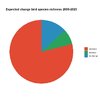
Similarly to mammals there was quite strong agreement with most people thinking the number of bird species in European zoos has declined (Figure 5), with 30 people expecting a decrease, 5 no change and 3 people expecting an increase. The median expected decrease was 13%, though there were 16 people who expected a decrease of at least 20%.

Figure 5: Overview of expected change of the number of bird species from 2000-2023
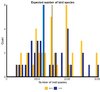
While there were wildly different expectations on trends, there was maybe even more disagreement on how many species have been kept in Europe (Figure 6). The responses varied between 430 and 3000 species kept in 2000 and 280 and 3000 species now. The median response was 1500 species kept in 2000, and 1200 species kept currently in Europe.

Figure 6: Expected number of bird species present in 2000 (yellow) and 2023 (blue), with the median for each year represented by the vertical line (yellowbrown for 2000, skyblue for 2023)
It appears that it was more difficult to pick bird groups that had increased or decreased compared to the mammals, given that there were less answers filled in and there was more variation within those answers (Figure 7). There is however one clear expected winner with the Parrots (mentioned 9x), with penguins (6x), doves (4x), pelecaniformes (4x), hornbills (3x) and owls (3x) following. Passerines (2x), ratites (2x) and galliformes (2x) also got multiple mentions.

Figure 7: Wordcloud representing all answers to which bird groups have gained most popularity this century. The larger the font size, the more mentions. Groups with the same colour represent the same taxonomic group (e.g. all passerines)
When picking birds gaining in popularity was hard, even less responses for birds losing popularity came in (Figure 8). With passerines (9x) there is however a clear front runner, parrots (4x) came second and the shore birds/ Charadriiformes (3x), hummingbirds (3x), parrots (3x) and galliformes (3x) came third. Only toucan were mentioned twice and an array of species ranging from gannets to hornbills and sunbirds were mentioned once.

Figure 8: Wordcloud representing all answers to which bird groups have lost the most popularity this century. The larger the font size, the more mentions. Groups with the same colour represent the same taxonomic group (e.g. all passerines)
Summarizing
While there is quite a bit of variation in the answers it is clear that overall Zoochatters expect that species richness of both mammals and birds has decreased, with a median of 13% since 2000. How many species are and have been present is something there wasn’t strong agreement on and nobody nailed the test, though some people came close with their species richness estimates for either birds or mammals. There seems to be a bit more certainty about which mammal groups are responsible for the trends, whereas with birds there seems even more uncertainty. But in both mammals and birds some groups were mentioned both as increasing and as decreasing in popularity. I am not going to give away any answers now, you shall have to find out along the way.
This means all the preparations are done and we can start with the real work: the species accounts. I will soon start with our prickly friends from down under, though less down under than in the past
Over the past weeks nearly 40 people have filled in the small survey I was stalking everyone about. I have analysed the results and it has yielded some interesting results. It is clear that Xoochatters can hit the mark at times, but other predictions were widely off. That is maybe not surprising given that all but 1 reply said that they were either somewhat or very unconfident about their responses.
Mammals
There was quite broad agreement on the trend that zoochatters think mammal diversity is going (Figure 1). 28 people expect a decrease, 2 believe the trend is stable and 8 people think the number of mammal species has increased since 2000. The median expected change is a 13% decrease in the number of mammal species held.
Figure 1: Overview of expected change of the number of mammal species from 2000-2023
While there were wildly different expectations on trends, there was maybe even more disagreement on how many species have been kept in Europe (Figure 2). The responses varied between 250 and 1500 species kept in 2000 and 170 and 2200 species now. The median response was 800 species kept in 2000, and 723 species kept currently in Europe. (for people with some knowledge of statistics: I use median here as the average instead of mean as the data is far from normally distributed.)
Figure 2: Expected number of mammal species present in 2000 (yellow) and 2023 (blue), with the median for each year represented by the vertical line (yellowbrown for 2000, skyblue for 2023)
There was quite a bit of agreement on which mammals have increased in popularity since 2000 (Figure 3). Marsupials (9x), rodents (8x) and xenarthrans (7x) were the groups that were expected to have increased in popularity the most. Carnivores, in particular small carnivores, and primates, in particular lemurs and callitrichids, were also mentioned often.
Figure 3: Wordcloud representing all answers to which mammal groups have gained most popularity this century. The larger the font size, the more mentions. Groups with the same colour represent the same taxonomic group (e.g. all primates)
When it comes to mammals that have lost popularity since 2000 it were the ungulates (13x), with event-toed ungulates and bovids in particular, and cetaceans (13x) that were generally expected to have done worst (Figure 4). Primates and in particular the old world monkeys were another group that is widely expected to not have done great, whereas primates were by others mentioned as a group that has increased in popularity. Carnivores (6x) are another group zoochatters can’t seem to agree about. Bats (5x), rodents (3x) and elephants (2x) are the other groups that were mentioned more then once.
Figure 4: Wordcloud representing all answers to which mammal groups have lost the most popularity this century. The larger the font size, the more mentions. Groups with the same colour represent the same taxonomic group (e.g. all primates)
Birds
Similarly to mammals there was quite strong agreement with most people thinking the number of bird species in European zoos has declined (Figure 5), with 30 people expecting a decrease, 5 no change and 3 people expecting an increase. The median expected decrease was 13%, though there were 16 people who expected a decrease of at least 20%.
Figure 5: Overview of expected change of the number of bird species from 2000-2023
While there were wildly different expectations on trends, there was maybe even more disagreement on how many species have been kept in Europe (Figure 6). The responses varied between 430 and 3000 species kept in 2000 and 280 and 3000 species now. The median response was 1500 species kept in 2000, and 1200 species kept currently in Europe.
Figure 6: Expected number of bird species present in 2000 (yellow) and 2023 (blue), with the median for each year represented by the vertical line (yellowbrown for 2000, skyblue for 2023)
It appears that it was more difficult to pick bird groups that had increased or decreased compared to the mammals, given that there were less answers filled in and there was more variation within those answers (Figure 7). There is however one clear expected winner with the Parrots (mentioned 9x), with penguins (6x), doves (4x), pelecaniformes (4x), hornbills (3x) and owls (3x) following. Passerines (2x), ratites (2x) and galliformes (2x) also got multiple mentions.
Figure 7: Wordcloud representing all answers to which bird groups have gained most popularity this century. The larger the font size, the more mentions. Groups with the same colour represent the same taxonomic group (e.g. all passerines)
When picking birds gaining in popularity was hard, even less responses for birds losing popularity came in (Figure 8). With passerines (9x) there is however a clear front runner, parrots (4x) came second and the shore birds/ Charadriiformes (3x), hummingbirds (3x), parrots (3x) and galliformes (3x) came third. Only toucan were mentioned twice and an array of species ranging from gannets to hornbills and sunbirds were mentioned once.
Figure 8: Wordcloud representing all answers to which bird groups have lost the most popularity this century. The larger the font size, the more mentions. Groups with the same colour represent the same taxonomic group (e.g. all passerines)
Summarizing
While there is quite a bit of variation in the answers it is clear that overall Zoochatters expect that species richness of both mammals and birds has decreased, with a median of 13% since 2000. How many species are and have been present is something there wasn’t strong agreement on and nobody nailed the test, though some people came close with their species richness estimates for either birds or mammals. There seems to be a bit more certainty about which mammal groups are responsible for the trends, whereas with birds there seems even more uncertainty. But in both mammals and birds some groups were mentioned both as increasing and as decreasing in popularity. I am not going to give away any answers now, you shall have to find out along the way.
This means all the preparations are done and we can start with the real work: the species accounts. I will soon start with our prickly friends from down under, though less down under than in the past
Attachments
-
 BirdHist.jpeg97.7 KB · Views: 164
 -
 MammalPie.jpeg61.6 KB · Views: 169
 -
 Wordcloud Mammalincrease.jpeg111.2 KB · Views: 167
 -
 Birdpie.jpeg60 KB · Views: 181
 -
 Wordcloud Mammaldecrease.jpeg91.9 KB · Views: 183
 -
 MammalHist.jpeg81.7 KB · Views: 165
 -
 Wordcloud Birdincrease.jpeg92.4 KB · Views: 175
 -
 Wordcloud Birddecrease.jpeg88.1 KB · Views: 179
Using this logic, why aren't some meerkats being phased out in favour of more endangered mongooses?Gaur are being phased out by EAZA in favour of the more endangered (though possibly less attractive) Banteng.

Because most normal folk won't have the foggiest what a banteng or gaur are, but they'll certainly know a meerkat. If they were gone, they'd notice.Using this logic, why aren't some meerkats being phased out in favour of more endangered mongooses?
Books and TV programmes include many obscure animals that could interest children. I suspect that many children know more species of animals than most adults. It seems that some marketing teams don't know much about animals and can't be bothered to produce information to interest visitors in animals they haven't seen before. I doubt there were many visitors who wanted to see all of the 8 meerkat enclosures at Edinburgh Zoo a few years ago.Because most normal folk won't have the foggiest what a banteng or gaur are, but they'll certainly know a meerkat. If they were gone, they'd notice.
It seems strange that zoos seem to want to keep all subspecies of some species but not all species of a genus.The real problem with banteng and gaur is, that EAZA and AZA both want the same species to be kept. This is a perfect example that the RCPs are not working the way they should.

I cannot find the issue of EAZA’s Zooquria issue that brought it up but if I recall correctly, the Small Carnivore TAG (SCTAG) plans to manage meerkats under the new style EEP (which is already listed under the list of ex-situ programs) so meerkats won’t take up space that could be used for endangered small carnivores.Using this logic, why aren't some meerkats being phased out in favour of more endangered mongooses?
What I am trying to say here is that EAZA is probably aware of the dominion of meerkats as much as many of us here, and it and the SCTAG probably wants to change something about it.
Last edited:
I cannot find the issue of EAZA’s Zooquria issue that brought it up but if I recall correctly, the Small Carnivore TAG (SCTAG) plans to manage meerkats under the new style EEP (which is already listed under the list of ex-situ programs) so meerkats won’t take up space that could be used for endangered small carnivores.
What I am trying to say here is that EAZA is probably aware of the dominion of meerkats as much as many of us here, and it and the SCTAG probably wants to change something about it.
Exactly this. Both meerkats and gaurs will be covered later on in the thread, so we can have the discussion then. Now it detracts from the survey results which 39 people took the trouble to fill in and these results deserve recognition as they are the starting point for the rest of the thread.
What does Zoochat expect?
Over the past weeks nearly 40 people have filled in the small survey I was stalking everyone about. I have analysed the results and it has yielded some interesting results. It is clear that Xoochatters can hit the mark at times, but other predictions were widely off. That is maybe not surprising given that all but 1 reply said that they were either somewhat or very unconfident about their responses.
Mammals
There was quite broad agreement on the trend that zoochatters think mammal diversity is going (Figure 1). 28 people expect a decrease, 2 believe the trend is stable and 8 people think the number of mammal species has increased since 2000. The median expected change is a 13% decrease in the number of mammal species held.
View attachment 643077
Figure 1: Overview of expected change of the number of mammal species from 2000-2023
While there were wildly different expectations on trends, there was maybe even more disagreement on how many species have been kept in Europe (Figure 2). The responses varied between 250 and 1500 species kept in 2000 and 170 and 2200 species now. The median response was 800 species kept in 2000, and 723 species kept currently in Europe. (for people with some knowledge of statistics: I use median here as the average instead of mean as the data is far from normally distributed.)
View attachment 643081
Figure 2: Expected number of mammal species present in 2000 (yellow) and 2023 (blue), with the median for each year represented by the vertical line (yellowbrown for 2000, skyblue for 2023)
There was quite a bit of agreement on which mammals have increased in popularity since 2000 (Figure 3). Marsupials (9x), rodents (8x) and xenarthrans (7x) were the groups that were expected to have increased in popularity the most. Carnivores, in particular small carnivores, and primates, in particular lemurs and callitrichids, were also mentioned often.
View attachment 643078
Figure 3: Wordcloud representing all answers to which mammal groups have gained most popularity this century. The larger the font size, the more mentions. Groups with the same colour represent the same taxonomic group (e.g. all primates)
When it comes to mammals that have lost popularity since 2000 it were the ungulates (13x), with event-toed ungulates and bovids in particular, and cetaceans (13x) that were generally expected to have done worst (Figure 4). Primates and in particular the old world monkeys were another group that is widely expected to not have done great, whereas primates were by others mentioned as a group that has increased in popularity. Carnivores (6x) are another group zoochatters can’t seem to agree about. Bats (5x), rodents (3x) and elephants (2x) are the other groups that were mentioned more then once.
View attachment 643080
Figure 4: Wordcloud representing all answers to which mammal groups have lost the most popularity this century. The larger the font size, the more mentions. Groups with the same colour represent the same taxonomic group (e.g. all primates)
Birds
Similarly to mammals there was quite strong agreement with most people thinking the number of bird species in European zoos has declined (Figure 5), with 30 people expecting a decrease, 5 no change and 3 people expecting an increase. The median expected decrease was 13%, though there were 16 people who expected a decrease of at least 20%.
View attachment 643079
Figure 5: Overview of expected change of the number of bird species from 2000-2023
While there were wildly different expectations on trends, there was maybe even more disagreement on how many species have been kept in Europe (Figure 6). The responses varied between 430 and 3000 species kept in 2000 and 280 and 3000 species now. The median response was 1500 species kept in 2000, and 1200 species kept currently in Europe.
View attachment 643076
Figure 6: Expected number of bird species present in 2000 (yellow) and 2023 (blue), with the median for each year represented by the vertical line (yellowbrown for 2000, skyblue for 2023)
It appears that it was more difficult to pick bird groups that had increased or decreased compared to the mammals, given that there were less answers filled in and there was more variation within those answers (Figure 7). There is however one clear expected winner with the Parrots (mentioned 9x), with penguins (6x), doves (4x), pelecaniformes (4x), hornbills (3x) and owls (3x) following. Passerines (2x), ratites (2x) and galliformes (2x) also got multiple mentions.
View attachment 643082
Figure 7: Wordcloud representing all answers to which bird groups have gained most popularity this century. The larger the font size, the more mentions. Groups with the same colour represent the same taxonomic group (e.g. all passerines)
When picking birds gaining in popularity was hard, even less responses for birds losing popularity came in (Figure 8). With passerines (9x) there is however a clear front runner, parrots (4x) came second and the shore birds/ Charadriiformes (3x), hummingbirds (3x), parrots (3x) and galliformes (3x) came third. Only toucan were mentioned twice and an array of species ranging from gannets to hornbills and sunbirds were mentioned once.
View attachment 643083
Figure 8: Wordcloud representing all answers to which bird groups have lost the most popularity this century. The larger the font size, the more mentions. Groups with the same colour represent the same taxonomic group (e.g. all passerines)
Summarizing
While there is quite a bit of variation in the answers it is clear that overall Zoochatters expect that species richness of both mammals and birds has decreased, with a median of 13% since 2000. How many species are and have been present is something there wasn’t strong agreement on and nobody nailed the test, though some people came close with their species richness estimates for either birds or mammals. There seems to be a bit more certainty about which mammal groups are responsible for the trends, whereas with birds there seems even more uncertainty. But in both mammals and birds some groups were mentioned both as increasing and as decreasing in popularity. I am not going to give away any answers now, you shall have to find out along the way.
This means all the preparations are done and we can start with the real work: the species accounts. I will soon start with our prickly friends from down under, though less down under than in the past


Only a survey of ZooChat members could possibly have expected so many of the answers to an open ended question to be "Xenarthrans".What does Zoochat expect?
Over the past weeks nearly 40 people have filled in the small survey I was stalking everyone about. I have analysed the results and it has yielded some interesting results. It is clear that Xoochatters can hit the mark at times, but other predictions were widely off. That is maybe not surprising given that all but 1 reply said that they were either somewhat or very unconfident about their responses.
Mammals
There was quite broad agreement on the trend that zoochatters think mammal diversity is going (Figure 1). 28 people expect a decrease, 2 believe the trend is stable and 8 people think the number of mammal species has increased since 2000. The median expected change is a 13% decrease in the number of mammal species held.
View attachment 643077
Figure 1: Overview of expected change of the number of mammal species from 2000-2023
While there were wildly different expectations on trends, there was maybe even more disagreement on how many species have been kept in Europe (Figure 2). The responses varied between 250 and 1500 species kept in 2000 and 170 and 2200 species now. The median response was 800 species kept in 2000, and 723 species kept currently in Europe. (for people with some knowledge of statistics: I use median here as the average instead of mean as the data is far from normally distributed.)
View attachment 643081
Figure 2: Expected number of mammal species present in 2000 (yellow) and 2023 (blue), with the median for each year represented by the vertical line (yellowbrown for 2000, skyblue for 2023)
There was quite a bit of agreement on which mammals have increased in popularity since 2000 (Figure 3). Marsupials (9x), rodents (8x) and xenarthrans (7x) were the groups that were expected to have increased in popularity the most. Carnivores, in particular small carnivores, and primates, in particular lemurs and callitrichids, were also mentioned often.
View attachment 643078
Figure 3: Wordcloud representing all answers to which mammal groups have gained most popularity this century. The larger the font size, the more mentions. Groups with the same colour represent the same taxonomic group (e.g. all primates)
When it comes to mammals that have lost popularity since 2000 it were the ungulates (13x), with event-toed ungulates and bovids in particular, and cetaceans (13x) that were generally expected to have done worst (Figure 4). Primates and in particular the old world monkeys were another group that is widely expected to not have done great, whereas primates were by others mentioned as a group that has increased in popularity. Carnivores (6x) are another group zoochatters can’t seem to agree about. Bats (5x), rodents (3x) and elephants (2x) are the other groups that were mentioned more then once.
View attachment 643080
Figure 4: Wordcloud representing all answers to which mammal groups have lost the most popularity this century. The larger the font size, the more mentions. Groups with the same colour represent the same taxonomic group (e.g. all primates)
Birds
Similarly to mammals there was quite strong agreement with most people thinking the number of bird species in European zoos has declined (Figure 5), with 30 people expecting a decrease, 5 no change and 3 people expecting an increase. The median expected decrease was 13%, though there were 16 people who expected a decrease of at least 20%.
View attachment 643079
Figure 5: Overview of expected change of the number of bird species from 2000-2023
While there were wildly different expectations on trends, there was maybe even more disagreement on how many species have been kept in Europe (Figure 6). The responses varied between 430 and 3000 species kept in 2000 and 280 and 3000 species now. The median response was 1500 species kept in 2000, and 1200 species kept currently in Europe.
View attachment 643076
Figure 6: Expected number of bird species present in 2000 (yellow) and 2023 (blue), with the median for each year represented by the vertical line (yellowbrown for 2000, skyblue for 2023)
It appears that it was more difficult to pick bird groups that had increased or decreased compared to the mammals, given that there were less answers filled in and there was more variation within those answers (Figure 7). There is however one clear expected winner with the Parrots (mentioned 9x), with penguins (6x), doves (4x), pelecaniformes (4x), hornbills (3x) and owls (3x) following. Passerines (2x), ratites (2x) and galliformes (2x) also got multiple mentions.
View attachment 643082
Figure 7: Wordcloud representing all answers to which bird groups have gained most popularity this century. The larger the font size, the more mentions. Groups with the same colour represent the same taxonomic group (e.g. all passerines)
When picking birds gaining in popularity was hard, even less responses for birds losing popularity came in (Figure 8). With passerines (9x) there is however a clear front runner, parrots (4x) came second and the shore birds/ Charadriiformes (3x), hummingbirds (3x), parrots (3x) and galliformes (3x) came third. Only toucan were mentioned twice and an array of species ranging from gannets to hornbills and sunbirds were mentioned once.
View attachment 643083
Figure 8: Wordcloud representing all answers to which bird groups have lost the most popularity this century. The larger the font size, the more mentions. Groups with the same colour represent the same taxonomic group (e.g. all passerines)
Summarizing
While there is quite a bit of variation in the answers it is clear that overall Zoochatters expect that species richness of both mammals and birds has decreased, with a median of 13% since 2000. How many species are and have been present is something there wasn’t strong agreement on and nobody nailed the test, though some people came close with their species richness estimates for either birds or mammals. There seems to be a bit more certainty about which mammal groups are responsible for the trends, whereas with birds there seems even more uncertainty. But in both mammals and birds some groups were mentioned both as increasing and as decreasing in popularity. I am not going to give away any answers now, you shall have to find out along the way.
This means all the preparations are done and we can start with the real work: the species accounts. I will soon start with our prickly friends from down under, though less down under than in the past

While there were wildly different expectations on trends, there was maybe even more disagreement on how many species have been kept in Europe (Figure 2). The responses varied between 250 and 1500 species kept in 2000 and 170 and 2200 species now.
While there were wildly different expectations on trends, there was maybe even more disagreement on how many species have been kept in Europe (Figure 6). The responses varied between 430 and 3000 species kept in 2000 and 280 and 3000 species now. The median response was 1500 species kept in 2000, and 1200 species kept currently in Europe.
A rather wider range of responses than I expected - and I certainly didn't expect anyone to think around one-third of all extant mammal species are present in European collections today!

I find estimating mammal species difficult because collections like Pilsen hold a significant number of species behind the scenes that visitors cannot see. It is quite possible that the large number of small species behind the scenes more than compensates for the obvious decline of larger species in the public area.
For me estimating birds was difficult because of how the European aviculture industry seems to have a great number of birds that is overwhelming for my novice brain. Not to mention while I do believe that there was a decrease it was difficult to guess how much because of the possible rate of new or returning species replacing species that are gone.
A rather wider range of responses than I expected - and I certainly didn't expect anyone to think around one-third of all extant mammal species are present in European collections today!
I was also somewhat surprised by the wide range, but estimating big numbers is difficult and some of the lowest and highest scores also do come from people who have visited over 50 or 100 different European zoo. So relative unfamiliarity with European zoos of some members isn't the explanation. I think @wstefan is going in the right direction with his answer that estimating how many species a single zoo holds can be a challenge (if you don't have Zootierliste or an inventory open) and extrapolating that to all of Europe is even more difficult. All but 2 (not 1 as I erroneously posted above) of the 39 replies indicated low confidence in their answers and the 2 that were somewhat confident weren't necessarily better answers
 . So that should go a long way in explaining.
The bulk of the answers expected mammal diversity between 500 and 1000 which isn't a bad guess actually. For birds the answers are all over the place with anywhere between 800 and 2000 species having some support. Obviously the "true" number is somewhere in that bracket.
@lintworm , out of curiosity did you fill in the form before your research and if so, how did you fare?
I didn't, I only came up with the idea of the survey when I was in the middle of writing, so I already had my master list. Looking back I would say I would have expected a similar amount of mammals as the median, but a somewhat smaller decrease. For birds I would have guessed closer to 2000 species and a decline.
In terms of the animals gaining/losing popularity my main expectation aligns fairly well with the main options given here. Marsupials increasing, primates, cetaceans & ungulates decreasing for mammals and pelecaniformes increasing and passerines decreasing for birds. 2 groups that weren't mentioned which I would likely have included as an increase are hyraxes and birds-of-paradise. Just to be clear, that is all a priori expectations and now I know much better
MAMMALS - MAMMALIA
With 6459 species of extant wild mammals across 160 families and 27 orders, this is a small branch of the animal kingdom. They are however some of the most instantly recognizable and well-known animals for humans and in general they tend to dominate zoo collections.
Out of the 27 mammal orders, 22 have been kept in European zoos this century and there is even a chance a 23rd order will be added in the coming years. The absent orders are mostly marsupials, but with the colugos (Dermoptera) there is 1 placental mammal order absent too. A total of 106 families (out of 160) have been present in European zoos this century and the unrepresented families are mainly bats (15 families) rodents (10 families) and cetaceans (9 families). So overall, mammals have been present in large higher taxonomic diversity this century. Today we will completely cover one of the 3 major branches of the mammal tree. That doesn't mean the rest of the thread will be quick though.
MONOTREMES - MONOTREMATA
5 species across 2 families
1 species kept this century (20%)
A rather unique group of mammals with some weird characteristics and looks that make them zoochat favourites. The rarity of this order outside of Australia likely plays a role there, but their unique appearance is an even bigger selling point. Only one of the two families is represented in Europe currently, though I wouldn’t be very surprised if a European zoo will gain platypus in the coming decades.
Echidnas - Tachyglossidae (4 species)
# Species kept 1-1-2000: 1
# Species kept currently: 1
# Species gained: -
# Species lost: -
A small family consisting of the three long-beaked echidna species (Zaglossus) and the short-beaked echidna. Eastern long-beaked echidna were kept in London Zoo 1965-1994, before the three individuals were sent to Taronga Zoo, Sydney, where the last animal still lives. Moscow also held a single Western long-beaked echidna this century, which was held there 1996-2013, but that is outside of the scope of this thread. Only short-beaked echidna have been kept this century and this is a species currently on the rise.

@gentle lemur Bruce, the final short-beaked echidna of Paignton Zoo, is basically a national treasure
Species gaining popularity
Short-beaked echidna - Tachyglossus aculeatus
While having been around for most of the twentieth century this has always been a scarce species and the main reason it has been around most of the time is their longevity, as breeding results have long been poor. For example, the remaining animals in Dierenpark Planckendael, Mechelen, and Paignton Zoo are both approximately 50 years old. Echidna land got a shake up with multiple rounds of imports of New Guinea short-beaked echidnas (subspecies lawesii) from 2011 onwards, first by Czech zoos. These animals were imported from Indonesia and while a significant number of imported animals did not live long, enough were imported to create a sizable population. The first breeding took place in Zoo Rostock, Germany, in 2014 and since then 5 other zoos have also successfully bred this subspecies. This subspecies is currently held at 13 zoos, so there is a good chance a stable population can be created based on breeding alone if current rates continue. While there are still 6 echidna from Australia around, these are basically all retired and it is likely that the future population will consist of the New Guinea subspecies alone.

@hmb_zoo A New Guinea short-beaked echidna at Hamerton Zoo. These buggers are the echidna future of Europe
Progress
1/106 families
1 species present in 2000
1 species present in 2023
With 6459 species of extant wild mammals across 160 families and 27 orders, this is a small branch of the animal kingdom. They are however some of the most instantly recognizable and well-known animals for humans and in general they tend to dominate zoo collections.
Out of the 27 mammal orders, 22 have been kept in European zoos this century and there is even a chance a 23rd order will be added in the coming years. The absent orders are mostly marsupials, but with the colugos (Dermoptera) there is 1 placental mammal order absent too. A total of 106 families (out of 160) have been present in European zoos this century and the unrepresented families are mainly bats (15 families) rodents (10 families) and cetaceans (9 families). So overall, mammals have been present in large higher taxonomic diversity this century. Today we will completely cover one of the 3 major branches of the mammal tree. That doesn't mean the rest of the thread will be quick though
.MONOTREMES - MONOTREMATA
5 species across 2 families
1 species kept this century (20%)
A rather unique group of mammals with some weird characteristics and looks that make them zoochat favourites. The rarity of this order outside of Australia likely plays a role there, but their unique appearance is an even bigger selling point. Only one of the two families is represented in Europe currently, though I wouldn’t be very surprised if a European zoo will gain platypus in the coming decades.
Echidnas - Tachyglossidae (4 species)
# Species kept 1-1-2000: 1
# Species kept currently: 1
# Species gained: -
# Species lost: -
A small family consisting of the three long-beaked echidna species (Zaglossus) and the short-beaked echidna. Eastern long-beaked echidna were kept in London Zoo 1965-1994, before the three individuals were sent to Taronga Zoo, Sydney, where the last animal still lives. Moscow also held a single Western long-beaked echidna this century, which was held there 1996-2013, but that is outside of the scope of this thread. Only short-beaked echidna have been kept this century and this is a species currently on the rise.
@gentle lemur Bruce, the final short-beaked echidna of Paignton Zoo, is basically a national treasure
Species gaining popularity
Short-beaked echidna - Tachyglossus aculeatus
While having been around for most of the twentieth century this has always been a scarce species and the main reason it has been around most of the time is their longevity, as breeding results have long been poor. For example, the remaining animals in Dierenpark Planckendael, Mechelen, and Paignton Zoo are both approximately 50 years old. Echidna land got a shake up with multiple rounds of imports of New Guinea short-beaked echidnas (subspecies lawesii) from 2011 onwards, first by Czech zoos. These animals were imported from Indonesia and while a significant number of imported animals did not live long, enough were imported to create a sizable population. The first breeding took place in Zoo Rostock, Germany, in 2014 and since then 5 other zoos have also successfully bred this subspecies. This subspecies is currently held at 13 zoos, so there is a good chance a stable population can be created based on breeding alone if current rates continue. While there are still 6 echidna from Australia around, these are basically all retired and it is likely that the future population will consist of the New Guinea subspecies alone.
@hmb_zoo A New Guinea short-beaked echidna at Hamerton Zoo. These buggers are the echidna future of Europe
Progress
1/106 families
1 species present in 2000
1 species present in 2023
Last edited:
For example, the remaining animals in Dierenpark Planckendael, Mechelen, and Paignton Zoo are both approximately 50 years old
At least 52 or 53 in fact, having arrived in Europe as wild-caught adults estimated at 3 years old, as part of the same overall import in Feb 1973.
I'm not sure whether any of the other remaining Australian animals in Europe (at Frankfurt and Duisburg) were among the tiny number successfully born and reared *in* a European collection, as I don't know if the captive-born female at Frankfurt still lives, but if they are the odds are good they'll be around for some decades yet given the first such birth (aforementioned female, at Saarbrucken) took place as recently as 1995.
And both are wild-born, at that - I'm not sure whether any of the other remaining Australian animals in Europe (at Frankfurt and Duisburg) were among the tiny number successfully born and reared *in* a European collection , but if they are the odds are good they'll be around for some decades yet given the first such birth took place as recently as 1995.
Duisburg's animals came from Diergaarde Blijdorp and given they never bred, but kept the species continually for decades, I wouldn't be surprised if their echidna, the remaining now at Duisburg, were imported for their Notogea exposition in the 1970s... Maybe someone with ZIMS access could check their background...
The young born in Saarbruecken in 1995 was sent to Frankfurt, so could very well be one of the 2 current animals there, so while the Australians could be around for decades, a dead end it seems to be.