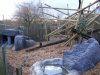
Electric barriers

zooman

Well-Known Member
15+ year member
Does anyone have an idea of costings on construction, maintence and importantly runung costs of electric fenceing, bridges?

I have heard many stories regariding dominant male primates testing and then irregualy retesting fenceing. Also the bridges at apenheaul have proved entertaining;):o

I wonder actually if anybody has ever researched primate language using the response of a electric shock as the key??
 

Attachments

  • electric fenceing.jpg
    electric fenceing.jpg
    88.2 KB · Views: 25
I have heard many stories regariding dominant male primates testing and then irregualy retesting fenceing.

Sounds like you've been watching the seen in Jurassic Park where the guy explains the raptors testing the fences ;)
 
LIfe immitaes Art.

Jummy if you are ever able to visit Gorilla Haven Georgia. Do as Its Jurrasic park for Gorillas also the resemblence of Steuart to John Hammond is just to close!!! In many ways including aperance and dedication and passion.
 
Okay replying to my own thread:(

Nobody with electric fence experiance?
 
ive always wondered about electric fence, and how the animals act to it, and if they test it like the Raptors of Jurassic Park
 
ive always wondered about electric fence, and how the animals act to it, and if they test it like the Raptors of Jurassic Park

All depends. I've known elephants that "respect" it until the day they decide to rip it out. I remember gorillas where the adults were very aware of the fence and carefully plucked leaves through it without ever touching the wires. I knew of a black maned lion that, when released for the first time into its new exhibit...where the chain link fence had a hot wire fence in front of it...attacked the hot wire with such rage in spite of the shocks, that he had to be relocated to a grotto style exhibit.

I have little velociraptor experience to share.
 
I know that many aniamls are able to detect when a fence is switched off either they can hear the current running through it or they continually test it!

As for running costs it depends on the set up. some can run off solar panels other off batteries and others off mains power. I dont think they are difficult to construct and in many cases are a cheap alternative to massive wire or brick enclosures!
 
Very few American zoos are willing to take the risk of using hotwire or electrified fencing as a primary barrier to contain any animals. It is typically used in combination with other, more secure barriers to discourage animals from even testing the walls or fences. More often it is used to protect vegetation or to keep animals from hiding in moats or behind hills inside the exhibit. The concern is always that if the power fails for whatever reason, the animals can get loose ala Jurassic Park, and very few zoos in litigious America are willing to take that risk.
 
I don't know about testing and retesting, but in the early days of their exhibit the chimps at Taronga Zoo used to get past the hotwires fairly easily.

These days it's just one female - Kuma - who regularly avoids being shocked and ventures into the garden or climbs the palm trees in the exhibit.

:)

Hix
 
I think the chimps at Dudley are enclosed with just hotwire, as are the elephants at most safari parks. Seems a bit risky with animals like these, but it obviously works and improves viewing.
 
All depends. I've known elephants that "respect" it until the day they decide to rip it out. I remember gorillas where the adults were very aware of the fence and carefully plucked leaves through it without ever touching the wires. I knew of a black maned lion that, when released for the first time into its new exhibit...where the chain link fence had a hot wire fence in front of it...attacked the hot wire with such rage in spite of the shocks, that he had to be relocated to a grotto style exhibit.

I have little velociraptor experience to share.

so whats your velociraptor experience
i have at Universal studios Island of Adventure, orlando, you get on a boat and get a tour around jurassic park!
 
Well

Just last two weeks I was fortunate enought to assist the opening of two new outdoors enclousures to Baboons and to Chimps. Both were well-formed group, with a dominant male. none on the them had ever been in contact with electric fences

Baboons with a dominant male, a sub-dominant and severall females and juniors.
When we first opened the door of the indoor enclosure to the outdoors they wuickly come to the door and after a few minutes they were outside. The dominant male CLEARLY was in charge! Even myself was suprise ... he proudly carried himself by the enclousure, exploring everything. Not a single expression of fear. The females and the juniors were behind him and very much afraid. He was also the first to touch the electric fence, which he quicly run away. One junior repeat it and quickly made noisy and all the family run inside, except the dominant male. During the remaining 1.5 weeks that I was there, none on them come near the electric fence and all of them kept a safe distance.
With the chimps, it was a total diferent story. It took them 4 fours untill they got the courage to come outside! And the females were the most curious about it! None of them (druing the next week) touched the electric fence.

So, I've my doubth about re-testing, but I think it all goes to the individual and to how strong is the electric fence.

Talking about antilopes, I've seen small antilopes charge the fence and get by it, over and over (knowing that they will get a shock, but still they do it quickly) as well I've seen big antilopes charging fences, slowling just to get some food.

So again, I think it all goes to the individual and to how strong is the electric fence.
 
First of all sorry for my bad english.

We are keeping a pair of Ateles paniscus in a enclosure of 17 x 15 m, with electric fence with 1, 5 m high and 10 cm between each wire.

This enclosure is new build and the spider monkeys where placed in at 20 december 2008.

5 minutes after they where in the enclosure the female touched the wire and got a small shock (we use a low potence electric fence same for catle). This was all, the male never touched the fence. The female every day looks the fence and is trying to touch but its seems that she dont want to get a shock again and never touched more, it also seems that the soil conduct a small shock and this makes that she dont touch the fence any more.
 
it also seems that the soil conduct a small shock and this makes that she dont touch the fence any more.

eduardo your english is great. Really mine is worse its my first language.

Interesting that the female touched the wire not the male. Also that she looks each day. A electric fence acts as a form of enrichment.

The soil conducts a small current as well?? Is this standard?
 
Zooman,

This is not standart, it gives the impression that the soil is conducting a law shock, is imperceptible for humans, we made tests but dont show any thing.

In my opinion such barriers if well managed can be used for several species of primates, they have a low price and could be hiden with live trees, etc. Making more natural exhibits, for example fencing a bigger area with natural trees, etc. Attention have to be made for no leaf or other object be in conntact with the fence, this can broke the shock and the animals can scape.
 
Zooman,

This is not standart, it gives the impression that the soil is conducting a law shock, is imperceptible for humans, we made tests but dont show any thing.

For the right animals by species and personalities. This makes for a really interesting idea of enclosure barrier.
 
Friends who live in the country have dogs restrained by collars that produce a loud noise when within close proximity to the perimeter of there property. Restaring them within there property.

This and what we are discussing are ways of the future for large open range zoos perhaps? Or even smaller city zoos within resaon?
 
In my opinion this can be the future of zoos, with bigger exhibits, more naturalistic, etc.

Principally we have to look for the pricing of such structure, that is very law comparing with "normal" enclosures.
 
Back
Top