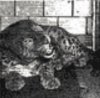
The White Leopard of Central Park Zoo

Newt

Well-Known Member
I was curious if there has ever been an albino/leucistic leopard recorded in history, so I googled it. There’s one taxidermy specimen found in the Tring Museum of Natural History. However, it’s claimed that the Central Park Zoo obtained a wild caught specimen between 1935 - 1960. His name was Jinx and was captured from Mombasa. He was described to look like a ghost, with very faint spots and pink eyes. Are there any known photos or has anyone here somehow seen it? I’m not even sure if he was only display but considering money flow, rarity, and guest attraction I’m sure he was.
 
Jinx was on display. Every website says something like "between 1935-1960" (because they are all just copying from copies of copies), however the The New York Times, in an article dated December 17 1948, says "The city's animal lovers got a unique Christmas present yesterday when the Department of Parks unveiled the only albino leopard in captivity, a handsome tawny female named Jinx, at the Lion House of the Central Park Zoo."
 
Jinx was on display. Every website says something like "between 1935-1960" (because they are all just copying from copies of copies), however the The New York Times, in an article dated December 17 1948, says "The city's animal lovers got a unique Christmas present yesterday when the Department of Parks unveiled the only albino leopard in captivity, a handsome tawny female named Jinx, at the Lion House of the Central Park Zoo."
Oh wow, I’ll look more into it. Thanks for the info!
 
This is what was provided in the New York Times article, so I assume this is her. Very glad I was able to find a picture
 

Attachments

  • IMG_1544.jpeg
    IMG_1544.jpeg
    116.6 KB · Views: 69
There’s one taxidermy specimen found in the Tring Museum of Natural History
.
It has been suggested that the white leopard, on exhibit in the Tring Museum, is the specimen London Zoo acquired in 1848.
 
.
It has been suggested that the white leopard, on exhibit in the Tring Museum, is the specimen London Zoo acquired in 1848.
Right down the bottom of this page is a 1925 newspaper article with a photo of what appears to be the Tring specimen, saying it was shot near Dar-es-Salaam.
MUTANT LEOPARDS
 
This is what was provided in the New York Times article, so I assume this is her. Very glad I was able to find a picture
Certainly not a true albino. Is this photo of a different leopard? It describes it as a 'handsome tawny female' - albinos are white...
 
Certainly not a true albino. Is this photo of a different leopard? It describes it as a 'handsome tawny female' - albinos are white...
I find it intriguing that for what resolution the picture has, the animal still clearly has visible spots... assuming that lighting didn't do a similar thing it can do with black leopards and jaguars
 
Certainly not a true albino. Is this photo of a different leopard? It describes it as a 'handsome tawny female' - albinos are white...
I find it intriguing that for what resolution the picture has, the animal still clearly has visible spots... assuming that lighting didn't do a similar thing it can do with black leopards and jaguars
Lee Crandall described it thus: "An albinistic specimen of the tall East African race (Panthera pardus pardus) recently living in the Central Park Zoo, was a beautiful creature. Its ground color was pale buff, almost white, its spots were very light brown, and its eyes were pink. This animal, a male, was brought from Mombasa, with a normally colored male companion, as a 'leopard by lion hybrid.'"
[Note that the newspaper article says female, and Crandall says male. One of them is a misprint]
 
Certainly not a true albino. Is this photo of a different leopard? It describes it as a 'handsome tawny female' - albinos are white...

Leucistism is a type of albinism. Plenty of leucistic animals still show some form of markings and/or are more of a yellowish/tan hue than real white. White lions, for example.
 
Leucistism is a type of albinism. Plenty of leucistic animals still show some form of markings and/or are more of a yellowish/tan hue than real white. White lions, for example.

THe photo shows a quite dark- looking animal but I think that's the quality of the print and the Lee Crandall description of it does sound like leucism rather than true albinism.
 
THe photo shows a quite dark- looking animal but I think that's the quality of the print and the Lee Crandall description of it does sound like leucism rather than true albinism.
Yea I noticed that as well. I’m sure it wasn’t pure white and rather leucistic with just light pigmentation, either way a good find
 
Certainly not a true albino. Is this photo of a different leopard? It describes it as a 'handsome tawny female' - albinos are white...
She’s probably leucistic, rather than albino, meaning her patterns and pigemnts are still there just lightened
 
Back
Top