The Zoo was busy this past Sunday installing a large window to view the polar bears from the amphitheater, so I have postponed my second visit to Wild Canada. I was hoping to take more photos and do a more in depth review. Instead, I am opting to post a less exhaustive review and focus a bit more on some of my experiences from my first visit. I wish I had more photos to share with this, but I forgot my well-charged reserve camera battery.
Before I begin, I think it's important to discuss some of my personal hopes and expectations of Wild Canada. Seeing healthy and happy polar bears is extremely important to me. I remember Misty and Snowball. I was a bit too young at the time to fully understand the controversy surrounding them and their welfare, but I was still aware of it.
Fast forward almost two decades to my first US zoo trip,
My First US Zoo Trip . It was very disheartening for me to see one of the polar bears at the San Diego Zoo pacing very stereotypically. It put a dampener on my visit to that facility. I hope that it was just a bad time to visit and that the polar bears there are doing much better than what I saw that day. We all have bad days and it's important not to generalize. That was the last time I saw polar bears until Wild Canada opened last month. Going in I was hopeful, but also nervous.
With a fresh coffee in hand to ward off the cold, I headed for
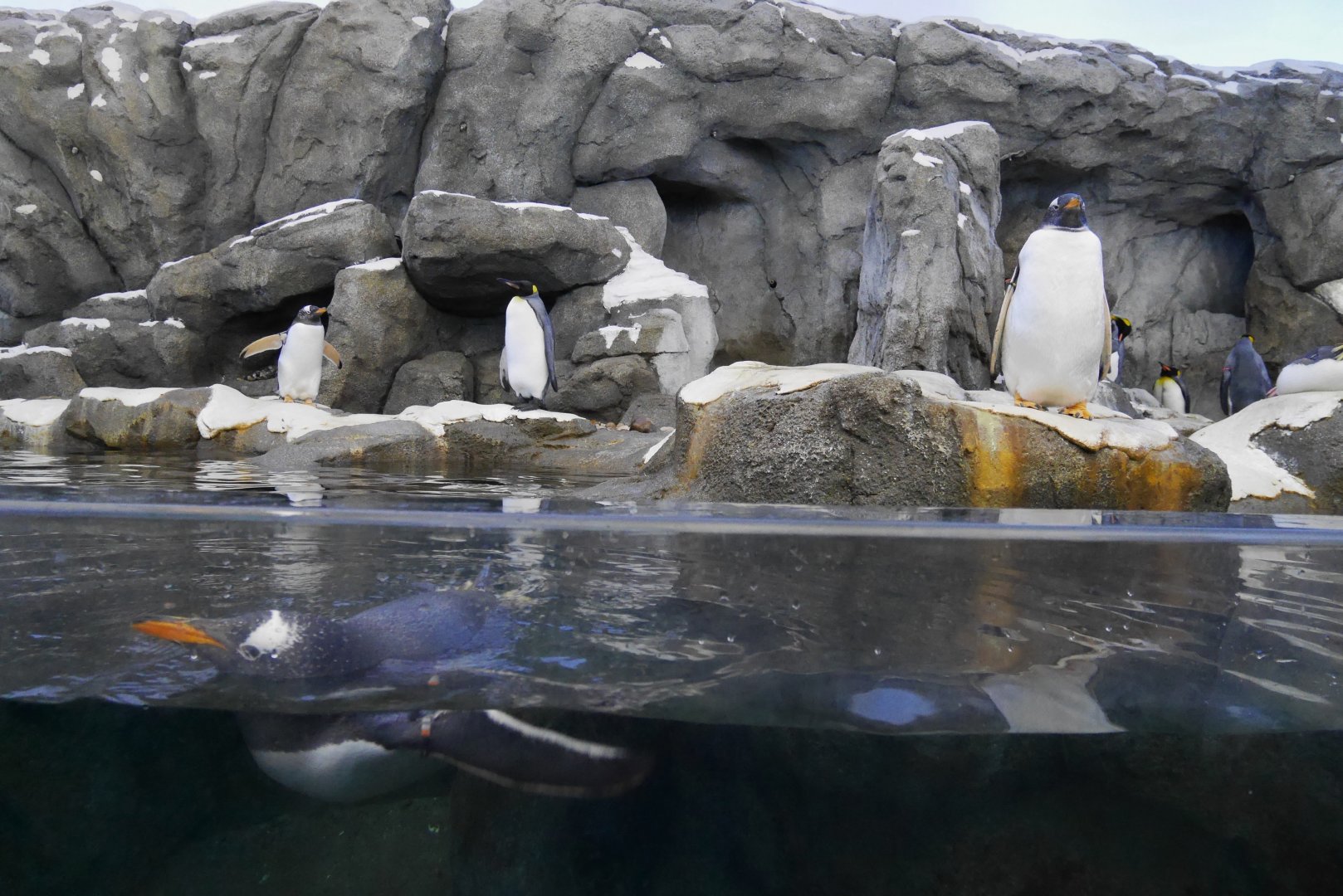
Penguin Plunge because it is just a few steps from the tunnel entrance/exit of the Zoo and because penguins are awesome. Inside the immersive dome, a volunteer said that I had good timing because the penguins were active. I told her, "I haven't been here once where at least some of the penguins haven't been active".
. With four species (Humboldt, king, northern rockhopper and gentoo), and dozens of individual penguins, one, or more, of the penguins is almost always up to something interesting! And you feel surrounded by them too. The visitor path, with low viewing windows, goes through the middle of the exhibit. There are two underwater passages under the path that connect both sides for the penguins. They can even gather up enough speed to porpoise (jump) out of the water and splash visitors. Luckily, on that day I saw them porpoise a few times and didn't wind up getting splashed with penguin and fish marinated water. On the way out, a little girl was crying because she didn't want to leave the penguins. Her parents tried to comfort her that she would also love the new polar bears.
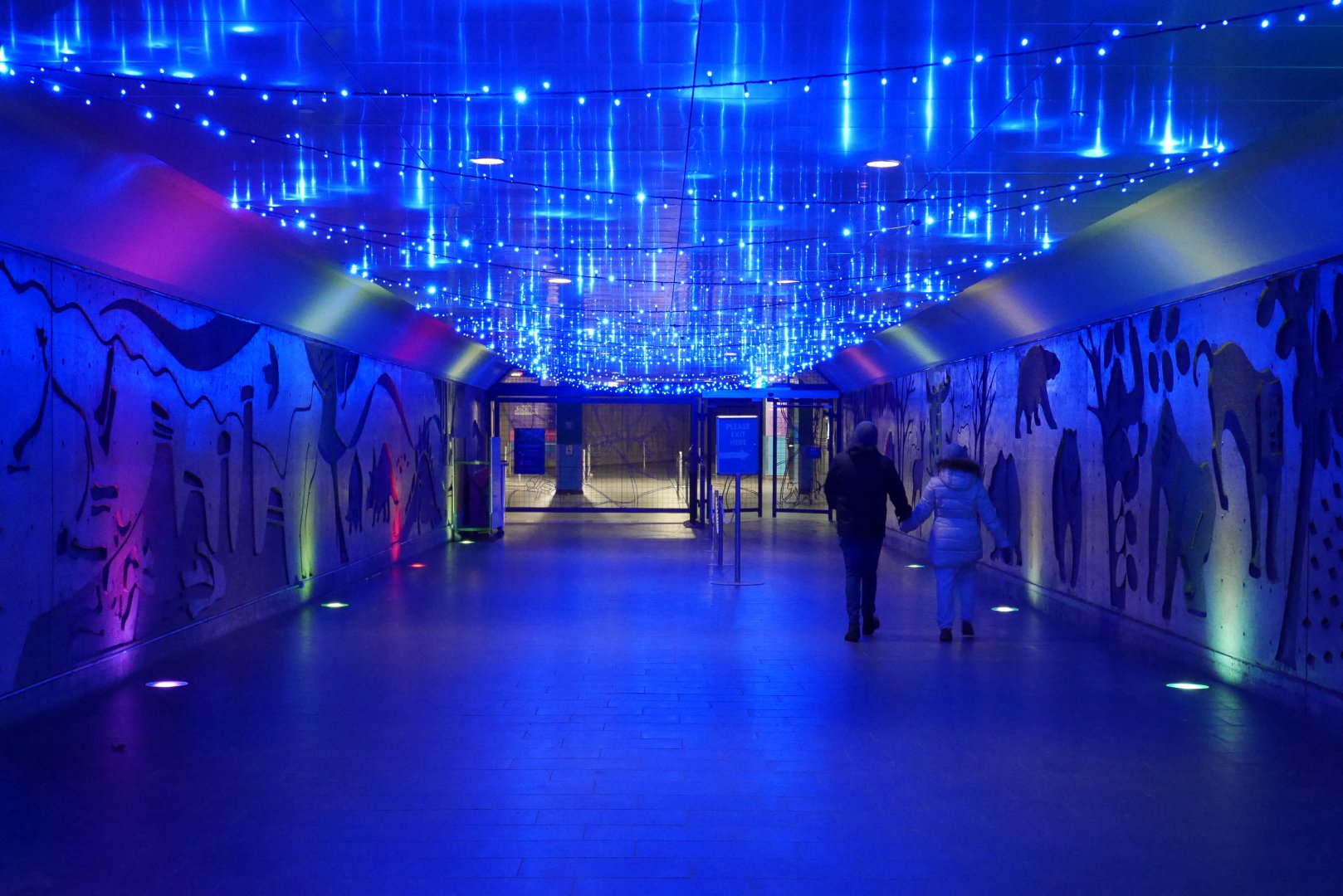
You don't have to travel very far to begin that journey to the polar bears. A few steps away, abstract aurora borealis sculptures invite you to head into the newly redeveloped
Wild Canada exhibit complex. The entire area is over 21 acres in size and and currently has over 13 medium to large animal exhibits for about 15 species of animals. The complex is themed to represent Canada's iconic ecological zones. These zones are not disjunct and I believe I missed some of the signs while getting caught up looking at everything else.
The winding path travels past clumps of deciduous aspen trees and shrubs and rolling topography to the
Foothills zone. An opening in the vegetation provides the first view into a hill-like exhibit for
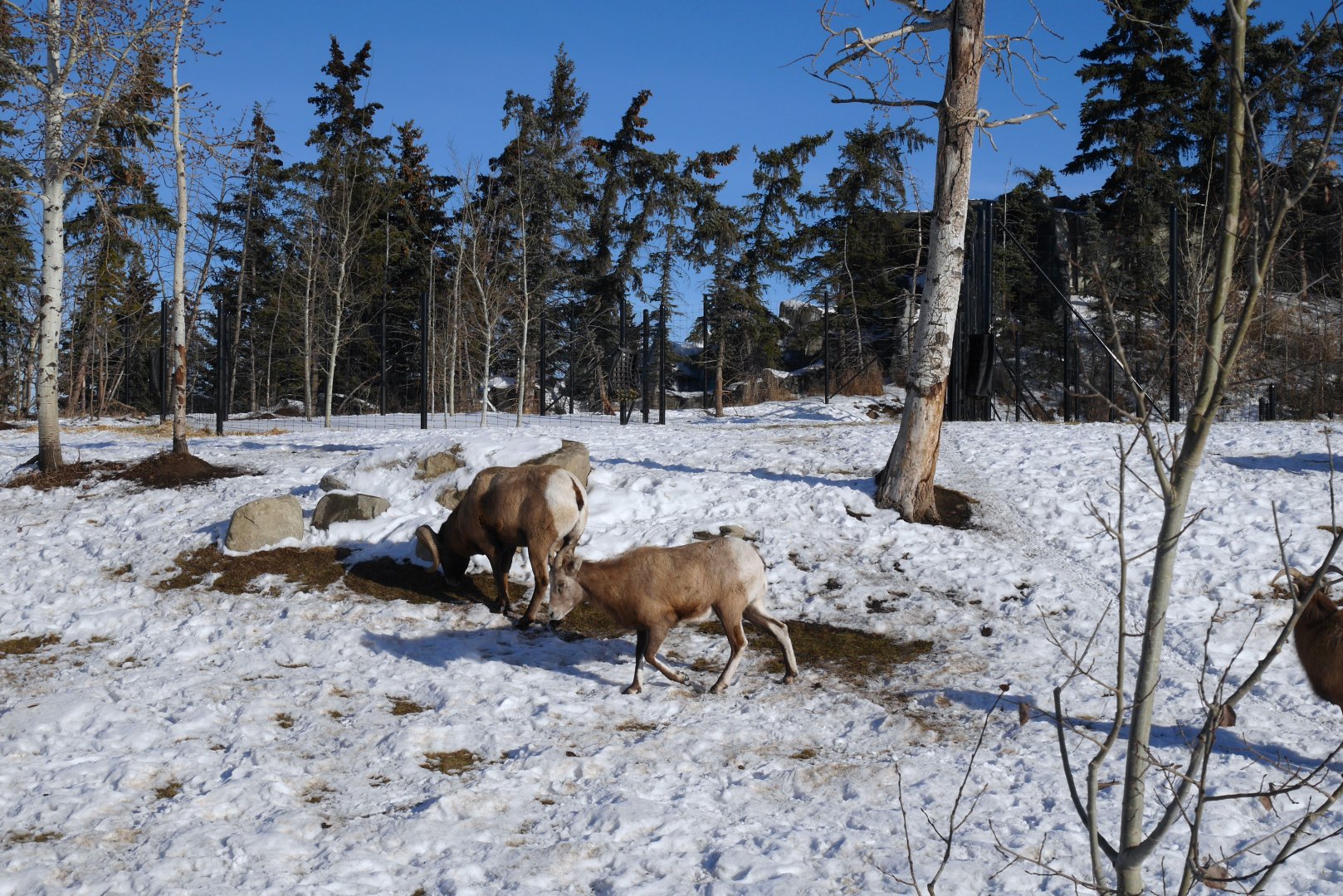
bighorn sheep. The bighorn sheep exhibit is an organic shape vaguely like the letter c with viewing on the inside of that c. You could also liken it to a planarian in shape. The best viewing is from the middle. Here, the views are more sweeping and the topography hides the wall drop-off barrier between the sheep space and visitor lookouts. The sheep herd wasn't obliging that day though and they were instead congregated at the far end of the exhibit. There they were nibbling on some branches, rubbing their heads a bit on tree trunks, and navigating around some spruce trees.
Coniferous trees, especially spruce, become much more dominant in the
Rocky Mountain zone. The path ascends to the foot of a narrow gully between imposing simulated rock walls. There are also piles of large boulders that the path curves around. An outlook provides a view into one of two connected grassy alpine habitats for
Rocky Mountain goats. Tall rockwork frames the back of the exhibit and smaller rockwork retains parts of the terrain. The meadow slopes steeply down to the foot of a hidden wall that contains the goats from the visitors. The goats were all in the second exhibit looking statuesque above the onlooking visitors.
Further down the path there is another opportunity to see the nimble white goats in the distance from an alpine meadow. Turn your body around, and a waterfall tumbling in front of a hillside helps disguise the washrooms behind. This waterfall helps draw you into the next exhibit the
Jihad Shibley Rocky Mountain Aviary.
There is an option to bypass the aviary, but why would you miss the chance to walk among large carnivorous birds? The aviary was home to 2
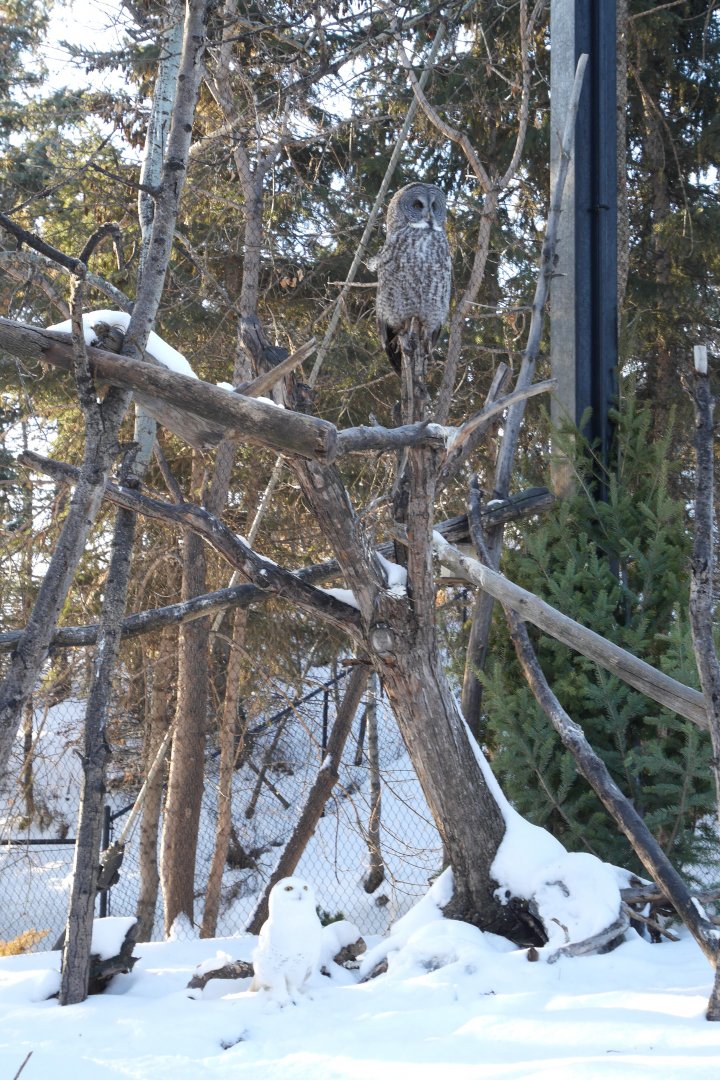
snowy owls and 6 other owls that I believe were all
great grey owls. In the warmer months,
Painted turtles will enliven the stream running through the aviary. There may be a rough-legged hawk here too. Dozens of spruce trees flesh out the space and provide perches for the owls to survey from. There's also an artificial rock wall with ledges that the owls have successfully used to raise several clutches of owlets. For many years the owls in this aviary have arguably been the most popular animals in the northern end of the Calgary Zoo, excluding penguins.
Outside the aviary you are still amongst stands of spruce trees in the
Boreal Forest. Actually, I believe the Boreal Forest started just before the aviary, but that's confusing. I guess that they didn't want to change the name of their aviary. A parting in the forest provides a view into the
woodland caribou exhibit.
I could hear the clicks of their tendons (don't worry, this is normal) as the caribou walked from the shelter of some spruce trees and into the grassy stretches of their exhibit. I was getting excited to see the next inhabitants, so I hurried along.
The next animals are the mega-charismatic stars of the exhibit complex-
polar bears!. Their exhibit is so large though that they weren't visible at the first two major viewing areas. The first viewing area has a large window overlooking a stream that tumbles from a steep grassy slope. The top is so high that it can be seen for kilometers from outside of the Zoo. An artificial rock feature forms part of the containment at the cap of this hill. Large spruce trees soften the fencing on the sides. There are a few polar bear activated water sprayers/features that are incongruous with the other natural features, but I will accept that if the polar bears use and enjoy them. A cave at the side of the first viewing area has a bubble window looking into the deep (about 5 meters) polar bear pool.
The second viewing area also has a large window, except this one has underwater viewing along it's length. Swimming polar bears are at eye level of human onlookers when their heads are held just above the water to breath. Scraggly large spruce form a curtain behind the pool. This is where the most dramatic photos of the polar bears I've seen were shot. In time, and with more visits, I am confident that I can get a similar shot, though not of the same quality!
Both of the first two viewing areas are protected under a large planted overhang suggestive of a rocky coastline. It is partially softened by some artificial rockwork and logs. This area is themed as a
Coastline or something similar. I saw the sign for this area, but don't trust my memory. Children can play nearby amongst logs sprawled with riddles and topped with cutouts of ptarmigan and leaping foxes. Playful interactive signs of polar bears are also nearby. My interest in this area waned and was recaptured by the nearby woodland caribou.
North America's reindeer were crossing the small stream in their exhibit. The trees thin in this area and you enter the
Tundra. On the left you can find caribou, and on the right, well, you might be able to find polar bears, but they were somewhere else.
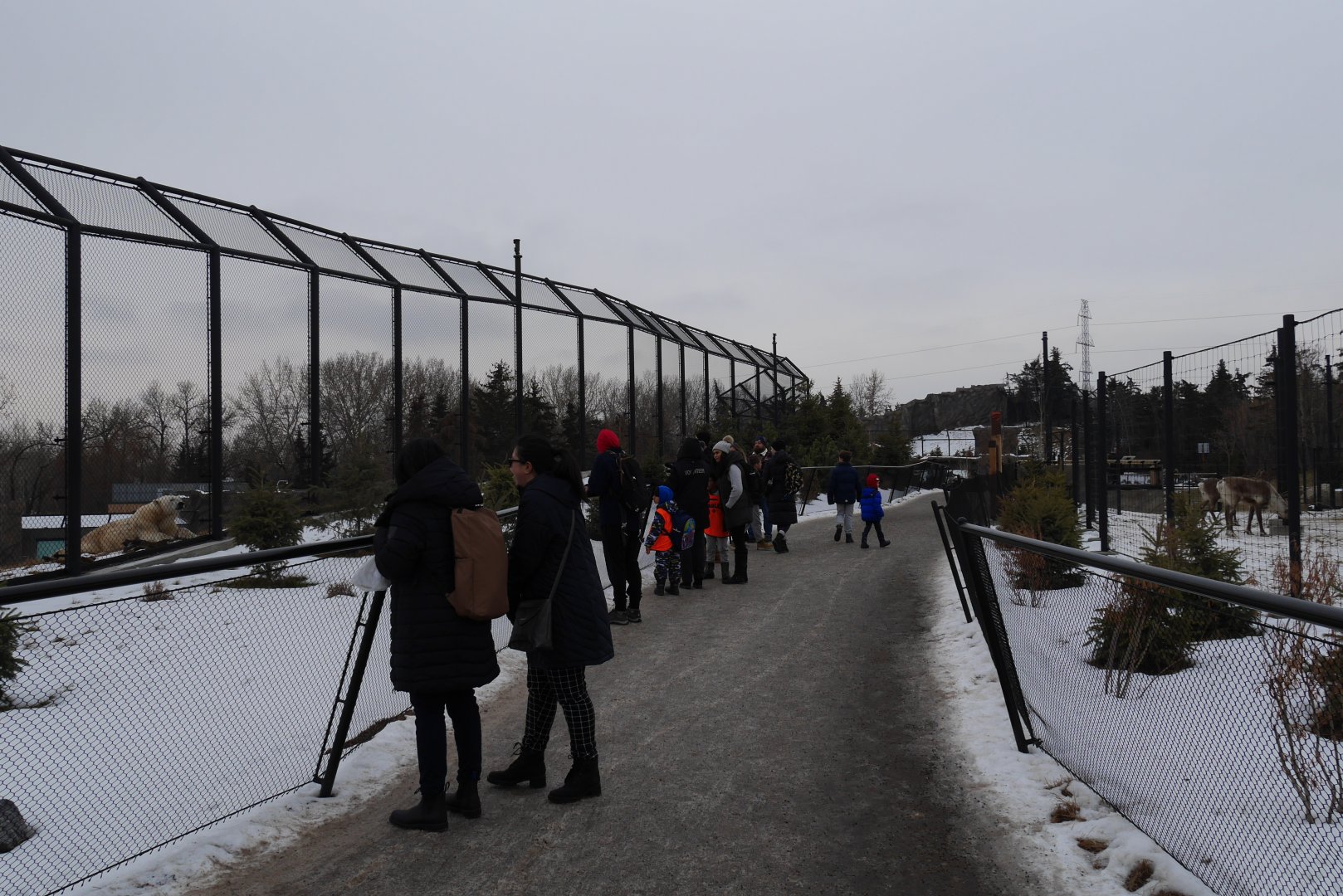
Further down the path, an overlook provided my first glimpse of a polar bear! The views of the over 2 acre exhibit are more panoramic here and I could see one of the iconic white bears sauntering in the distance. I probably should have just waited there, but I thought I could get a better view by continuing on the path.
I stopped to watch a
muskox amble up to a viewing area. This was Tilly and she came as close to me as she possibly could and looked right at me. I didn't realize how adorable muskox can be! I was too caught up to want to put my camera between us. Some other visitors came up and Tilly wandered off. She climbed atop some rocks and momentarily poised there elegantly. It was a little far for my camera to get a good zoom. In the process of fiddling around with my camera I missed the shot completely. Oh well, at least writing about it will help me remember it.
Other memorable encounters with animals awaited me ahead.
Otters are the star of the
River zone and
Brawn Family Foundation River Lodge. A group of three of the energetic mustelids was swimming around a shallow stream in the first exhibit. One was carrying and playing with a large scallop shell. An overhead tunnel connects that exhibit with another exhibit on the other side. I continued into the building to watch the otters from other vantage points. In addition to several tall viewing windows inside, the first exhibit also has a training wall. In the second exhibit I watched a group of four otters tumble around underwater. They were an absolute delight to watch, but I was getting anxious to finally see the polar bears, so I headed out.
Past an overlook of the Bow River and a sprawling moose exhibit in a riparian forest, the polar bear exhibit continues. I ascended to an overlook with a panoramic view of the exhibit and saw the polar bears, but they were moving towards the area that I had already visited. I wasn't about to leave it at that, so I backtracked all the way back to the first overlook before the muskox.
The
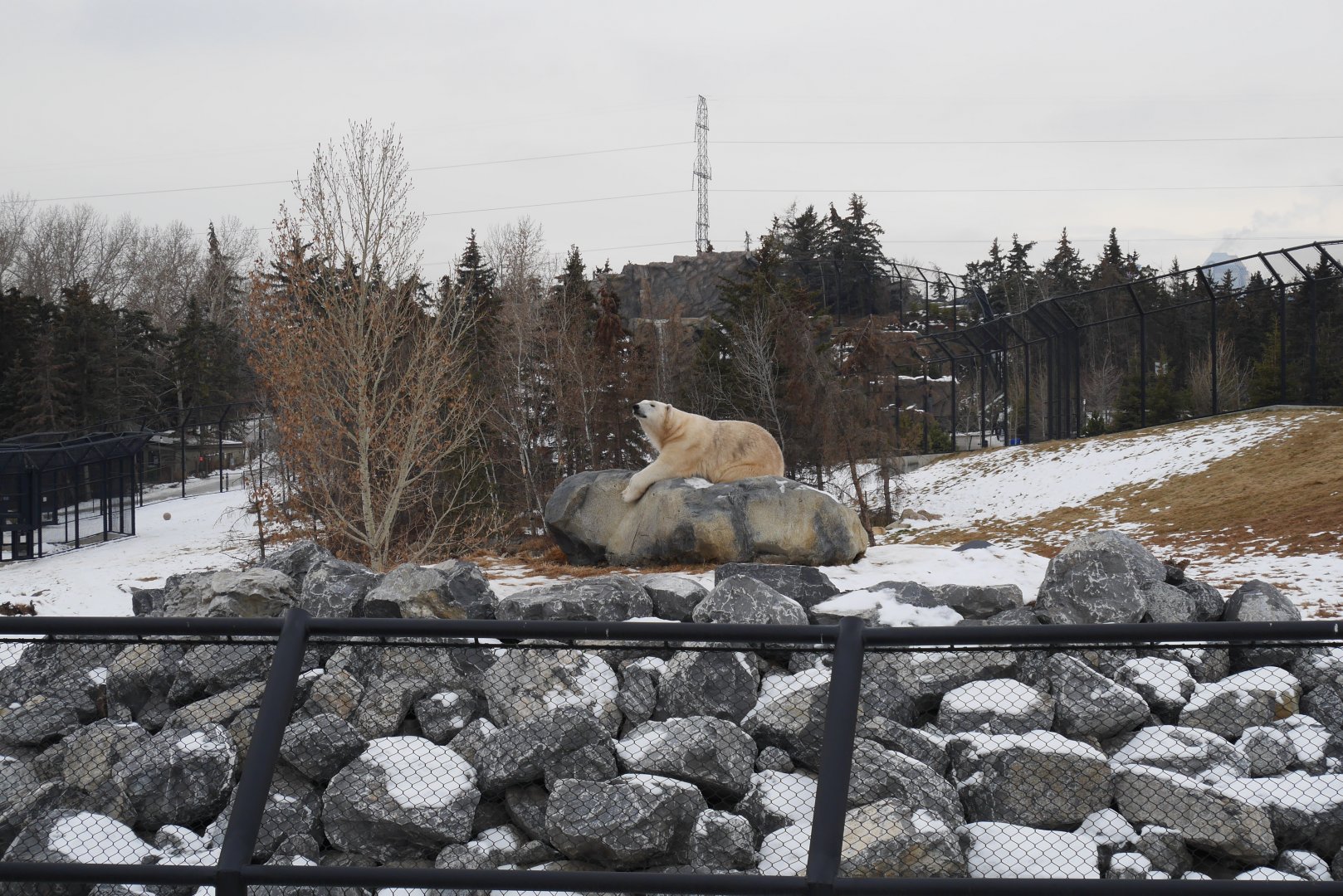
polar bear was just climbing atop a large rock perch on his overlook. This is the picture I took:
. He seemed very relaxed, but was still attentive to his surroundings. He scanned the horizon and would occasionally arch his nose upwards and sniff the air. One smell seemed to catch his interest and so he climbed off his rock perch to investigate. I followed him, backtracking further down the path.
Baffin or Siku, I'm not sure which one he was, stopped at the edge of his exhibit to watch the caribou across from him. He dug into the earth and settled down.
.
Eventually he lost interest and moved across his exhibit. I followed him as he came to a rock den in the grassy hillside. After investigating it a little he sprawled down.
This encounter felt so different from the polar bear I had seen at the San Diego Zoo, or the polar bears that were at the Calgary Zoo over 20 years ago. He seemed much more relaxed, and also more tuned into his surroundings. He had moved about his exhibit deliberately and not at all in a stereotypical manner. Of course this was just one visit, and I would like to see them again to make sure that they're doing well. Overall, I felt immensely relieved and excited to visit them again.
After that encounter I walked to the final polar bear viewing area which was still under renovation, but will open soon. It will have a large window overlooking a different part of the exhibit. An amphitheater overlooks the viewing window with washrooms built into the back. Those washrooms help service the nearby massive
Bugtopia playground.
Passing on a bridge spanning a lagoon brings visitors to Bugtopia. This playground was built in a natural riparian forest of towering balsam poplars. The playground is themed as a giant sized version of local organisms, especially bugs. It's meant for children, so I resisted the urge to play and explore there myself, but you should go there regardless because of the adjacent
moose exhibits.
The moose exhibit was enlarged recently and now spans the area from the porcupine exhibit to the muskox exhibit. It has been built lightly in an existing riparian forest with lagoons from the nearby Bow River. There are occasionally moose seen in Calgary, and this flooded forest would have once supported wild moose travelling from the west. It is now home to two orphaned rescue moose. Aspen and Maple were resting under some trees.
A nearby lagoon will soon center a
whooping crane exhibit. There were lots of signs about the Calgary Zoo's conservation efforts with Canadian wildlife. The statures of swift foxes were realistic, but I couldn't help but want to see the real thing too. I wish the Calgary Zoo would display more of the small Canadian animals that they have conservation projects for.
The rest of Wild Canada was not part of the recent redevelopment and the animal exhibits are now some of the oldest at the Calgary Zoo. That does not mean that they're bad. For their time they were very well done and I would argue that they're still better than some new exhibits for the same species in American zoos. I went past them fairly quickly on this visit and only really watched the
gray wolves. The
grizzly bears and
black bears were in torpor, and the porcupine wasn't visible either. The
cougars weren't too active as can be expected of two elderly animals.
The last part of Wild Canada is a representation of a forest recovering from a fire with lodgepole pines growing amongst the charred remains of tall trunks.
I am biased towards the Calgary Zoo, and I have not been to nearly as many zoos as some other ZooChat posters, in particular Snowleopard, so I will pass on ranking Wild Canada. However, I have been to some of the premier zoos in western North America, Disney's Animal Kingdom, the Singapore zoological institutions, and a few other zoos in Australia and North America. Leaving the newly redeveloped Wild Canada I certainly felt impressed and that I had had many great experiences there. I'll leave it at that for now.
In total, I spent over 2 hours in Wild Canada. I planned to go back there, but I got to the Zoo late, needed to eat a big lunch and had other animals to see.
Tanuck, the
Malayan tapir, was the highlight of the rest of that visit. He had a case of the zoomies and made high pitched neighing sounds while thrashing a suspended feeder ball around. He also had fun dunking another ball into his pool and pushing it down.
The other highlight was watching the
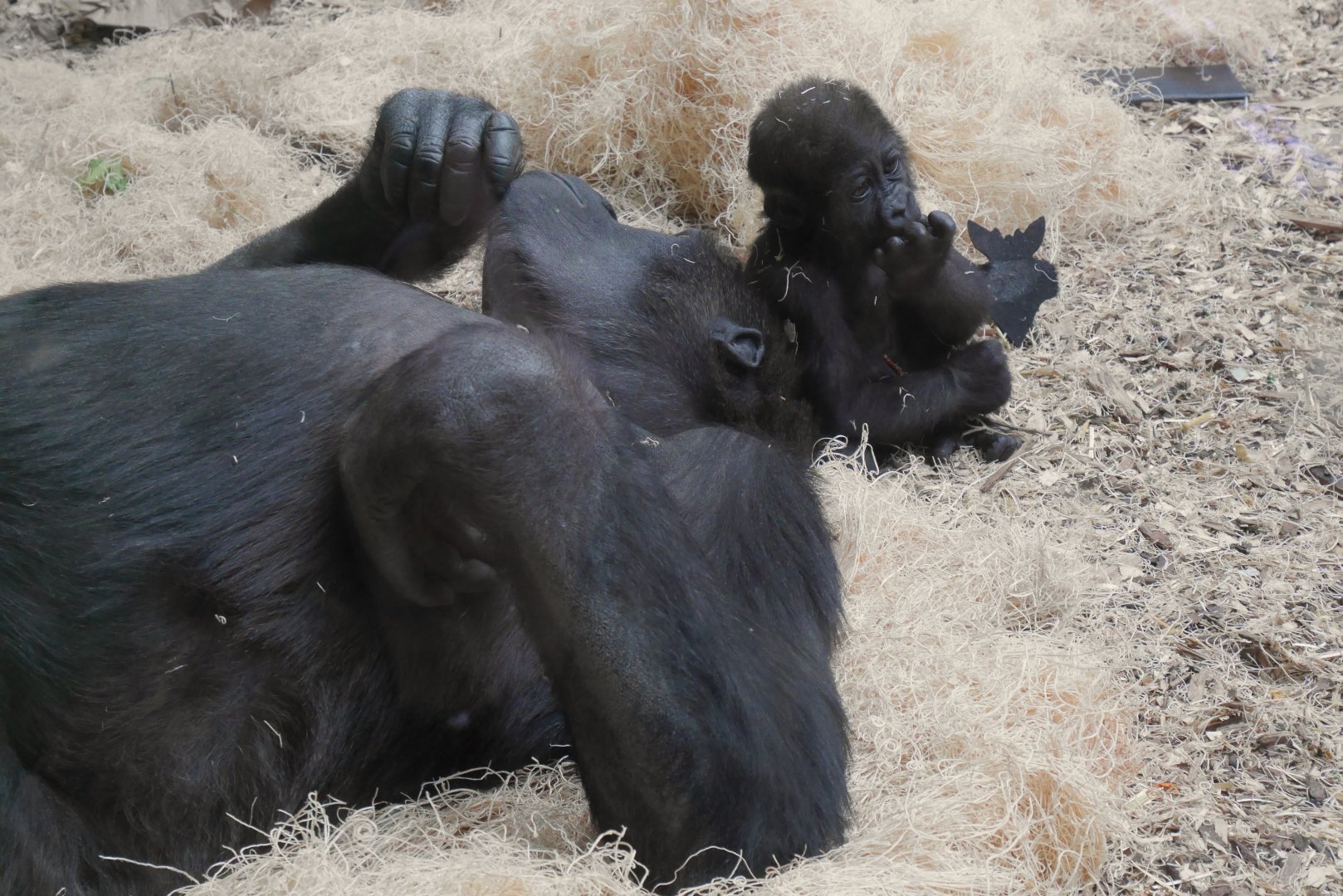
gorillas and
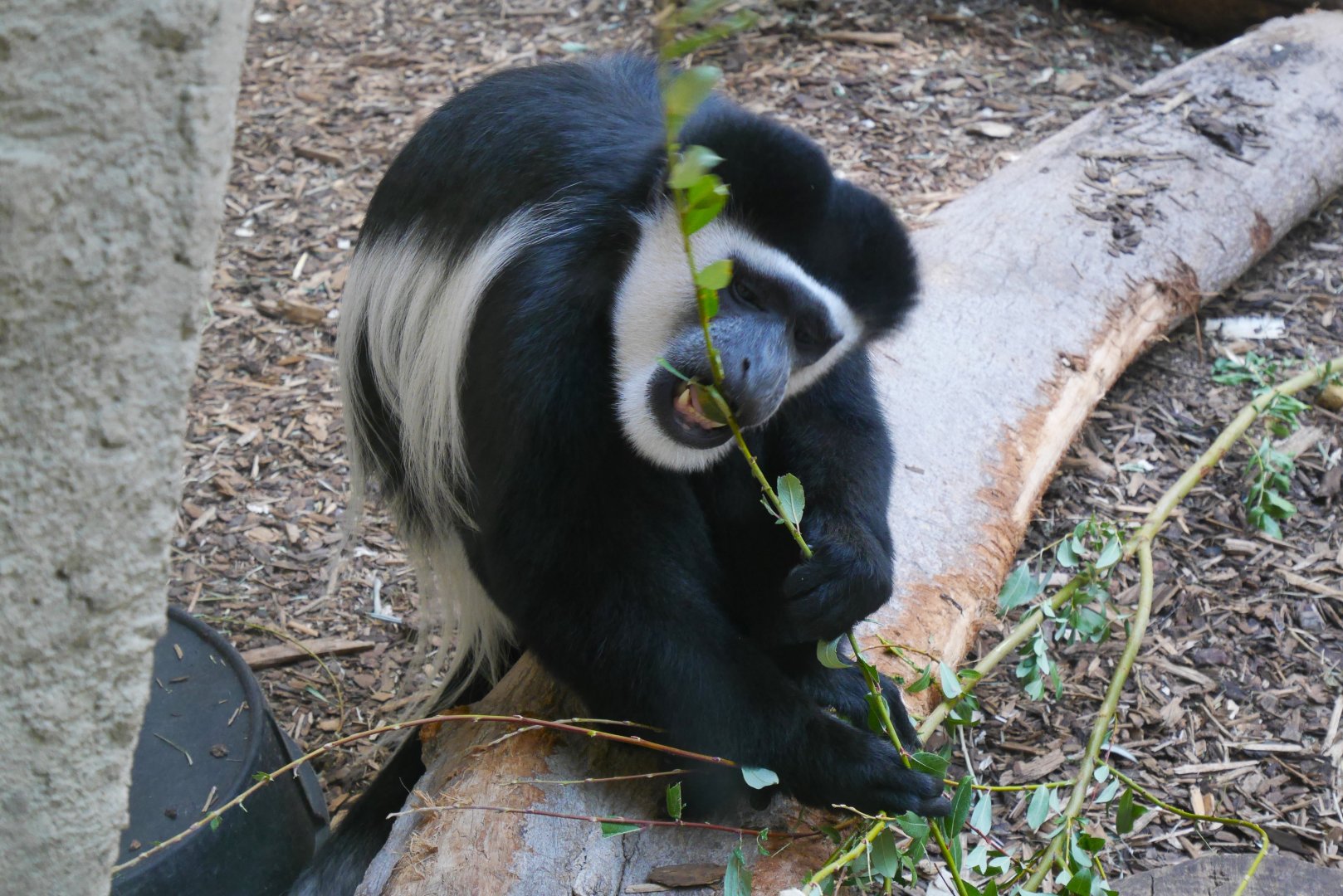
eastern black and white colobus. It was closing time and I got to see them feed right by the viewing windows.
I came back to the Calgary Zoo later that evening for
ZooLights.

 .
.  ! I was racing back and forth between the many different viewing areas trying to keep up with them
 . The Calgary Zoo needs to spread out visitors more.