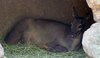
An other species that we have lost:
Japanese Serow(Capricornis crispus) last held in Usti, 2018
@Dianamonkey's photo

Japanese Serow(Capricornis crispus) last held in Usti, 2018
@Dianamonkey's photo


According to ZTL Wildpark Altenfelden in Austria had Snow sheeps (Ovis nivicola), at least until 2017. There is also a picture on the Zuinstitutes from 2015. Were the animals ever on display ? Does someone know their story ?
To the best of my knowledge, although the collection *did* have the species at one time, by the time the last individual died the population had represented hybrids with domestic Mouflon for several years.


I agree, and there is an additional reason: such "low-profile" species are often kept in a zoo because of the interest of a single person, which could be a curator, head keeper, a department head or even just a single animal keeper with an exceptional interest. With a change of staff, other employees often feel no attachment to these species, because they do not see a commercial value to keep them. The animals are still routinely cared for, but nobody does more than a general maintenance protocol prescribes and this is usually not enough for those species to breed. Couple of years later, the said species is lost from the ZOO collection and nobody really cares, until years later another single employee regrets this and does an extensive effort to get it back. Same happens in private collections. There are very few exceptional people who are interested in keeping the same species for several decades when that species is not getting a lot of attention and they also donćt earn anything with it (often not even appreciation from colleagues!).
Also, in my experience, there are animal keepers who are also keen observers of their animals, and this is what you need to get many species to breed. The majority of animal keeper work on routine, and they are not necessarily to blame for that, because for observing animals you need time, which is often lacking (or misused with taking some extra breaks in some cases). How many directions allow keepers "observation time" on a daily basis? Keepers who keep observing those non-commercial animals regularly are the first to be overburdened with work and to leave the zoo-world

The last Hunter's sunbird in Kerzers died a little while back.
I believe next on the list are Variable sunbirds, who seem to be gone from Stuttgart, and according to ZTL not signed anymore in Hamburg. The last one in Kerzers died. I don't know about the last male in Zamosc, Poland.

Well the most major loss since the last update here is definitely Amazon river dolphin! Sri Lankan sloth bear is another recent loss though of course the other subspecies is still present. There is always the looming loss of other species down to very small numbers e.g. Panay cloudrunner, eastern gorilla, Bornean bearded pig, aardwolf...Any possibilities of an update of losses/regains on the horizon? Just refound and reread this whole thread, and still find it one of the most thought-provoking on here

Any possibilities of an update of losses/regains on the horizon? Just refound and reread this whole thread, and still find it one of the most thought-provoking on here
There is always the looming loss of other species down to very small numbers e.g. Panay cloudrunner, eastern gorilla, Bornean bearded pig, aardwolf...
I can't think of any more off the top of my head that have actually been lost but I'm sure others can name some.


Last Ethiopean klipspringer died in Valencia.

I do wonder if these were truly Pavonine at all.Pavonine Quetzal (Pharomachrus pavoninus) - this taxon was last held in 2002 at Wuppertal. There are no images of the taxon within the Zoochat gallery.
I believe this to be the case. The true Pavonine has an orange-red bill, yellow towards its tip; the Golden-headed has an all-yellow bill. I remember specifically examining the last male at Wuppertal and finding his bill to be entirely yellow. I think the zoo labelled their birds as being Pavonine because the bird curator was following a taxonomy that viewed Golden-headed as a subspecies of Pavonine.I do wonder if these were truly Pavonine at all...it could be that those held at Wuppertal were in fact golden headed after all!
Apenine chamois.
Just visited Hellabrunn for the first time. Was really looking forward to seeing this species, but they're all gone.
Species is now extinct in captivity it seems.
And I just missed my chance at seeing them.